VALPARAISO, CHILE

8%

Pacific Press Publishing Company · MOUNTAIN VIEW, CALIFORNIA · Jan 9, 1907

FromSigns of the Times, Vol. 33, No. 2.

Read the full edition

VALPARAISO, CHILE.

[The following did not reach us till after we had published several articles on the Chilean earthquake several weeks ago. But as it contains facts not before given, we publish it, even tho it may seem to be stale. Be assured the awful calamity which visited the prosperous city of Valparaiso is not stale to those there dwelling.—ED. S. OF T.]
THE damage done to this city by the recent earthquake, August 16, may be summed up in a few words; the city as far as habitations are concerned is almost completely ruined. The whole central part of Chile suffered, many smaller cities were also shaken down. The loss of life, I think, was not less than six thousand, while the loss of property will reach about 500,000,000 Chilean dollars. Thus far the insurance companies have refused to pay any part of the loss caused by the fire.
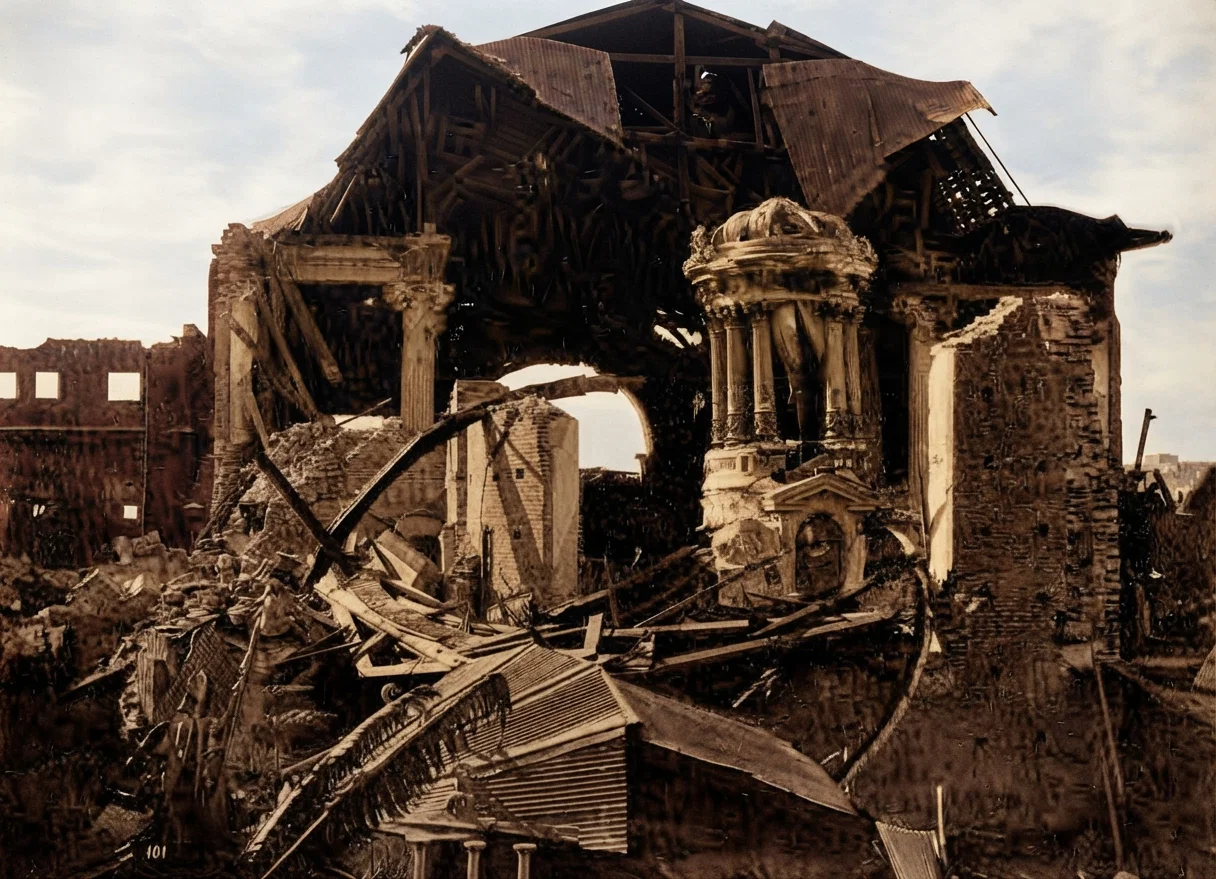
It is safe to say that there is not one house that is not damaged or destroyed. From an outward view many seem not to have suffered, but when the interior can be seen they are nothing but masses of fallen walls. When one views the wreck, he involuntarily wonders how so many escaped with their lives. It was a repetition of the San Francisco disaster, only, if possible, the shock was much more severe here. Comparing the size of the two cities, it appears that the damage by fire was possibly less here than there. When we view the ruins of what once were magnificent houses, and the pride of those who dwelt in them, we realize the inability of man and can but exclaim, “What hath God wrought?”
Church of Merced, Valparaiso, after the Earthquake of August 16, 1906.
It was the most terrible scene I have ever witnessed; and can only be realized by those who have passed through a similar experience. About ten minutes before eight in the evening it began. Had it come in the middle of the night the loss of life would have been appalling. We had no idea that it would be such an awful thing. Ever since our arrival in Chile there has been at intervals what are called temblors; thus we had become accustomed to them. There were three distinct, heavy shocks. At the beginning of the shaking we went to the “patio,” a small garden about twelve feet square at the back of our house. On one side was a tall building and we could not be sure but that it might fall on us. Yet, I can truly say, we felt no fear, for we knew in whom we trusted. A lamp, which was standing on the kitchen table, ignited the first thing, by a part of the wall falling on it. At the end of perhaps one-half minute came a few seconds of calm, during which time we tried to extinguish the fire, falling in this,
Mr. Steele threw the lamp in the “patio” where it could burn without damage to the house. Again we waited in the “patio” for the second shock to exhaust itself, then came a few seconds more of quiet, during which we managed to reach the street. The entrance to our house was through a long, narrow passage which was very perilous.
Scarcely had we reached the street when the third shock began. The buildings that were yet standing could be seen jerking back and forth as a dog might shake a rat; it seemed as if the earth was moving in every direction at the same time. In some parts the ground opened. In the street pandemonium reigned, dogs howled, women and children screamed; and all this, added to the crashing of falling walls, made it a night of horror long to be remembered. Immediately after the first quake, fires broke out in more than forty places, making the city appear almost like an inferno. For several days it raged until they had burned themselves out, as no means were at hand to quench them. For days the crashing of walls thrown down by dynamite could be heard.
For three days and nights we camped in the street with only the sky over us. On Sabbath I walked to the other end of the city, as we were anxious to know how our friends had fared. The city, in many parts, could not be recognized, some of the streets had been swept by the flames, and nothing remained but charred walls or heaps of debris. Others were so filled with ruins, as to be absolutely impassable. All the theaters, nearly all the churches, the jails, and all other public buildings were completely destroyed. In the Church of the “Merced” it is said that eight hundred people were killed;many are still buried under the tons of brick which fell from the towers as the people were trying to escape.
In the parks as many people as could possibly crowd in had gathered; here could also be seen the dead among the living, as there had not yet been time to bury them. On one street we saw eight bodies lying in a row on the sidewalk, some were sewn up in cloth and thrown into carts or tied on the backs of horses and taken to the cemetery, while many more were only thrown into carts and buried as quickly as possible. Two weeks after the earthquake, bodies were still lying in the street, and the work of recovering bodies from the ruins continued for a month.
All the cemeteries were greatly damaged, large tombstones and huge monuments were thrown down or moved from their base, while many graves were opened and vaults destroyed. Costly mausoleums containing the remains of wealthy persons were destroyed, and the bodies thrown in a ditch together with the poor who were killed in the catastrophe. It is impossible to give by pen an adequate description of what has happened to Valparaiso. Instead of being the beautiful city, the paradise of South America, it is a city of zinc shanties of every imaginable shape and size. The average shanty is about ten feet square, and some are less. But the people have the knack of being contented with their lot, no matter how unpromising their surroundings.
Our house burned the morning after the earthquake, tho we managed to save the greater part of our household goods. All the property of the Mission was destroyed. Now while the majority of the population are vainly looking for houses in which to live, we, without any effort on our part, had a house offered us in which we are living as comfortably as the circumstances will permit. To God be all the praise and glory, as He is worthy. MILLIE E. STEELE.