1890 and 1906 Compared

4%

Pacific Press Publishing Company · Mountain View, California · Jan 30, 1907

FromSigns of the Times, Vol. 33, No. 5.

Read the full edition

1890 and 1906 Compared

THE PRICE OF THE WORLD'S PEACE—$1,389,859,374.

THE most expensive blessing that the world enjoys is peace, armed peace. "No person knows what the various nations of the earth, constantly eyeing each other in watchful suspicion, like bulldogs in leash, pay for the maintenance of peace thru the preparedness of war." There are sources of great expenditure that are secreted and never publicly known. But for their armies and navies alone, eight of the principal powers spent last year the enormous total of $1,389,859,374.
It is difficult to grasp the immensity of such gigantic figures. Diverted to the channels of commerce, one year's cost of peace would build the Panama Canal five times over, with enough left to operate the waterway nearly seventy years. For the education of their children and the development of agriculture,—the greatest safeguards of future peace,—seven of these eight nations spend in the aggregate something more than one-third the cost of armies and navies, or $532,163,049.
Staggering under the enormous load, the world is continually adding to it. Each year witnesses a greater demand for the armament of nations. In 1890, only sixteen years ago, the total was $786,888,350. To-day it is nearly twice that sum. At the present rate of increase, Europe alone, ten years from now, it is estimated, will be spending $10,000,000,000 to preserve its peace and insure seeming good-will among men.
Should not these figures alone disclose the fallacy of the doctrine of the spiritual peace dreamers that the nations are about ready to beat their swords into plowshares and to learn war no more, and that the world is getting better—just entering the dawn of a millennium of peace and flowery beds of ease? If this were the case, should there not be some signs of the disarmament of these so-called civilized nations? Yet, to the contrary, the most civilized nations are making the greatest preparations for war.
In 1903 the United States had arisen to be the greatest exporting nation on the globe. It sold to foreign buyers products of its fields, mines, and factories to the value of $1,392,231,000. Yet all this industry of its farmers, miners, mechanics, and artisans resulted in but little more than enough to keep the armies of the world ready to fly at each other's throats, the navies manned and afloat. Such is the cost of armed peace. Neither is it a stationary cost; it is on the continual increase.

1890 and 1906 Compared.

France, Great Britain, Austria, United States, Germany, Russia, and Italy in 1890 spent upon their land and naval arms the grand total of $786,888,350. By 1898 these figures had grown to $1,028,644,150, and this year to $1,358,153,689. (Figures for Japan are not included, as they are not available for the earlier periods, altho they are included in the grand total for eight nations this year.) The increased cost, then, during the first eight-year period was $241,755,700, or an average of $30,219,450 a year. For the second eight-year period the increase was $329,509,719, an average of $41,188,614 a year. Think of the enormous total aggregate for this sixteen-year period alone, and then the added expense of several great wars during this same period, and you have the grand total of $17,732,401,732 for army and navy expenditures alone, without the immense war expenses of the war between Russia and Japan, England and the Boers, and the United States and Spain.

For What Purpose?

And now stop and think! For what purpose did these nations expend over seventeen billions of dollars during the last sixteen years? President Roosevelt answers this question in his last message to Congress by saying that the condition among the great nations was such to-day that this way of conducting affairs was the only avenue left to us in saving the nation from being wrecked and devoured by the other great military powers. Thus it is plain that, instead of securing peace, they have created a condition of fear, insecurity, and incapacity among themselves, in the discharge of national and international affairs, that there is now "upon the earth distress of nations, with perplexity," and "men's hearts failing them for fear, and for looking after those things which are coming upon the earth."
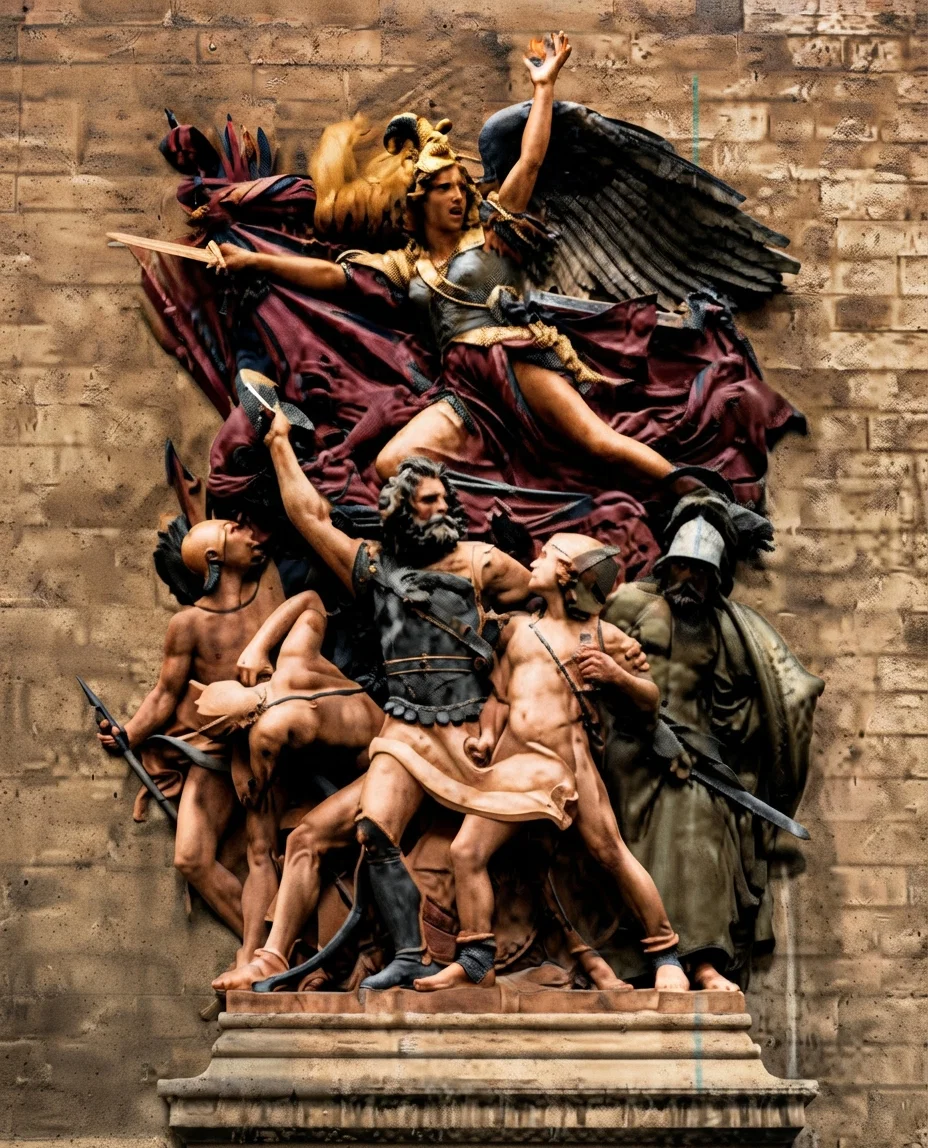
The Genius of War Summoning the Nations to Arms. See Joel 3: 9-12.

All Europe Is a Vast Military Camp

staggering under its fearful load of soldiers and sailors, of fighting ships and modern guns, the maintenance of which is drying up its resources and sapping the very vitals of its subjects beyond endurance. "In 1865," states a French authority, "the military budget of Europe was represented by $55,000,000; in 1886 it was $700,000,000; in 1905 it was nearly $1,500,000,000. Should it continue to increase at the present rate, in 1915 it will be $2,000,000,000, and in 1945 [should time last] it will amount to $3,500,000,000 which will mean national annihilation for Europe, as the resources of the people will not increase in proportion."
This striving to keep its head above water as a principal power of the earth is responsible for the terrific debt of France, amounting to nearly $6,000,000,000. The immensity of this sum is difficult to grasp. The authority quoted above states that if it were converted into 100 sou pieces—a sou is about one cent—there would have to be to carry it 62,000 heavily laden carts, drawn by three horses each. But as other nations are constantly adding to their navies and the efficiency of their armies, France must do likewise. Her greatest strain has been in maintaining her place as the second naval power. In 1890 she spent $39,207,560 upon marine protection; eight years later this drain on her purse had grown to $57,391,389, and the present year witnessed a demand for $65,507,445. Germany has been even more lavish in her orders for new vessels and equipments and in maintaining the navy. In 1890 her naval budget was $3,658,720; in 1898 it jumped to $29,293,092, and last year to $60,216,916.

National Pride.

"The influence of navies on the fate of nations has been growing year by year," states a recent annual of the United States Navy. "Now, no nation, whatever has been its military power or its geographical position, can fight as a great world-nation unless it be strong upon the sea. For some, of course, this strength is more important than for others. To England it is life. But no matter what the country, if it falls behind in the race for naval supremacy, it falls behind in the race for greatness." This explains why seven of the great nations, which spent $181,833,015 on their navies in 1890, had increased this to $313,650,416 in 1898, and to $503,194,510 this year.
One would imagine that such enormously increased expenditures for warfare alone would arouse the people of the various countries to strenuous protest and abject humility. Yet the people of the world-powers take great pride in the efficiency of their navies and armies to destroy human life and property, and are constantly clamoring for greater preparedness of death-dealing missiles to use in the bloody race for national greatness and military supremacy. It appears as if the very demons of destruction have gone forth to the rulers and councils of all nations, inspiring their deliberations thru their satanic deceptions, making them believe that peace can be maintained thru superiority of carnal weapons, when eventually it will mean the utter overthrow of these great military powers.
Every nation in Europe has many enthusiastic workers employed in an effort to work up a fighting spirit among the people. To insure peace, for example, the German Navy League has forty men employed in the Berlin office headquarters alone, distributing literature, furnishing information, and working to increase the sentiment for greater naval growth. England persists in the belief thatin order to protect herself and her possessions she must be equal in naval strength to any other two nations. Her navy alone in 1890 cost $63,180,000; in 1898, $104,250,000; and in the past year it jumped to $175,390,935.
Japan proposes to spend $135,000,000 during the next eight years for naval expansion alone, in addition to the regular annual cost of maintenance. They propose to build eight battle-ships of the "Dreadnaughts" type, two armored cruiser squadrons of eight ships each, and three fast cruiser squadrons of four ships each.

But the United States

has opened the eyes of the world by her gigantic naval strides during the last sixteen years. Congress appropriated to the navy alone for 1890, $25,881,180; for 1898, $58,823,958; and for 1906, $118,000,000. And now the United States proposes to build three "Dreadnaughts," even larger than any yet proposed, in a single year, each of which is to cost about $7,000,000. These mighty, modern moving-fortresses of the sea are the costliest "doves of peace," and yet within a moment's time these mighty and costly battle-ships may be reduced, thru the submarine destroyers, to a worth much less than so much junk.

C. S. LONGACRE.

The writer is indebted to the editor of the Pittsburg Dispatch for several of the comparisons and statistics in this article.
[The remainder of this striking article will be found in our next week's issue. It deals with "The Meaning" of these war preparations, to the nations and to the world.—ED.]