CHINA

4%

Pacific Press Publishing Company · Mountain View, California · Mar 13, 1907

FromSigns of the Times, Vol. 33, No. 11.

Read the full edition
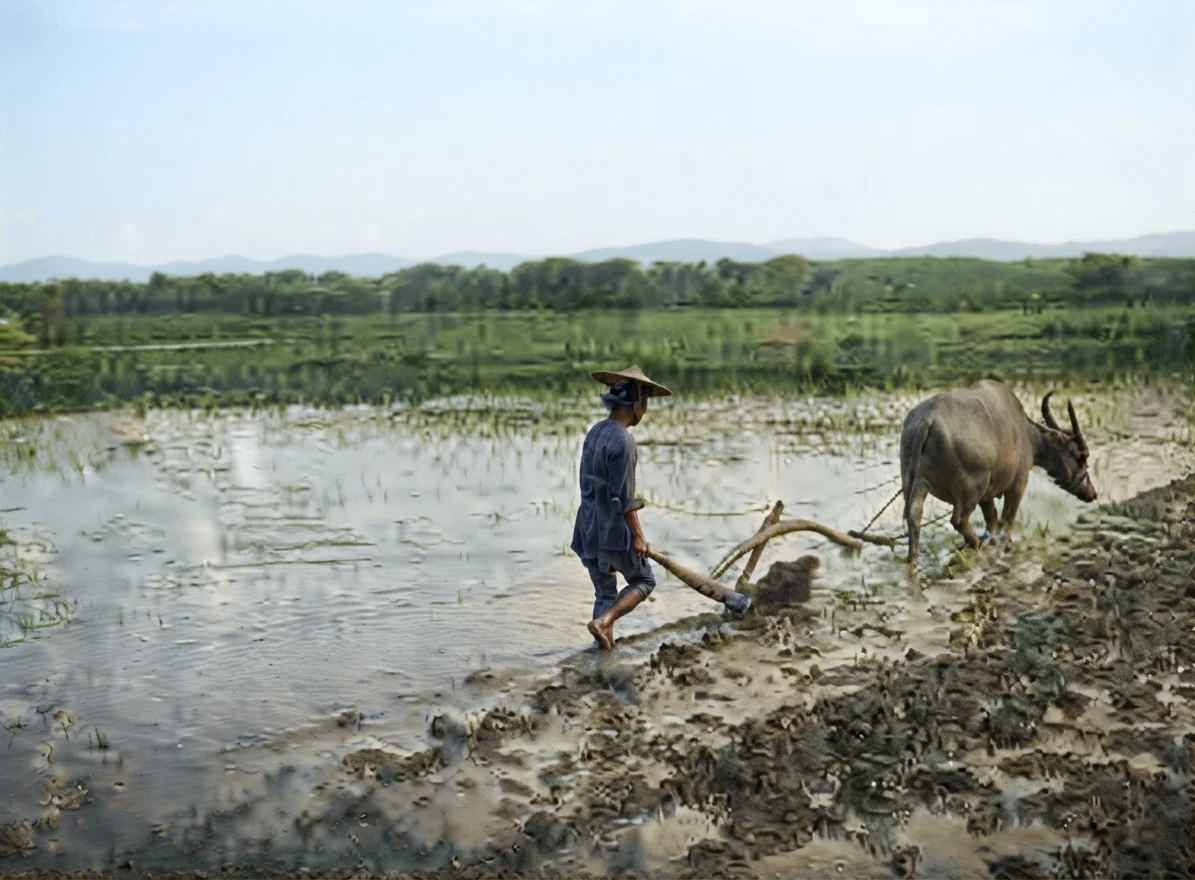
Plowing Rice-fields in West River Delta, with Water-buffalo.
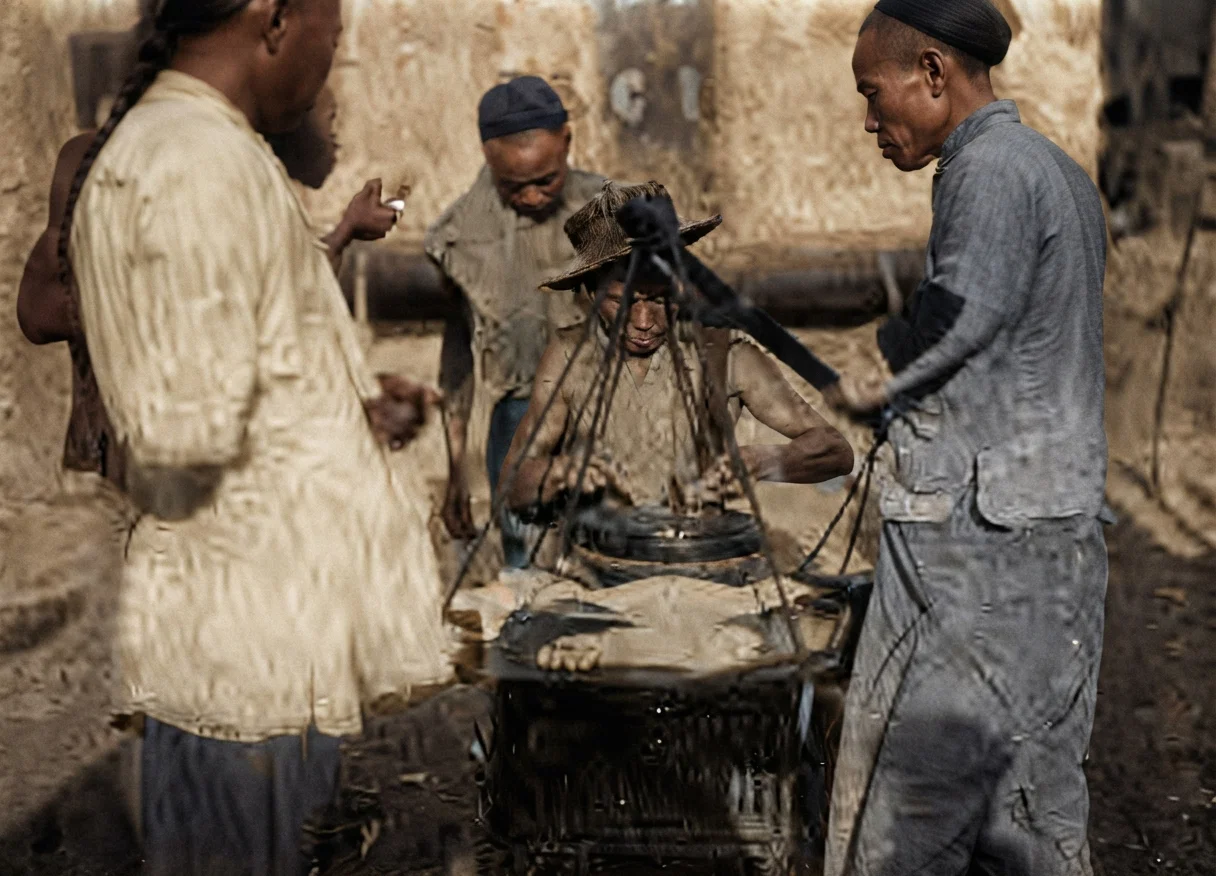
Street Vender of Victuals, Amoy, China.

CHINA.

II. Her People and Population.

IT is quite inadequate to speak of the Chinese as a nation; they are more properly a race, constituting a large fourth of the population of the entire planet. Whence came they? Of what stock are they? and what was their original home? What are their racial characteristics?
Like so many other questions relating to the origin of peoples, this query about China is beset with difficulties. The whole matter is involved in obscurity, and so great is the uncertainty that no definite answer can be made to this very interesting question. The consensus of opinion, however, is that the original home of the Chinese was somewhere in the valley of the Euphrates, the world's racial cradle. As a correlate to this opinion, it is further asserted that much of China's present civilization can be traced to the ancient Chaldeans. Be that as it may, a mere nodding acquaintance with this race reveals the fact that the Chinese are Orientals, and that China in her domestic, social, and national life reflects in many particulars the civilization of the Old Testament times.

A Nomadic People.

It seems quite certain that the primitive Chinese were a nomadic people who traveled from the western part of Asia, and finally made their first settlement in what is now the province of Shensi, in the valley of the Yellow River. Once settled in the fertile parts of this great country, these primitive Chinese nomads soon took to tilling the soil, and by a natural and gradual process spread over the entire territory now known as China Proper, either subduing or driving to the mountains the aborigines, who are still to be found in different parts of the empire, unconquered and more or less barbarous. This process of absorption was the work of centuries, being in very truth the founding of the Chinese State as it exists to-day. Antedating the time of Abraham in her first beginnings, China was a contemporary of ancient Egypt, Babylonia, and Assyria, each of which passed away, while China and the Chinese civilization went forward, reaching their highest level some time before the Christian era.
That the Chinese as a race sprang from one common stock, there can be no reasonable doubt; yet it remains a fact that some quite pronounced differences mark this people in different parts of the empire. Broadly speaking, it is safe to say that from the Yang-tse River north, the Chinese resemble the Mongols, while to the south of that river they assimilate to the Malay type. In physique the race makes a better showing as we pass from the tropics to the higher latitudes. In the matter of mental acumen and initiative, the people of the South outclass those of the North.

National Characteristics.

Outwardly the Chinese are too well known to require description, being classed with the Mongolian race, a fact well understood even by the average schoolboy; but when it comes to a characterization of their inward qualities, the case is quite different, as the conflicting testimony of many witnesses abundantly shows. Some of their most marked national characteristics are readily and clearly recognized by all close observers; yet it remains a fact that Chinese mental and moral make-up has been the subject of much discussion both in and out of books.
First may be mentioned their conservatism, which has come to be part and parcel of this race. China's golden age is believed by every Chinese to be in the remote past, and so every question pertaining to the present must, as a matter of course, be referred to that glorious past. It is a national conceit that Chinese civilization in all of its aspects reached the ideal stage during that period. And in common with the rest of the human race, the Chinese mind concludes that when a thing is as good as it can be, it is idle to attempt improvement. Reasoning on this assumption, it is rank heresy to even suggest reforms, for the very obvious reason that it calls in question, and must logicallylead to a final break with, that honored past. To the orthodox Chinese such a step is both dangerous and unnecessary. Dangerous because it means a cutting loose from the old, the tried, the perfect, and embarking on a course that is sure to involve the Chinese ship of State in total wreck. It is unnecessary because whatever defects the China of to-day may have (and that there are defects even the most radical Chinese will admit), she still has the immortal classics which, if followed, will yield every desirable result to the Chinese State. Like the ancient Romans who had one word for both customs and morals, the Chinese look upon their customs as most sacred. Some of these, it should be remembered, are of foreign origin, such as the queue and the rites of Buddhism, yet when once established they resist change. And yet China is in process of change—the new wine of the West is rending the old wine-skins of this nation.

Ancestral Worship.

Filial piety is at once a Chinese characteristic, and at the same time essentially the religion of China. The term "filial piety" comes very far short of representing the thing it is supposed to stand for. Filial piety is in very truth ancestral worship. One has said that ancestral worship is filial piety gone mad. Yet it is true that China's filial piety has elements that the West would do well to emulate; but taken as a whole it is inherently only evil, and most of China's sorrows can be traced to this fountainhead. It virtually destroys the family by ignoring the wife and the daughter. It enjoins filial duties on the son, but says not one word as to the father's duties toward the son. And worst of all, it makes gods of dead men.

Economy.

One of the most striking characteristics of the Chinese is their economy. A writer of long experience in China has well said that sixty million Chinese could be well fed on the annual waste of the American people. Everything, whether in the line of eating or wearing, is made to do full service, if possible, not merely once but twice and even three times. Almost every living thing, in whatever physical condition, whether in the water, in the air, or in the land is regarded as having food value; and every scrap is made to go as far as possible in satisfying the demands of the physical man. In many parts of the country it is a common sight to see men, women, and children scurrying about gathering stalks, stubble, and leaves to be used for fuel. The fields are literally scraped and so made to yield the last possible handful of dried grass or scattered leaves, all of which is made to reach the very farthest possible in the preparation of the family meal. To meet the needs of the case, the bottoms of the cooking utensils are made very thin so as to require the least possible fire in cooking the food. The diet is in the majority of cases very simple and not infrequently scant.
A characteristic illustration of Chinese economy is afforded in the case of an old woman who was found making her way slowly and painfully to the home of a relative in order that she might die in a place convenient to the family cemetery, and so cut down the funeral expenses.

The Yellow Peril.

If the Chinese are noted for their economy, they are equally conspicuous for their industry. And it is in the industrial race that the Chinese threaten to become serious competitors of the West. This is the real "yellow peril" so widely discussed at the present. This industry is not peculiar to any one class; it is rather a characteristic of the race. Single provinces boast of scholars, scores of them, who have passed their eightieth year in their endeavors to arrive at literary honors, and not a few there are who diligently travel the intellectual road until they have passed their ninetieth year.
The industry of the scholar is equalled by that of the farmer who seems to work incessantly. The fields, which in most cases resemble well-kept gardens, give ample evidence of the painstaking care and unflagging diligence. It is no common sight to see Chinese farmers at all hours of the night working by the light of the moon.
The ordinary day laborer is, if possible, even more diligent than the hard-working farmer. The income of this class of laborers is very uncertain, and for that reason they very often eke out a precarious existence. Not infrequently is he driven to his tasks by the sight of grim starvation, and it is really pitiful to see how some of this class will patiently bear actual suffering to earn a mere pittance. A very interesting example of this unmatched industry may be cited in the case of a large fish-market next door to where these lines are being written. From the moment the first rays of light appear in the east, until about 8 A.M., it presents a scene of bustling activity. Day after day, coolies and fish-mongers, barefooted even in the coldest seasons, vie with each other in getting their supply of fish to be carried on their backs into the city and sold thru the day.
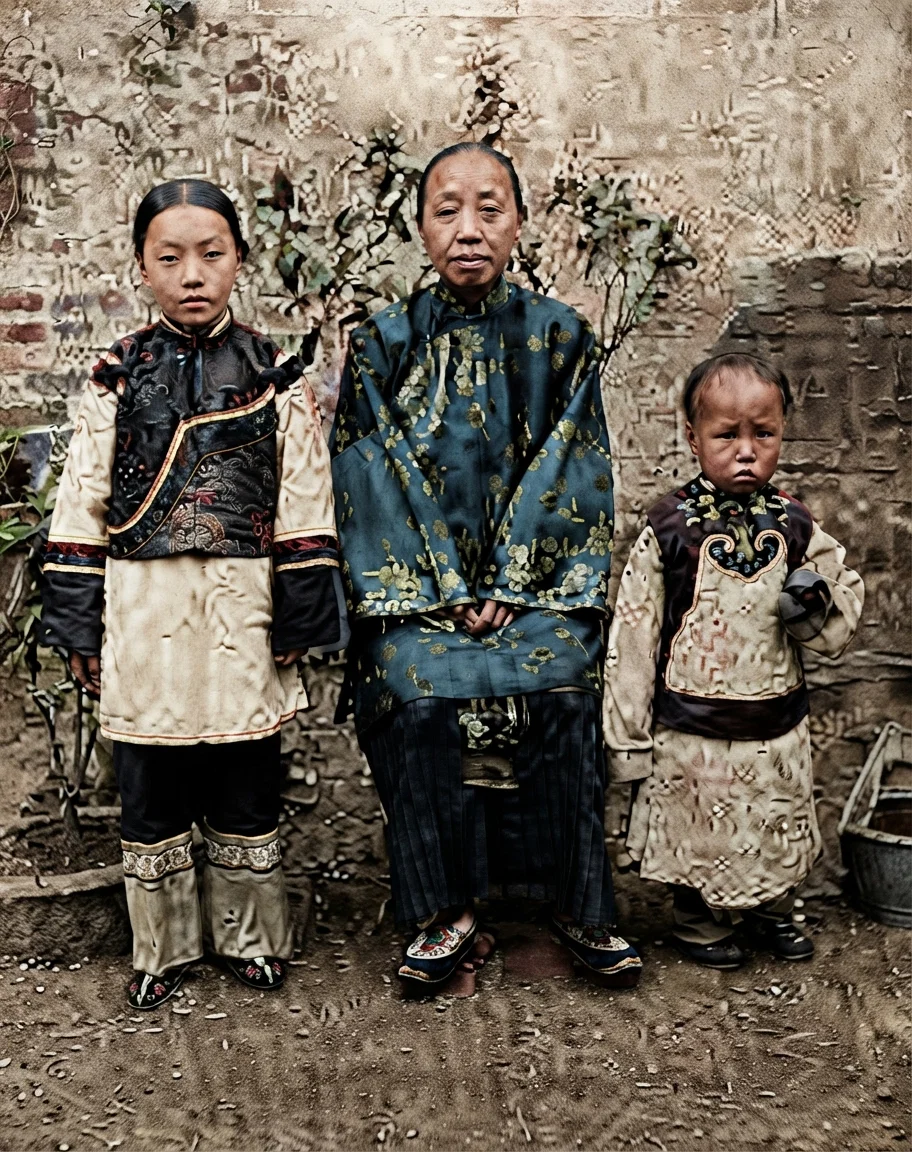
Mother, Daughter, and Son, Canton, China.

Patience and Perseverance.

Granting that the Chinese have no nerves, and that they have an almost inexplicable disregard of time, it still remains a fact that they are endowed as a race with patience and perseverance which in so-called Christian lands would seem very rare. Not only do they bear their ills with patience, they do it with a cheerfulness that is truly remarkable. It is true, however, that this patience smacks somewhat of fatalism.
China has practically no public spirit, as this term is used in the West. Sympathy and her twin sister benevolence are little known and act a small part in the affairs of China. The Chinese are polite to a fault, and their desire for peace and dread of giving offense cease to be virtues by being carried too far. Insincerity is perhaps the most conspicuous weakness in the Chinese character.
Considering that this race has been for so many years without the light of God's special revelation, the wonder is not that they have so many vices, but rather that they have so many excellent traits of character. And that is not saying that as a race they are in a good way, or that the preaching of the Gospel is superfluous. On the contrary, China is in desperate need of the saving power of God's truth. She is exactly in the position of the man, who, conscious of some good qualities, conceives himself to be, if not perfect, the best, the very best of humanity. Self-sufficiency is of all conceits the most dangerous. China must be taught the true God, the true character of sin, and the all-sufficiency of Jesus Christ, the One only true Saviour. "He that hath the Son hath life; and he that hath not the Son of God hath not life." This is China's great need; not an army, a navy, and arsenals, all modern, as her leading statesmen contend; nor is it true that her first need is a modern educational system, as some of her foreign friends would have us believe. This is the hour and opportunity for God's final message to go in the land of Sinim. J. N. ANDERSON.