The Religions of China

6%

Pacific Press Publishing Company · Mountain View, California · May 15, 1907

FromSigns of the Times, Vol. 33, No. 20.

Read the full edition

The Religions of China.

Taoism, Buddhism and Mohammedanism.

(Concluded.)
TAOISM, as Confucianism, is indigenous to Chinese soil. It was originally quite pure, and dealt with the problem of life in a philosophic way. Lao-tsz, the founder, was some fifty years the senior of Confucius. He held a high position in the State, but seeing so much disorder and lawlessness, he retired from office and led the life of a recluse, giving himself up to philosophical speculation. He wrote a small book about twice the size of the matter contained in the Sermon on the Mount, in which he set forth some very excellent thoughts. This is the Taoist bible, and on this little base the entire system of Taoism rests.
The chief corner-stone of this system is "Tao," literally meaning "the way," "the right way," tho it doubtless refers to impersonal nature, which permeates all things, and is in very truth the source of all things. Lao-tsz taught that true peace comes from ceasing to strive and by living in harmony with the leadings of "Tao." Man, by all his artful and unnatural development, is the cause of all the disorder in the world. His remedy, return to the "Tao."
WA LUM TEMPLE, CANTON.
He was never understood by his own countrymen, and his entire system has been perverted into a mass of superstitions, which finds expression, at present, in the Black Art, and which, in a very large measure, is the fruitful source of the wild and fanatical outbursts, which from time to time sweep over whole provinces, bringing death and unnamed horrors. It is this modern Taoism with all its admixture from every other source of idolatry that fills the Chinese mind with superstitious terror. This is very vividly depicted in the "Temple of Horrors," in this very city of Canton. Here in the "Ten Courts of Hell" are illustrated every conceivable form of punishment which poor mortals are supposed to undergo in the nether world. Stucco images about the size of children stand all about busily inflicting the most cruel tortures, while the hapless victims are shown in indescribable torture. This Taoistic hell easily holds its own with that of Dante, or even that of the ancient Greeks. A life lived in anticipation of such awful prospects can not be other than miserable.
"The dread of spirits is the nightmare of the Chinaman’s life, and to this dread Taoism panders." This is where the ignorant, drone-like priest reaps his harvest by posing as the sole mediator between the material and spirit world.

Buddhism.

Buddhism, a foreign religion emanating from India, is said to have been introduced into China by imperial authority, in the first century of the Christian era. Ever since its appearance, it has been by turns welcomed, smiled upon, persecuted, patronized, tolerated, until to-day it has come to be looked upon as a fixture. Its early vigor and strength have long since passed away, leaving it an effete system whose ignorant, immoral, and opium-poisoned priests, as well as its nuns, are the objects of popular contempt and ridicule.
How many Buddhists are there in China? —Broadly speaking, there are no less than there are individuals, for the reason that by a peculiar and inexplicable eclecticism, a Chinese is at once a Confucianist, a Taoist, and a Buddhist. These three religious systems are said to supplement each other, so making one whole scheme of human salvation.
Buddhism is a meditative, speculative, pantheistic philosophy, having as its studied objective, absolute "nothingness;" and as such it is well received by peoples of enervating climates. After being introduced into China, it was, owing to the more practical turn of mind of this people, materially modified as is evidenced by the substitution of a real and material paradise for the Nirvana of the more orthodox Buddhism, which deals almost altogether with abstractions. In India, Buddhism is atheistic, while in China it is rather silent or non-committal as to God. Let us hope and believe that this misleading light of Asia is speedily being displaced by the eternally true and invincible light of the true God and His Son Jesus Christ.
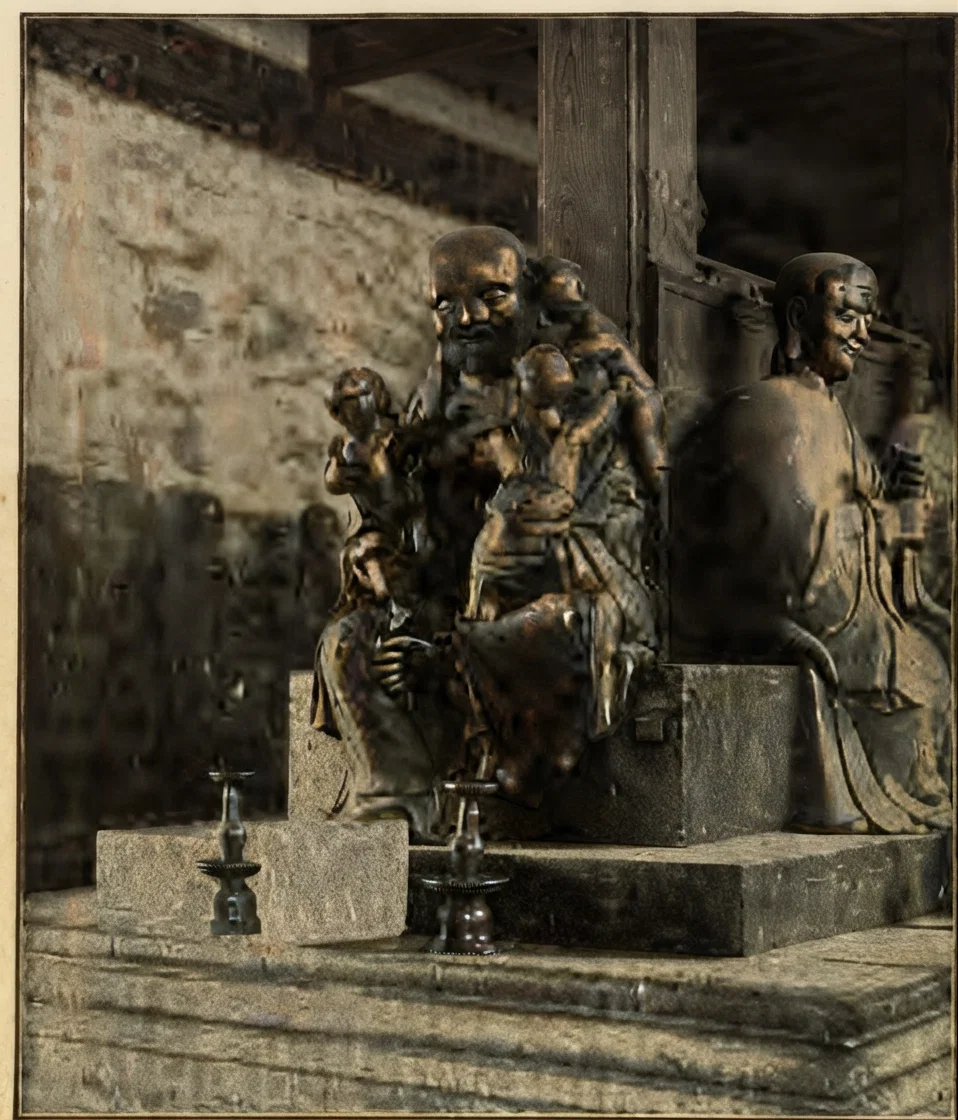
Buddha, with three smaller ones climbing on him. Wives desiring children worship at this shrine.

Mohammedanism

The Arabian prophet has in China a following of some 20,000,000 scattered thru the entire empire. Strange as it may seem, these idol-haters have been led into at least one form of idolatry, that of worshiping the emperor’s tablet. Doubtless this came about thru fear of persecution, on which account the Koran allows the lapse.
Mohammedanism in China has been more conspicuous for its rebellions than for its activity in propagating its faith. The Koran has not been translated into Chinese, and this faith never exerted a great influence in China.
This in brief, and more or less perfectly, is China, groping about in the dim, misleading light of her own and foreign faiths. She is in sore need of the one true Light of the world. She needs the Bible, the living word of the living God; and she needs the convicting and comforting power of the Holy Spirit. On her own part, she is consciously turning away from the false gods of her fathers, and it becomes the followers of Jesus to see and seize upon this their opportunity. Let us all as never before give ourselves tothe work of preaching in China as elsewhere the Gospel of Him who is "King of Kings, and Lord of Lords."
J. N. ANDERSON.