Affairs in China

4%

Pacific Press Publishing Association · Mountain View, California · Sep 20, 1910

FromSigns of the Times, Vol. 37, No. 37.

Read the full edition

Affairs in China

(From Our Own Correspondent)

Despoiled by the Nations

HINA to-day is again occupying the place in world politics that she did in the years just preceding the Boxer outbreak. We can easily believe that she would much desire to be left to work out some of her numerous problems herself. But this will never be, for she alone remains as an undeveloped market for the products of Europe, America, and Japan. The temptation for large returns, both financially and politically, to those who supply the funds for building her railroads and developing her natural resources, is leading the moneyed powers to force their help upon China. Recent developments make it clear that China is losing her grip on one of her richest and most promising dependencies. Russia's hold on the northern half of Manchuria, and Japan's influence in the southern half, grow stronger with every piece of political maneuvering that has to do with the Manchurian situation. Now that Japan has absorbed Korea, even going so far as to do away with the name entirely and making it part and parcel of the Japanese Empire, she can give more attention to developing her Manchurian interests.

Chinese National Exposition

The successful opening and carrying on of the first Chinese national exposition, is eliciting favorable comment from all sides. Its value educationally can not be overestimated. Then again the united action of various government boards and provincial officials that made the exposition possible is a most helpful omen. The outlay is very small when compared with that of the expositions held in America, yet for the first effort it is a credit to China.

Floods and Famines

Not a year passes without one or more floods or famines. The suffering and loss at such times are greatly aggravated by the poor facilities for transportation of food supplies from other districts. This year is having more than the usual quota of floods. The result is that the price of rice is something unheard of for many years. Uprisings and riots always follow in the wake of floods and famines, and the last few months have seen many local disturbances, the most serious one being the Chang-Sha riots, in which most of the mission property of the city was destroyed, together with the freight-houses of two of the large steamship companies. China was long since deforested. This together with the slight fall in the large rivers,
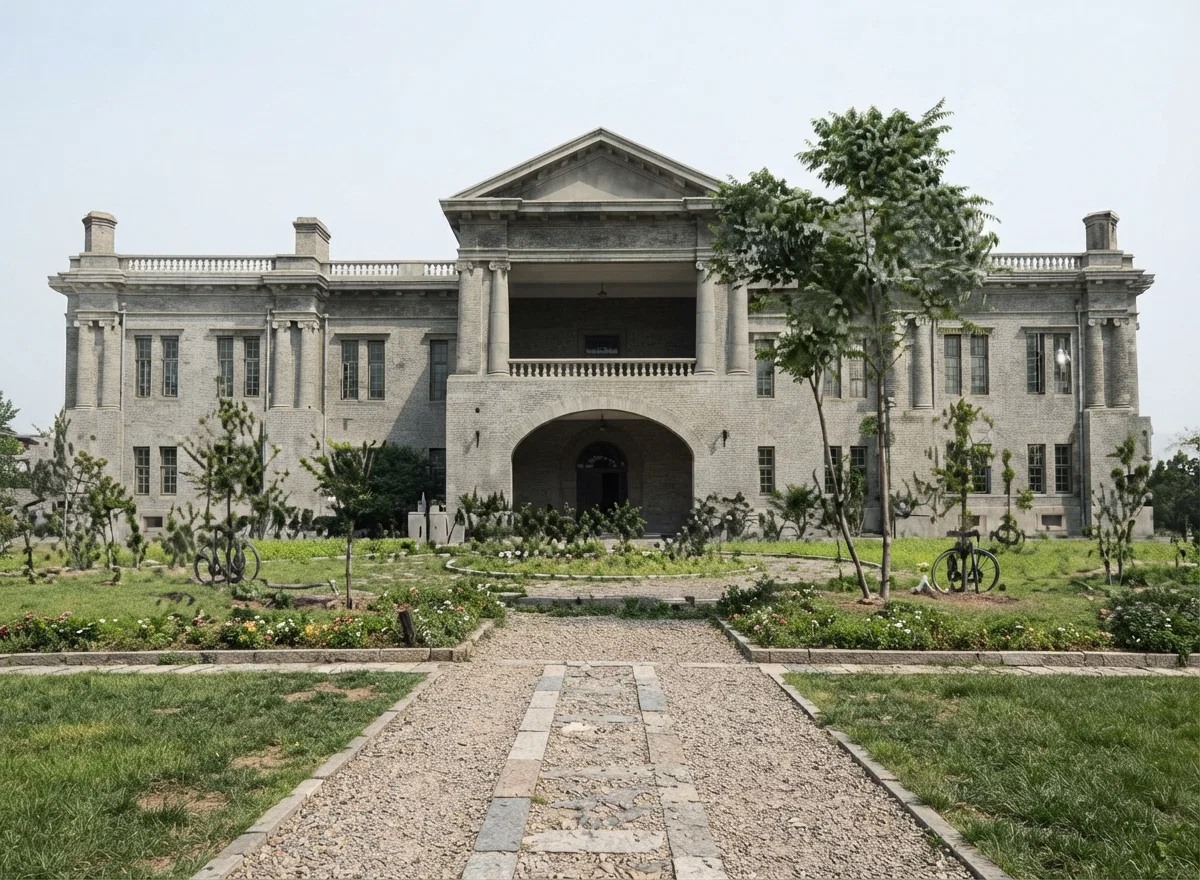
The new Waiwupu (Department of Foreign Affairs) Building at Peking
and the fact that no pains are taken to keep them from silting up, is a prime cause of the frequent floods. The magnitude of these floods can be better appreciated by referring to the recent case of Chang-teh, a large city in Hunan. For eight days the rain fell unceasingly. The Yuen River rose twenty-five feet in three days, and at least one thousand persons are estimated to have been drowned, besides live stock without number. The farmers throughout all that section will lose their entire rice crop for this year.

A Parliament for China

The changing conditions in China, and especially the advance educationally, have led to urgent requests on the part of the people for a parliament. During the reign of the deceased emperor Kwang Hsu, a period of nine years was set, at the expiration of which time (1917) a parliament was promised. This did not satisfy the people, and for the last two years, especially, they have been insistent in demanding a parliament at once.
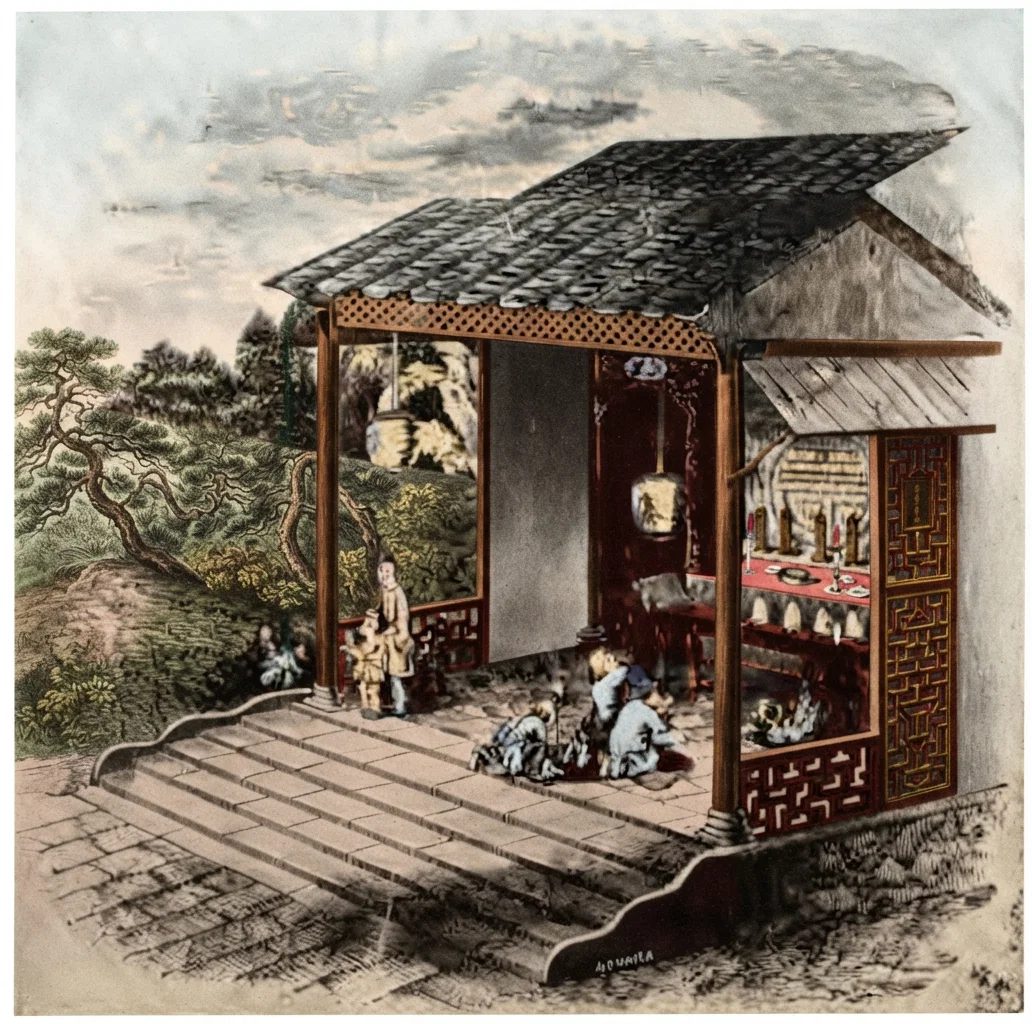
Ancestral Hall and mode of worshiping the tablets. Four tablets are shown on the innermost shelf.
Memorials are poured in from all sides with this request. But the Throne has recently refused a memorial sent in by provincial delegates, and states that it is impossible to shorten the period of nine years, formerly decided upon. It is pointed out by the Throne that the condition of the national finances and the recent riots show that the country is not ripe for a constitution. Taken all in all, the political outlook in China is not promising. Nor can one have high hopes for the future, because of the lack of harmony between the central government and the provinces. In a general way it may be said that the influence of the central government over the provinces decreases in proportion to the square of the distance. Many of the edicts issued from Peking are nothing more than paper reforms. New boards are created from time to time in the capital, and this calls for increased revenue for salaries. The result is that taxation has been increased everywhere, and this naturally aggravates the prevailing unrest.

Population of China

The ministry of the interior recently reported that the total population of China is now 433,553,030. Out of this number 407,253,030 reside in the eighteen provinces.
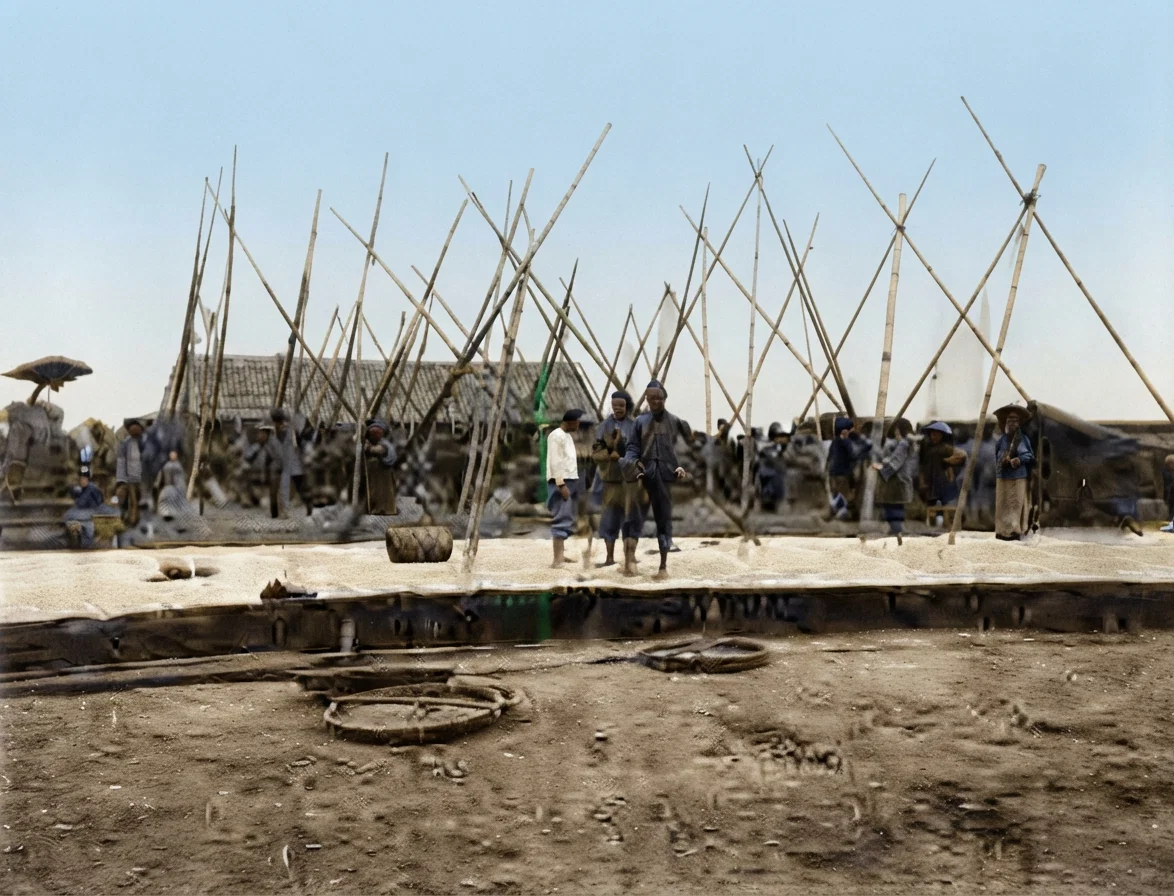
A public market-place where officials are collecting taxes which are paid in rice

Printing in China

is still in its infancy. As late as eight years ago it was not uncommon in cities of a hundred thousand population and over, to find not more than half a dozen newspaper subscribers. But this condition no longer exists, for to-day cities of this size not only have a host of people who read the news of China and the world, but many have their own dailies. The Chinese press is still under serious disabilities due principally to the vagueness of the press laws, which leave altogether too much to the discretion, or indiscretion, of the officials. Civil officials are apt to interfere with the conduct of the newspapers in a way that leaves no redress and destroys the independence that a well-conducted newspaper must have. But in spite of difficulties, marked progress is seen, and public opinion is being educated and shaped by the in many cases able editorials on questions of the day.

The Missionary Attitude toward Chinese Social Customs
This is a question which of late has been attracting no little attention among a large number of the missionary force in China. The attitude of an ever increasing number of missionaries — and as a rule they are those who have been many years in the field — is one of compromise and adaptation. I can do no better than to quote from some contributed articles which appeared in a recent number of the “Chinese Recorder and Missionary Journal.” The title of one paper is “Christian Suggestions in Chinese Superstitions.” The writer states that in view of the tendency of modern education in China to cast forth from the mind all belief in the spiritual, it behooves the missionary to conserve and cherish all absolute spiritual truth already existing in the minds of the Chinese. This writer recommends the attitude of “stooping to conquer,” because he says God did so of old in two striking instances — making use of existing and superstitious material: “(1) Whatever the primeval origin of the week of seven days, for fully two thousand years beforeMoses each seven days of the lunar month had been associated with the sun, moon, and the five planets (quoted in China as well). And of the days of the lunar month the 7th, 14th, 21st, and 28th were 'quiet days' on which it was unlucky to change the clothes, to offer sacrifice or worship of any sort, to eat flesh cooked at the fire, or even in sickness to take medicine. Here was an institution which, from time immemorial, had been one of superstitious avoidance of both work and worship; yet God, through His servant Moses, laid hold of that ancient superstition and elevated it, in connection with His finished work of creation, into a Sabbath observance of rest for the laborer, of refreshment for the soul, and of adoration toward Himself. “(2) The second instance is still more striking. In the plague-stricken camp of Israel, Moses was divinely prompted to lift on a pole a serpent of brass; the serpent being an object of superstitious veneration in Egypt as connected in some way with the healing art. How boldly then did God risk the danger of encouraging serpent-worship itself (see 2 Kings 18:4) to bring His own salvation to the bodies of the multitudes, and to afford their descendants in after ages with a type of the Saviour (John 3:14) of more than the bodies of men! We are not called nowadays to run such risks as that, but may feel justified in pointing out certain underlying principles in the superstitions around us.” Even thus would the professed servants of Christ base the Scriptures on heathen superstition. Another writer discusses “Chinese Memorials to the Dead and Their Relation to Christian Practice.” He advocates retaining as far as possible the Chinese “Ching-Ming” festival. This festival is the feast of graves. On this
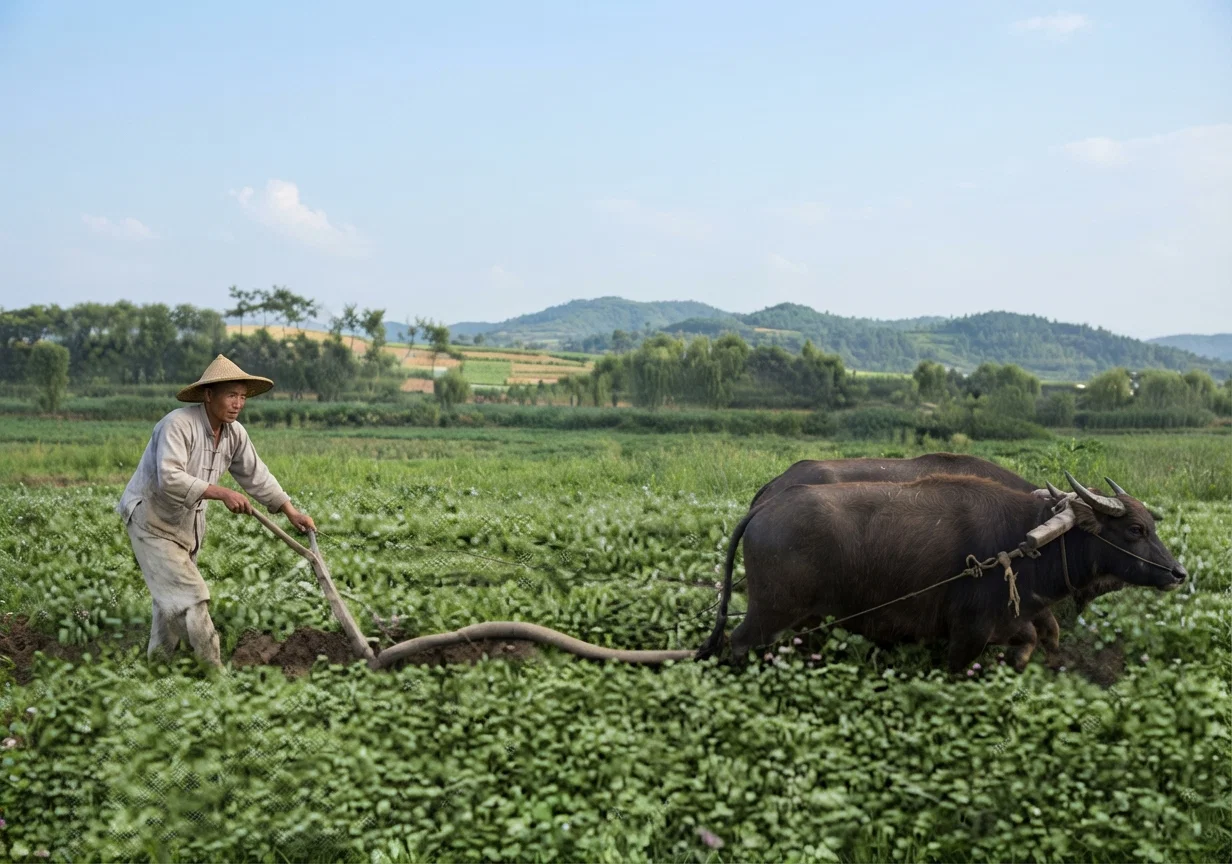
Chinese farmer plowing under clover as a fertilizer
day people of every rank repair to the graves of their ancestors to worship the departed spirits, and this they do by making offerings of food and wine, burning imitation money, and firing off crackers. The writer above mentioned advocates retaining the festival and the Chinese name for this festival in all Christian communions, just as the orthodox churches retain the old Anglo-Saxon title Easter. He points out that the two HEATHEN FESTIVALS (capitals ours) are almost an exact parallel, and both may be observed as the festival of the resurrection of Jesus. What this writer here advocates is already practised by Christian communities in some parts of China. The hall of ancestors is found in the house of almost every family. It may be a room entirely devoted to this, or in the case of the poor there is merely a shelf or shrine. Here are found the ancestral tablets, usually a board about twelve inches long and three inches wide placed upright in a block. The inscription on the tablet states that it is the abode of the soul of the honored father, mother, or brother, as the case may be. Incense and paper are daily burned before these tablets, accompanied by a kotow, forming in reality a sort of family prayer. At stated times feasts are spread before these tablets. Strange and inconsistent as it may seem, some missionaries are openly advocating the use of some form of memorial or ancestral tablet. They think it possible to retain the old ancestral tablets, disassociated from idolatry. The advocacy of such views as these by Protestant missionaries reminds one very forcibly of the attitude of the famous Jesuit, Matthew Ricci, who entered China in 1582. As a matter of expediency he allowed the converts to practise the rites of ancestral worship. It is said of Ricci that he was more a politician than a theologian, for he preached the religion of Christ according to his own fancy, disfiguring it by a faithful mixture of pagan superstitions. In striking contrast to this policy of expediency and adoption is the teaching of our Lord through the apostle Paul: “What communion hath light with darkness? and what concord hath Christ with Belial? or what part hath he that believeth with an infidel? and what agreement hath the temple of God with idols? . . . Wherefore come out from among them, and be ye separate, saith the Lord, and touch not the unclean thing; and I will receive you, and will be a Father unto you, and ye shall be My sons and daughters, saith the Lord Almighty.” A. C. SELMON.