The War-Mad Nations

2%

Pacific Press Publishing Association · Mountain View, California · Oct 4, 1910

FromSigns of the Times, Vol. 37, No. 39.

Read the full edition

The War-Mad Nations

NOTWITHSTANDING the constant talk of peace, peace councils, peace conferences, peace congresses, appointed by religious, political, and governmental bodies, still the mad preparation for war goes on apace, increasing with every year. Each of the nations talks peace, each of the nations prepares for war. Not a nation upon earth scarcely but what is apprehensive of danger from some other nation or is looking with jealousy upon some other nation. Sometimes it is the eager hunger, the greed, for more territory, which causes the jealousy, and stirs up the spirit of animosity. Sometimes it is commerce, and commercial war is bound sooner or later to awaken the spirit of civil war.
Admiral R. D. Evans remarked in the San Francisco "Examiner" of July 8, 1910:
"We [the United States] have everything needed to control a fair share of the commerce of the Pacific Ocean except the ships. As these increase in number, as surely they must, the chances of friction with other nations will multiply rapidly and war may come at an hour's notice."
This will probably be the result of increased commerce. It arouses more or less bitterness always. We read in despatches from Europe that Germany is looking upon her old rival, Austria, with a great deal of anxiety. Austria has caught the war fever, and Germany does not know but her next war may involve Austria. Turkey and Greece are at enmity, and nothing but the interference of the great powers would prevent war at almost any time for the possession of various provinces.
The fear of breaking the peace is all that restrains Russia from taking possession of the whole Balkan Peninsula if it were in her power. The same condition of affairs exists between England and Germany, between Japan and the United States. Some recent reports contend that while everything is outwardly smooth in the utterances of Japan and her professed friendliness toward this country, she is preparing for war a few years hence with tremendous rapidity, and expects to become mistress of the Pacific Ocean.
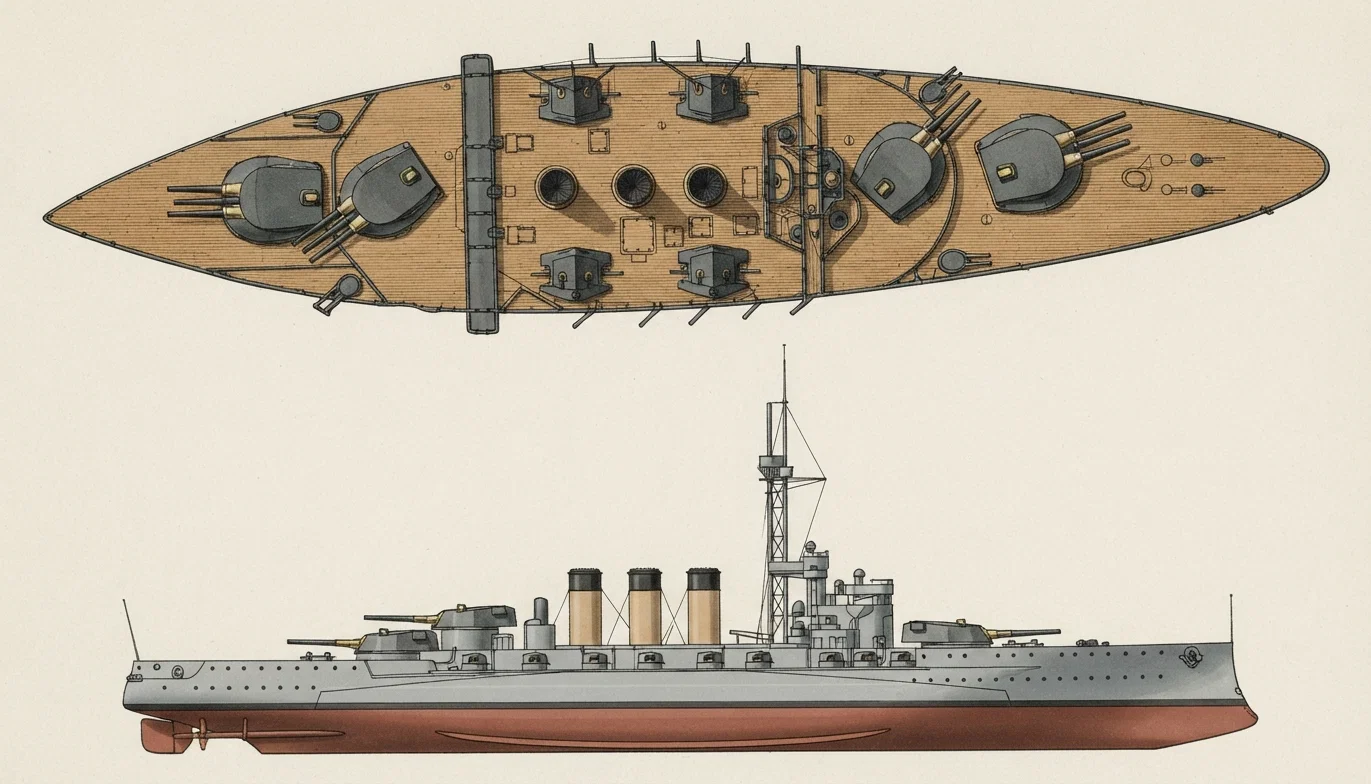
Plan of first Italian Dreadnought, the first vessel to be armed with three-gun turrets

The Fearful Cost of War

The fearful cost of war rests like a horrible incubus upon the breasts of the nations. It is a nightmare, under the influence of which they can scarcely move or breathe, with the vital difference that from the nightmare one awakes as from a fearful dream to relief, but the fearful war expenditures are a reality.
It is but a little while ago that battle-ships in the United States alone were relegated to the junk pile which cost about $50,000,000 when they were built. That is the case with all the various nations. Ships that a few years ago were considered first-class battle-ships or cruisers, like the Oregon and the New York, are now entirely out of class, and would be considered utterly worthless in an up-to-date squadron or fleet. Every advance stirs up the same ambition in some other nation.
Not long ago we noted the launching of the British battle-ship Orion, considered at the time that she was laid down the first battle-ship of the world, one which stood entirely alone. Her tonnage was about 23,000; but last week we noted four others, two American battle-ships of over 27,000 tons each, and two Brazilian battle-ships of over 30,000 tons; and Secretary of the Navy Meyer, of the United States, is advocating the 32,000 ton battle-ship, one of which at least Brazil is also planning.
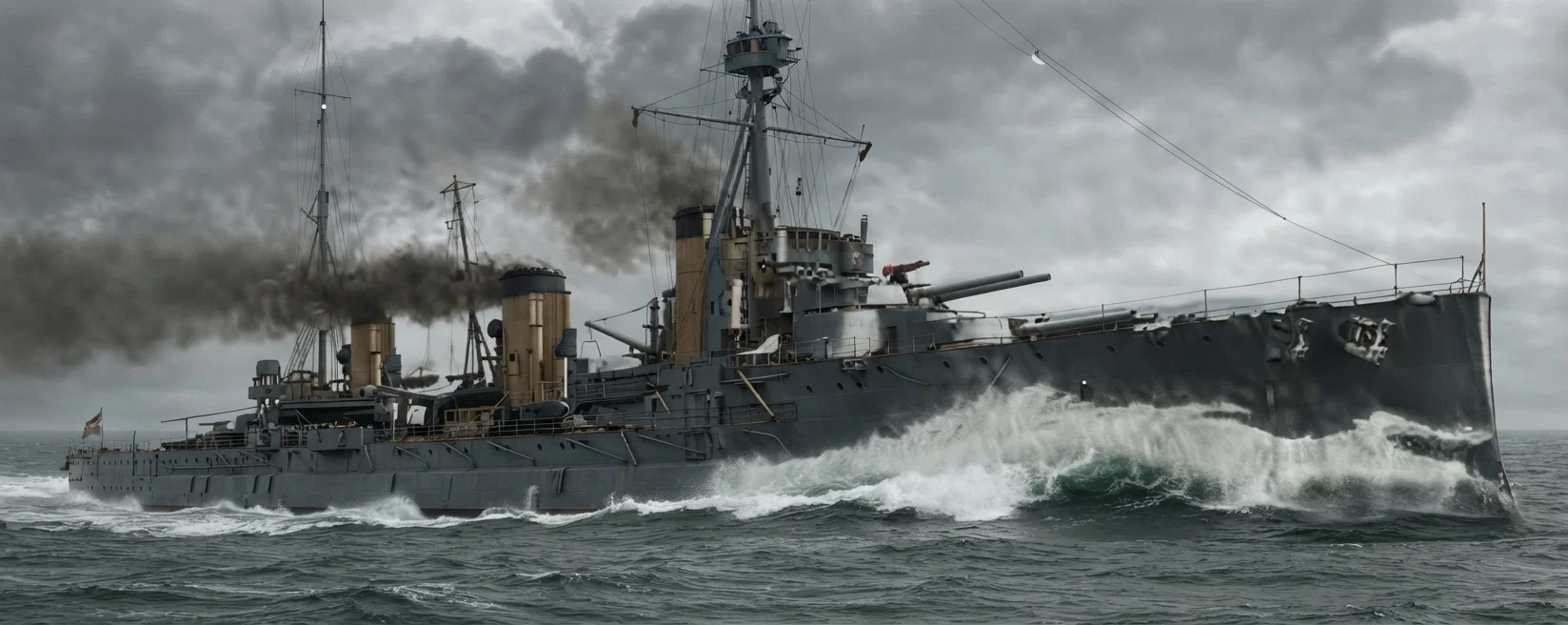
THE BRITISH CRUISER LION She combines the speed of a scout with the fighting qualities of a Dreadnought. Her length is 700 feet, and displacement 20,000 tons. She will mount eight 13.5-inch guns and steam thirty knots.
It was considered an immense price when four million dollars was paid for a battle-ship; but the 32,000 ton battle-ship could not be built for less than eighteen million dollars.
It is not peace advocates or religious newspapers that are pointing out this war-mad spirit, but men of standing, men who are out in civil and political life, whose talents, ability, and powers are given for their respective countries. They see the worship of the war god and wonder where it will end. For instance, in the San Jose "Mercury" of August 31, 1910, is a stirring editorial entitled "The Contest for the Sovereignty of the Sea." After referring to the last of the British Dreadnoughts launched (really a battle-ship cruiser), the Lion, 26,000 tons, that it was built in the wonderfully brief time of eight months, at a cost of eleven million dollars, that it was hardly in the water before Germany had begun to build a bigger, faster, more powerful ship, that Brazil had entered the race for a ship larger still, one of 32,000 tons, such as had been recommended by the Secretary of the Navy of the United States, the editor says:
Deck plan of the British cruiser Lion, showing the sweep of her eight guns from beam to beam
"When the hour comes that engines so mighty and so terrible as those ships crash together on the ocean, a new chapter of horrors will have to be opened in the history of mankind. And in this fierce competition for supremacy on the sea it is not simply that England, Germany, and Brazil are contending; nearly every other leading nation is engaged in the like struggle. . . . Now where and when is all this to stop? We live in a time of profound peace, a time too when all the leading nations are making most profuse protestations of their peaceful desires and purposes, and yet there are preparations for war going on everywhere on a scale never before known in the history of our race."
Referring again to the strong professions of peace, the writer uses this illustration:
"Suppose for instance that in this community the authorities, the newspapers, and the people in general were loudly professing their love for one another, their devotion to peace, and their hatred of strife, while at the same time every man was busy turning his house into an arsenal and going about armed to the teeth, should we not all have the feeling of insecurity and danger? It is precisely so in the great community of nations. If everybody is friendly to everybody and all sincerely want peace, why is everybody so intent on getting ready to fight? The truth is nobody believes in the sincerity of anybody and feels safe in going unarmed. Everybody is afraid of everybody else and thinks that the only security for peace is in being ready to fight. But where and when, we ask again, is this to stop?"
Then he refers to the awful burden which this war expenditure imposes upon the people, even now almost intolerable, but with no endin sight. Magnificent ships which we knew as such ten years ago are already on their way to the scrap heap. Naval commanders would not dare take them into the battle with the new Dreadnoughts; not one of them would last a minute. The United States is spending seventy per cent of its entire revenue in paying the cost of past wars and in preparing for war to come — and more to the same effect.
The New York "World" in a recent issue said, after referring to the eighteen million dollar battle-ship, the price of a 32,000 ton monster:
"When the British government built the original Dreadnought, it not only rendered obsolete a large fleet of its own battle-ships, but it started the other nations of Europe in a mad race of naval construction that threatens to bankrupt them." "The whole Dreadnought policy, ever since Great Britain first adopted it, worked harm wherever tried. It has led constantly to fresher excesses of militarism, burdensome taxation, and bloated armaments that in themselves are a menace to the peace of the world."
The Boston "Herald," referring to the eighteen million dollar battle-ship, asks:
"Is there to be no limit? Are the great nations of the earth to continue dumping millions on the table in the form of battle-ships and other military expenditure, each in turn raising the bet of his next neighbor, and taxing the people almost to the breaking point to provide the funds for this game of bluff? The American people are crying out against the burdens of the increased cost of living. It is practically impossible for the head of the average American family to make both ends meet and provide a decent living for his dependents. . . . No small part of this increased cost of living is due to the increase in the cost of government. . . . And facing this situation an appeal is made to national pride to sustain the extension of our naval policy on an infinite scale. It might be termed the reductio ad absurdum, were it not that it is put forward with a plea for national defense, backed up by semiofficial hints that rival nations are planning ships and laying keels along a similar policy, a plea that never has failed to appeal to the patriotic American people. . . . In the last eight years the appropriations for the navy were in the aggregate $600,000,000 in excess of the aggregate for the previous eight years. A similar comparison of army expenditures showed an increase of $472,000,000. Yet we are at peace with the world, professing a policy of international peace."
Former Vice-President Fairbanks last March, in reviewing the situation, said:
"The world presents no condition demanding war. . . . Both war and the preparation for war unhappily weigh most heavily on the people, and not on those whose policy or intrigue is responsible for the burden. The increase in armies and navies must stop. It can not go on forever. How shall it be stopped? By the use of sense or an international cataclysm. Wherever I have been I have seen ships building and troops drilling for war, and yet I have seen no cause for war. The effects of this madness are visible in the squalor and distress of mankind. Persons calling themselves statesmen are taking their war machinery out of the mouths and off the backs of the men, women, and children who labor. Their wickedness is appalling. The theory that without war nations would become degenerate and that virility would go out of the masses, is unworthy of any mind outside of madhouse. Degeneracy is coming about because the people are so oppressed that they can not be properly clothed, housed, and fed."
In a recent despatch Mr. Lloyd-George, the chancellor of the British exchequer, referring to competition in armaments among the various nations, said:
"The countries of the world are spending annually 450 million pounds [$2,250,000,000] upon this machinery of destruction. In twenty years there has been an increase of two hundred million pounds [one thousand million dollars] per annum. All nations seem to be affected with an epidemic of prodigality which is sweeping over the land and sweeping to destruction. We take the lead. But, after all, we have got the greatest empire to defend; we have got that excuse. But if the nations increasingly spend their money upon matters that give neither sustenance nor support to their people on the road that leads to a higher civilization, we will suffer. . . . I think it is a great and growing misfortune."
Take three nations for instance: Germany's naval estimates for the last year were $38,597,500, an increase of more than $3,600,000 over the previous year. England's estimates for the navy were $203,018,500, an increase of more than $27,000,000 over the year previous. America in eight years has increased its war expenditures $1,072,000,000; from $51,000,000 in 1890 to $185,000,000 in 1902. No wonder that Mr. Stead calls the idea of peace a "fatuous dream."
The aggregate increase in the nations of Germany and England in one year amounts to the vast sum of $30,917,500. At $200 a year,—and there are many schools which young men and women could attend at that price,—it would maintain in school for one year 154,587 boys and girls; at $300 cost it would maintain 103,058 young men and women in school for a year. At one thousand dollars a year it would support 30,917 ministers. It would build 520 miles of railway at $60,000 a mile. It would erect 10,300 homes at $3,000 each. And we certainly know that there are thousands upon thousands in the teeming populations of Germany and England that need the houses, and the young men and women who need the education.
All this sounds remarkable, and yet it should not. It is utterly inconsistent, the professions which the nations and the world are making; but he who reads that Book of all books, the only always up-to-date book in the whole world, the Bible, should expect just what we see now. But by the ancient prophets, Isaiah and Micah, we are told that in the last days many peoples and nations will make great professions of peace, will go up to their great assemblies and say, Let us beat our swords into plowshares and our spears into pruning-hooks; and the same prophets declare that they are soothsayers, they are speaking the things that are not in harmony with God's will. On the other hand we are told, as is set forth in the scriptures in the center of the last page, that in the last days, just previous to the time when Jehovah will reap the harvest, all the nations of earth will be stirred to war, and all nations strong and weak will prepare for the great battle of Armageddon.
We are told in the 25th chapter of Jeremiah that all the nations will drink of the wine of wrath, will drink and be mad, and come up to that great battle that will leave the slain from one end of the earth to the other. We are told in the 16th chapter of Revelation of the agencies that stir up this spirit of strife, and which will gather the nations to that great war. They are the demons that go forth from the bottomless pit. And this article is but a faint echo of the work that is being wrought by them. At the very basis of it all lie selfish pride, selfish aggrandizement, greed, love of glory; and taking advantage of them all, dominant in the human heart, Satan by his demons of darkness infuses in the hearts of men the great struggle for supremacy, the spirit of war. The outcome will be just what is stated in Holy Writ; but beyond all that, all the strife and turmoil that will obliterate nations, in which vast wealth will go down to utter ruin, and in which millions will sink to rise no more, God will take to Himself His great power and reign. Then the universe shall know peace, and in that kingdom the work of righteousness shall be peace, and the effect of righteousness quietness and assurance forever.
The Cost of War.—We quote from the last publication of the American Association for International Conciliation: "Fifteen billions of lives have been destroyed within the historic period by a process that selects the more vigorous for destruction and the weaker for survival. Who can measure that effect? Forty billions of dollars have been expended, and as much more lost by checks on production. Three billions of dollars have been spent in our own country for pensions, and two more still to be spent as a result of wars now past." On the American army and navy two hundred million are expended each year. "Such figures, when quickly sighted, make no adequate impression on the mind, but if pondered at leisure, reveal the dimensions of an evil which it would not seem possible that civilization should knowingly tolerate."
The following table, a little out of date now, shows the comparative strength of the leading navies of the world (including ships now building). It shows plainly just how the whole world is slowly arming for the great battle of the Lord.
Nation War-ships Men Tonnage
Great Britain 510 125,000 2,005,873
Germany 248 60,000 820,692
United States 129 48,000 785,945
France 536 32,500 766,906
Japan 236 40,000 495,704
Russia 160 50,000 412,250
Italy 224 30,000 259,378
Ten Chicago millionaires, the real heads of the beef industry, were indicted September 12 by a federal grand jury in the United States District Court on the charge of several criminal violations of the Sherman anti-trust act. The report says, "In naming individuals, who may be imprisoned as a punishment on conviction, instead of corporations, which could only be fined and dissolved, the Government in these indictments struck the most severe blow that monopolists have yet felt."
The first Democratic governor the state of Maine has known for thirty years was elected in the person of Frederick W. Plaisted. By a singular coincidence his father, Horace M. Plaisted, was the last Democratic governor, who was elected in 1880. The Democratic victory will probably mean the choice of a Democrat to the United States senate to succeed Eugene Hale, who has served continuously since March 4, 1881.
The annual report of Inspector Darlington criticizes the army by saying that the army is wholly unprepared for field service because of the absence of field officers. He says that regulations are almost entirely theoretical or dependent on the experience of European armies, and that transportation facilities are no better than those used in the Civil War. The report mentions a whole battalion of artillery starting for the Philippines without a field officer.
According to reports said to be reliable, a reign of terror more wide-spread than anything of the kind ever before experienced in Nicaragua now prevails in that republic. Women are murdered on the streets, trains are bombarded, and men are hunted and shot down in the streets of Managua, the capital.
An Italian scientist asserts that pellagra is now traceable to the sand-fly, just as malaria is carried by mosquitoes, and insists that he is able to establish conclusively the truth of his surmise.
As the result of hazing in the local high school at York, Pennsylvania, ten young persons are likely to be disfigured for life. Hazing is a senseless, barbarous practise.
The cholera epidemic in Russia is abating. According to the reports of the sanitary bureau, the plague has numbered 170,363 victims and 77,466 deaths during the season.
Thirty lives were lost on Lake Michigan, September 9, when Pere Marquette car ferry No. 18 went to the bottom of the lake half way across. Thirty-five survive.
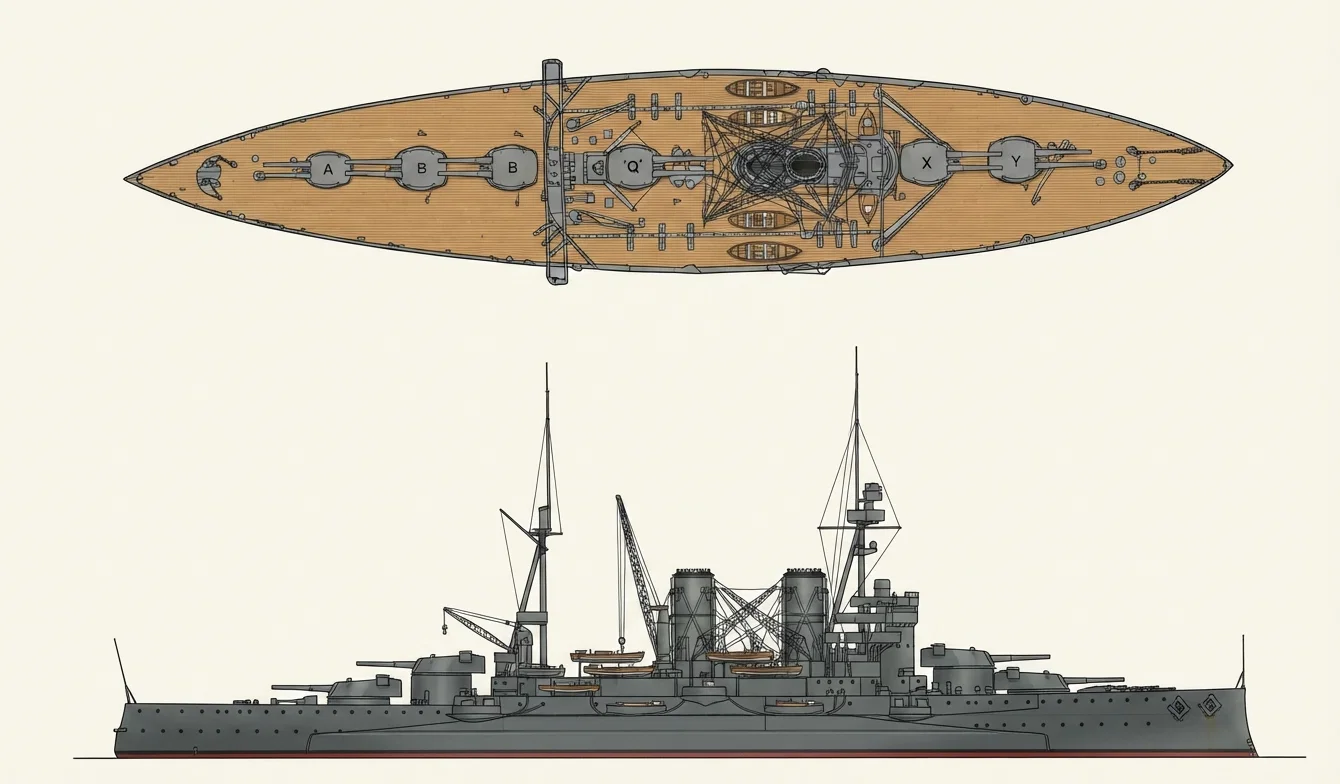
Plan of latest English Dreadnought, the Orion. All the turrets are on the center line. All can be used in a broadside. This is the first battle-ship so equipped.