MOKANSHAN: How good the word sounds. To all missionaries in Shanghai and vicinity, it means a haven of rest. It means pure, fresh air, and cool mountain breezes, in contrast to the disease-laden atmosphere and terrible heat and suffocating humidity of the plains during the months of July and August. It is a feast for the eyes to behold the beautiful mountain scenery and delightfully graceful bamboo trees, after having been shut up for a year with the repulsive sights and sounds and nauseating smells incident to a Chinese city. It is a place where tense nerves relax, and tired bodies find rest and recuperation, an atmosphere which encourages quiet communion with God and nature.
There are two ways of reaching Mokanshan from Shanghai. One way is to go in a house-boat all the way to the foot of the mountains. This requires two days, and is a very convenient way to travel when it is desired to take much baggage, as the house-boat can store away any amount of luggage and provisions.
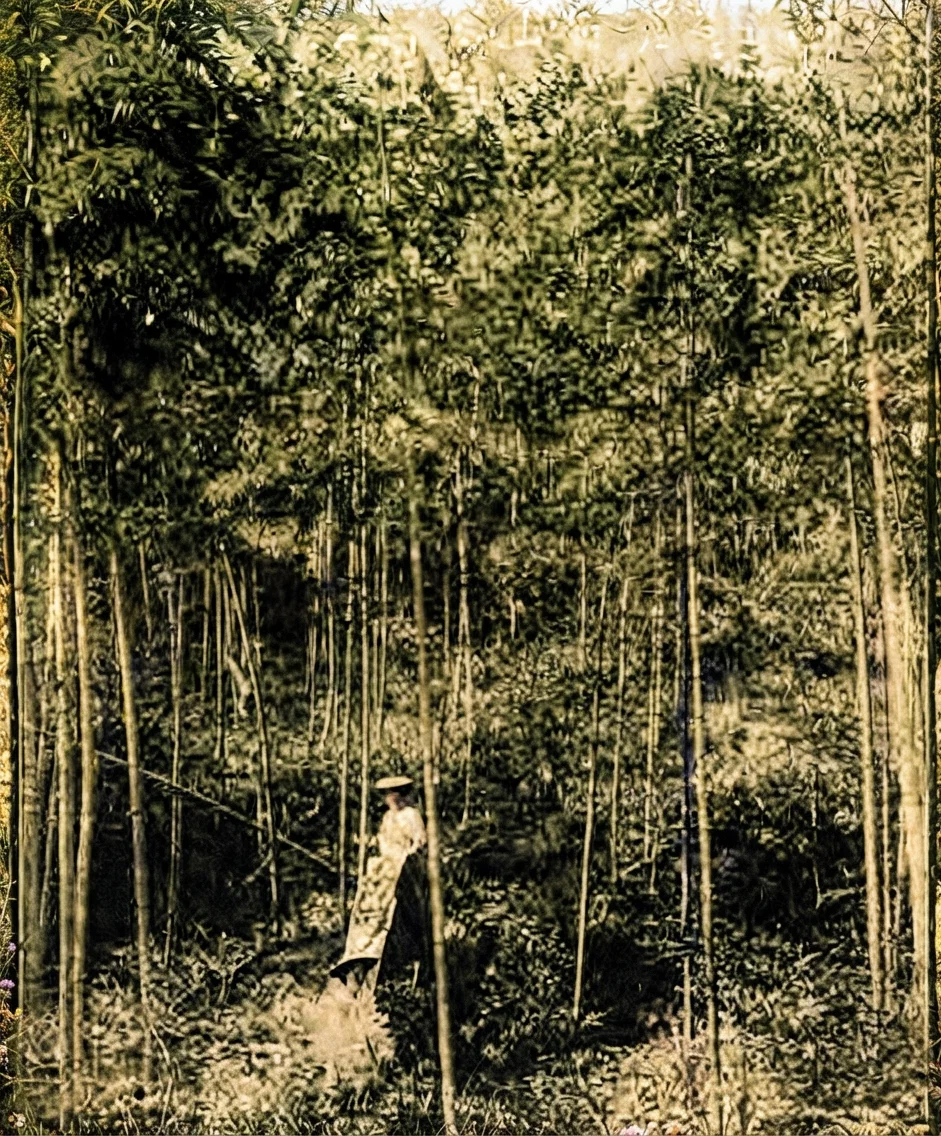
This gives a fine idea of a bamboo grove. Note the luxuriant growth of the foliage underfoot, and the sparkling effect of the sun shining through the tree tops. Beautiful wild flowers grow here in abundance.
The other way is to make the first part of the journey by rail. As we were fortunate enough to rent a furnished house on the mountains, and did not have to take much baggage, we chose the latter way.
Leaving Shanghai about noon, a half day's ride brought us to Hangchau, the "City of Heaven," with its picturesque surroundings and beautiful "West Lake."
This railway line has only been in operation one year, and is the only one in China which has American locomotives and coaches. We found the accommodations first-class in every respect, tho all the engineers, conductors, and brakemen are, of course, Chinese. Between each two opposite seats is a small stationary table; and as soon as we were seated, the Chinese porter came in and placed thereon a teapot of tea and four teacups. A few minutes later a coolie came in bearing a basket of steaming towels, which he handed out to every passenger to wash their face and hands. This luxury we decided to forego, not being sufficiently naturalized to enjoy washing with a second-hand towel.
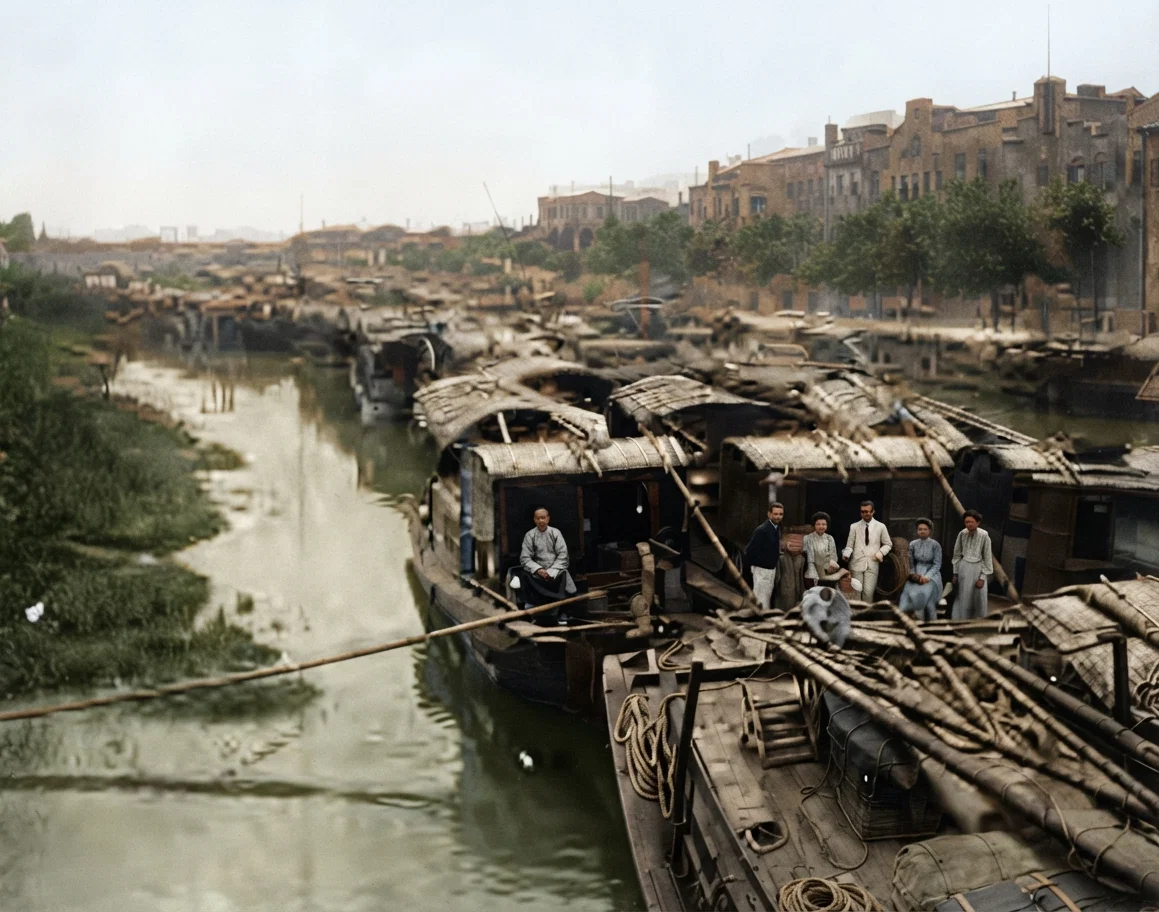
This is a picture of a string of house-boats on Loochow Creek in Shanghai. The launch steams along every day, and picks out those that are ready to go. The center boat shows a party ready to start for Mokanshan — Brother and Sister Westworth and Paul Westworth, Dr. and Mrs. Larsen, and Mrs. H. H. Winslow.
They have no dining-car attached, but serve meals on the individual tables by each seat. They will cook either Chinese or foreign style, and we found, they served a very good meal for one dollar Mexican, which is about forty cents United States money.
This ride is immensely interesting, as the train passes through a farming district, where we observed the primitive methods of agriculture, which are often very amusing.
The district through which we passed is one of China's greatest silk producing centers, and we saw miles and miles of flourishing mulberry-trees, the leaves of which form the food that sustains the cocoon during its silk producing period.
The vivid green foliage of these trees, intersected by hundreds of small square plots of rice, which is a brilliant yellow color when first sprouting, with an occasional field of red clover, or small orchard with pink and white blossoms, gives a kaleidoscope color effect which is very pleasant; while the native houses of mud with thatched roof of rice straw, the ancient pagodas and temples, the innumerable grave mounds mossy with age, and everywhere present the half-clad natives, men, women, and children, all working in the fields, or the women on their knees washing and pounding their clothes on the smooth stones by the side of the canals, and the men plowing their rice fields with the aid of a crooked-stick plow and the water-buffalo,—all combine to give a charm to the scene which makes it long to be remembered.
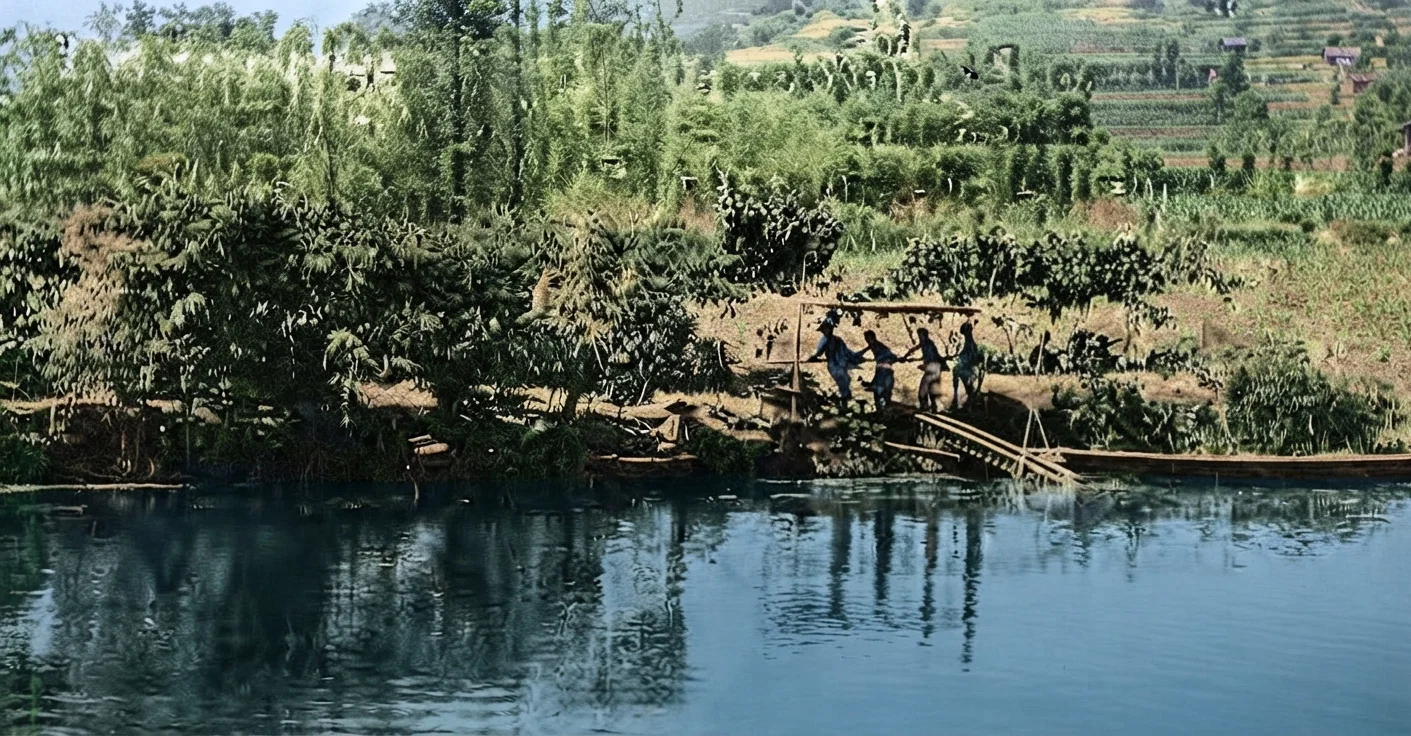
This is a chain paddle pump operated by foot-power. The main driving-shaft has a number of spindles, which form steps for the coolie to climb on, thus propelling the machine.
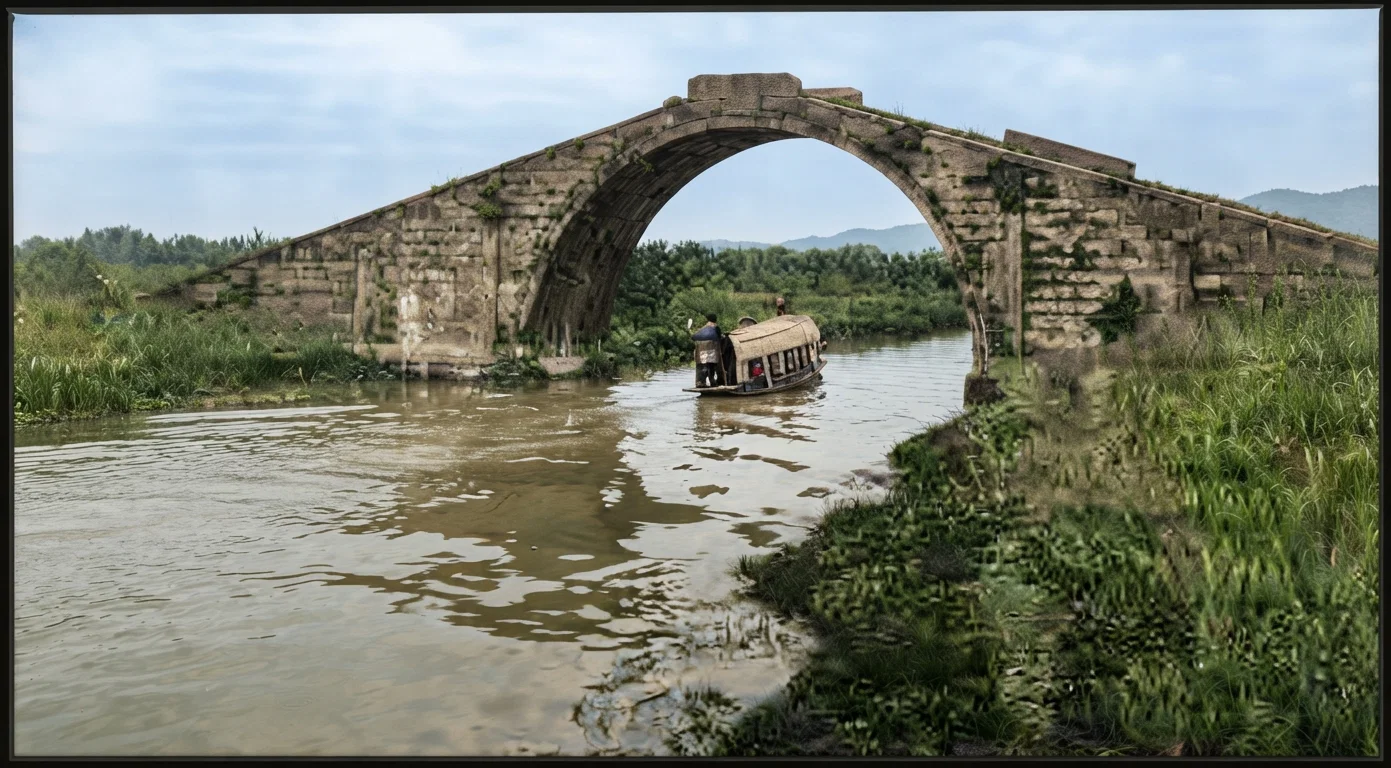
This is a sample of the numerous bridges we pass under. Wider canals have three arches built high in the center to allow high masted boats to sail under.
The country is densely populated, many walled cities being passed en route. At every station where we stopped, great crowds came down to the fence surrounding the station (They are not allowed on the platform without a ticket), and gazed with great curiosity on the "fire wagon," which is the literal translation for the Chinese name of a train.
Arriving at Hangchau we were besieged by the owners of various boats; and selecting a small boat-house, we transferred our baggage, and storing most of it under the floor, thus giving us more room to move about, we started on the next stage of our journey.
We were traveling on one of the innumerable canals which form a network all over the plain country of China; and while the trip on the train was interesting, we found the boat ride to be much more pleasant.
The boat is propelled by a scull, which also acts as a rudder in the hands of the experienced boat-man. In the case of large house-boats they are usually hitched to a steam launch, or pulled along with a tow-rope by coolies walking on the bank.
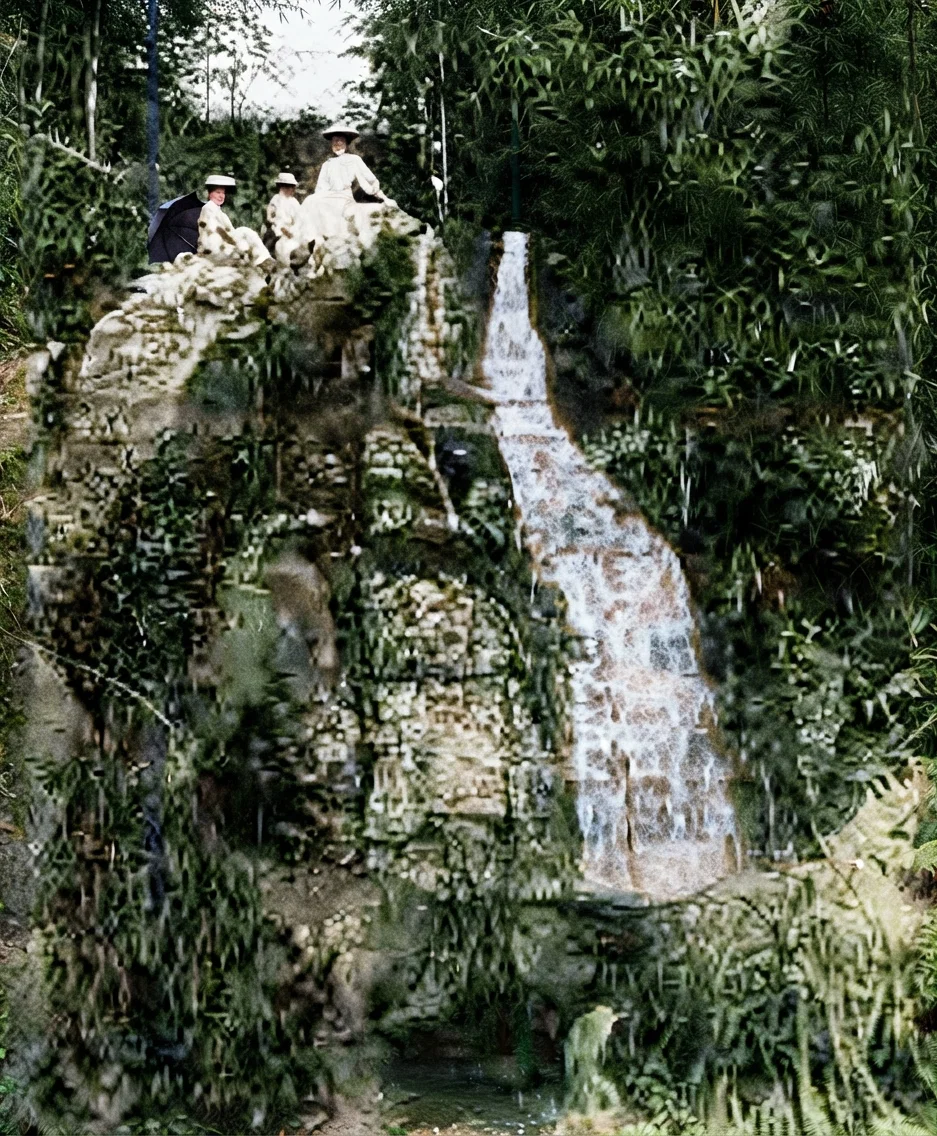
This is a view of the falls at Mokanshan — a poor view, and does not do the place justice.
We were soon attracted by a churning sound in the water, and noticed that on either bank could be seen the familiar chain and paddle pumps, which are the main reliance of the farmers for irrigation of their rice fields. Some are driven by the patient15buffalo, blindfolded, trudging round a never ending circle, while others are given the necessary impulse by men, women, or children, climbing the spindles arranged about the driving-shaft.
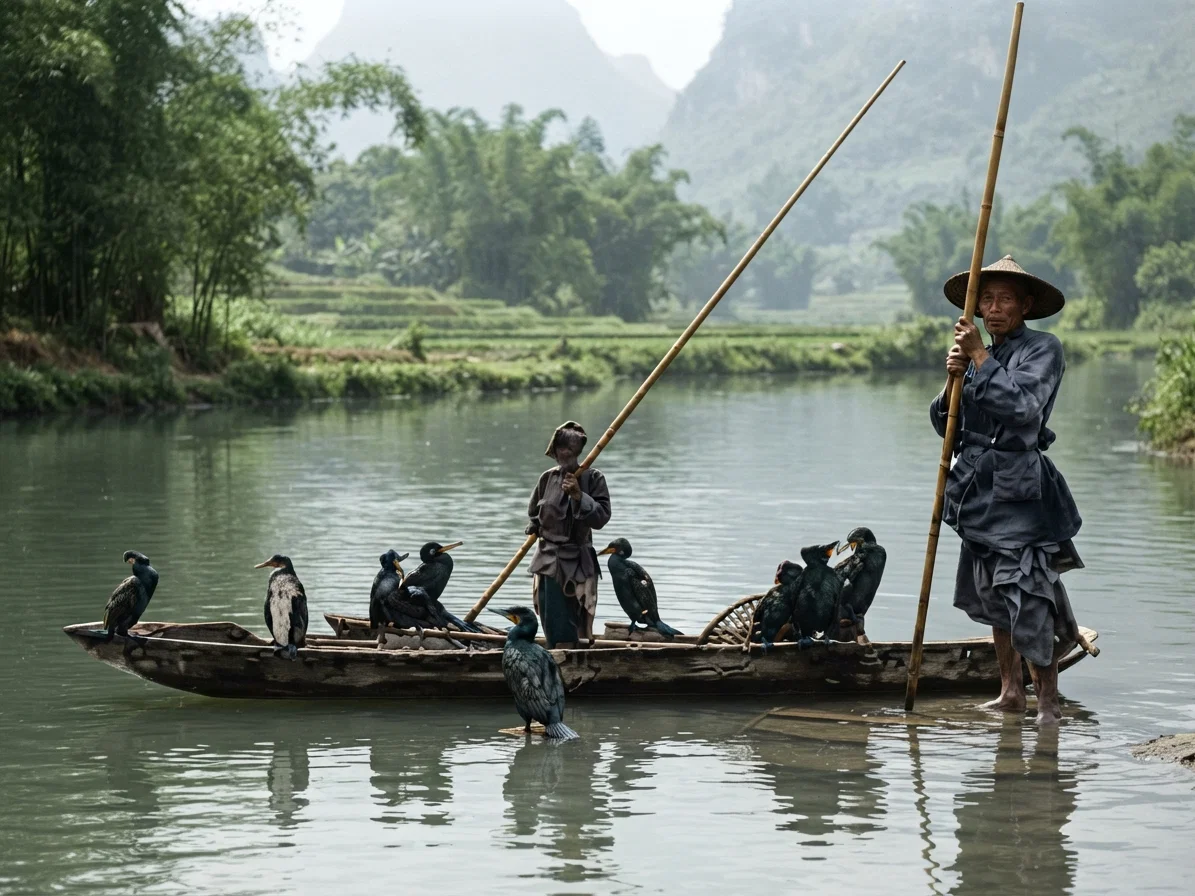
A fisherman with his flock of trained cormorants
Alternating with the pumps were huge stand dip-nets, so large in fact that it is quite a task for one man to operate the bamboo pole which lifts them, and it would seem that a few of them would clean up all the fish in the canals.
Occasionally we passed a small boat on which were a row of black fishing cormorants. These birds are about the size of a large chicken, and they stand on the edge of the boat, looking very wise, with their attention fixed on the water. Every little while one will dive, and come up with a fish in its mouth. The fish is promptly deposited in the bottom of the boat, and the bird is then ready for another dive.
Some of the most interesting sights on the canals are the arched bridges under which we pass. These arches, common all over China, circular in form, and with no prominent key-stone, are in many cases fine examples of the stone-mason's skill. They are a puzzle to all modern engineers who have seen them; and yet here they stand, large slabs of stone defying the laws of gravitation and balancing themselves in mid-air. Some of them have stood now for hundreds of years, and seem to be good for many more years.
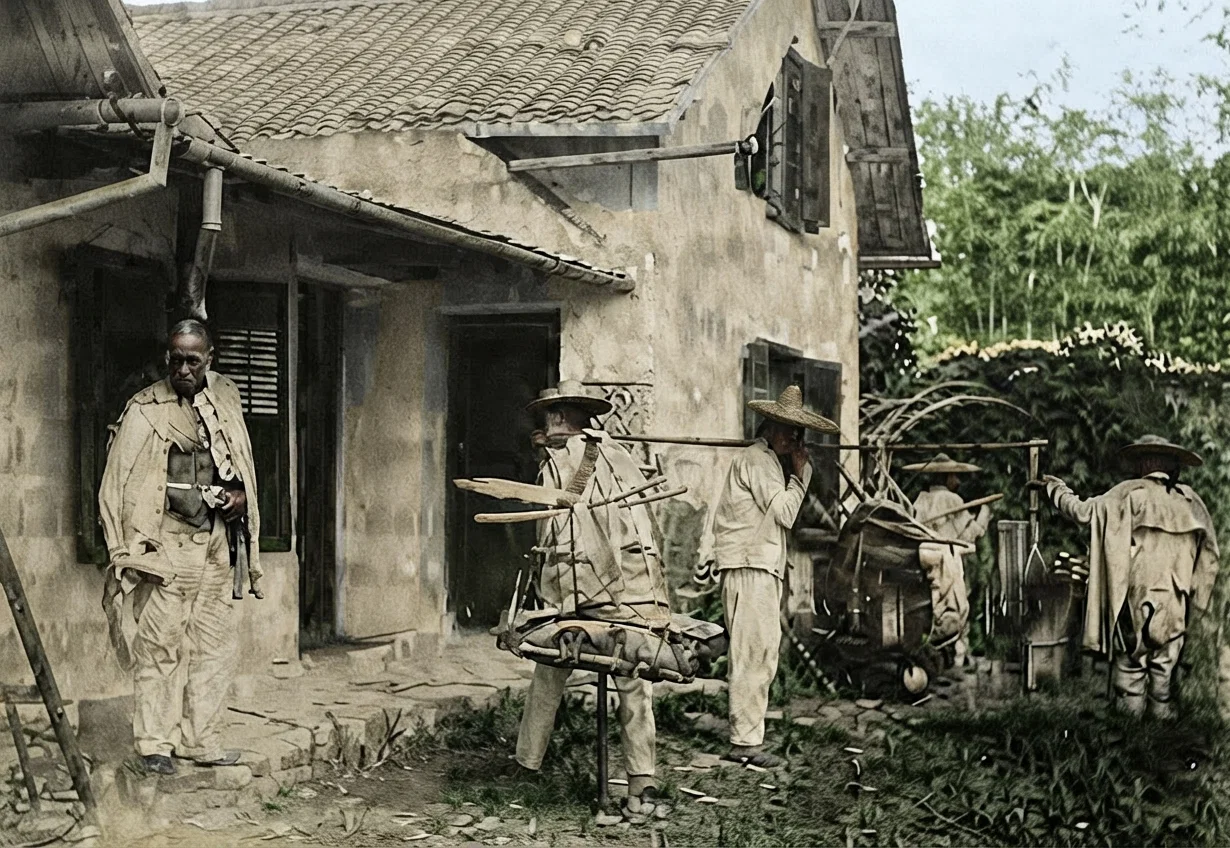
Coolies starting out with our baggage when we left the mountain. The poles they use are split bamboo, very strong and springy. This shows the house where Brother and Sister Roberts and ourselves lived this summer.