SLEEPING SICKNESS is known to be propagated by the species of tsetse fly known as Glossina morsitans. In this family of African fly there are three common species, the other two being called G. palpalis and G. fusca. Since the appalling spread of this disease over Uganda a few years ago, where in some districts of that country it is said more than two thirds of the population were swept away, more than 200,000 dying there, the disease has been the subject of investigation by many scientists and physicians. The most alarming thing about it is the very few facts that have been established concerning its nature. Really, what is not known about it may be said to be more alarming than what is known. Beyond knowing that there is no recovery from its attack, and that it has no discovered remedy, little is really established.
When a man with a family of children awakes in the night with the dying cries and struggles of one of his loved ones, his first terrified question is, "What is killing my child?" Many missionaries and doctors of Central Africa are asking that question concerning their adopted children of these African wilds. The eminent missionary and scientist Robert Laws, M.A., D.D., M.D., F.R.G.S., of Livingstonia, for thirty-five years resident here, asks the simple but agonized question, "Can anything be done to prevent the terrible results so easily foreseen?" In the last issue of the monthly Livingstonia News, Dr. Laws says further: "In our last issue we had to chronicle the infection with this disease of one of our trusted native helpers, Noah Chiporopo; and now his death in the mission hospital at Karonga has to be recorded. Noah's illness was followed soon by that of his companion teacher Yohane, due to the same disease. . . . Almost simultaneously with Yohane's case, a native living between Mvera and the lake shore was found by Dr. Murray to have contracted the disease. Then came the startling news that the Rev. Paul Roux of Beaufort West, Cape Colony, who had come as a visitor to the Mvera conference, had contracted the disease while in the tsetse area along the south part of the lake shore."
The bomb which caused the explosion was not loaded for great destructiveness. It was of brittle cast-iron with two cavities, one filled with fine-grained black powder, a little less than four ounces; the other with small iron projectiles to be hurled in all directions by the explosion.
Over seventy Europeans were attending the mission conference mentioned by Dr. Laws, and it is not improbable that others were also infected. Several others were with Mr. Roux when he was bitten by the fly, supposed to be G. morsitans, which is common in many parts of Nyasaland. My wife met Rev. Mr. Roux in Blantyre, and had a number of conversations with him. She took special interest in him, as she noticed that he was rather an old gentleman, and not much noticed by people at the hotel. She will never see him again. The disease develops very rapidly with Europeans. Two others, both doctors, have contracted the disease in Nyasaland, and each died within a few weeks.
Dr. Laws further says: "It is with regret that we have heard of eleven other cases of the disease having been found, and of deaths having occurred frequently during the last eighteen months. . . . Moreover, during the past few years, a good many deaths of natives have occurred among those who have been at work in the Kambovi district, while returning to their homes near the lake [Nyasa]. . . . The question arises how many such patients have become foci of infection the results of which are as yet unknown."
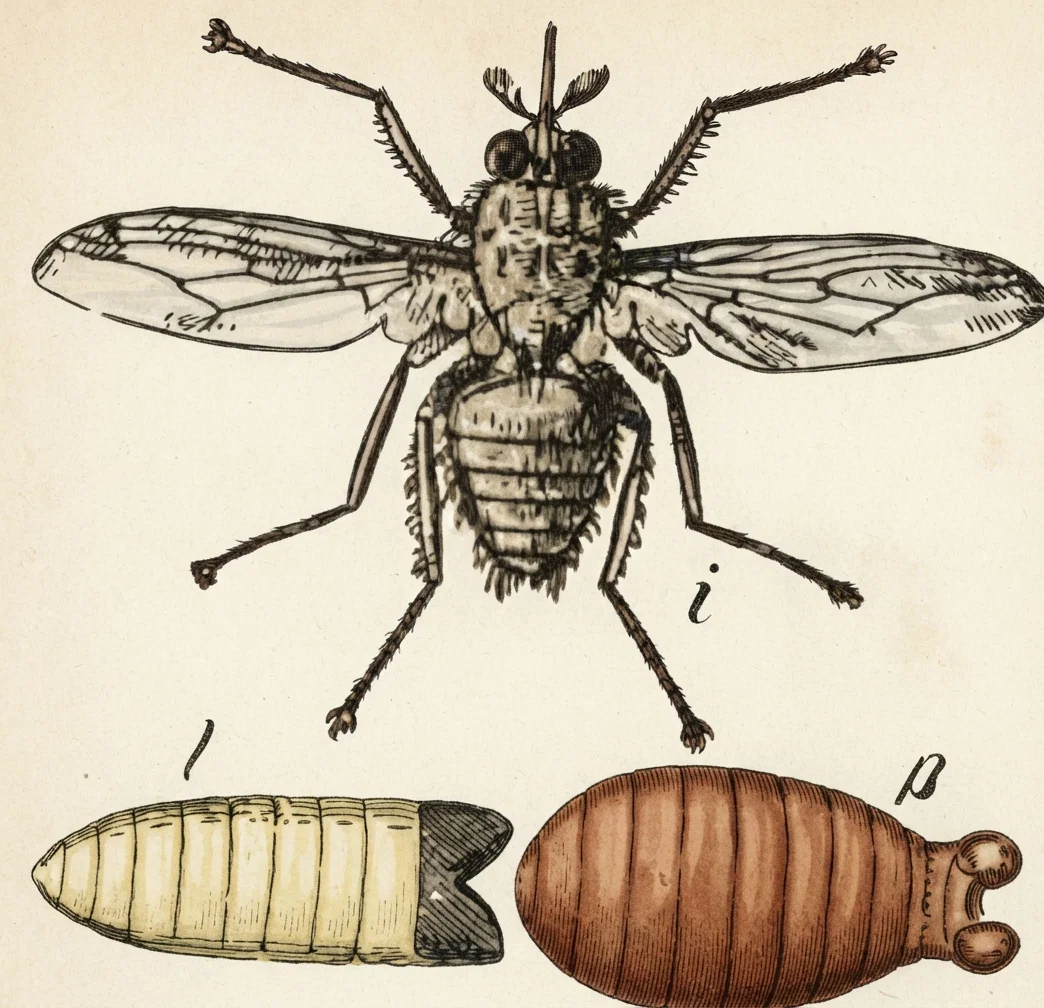
Tsetse Fly. l. Larva; p. Pupa; i. Imago
The tsetse fly belongs to the family of the Muscidae, as does the house-fly. This species, the Glossina morsitans, is confined to South Africa. It is about 5/8 of an inch long, with about the same spread of wing. It is a blood-sucker, and it is believed leaves a parasite in the wound, similar to the work of the malarial mosquito. It is not harmless to man, as it was once supposed to be.
How long will the inhabitants of this earth last before plagues like this which have no remedy?