KOREA, the "hermit nation," the land of mystery and of demon dancers, one of the darkest and least known countries, is now one of the most interesting of mission fields.
Korea tried to shut itself away from the world, like a hermit in his hut. Its coasts were patrolled to keep out the foreigner. Cities and villages were laid in ruins along the Manchurian border, in order to make a wide waste, more easily guarded.
But the day of opening doors came, and Korea's long-barred gates were swung ajar. The treaty of 1882, with the United States, permitted foreigners to enter. In 1884 the Presbyterians planted the first mission. Even before this, however, the Scriptures had entered, and the Word of God was bringing forth fruit.
A missionary in Manchuria, John Ross, of Mukden, sent a Chinese servant to the border towns to seek for a Korean who would teach him the language. It was a hard quest, for Korean laws forbade such intercourse with foreigners. One day a Korean merchant had his barge of goods sunk in the Yalu River, and landed on the Manchurian side a ruined man.
Just then the missionary's servant arrived, still looking for a teacher. The merchant engaged himself secretly, and the result was the translation of the New Testament into Korean.
Another providential "accident" then brought a Korean to set the type. In the process, the typesetter became a Christian.
Before ever the full Testament was brought out, this man was set free to go back to his native valley in Northwestern Korea with a supply of the Gospel of Luke and a few tracts.
He came back with the books all sold, and word that people wanted baptism. His story was not credited; and again he was sent out to other valleys with the printed Gospels. Erelong wandering Koreans brought word to Mukden that many people in Korea were praying to the "God of heaven."
Then the missionaries scaled the mountain passes and entered these valleys. Scores were found anxious for baptism, and hundreds were reading the Scriptures and praying. Later came the opening of the country, and fruitful mission work was begun in Seoul, the capital.
Our First Korean Call
The director of our Japanese mission, Prof. F. W. Field, had called for special prayer among our societies for Korea, to us an "unentered field." We little thought, at the time, that within two years companies of Sabbath-keeping believers would be calling from Korea for us to go to their help, and to send missionaries to instruct and lead them.
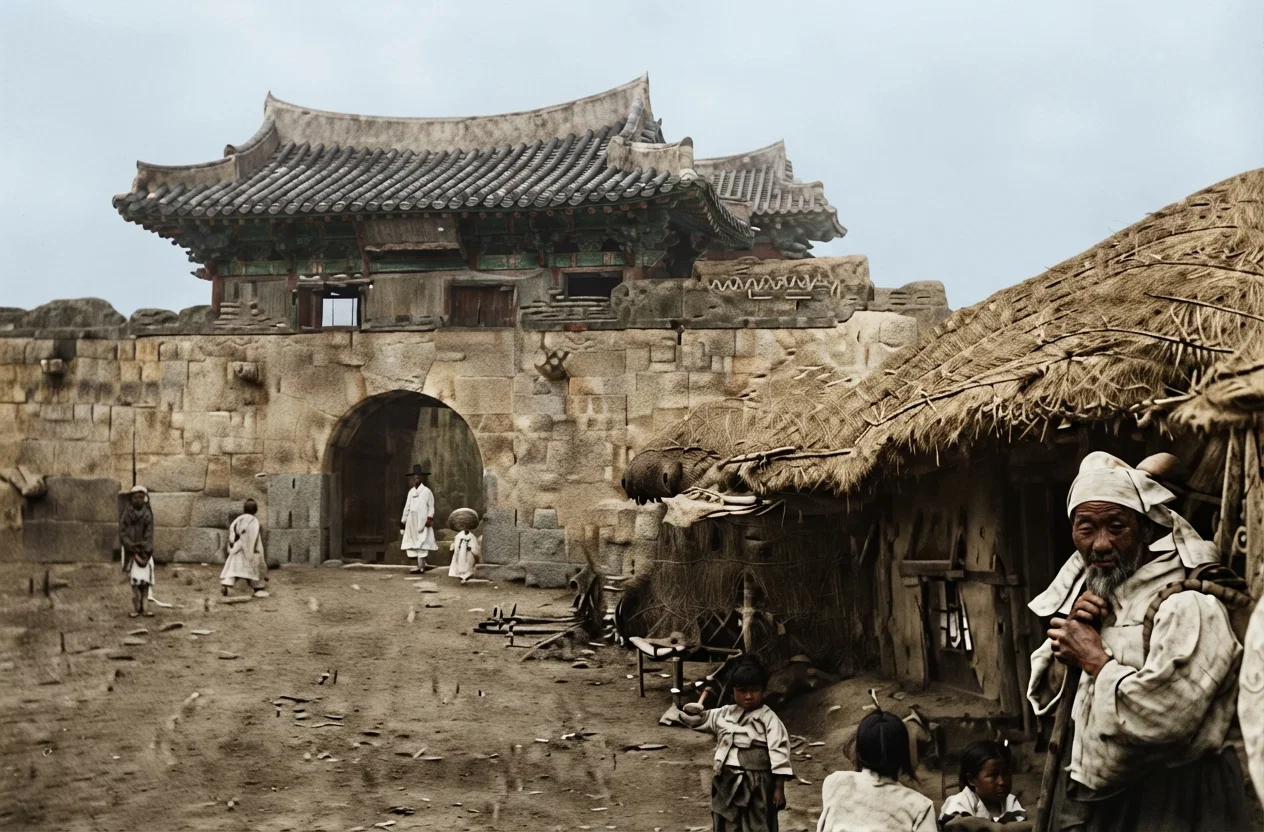
THE GATE AT FORAI, KOREA
In May, 1904, a Korean passing through Kobe, Japan, stopped to study a sign, written in Japanese and Chinese characters: "Meeting Hall of the Seventh-day Adventist Church." A brother within saw the stranger, and beckoned to him to enter. That friendly wave of the hand brought the first Korean to the study of the message of Sabbath reform and advent truth for which this movement stands.
It was a silent conversation, for they could talk only by writing in Chinese characters on a slate. The Korean could not speak Japanese, and none of our Japanese brethren could speak Korean. Again the Korean came, bringing a younger man. Both were hungering for more light, and the truths of this message captivated their hearts. The last study, which was on baptism, lasted till midnight. The older man, Ryn Un Hyun, was to sail in the morning, and with tears our first two Korean Sabbath-keepers begged for immediate baptism.
By the light of paper lanterns, after midnight, they were buried in baptism in a pool, below the Nunobiski Falls,—the older to go on to Hawaii; the younger, Song Fun Cho, to return to Korea.
On the return passage Song Fun Cho taught the new-found truth to another Korean journeying to Chinnampo, on Korea Bay, across from Port Arthur. The light spread in the region about Chinnampo. Then came this message to Kobe:
"Dear Brother: When you read this, hasten to take a boat and come to us. In your letter you wrote that you can not understand our language; but if God is with you, why need you fear?"
Then our Kobe preacher, Elder Kuniya, went over, and later Professor Field, director of the Japanese mission, followed. Seventy-one persons were baptized in the brief fortnight's visit, four churches were organized, and the Sabbath truth was "spreading like a blaze," they reported. This was their method of work:
"Elder Kuniya talks the little Korean that he has picked up, and what little Japanese the Korean brother knows, with an occasional English word. When words fail, he writes on a slate in Chinese characters. Then Brother Lim Ki Pan speaks to the inquirer in good Korean."
But notwithstanding all, the Word of God had free course and was glorified. No wonder the brethren reported that "this message is let loose in Korea," and called for a missionary to locate there.
Thus we were called to Cho-sen, as its people call it, which means the Land of Morning Calm.