DID we not know the history and age-long principles of the Roman Catholic Church, the recent great meeting, held the second week in November, in New Orleans, could be passed with little notice, simply as a great meeting of a great religious body. It means more, however, than the Methodist Episcopal convention or the Presbyterian convention. It is a religio-political convention, rather than religious, for the Roman Catholic Church is seeking the conquest of the world; not only the conquest of the world spiritually, but the conquest of the world politically.
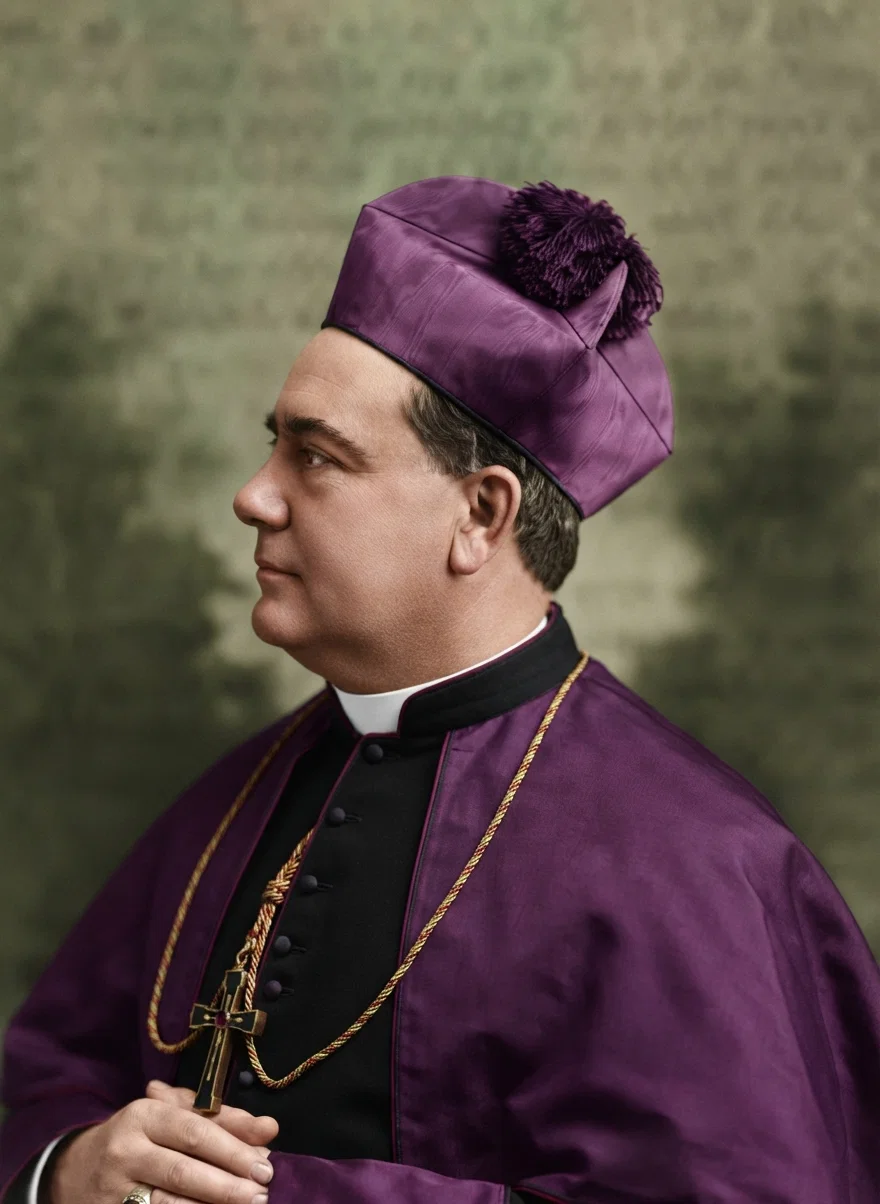
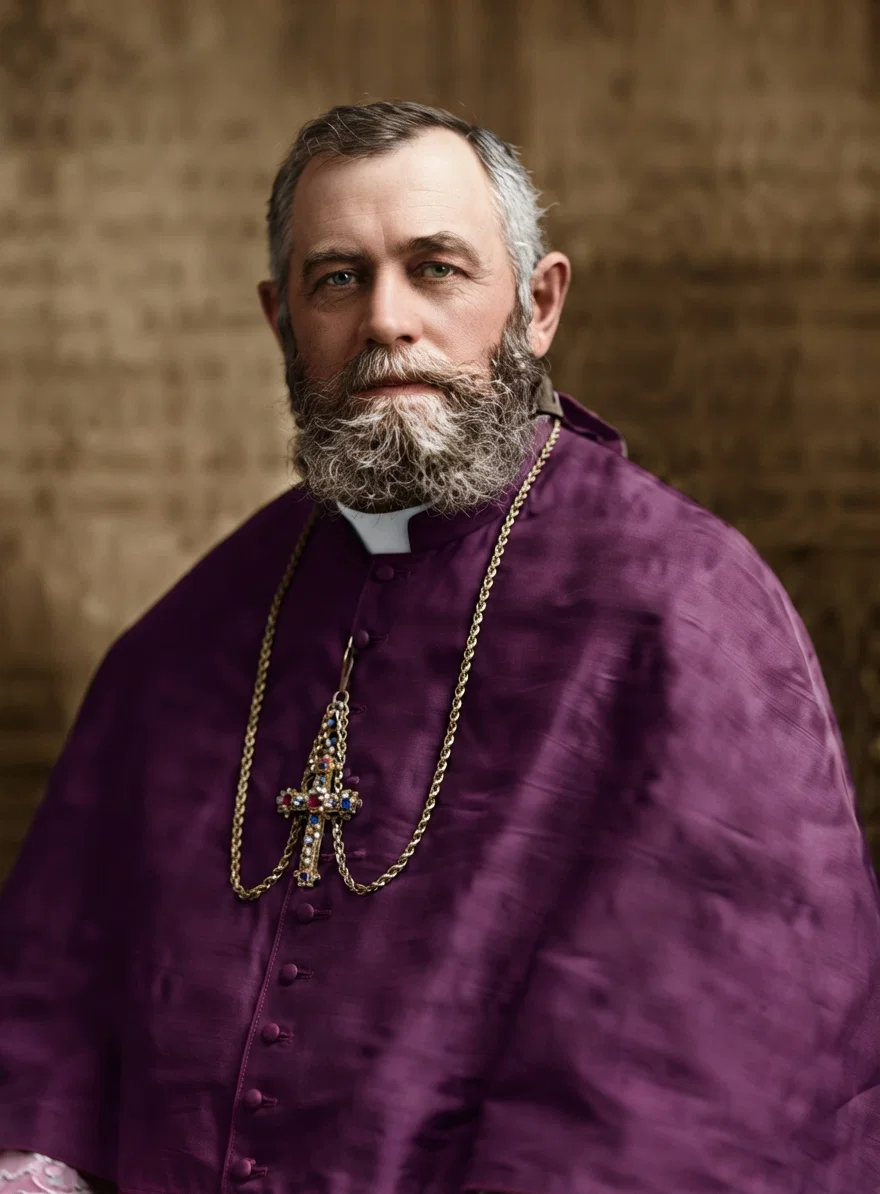
Bishop James A. McFaul of Trenton, New Jersey
The meeting in the old Southern city was indeed a great one. No building in New Orleans could accommodate the throngs that poured into that city, and great overflow meetings were held in various parts.
The meeting was opened in the ancient St. Louis Cathedral on Sunday, November 13, with pontifical high mass. The celebration was held in the old Cabildo, in colonial days the place of official business of the government. There was present Mgr. Falconio, apostolic delegate to the United States, and direct representative of Pope Pius X. The whole program was carried out with all the magnificence and ornate display of the Middle Ages, and certainly must have had a tremendous effect upon the minds of those who are impressed by such spectacles.
Items of Interest
The national secretary of the American Federation of Catholic Societies presented in his report the following items which will be of interest to our readers (our authority is the Roman Catholic daily, the "Morning Star"):
That the federation has now been practically introduced into every state in the Union, Hawaii, Porto Rico, and Alaska.
That more thoro organizations — state, diocesan, and county federations and leagues — have been established in the following states and territories: Arkansas, California, Colorado, Illinois, Indiana, Kansas, Kentucky, Louisiana, Maryland, Massachusetts, Michigan, Texas, Minnesota, Missouri, New Jersey, New York, Ohio, Pennsylvania, Vermont, Wisconsin, South Carolina, Connecticut, Porto Rico, Hawaii, and Alaska.
That twenty different colleges and institutions are affiliated with the federation.
That sixteen national organizations, such as the Catholic Order of Foresters, Knights of America, Ancient Order of Hibernians, Young Men's Institute, are affiliated with the federation. The Knights of Columbus still hold out.
That twenty archdioceses and dioceses with an aggregate population of over 7,000,000 were reported at the last convention by special delegates appointed by the respective bishops. This shows us some of its tremendous issues.
Some of Its Objects
Some of the objects for which it has been working and in which progress is reported are the following:
The strong propaganda against Socialism, especially in keeping Catholic men from joining the Socialist party. He pleads that "our societies everywhere keep up the fight against Socialism, which was born in the brain of atheistic agitators, and which, if permitted to gain a foothold, will bring on a state of revolution and bloodshed." The agitation of the federation, however, has not seemed to affect the standing of the Socialist party during the last two years.
A propaganda in favor of divorce laws along the line of the religious views of the body. The secretary tells us that a divorce bill introduced by Sir Walter George Smith of Philadelphia, a member of the executive board of the American Federation of Catholic Societies, has been adopted in Delaware, Wisconsin, and New Jersey, and is practically a law in Illinois. The "Sir" is a society title.
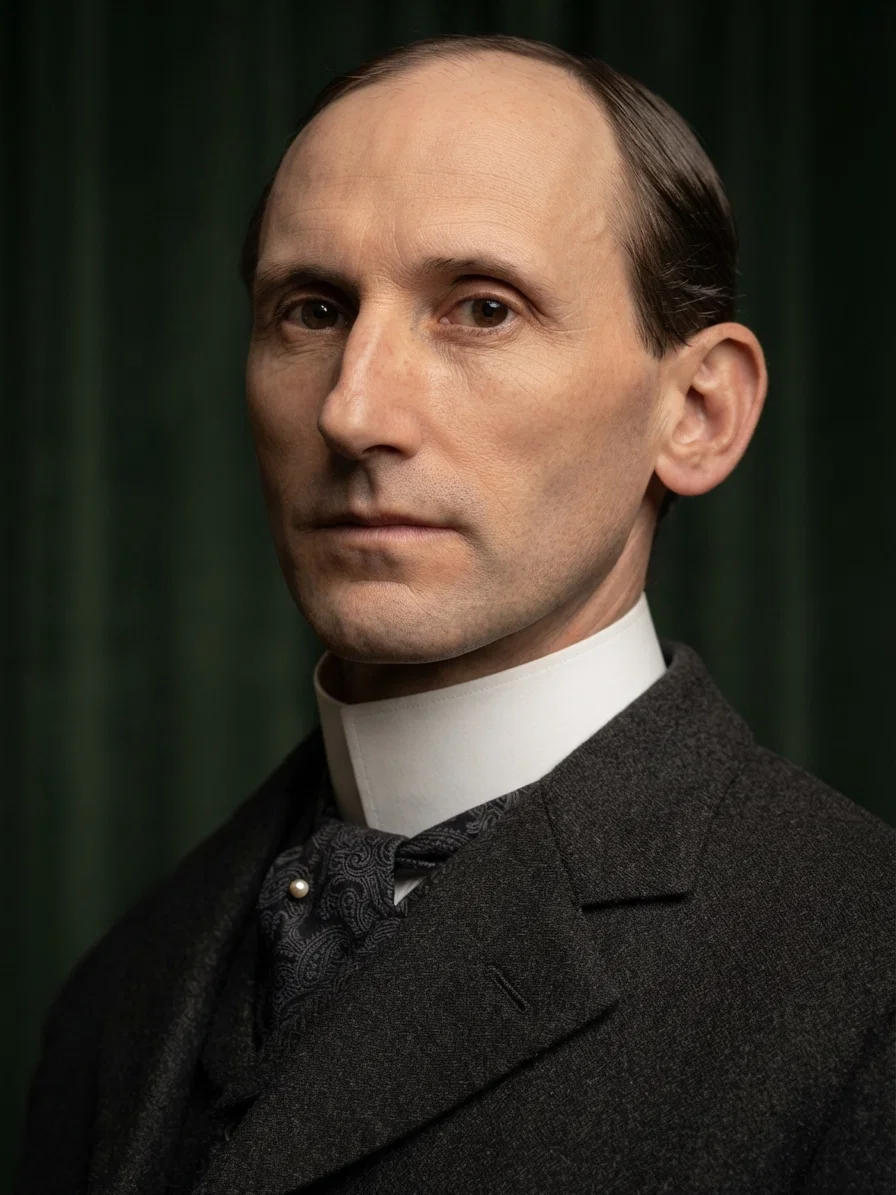
Anthony Matre, National Secretary American Federation of Catholic Societies
The federation is working against the white slave traffic. There are other organizations working just as strongly.
The secretary further reports that "several of our branch federations have taken decided stands against the desecration of the Lord's day." Notably among these are federations in the states of Pennsylvania, Massachusetts, Louisiana, and Wisconsin. Doubtless the federation would stand with the Protestant Church Federation in a demand for Sunday laws. A part of its work for Sunday laws, however, has been done in a perfectly legitimate way, and that is by requesting employees of labor to discontinue voluntarily Sunday labor.
The federation has been carrying on a crusade against immorality, indecent theatricals, post-cards, etc. The crusade against immorality, etc., seems to have been inspired by certain books antagonistic to Rome. Several of these books are mentioned, books, however, which can not be forbidden the mails under present laws, and are not evidently immoral in the ordinary sense of the term, but are antagonistic to Catholic views.
A crusade against monks, priests, and hierarchy. This effort has been carried on by direct communication with editors of papers and publishers whose papers have offended the officers of the federation.
Watching Periodicals
7. The secretary reviewed the Ferrer case and "McClure's Magazine," in which exception was taken by Roman Catholics against an article by Mr. Percival Gibbons, and an apology demanded. As a result of this the federation was asked to set forth the true Catholic view, the result of which was the article entitled "An American Catholic's View of the Ferrer Case," by Mr. Andrew Shipman, a Catholic attorney of New York, which appeared in the October issue. The secretary remarks, "After all, McClure has learned that it does not pay to insult Catholics, and the publication of Mr. Shipman's article may be considered somewhat of an amends to the insult heaped upon the Catholic Church in the article of Mr. Gibbons." This article is followed in "McClure's" by other articles by Mr. Archer, and the secretary tells us that the organization is investigating these.
The St. Louis federation caused, through its protest, the immediate suppression of an advertisement which appeared in a St. Louis daily paper advertising an anti-Catholic story; that exercises of public schools in Protestant churches in some places have been discontinued.
The organization is doing very strong work through its associated press department, in which the press of the United States is carefully watched, and prestige is brought to bear if anything antagonistic to Roman Catholicism appears.
A Hearty Welcome
The federation was welcomed to Louisiana by its governor, Jared Y. Sanders, in very warm words, and to New Orleans by Martin B. Behrman, mayor of the city. The proceedings were opened by Judge Caillouet. The address of the apostolic delegate was upon the subject of Capital and Labor, in which he declared that the only "sovereign remedy was found in the Holy Catholic and Apostolic Church;" but in his solution the one fundamental principle which he had to present was the Golden Rule, which certainly belongs to the12individual and to any religious organization as truly as it does to the Catholic Church. He pleaded with both classes to accept society as it exists, composed of "superiors and subjects, masters and servants, rich and poor, learned and unlettered, nobles and plebeians. The real question after all is, If all men should accept the Golden Rule, would many of these orders and classes now exist?
Its Long Heritage
Archbishop Blenk preached a stirring sermon on the review of the wonderful heritage of the Roman Catholic Church through all the centuries of Christendom, and then presented a picture of Pope Pius X, upon whom were hurled the insults and abuses of Mayor Nathan of Rome, and appealed to the Catholics of America "to tell him [Mayor Nathan] that as long as Catholics have any force in their arms, as long as there is any strength in their wills, as long as their hearts are filled with love (and please God these things will never be wanting to them), America will never suffer the greatest representative, the spiritual representative of eternal power, to be insulted, to be abused, to be mocked as if he were the veriest criminal. We will not tolerate this." And then Archbishop Blenk moved a protest against the action of the mayor of Rome, which was seconded and carried amid tremendous applause, and cheer after cheer was given for the pope, and also three groans for Mayor Nathan of Rome.
It may be well for our Catholic friends to remember that He whom they claim to represent suffered far greater indignities than Pope Pius X ever could, that He was treated and branded as a criminal, and that He died as such; and that when he whose successor the pope claims to be, assumed to lift his strong right hand in defense of the Master, he was rebuked, told to put up his sword, and warned against its future use. A little later, when that same ardent Peter received the Spirit of God, he could say of the Master whom he unwisely sought to defend by earthly power: "Who, when He was reviled, reviled not again; when He suffered, He threatened not, but committed Himself to Him that judgeth righteously."
He who has faith in God, and believes his cause to be of God, can certainly commit it all into God's hands, and know that it will be well. He certainly will not arouse and inflame the minds of millions against a human enemy, real or imaginary; rather he will pray with the Master, "Father, forgive them; for they know not what they do," echoed by the words of the protomartyr, "Lord, lay not this sin to their charge."
Bishop John D. Morris of Little Rock, Arkansas, reviewed the subject of progress from the very beginning of the church's history, and showed how these organizations had strengthened the church and revivified it in times of weakness. Among the societies which he especially extolled was that of the followers of Ignatius Loyola, the Jesuits, and he concludes that if these strong organizations had been known in Germany and England in the time of the Reformation as in America today, these great countries would never have become Protestant.
Loyalty to God's Law
One of the great addresses of the occasion was that of Bishop James A. McFaul, of Trenton, New Jersey, on the laying of the cornerstone of Marquette University. Taking as his text the question as to the great commandment in the law, the bishop remarked: "You may ask why I should emphasize the Ten Commandments, the moral law, on an occasion of this kind. I answer, Because it is the obligation and duty of a Catholic university to inculcate not only secular knowledge, but to be a great factor in dissemination of religious doctrines, and to form a bulwark for truth and a barrier against irreligion and error."
That is a splendid utterance without question, and if the Roman Catholic Church stood for that, it would indeed be a mighty bulwark against the unrighteousness of the world at this time; but while professing to stand for the great fundamental moral code of God, it has put forth unholy hands and changed the fourth commandment of that code. Tho God says, "Remember the Sabbath day, to keep it holy;" "the seventh day is the Sabbath of the Lord thy God," the Roman Catholic Church says, "Remember the Sunday;" and it has by that very act assumed to place itself above the Lawgiver, and declared to all the children of men that no law of God is so sacred but that man might change it. If their great prelates and scholars could but drink deep of these simple principles, they would not wonder that anarchy had followed the church's teaching for centuries. The study of these simple principles would also show them that it mattered not what prestige of centuries was their heritage or how long the papal prelate occupied the papal chair; this heritage is nothing, in the sight of God, tho it be upheld by all the hoary traditions of the past. God is able of insensate stones to raise up children unto Abraham, and that is worth all the traditions of the ages.
The president, Mr. Edward Feeney, gave an address which followed along the same line as that of the secretary's review of the work of the federation during the last year. He declared that the federation would still work for the purpose of inducing the state to pay for the secular education provided for children in Catholic free schools. Mr. Feeney declared: "We want to continue the work of the federation in amity with all our neighbors, and we welcome the cooperation of our separated brethren in our labors for the moral and social uplift of all the people." That of course would include the union of Catholics with Protestants who are working for Sunday laws; in other words, an opening wedge for church and state union in America. The Catholic federation, even as the Protestant federation, has for one of its purposes the effecting of a political object.
Americans need to take home the warning written by an American of Americans, Mr. R. M. Johnson: "Extensive religious combinations to effect a political purpose are always dangerous." Would to God that the great professed Christian church, under whatever name, might turn to the Lord Jesus Christ for His truth and His power, and leave politics and the world forever. Much mightier would be their progress and much less the worship and extolling of the human.