[Kansas City, Mo., is the storm-center for a medieval Sunday law. The following from the Kansas City Journal of May 19 lucidly discusses the question]:
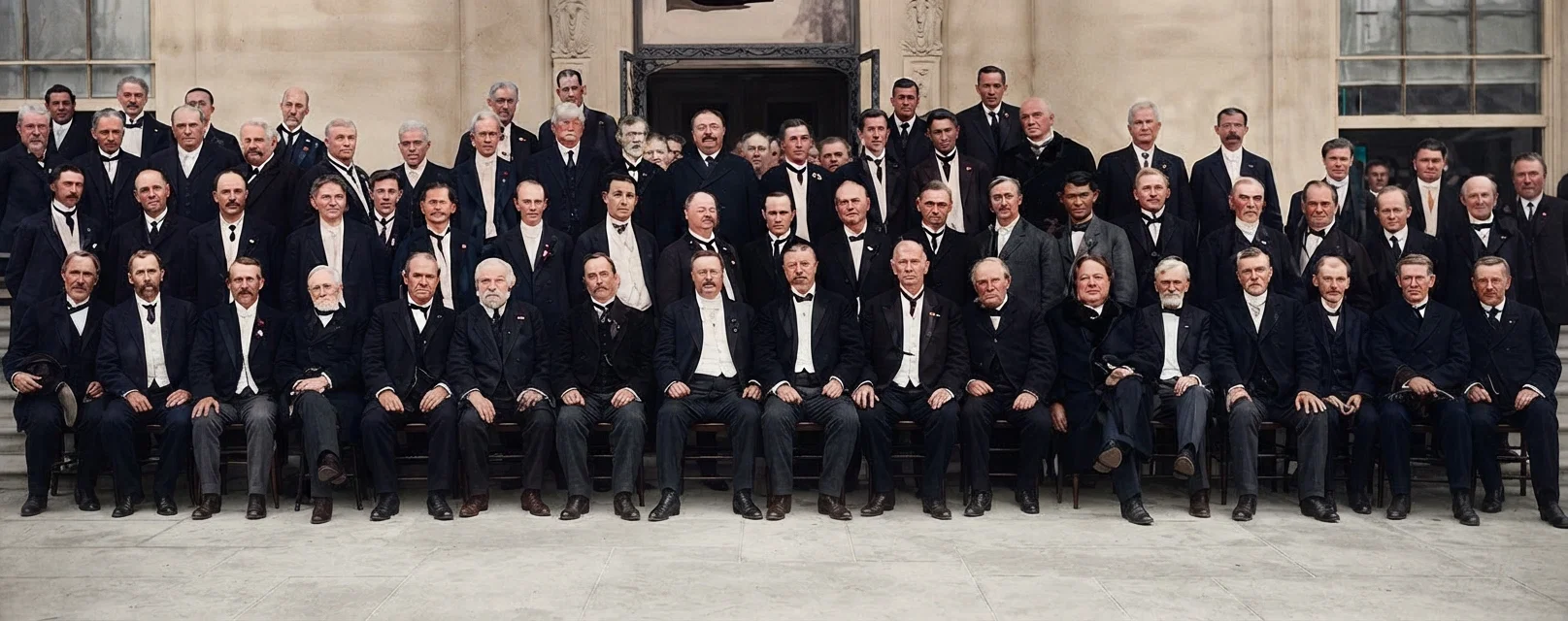
From Stereograph Copyright 1908, by Underwood & Underwood, N. Y. Photograph of Recent Governors' Congress in Washington, Including the President, Vice-President, Governors and Guests, Probably the Most Notable Group of Statesmen Ever Photographed.
IN all that has been said in the public prints concerning the Sunday-law enforcement crusade in Kansas City, the uppermost question has been,
"What is, and what is not, permissible on Sunday? What constitutes 'labor' on the 'Christian Sabbath' according to the act of assembly?" whereas, it seems to the writer, the larger question relating to the matter of Sunday laws ought to have been, and is:
Should Sunday as a religious institution be protected at all by civil law?
It was well stated, as early as 1829, in the memorable United States Senate report adverse to the discontinuance of the mails on Sunday: "Our government is a civil and not a religious institution. . . . The proper object of government is to protect all persons in the enjoyment of their religious as well as civil rights, and not to determine for any whether they shall esteem one day above another, or esteem all days alike holy."
In singular contradiction to the American system of government separating absolutely the respective spheres of the civil and the religious, we find the several states, with rare exceptions, requiring the people to accept, and to observe, a religious institution; and the grand jury of Jackson County is summoning certain Hebrew storekeepers before it, and demanding "in the name of the people" that Saturday or Sunday—one or the other—be observed as a day of rest. All know that the Jew observes Saturday solely for religious reasons: the Sabbath with him since the days of Sinai rests alone upon a divine command; and now that the grand jury is willing to accept—agreeably to the Missouri Sunday statute—the religious seventh day in lieu of the Sunday, it can no longer be claimed, in justice, that Sunday is a civil institution and that only, and its enforcement wholly a "local question of the police power of a state," designed for the physical and moral benefit of its citizens.
Sunday is a religious institution. To deny it is absurd. And upon the point of its compulsory observance by law, the same Senate report says: "If a solemn act of legislation shall in one point define the law of God or point out to the citizen one religious duty, it may with equal propriety proceed to define every part of divine revelation, and enforce every religious obligation, even to the forms and ceremonies of worship, the endowment of the church, and the support of the clergy." Congress is expressly prohibited by the Constitution from legislating upon the subject of religion, and the declarations of the various bills of rights of the states—with hardly an exception—acknowledge, and even enlarge upon, the same fundamental principle of government. James Madison wrote: "Religion is essentially distinct from government and exempt from its cognizance. A connection between them is injurious to both." George Washington clearly states the whole question of "unalienable rights" in religion, in a sentence: "Every man who conducts himself as a good citizen is accountable to God for his religious faith, and should be protected in worshiping God according to the dictates of his own conscience."
Protection of men in their equal rights—not enforcement of law-enshrined dogmas—is the desirable thing, to the end that the individual may enjoy the privilege "to worship God according to the dictates of his own conscience," and this should be the common denominator or collective of the state policy. The sovereign people should not leave to that inquisitorial relic of barbarism—the grand jury—either power or discretion to say to any man that he shall receive a religious institution of the people; that he "shall esteem one day above another, or esteem all days alike holy."
The danger—to the state—is not so much that of Sunday enforcement; it is, in fact, the larger and far more serious question of religious legislation. Sunday laws prove to be the entering wedge of a church-and-state system, the ecclesiastical dominating and speaking thru the civil institution. History furnishes an awful warning of the consequences of such a system; in the last analysis, the wreck and ruin of empires.
In 1848, in a religious-liberty convention in Boston, William Lloyd Garrison offered a resolution, which was adopted, as follows:
"Resolved, That if the Legislature may rightfully determine the day on which people shall abstain from labor for religious purposes, it may also determine the place in which they may assemble, the rites and ordinances which they shall observe, the doctrines which they shall hear, the teachers which they shall have over them, and the peculiar faith which they shall embrace; and thus entirely subvert civil and religious freedom."
As true to-day as it was in 1848! But how remedy the situation? Certainly not in the criminal court presided over by Judge Wallace, nor in the grand jury room. They—the officials—in enforcing the Sunday law are following the direction, and carrying out the will, of the people as expressed in the act of assembly—the crystallization of public opinion.
To remedy the situation, let the law be repealed. 'Tis the only consistent course. At a single blow in the right place the people may be delivered from an intolerable condition, and return to a fundamental principle of government, under which the religious right of the individual, and hence of all individuals, is fully safeguarded.
California has set a splendid example to the states—with no Sunday law whatsoever; the people are prosperous and contented, and lawlessness and crime are far less in actual proportion to population than in states where Sunday laws are severe. Repeal the law, and there can be no possibility of a return to those early colonial days, when (June 10, 1650) the general court in solemn assembly enacted the following: "Further be it enacted, that whosoever shall profane the Lord's day by doing servile work, or any such like abuses, shall forfeit for every default ten shillings, or be whipped." Let it be remembered that from the "fine of $1.00 and costs" imposed in a Kansas City criminal court it is but a step to the public whipping-post, and that, too, "in the name of Christ."