"Let the Revelation speak and tell what is truth. . . . Uplift Jesus as the center of all hope."
PATMOS
XI. The Seven Churches
A Review
It seems to the writer of these studies that it would be well to take one large general view of this sevenfold letter of our blessed Lord to His called-out ones through the Christian dispensation, the church of the living God under various conditions. Those conditions have not always been the best, the most favorable, or morally or spiritually ideal. In nearly all cases reproof is needed, but always there is hope.
It is always well to remember that these letters do not recognize as the church — the called-out ones — of God great apostate bodies. They belong to Babylon or of "the synagog of Satan." God may have children in Babylon; in fact we know He will till nearly the close of Babylon's career; they partake more or less of Babylon, but they are not essentially of Babylon. Let us then in our review of this study, note the following:
1. These letters are one sevenfold message. Various things are emphasized, specially fitted to particular conditions, but of general application nevertheless. We must not, for instance, leave alone for Ephesus, the first condition, the reproof, "Thou hast left thy first love." To do
that would be to ignore the sevenfold repeated injunction, "He that hath an ear, let him hear what the Spirit saith unto the churches."
2. Note, too, that history repeats itself. The highly desirable condition of Ephesus is repeated in Philadelphia, only more favorable. The experience of the church under pagan persecutions — Smyrna — was deepened and intensified in the Thyatira condition under the persecutions of the Dark Ages. Both suffered; to overcomers in both are given fitting promises. Pergamum, living in an easier age of growing skepticism and superstition, finds its antitype in
greater Sardis, which repeats her history this side of the papal domination and the vigor and height of the Reformation. Laodicea stands out alone, unique, the replication of no other. This will appear more and more as we proceed.
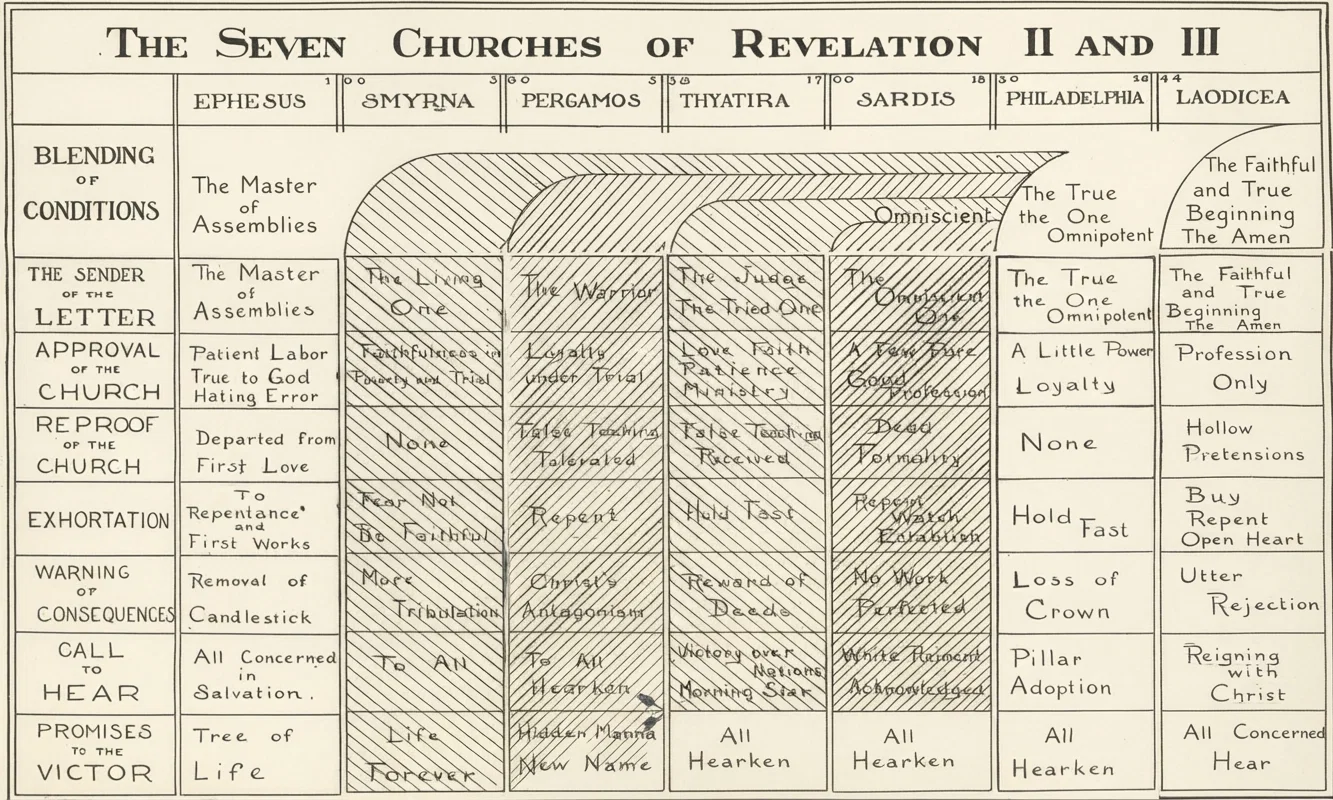
3. All that the Master sees that is worthy in His people He approves. The labor, the purity, the hatred of evil, the patient endurance of the early church are commended. She could not bear false messengers. They could go on their way, she would not, could not persecute, but they must not teach their false doctrine in the church of Christ.
Smyrna, poverty-stricken, persecuted, crushed, slain, under pagan persecutions, is
commended for patient endurance and the riches which she possesses in Christ Jesus.
Pergamos, notwithstanding her tolerated false teachers, is loyal. Under great trials she had proved true, and the Master remembers it.
Thyatira passed through the long, dark wilderness of the Dark Ages. The Master was with her in the furnace heat. He regards her works and love and faith and patience and ministry for Him, and He tells her so.
In Sardis, exalted, making high profession, the Omnipresent One finds a few tried, noble souls. Their knowledge is not per-
fect, but their love for the Master is dominant, and through grace they are worthy to walk with Him.
Patience and loyalty in the exercise of the little strength are approved in Philadelphia.
There is no approval of Laodicea. The True Witness sees only great profession with no corresponding works. In every other condition there has been something to commend; in Laodicea, nothing.
4. How faithfully our Lord reproves! Ephesus had left her first love, her heart had grown cold. Smyrna had suffered enough, the first love was laid down in death; there is no reproof. Pergamum tolerated7false teaching which Ephesus hated, and Thyatira was even more deeply guilty. Sardis was dying because she had departed from correct principles, the law of her life. The church of brotherly love receives no reproof, unless it is gently suggested in the expression, "Thou hast a little strength." Laodicea is reproved for hollow pretensions, nauseating to Him who has borne with patience all the failures of His people in the past.
5. Note the injunctions, the exhortations: To Ephesus, Repent, return; to Smyrna, Fear not, be faithful; to Pergamum, Repent; to the faithful in Thyatira, Hold fast; to Sardis, Watch, stablish, repent; to Philadelphia, Hold fast; to Laodicea, Buy, be zealous in repenting. How we need them all!
6. The warnings are faithfully given and equally needed. To Ephesus there is danger of removal; to Smyrna comes greater tribulation for her faithfulness; to Pergamum the awful danger of Christ's antagonism; to Thyatira the sure reward of unfaithful deeds; to Sardis the awful message that she is found wanting; to Philadelphia the danger of loss of crown; to Laodicea utter rejection. "He that hath an ear, let him hear what the Spirit saith unto the churches."
The last three churches present three present-day conditions: (1) Great worldliness, dead while professing to live, having not the life of Christ, seen in the great popular churches; (2) Devoted, earnest seeking of God, manifested among a far smaller number who are looking for their Lord's coming; (3) Those who possess an outward knowledge of God's truth, who feel rich because of that knowledge, proud because of their superior morality, but do not know the sweetness of God's grace, the power of His redeeming love.
There is hope in neither Sardis nor in Laodicea. Out of these conditions must the victors come into that of Philadelphia — brotherly love. He pleads with the few names in Sardis. Upon the greater part of those in Sardis, Christ will come as a thief in swift judgment, but He will save some. He has no promise to Laodicea as a whole. "If any man hear My voice," — He pleads with the individual; but the individual who opens the heart's door and lets Christ in, who comes into that wonderful communion with his divine Lord, will by that very process come into the condition of brotherly love. They will constitute the remnant who keep the word of His patience, against whom He has no condemnation, who are ready for translation. Out of that condition of lukewarmness means a hard struggle, earnest zeal, severe conflict; but he who wins shall share Christ's kingdom eternally.
The Answer of the Text
[The answers to the questions are from the American Revised Version. Omitting questions, and disregarding sometimes the capital at the beginning and the period at the close of an answer, the text may be read continuously. In notes and comments both versions are used without designation.]
To the Overcomers
1. What is promised to him that overcomes the enticements to death and the lusts for forbidden fruit?
To him that overcometh, to him will I give to eat of the Tree of Life.
2. Entrance to what will that insure him?
Which is in the Paradise of God.
3. To those who in life place themselves upon God's altar of service, or die for His sake, what is promised?
He that overcometh shall not be hurt of the second death.
4. To those who reject the superstitions of the world, the salvation promised by men, nor trust in their substitutes or charms, what will God do?
To him that overcometh, to him will I give of the hidden manna, and I will give him a white stone, and upon the stone a new name written, which no one knoweth but he that receiveth it.
5. To him who overcomes with the very nations against him, with prevalent popular false teaching to drag him downward, meeting the severest persecution, faithful to the last, what is promised?
He that overcometh, and he that keepeth My works unto the end, to him will I give authority over the nations: and he shall rule them with a rod of iron, as the vessels of the potter are broken to shivers; as I also have received of My Father: and I will give him the morning star.
6. To those who are willing to stand alone or with the few for Christ's sake, who are willing to have reputations blasted and their names blotted out of the books of popular churches for His name, what is assured?
He that overcometh shall thus be arrayed in white garments; and I will in no wise blot his name out of the Book of Life, and I will confess his name before My Father, and before His angels.
7. What will those be made who have stood as pillars of God's truth here?
He that overcometh, I will make him a pillar in the temple of My God, and he shall go out thence no more.
8. To those who desire above all things the honor and glory of God's name what will be done?
And I will write upon him the name of My God, and the name of the city of My God, the New Jerusalem, which cometh down out of heaven from My God, and Mine own new name.
9. What is the glorious comprehensive climax of promises to all overcomers?
He that overcometh, I will give to him to sit down with Me in My throne, as I also overcame, and sat down with My Father in His throne.
Note and Comment
For extended notes on all the above, see the articles on the various churches preceding, this. The following are a few of the additional thoughts the studies have suggested.
1. Tree of Life. — No longer will a flaming sword of cherubim, or the withdrawal of the Garden of Eden, keep from humanity the Tree of Life. Through Christ the child of faith partakes of life now; then he shall have free access to the marvelous fruits continually. There are no walled cities or gardens in the kingdom of God.
2. The second death is the death from which there is no resurrection. Justice does not demand it; in mercy it would do no good. The second death is the compensation due to sin.
3. Which no one knoweth; Christ, of course, excepted. Every new name is spelled out of the letters composing Christ's name; all the excellencies of all the characters are but different phases of His. Every character prism but refracts some of the white light of Christ.
4. Power over the nations — with Christ. Christ has identified Himself with them in all their suffering; He identifies them with Himself in all His triumphs over sin. See Ps. 2:8, 9; 149:5-8; Rev. 12:5; 19:11-16. The Morning Star — Christ Jesus. Rev. 22:16.
5. Name indicates descent, relationship, character. Every true child of God is born from above. To him belongs the name of the Father, the Son, the eternal city of God, the capital of his future home. The overcomer is eternally labeled for what he is.
6. In My throne. — Note how this final promise includes all others, — the Tree of Life and Paradise; kept from the second death — immortality; the new name; power over the nations; a shining name in the Book of Life; a citizen of the kingdom, bearing the fourfold name of that citizenship forever.