Man's Sin and Saviour

5%

Pacific Press Publishing Association · Mountain View, California · Aug 9, 1910

FromSigns of the Times, Vol. 37, No. 31.

Read the full edition

Man's Sin and Saviour

V. A Nation of Slaves

"And He said unto Abram, Know of a surety that thy seed shall be a stranger in a land that is not theirs, and shall serve them; and they shall afflict them four hundred years; and also that nation, whom they shall serve, will I judge: and afterward shall they come out with great substance. And thou shalt go to thy fathers in peace; thou shalt be buried in a good old age. But in the fourth generation they shall come hither again: for the iniquity of the Amorites is not yet full." Gen. 15: 13-16.
THUS spake the Lord to the "father of the faithful." These words were spoken, too, on the occasion when, in revealing the unnumbered stars of the firmament, the Giver of the promises had declared, "So shall thy seed be." He who sees the end from the beginning, also foresaw and foretold the sojournings of the descendants of Abraham, and their bondage in Egypt.
But the four hundred years here mentioned were not all spent by the Israelites in Egypt; for we read in Gal. 3: 17, that God's promise and oath to Abraham were four hundred and thirty years before the law was given on Sinai. This being true, it is evident that the four hundred years' sojourn mentioned in Genesis fifteen, includes their pilgrimage from the day Abraham entered Palestine, to the deliverance of His people from Egyptian bondage.
It figures thus: "Abram was seventy and five years old when he departed out of Haran" and came into the land of Canaan (Gen. 12: 4). Twenty-five years later Isaac was born. Gen. 21: 5. Isaac was sixty (Gen. 25: 26) at the birth of Jacob; and Jacob was one hundred thirty when he and his family entered Egypt. Gen. 47: 8, 9. Hence we have the sum of 25 and 60 and 130, or 215 years, as the total time spent by Abraham and his posterity in the land of Canaan before the sojourn in Egypt began. And this subtracted from the 430 years mentioned in the book of Galatians, leaves 215 years as the time spent in Egypt. But this is nothing new, for the marginal dates in all our Bibles sustain the same reckoning.

A Change in Attitude

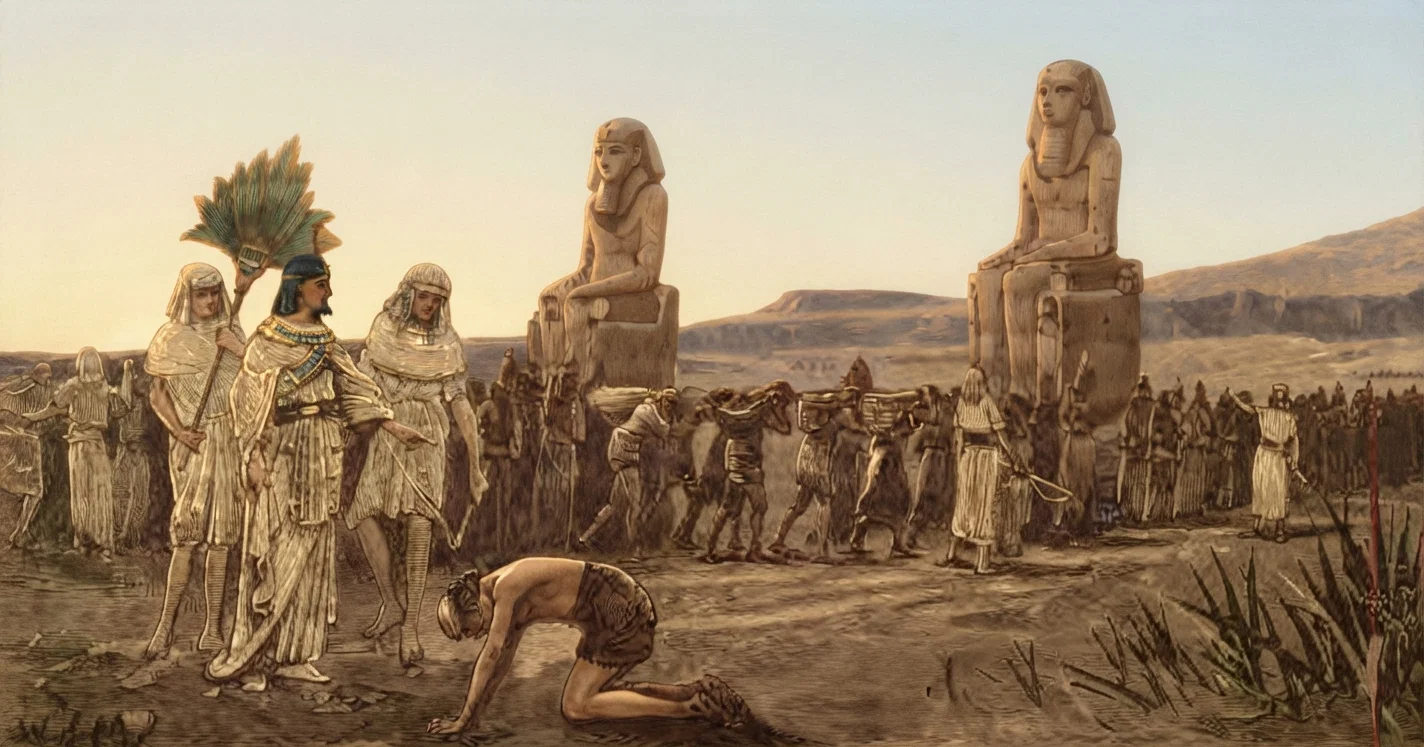
Because of the service rendered by Joseph previous to their entrance, the king of Egypt insisted that to his people be given a home in the best of the land. Here, in the land of Goshen, they fared sumptuously during all the remaining years of Joseph, which were seventy-one in number. But some time afterward (the exact time we do not know), "there arose a new king over Egypt, which knew not Joseph. And he said unto his people, Behold, the people of the children of Israel are more and mightier than we: come on, let us deal wisely with them; lest they multiply, and it come to pass, that, when there falleth out any war, they join also unto our enemies, and fight against us, and so get them up out of the land. Therefore they did set over them taskmasters to afflict them with their burdens. And they built for Pharaoh treasure cities, Pithom and Raamses." Ex. 1: 8-11.
Toiling in Hard Bondage in Egypt. Ex. 1: 11, 13, 14.
In ancient Egypt, as in modern India, the gods were more numerous than the people. "It was easier to find a god than a man." "All Egypt bore the impress of religion. Its writing was full of sacred symbols and of allusions to sacred myths, so that its use beyond the influence of Egyptian religion became, as it were, impossible. Literature and science were but branches of theology. The fine arts were only employed with a view to religion and the glorification of the gods or deified kings. The prescriptions of religion were so multiplied, so constantly repeated, that it was not possible to exercise a profession, to provide for one's subsistence, or satisfy one's commonest wants, without being constantly reminded of the laws laid down by the priests. Each province had its special gods, its peculiar rites, its sacred animals."—Lenormant. In such an environment the people of God must live—did live, for over two centuries.
It was under the reign of Thothmes III, and in the year 1706 B.C., that the children of Israel entered Egypt. This king was a mighty conqueror of nations, and under his reign Egypt attained to the zenith of her power. This king left a list of more than three hundred names of cities, towns, and districts he had conquered. "When his conquests were completed, his dominions embraced Ethiopia, Nubia, Libya, Cyprus, and 'the isles in the midst of the Great Sea,' the 'circuit of the Great [Mediterranean] Sea,' Arabia, Moab, Ammon, Palestine, Phenicia, Asia Minor, the land of the Hittites, Armenia, Mesopotamia, Assyria, Babylonia," and beyond that to the east, even into the land of India. This gives something of an idea of the earthly power of that nation amid whose confines the Israelites lived.
Now Joseph continued to live throughout the reign of this king and three of his successors, to the beginning of the reign of Amenophis IV. So Joseph died at the age of one hundred and ten years, in 1635 B.C.

A Sun-Worshiping Nation

It was this last named king who endeavored to bring his whole realm to the worship of only one god, and that god the sun. To accomplish this, fearful pressure was brought to bear upon all the people of his realm. In such a time, we can easily imagine the attitude of God's faithful children, and the affliction it brought upon them. But this must have been somewhat relieved because of the fact that his whole realm revolted at the thought of giving up the worship of their "gods many" and "lords many." In fact, such revolutions were caused by this attempt to swing all into the worship of the one sun-god, that it led to a change of dynasty; and the one who succeeded in bringing order out of chaos took the throne, and assumed the name of Rameses I.
Between this king and Rameses II there was one king who reigned. But Rameses II it was who built the treasure cities named in Exodus, chapters one and twelve, one of which bore the name of the builder, "Rameses." His reign continued from 1564 to 1497 B.C., a period of sixty-seven years, and to within six years of Israel's exodus from the land of Egypt. It was he who is now known as the Pharaoh of the oppression.
But notwithstanding their hardships and oppressions, the people "multiplied and grew," until at the exodus, instead of the "threescore and fifteen" who entered, there were about three million that departed.

The Meaning of Egypt

The very name of Egypt is a synonym for all that is idolatrous and sinful; for that bondage to the powers of evil from which there is no deliverance for a helpless and enslaved people, except through the power of the Infinite. But that power is ample, and God had given His promise.
"But when the time of the promise drew nigh, which God had sworn to Abraham, the people grew and multiplied in Egypt, . . . in which time Moses was born. . . . And when he was full forty years old, it came into his heart to visit his brethren the children of Israel. . . . For he supposed his brethren would have understood how that God by his hand would deliver them; but they understood not." Acts 7: 17-25.
When Moses was forty years old, the time was nigh, the 400 years mentioned of God, for 390 years had passed. But Moses' attempt at deliverance, at that time, brought only trouble. So he fled to the land of Midian, where he remained forty years longer. This made 430 years in all, and brought the time of their deliverance 30 years later than it might have been, had all understood the "promise," and the power of God.
But tho the people themselves delayed their own deliverance, yet the mercy of God finally accomplished it, without sword or spear, or the din of battle. He took "one nation from the midst of another nation" in the manner concerning which all are familiar, and which need not be repeated here. But the degradation of that vast host, born and reared in the midst of idolatry and slavery, who could fathom? This was the people whom God saw fit, in fulfilment of His promise, to make the light of the world. How could it be accomplished?