The ROYAL LAW

5%

Pacific Press Publishing Company · Mountain View, Cal. · Jul 4, 1906

FromSigns of the Times, Vol. 32, No. 26.

Read the full edition

The ROYAL LAW

BY F. C. GILBERT. (A Hebrew Christian.)

VI. WHAT THE LAW COULD NOT DO; WHAT CHRIST COULD DO.

IN his great discussion on the law question in the book of Romans the apostle Paul declares that "what the law could not do in that it was weak through the flesh, God sending His own Son in the likeness of sinful flesh, and for sin, condemned sin in the flesh." Rom. 8 : 3. When God gave to man His plan for him in the garden, among other things He said, "Of the tree of the knowledge of good and evil, thou shalt not eat of it; for in the day that thou eatest thereof thou shalt surely die." Gen. 2 : 17. The words which are rendered, "Thou shalt surely die," in the Hebrew are "Moth Ta-mooth," which second word is simply a repetition of the first. In other words, God assured man that as surely as he ate of the forbidden tree the death sentence was passed upon him; and as far as he was concerned he would be separated from God. He would die, he would be alienated from God's life, he would be irretrievably lost, and there would be no hope for him. Death was certain, and man could not help himself.

God's Plan Devised.

So when man did eat of the forbidden tree he realized he was a lost man, and immediately started to hide himself. Gen. 3 : 8. Sin had brought in the separation. Isa. 59 : 2. Man had gone out of the way, and had become alienated from the life of God. Rom. 3 : 12; Eph. 5 : 18. He could not find his way back to God. He had forfeited his right to life, and now the death sentence was lawfully to be imposed upon him. Having disobeyed God, he lost the power and ability in himself to do anything for God that was demanded of him. The law condemned him; it demanded his life, and die he must. If, however, he is to have another opportunity, God must devise a way whereby he can be brought back, which will still demonstrate the justice of God in man's receiving the death sentence, yet manifest the love and kindness of a tender God.
The Lord, therefore, did devise a means whereby his banished creature should be brought back. 2 Sam. 14 : 14. Immediately Jehovah God starts in pursuit of man, and calls him to come back. "Adam," the Lord calls, "Where art thou?" Gen. 3 : 9. And from that hour to this present moment Jehovah has been calling men to come back to Him. He has devised a plan whereby man might find the way back to God, where there need not be any separation or alienation, while at the same time the death sentence has been proclaimed, and the demands and claims of the law are as obligatory as ever.
Adam immediately begins to excuse himself by blaming some one else. God listens. Before He passes the death sentence upon Adam, and through him upon the human race, the Lord utters these sentiments to the serpent: "And I will put enmity between thee and the woman, and between thy seed and her Seed; He shall crush thy head, and thou shalt bruise [or hinder] His steps." Gen. 3 : 15. Hebrew translation. The thought in the Hebrew of the last clause in this verse is that the serpent would seek to bruise or wound or hinder the progress of the Seed of the woman, even as one person would hinder another by holding him by the heels, and not allowing him to go forward. Yet, in spite of this, he would make progress. The word translated "heel" in this verse is the same word that is translated "steps" in Ps. 56 : 6.
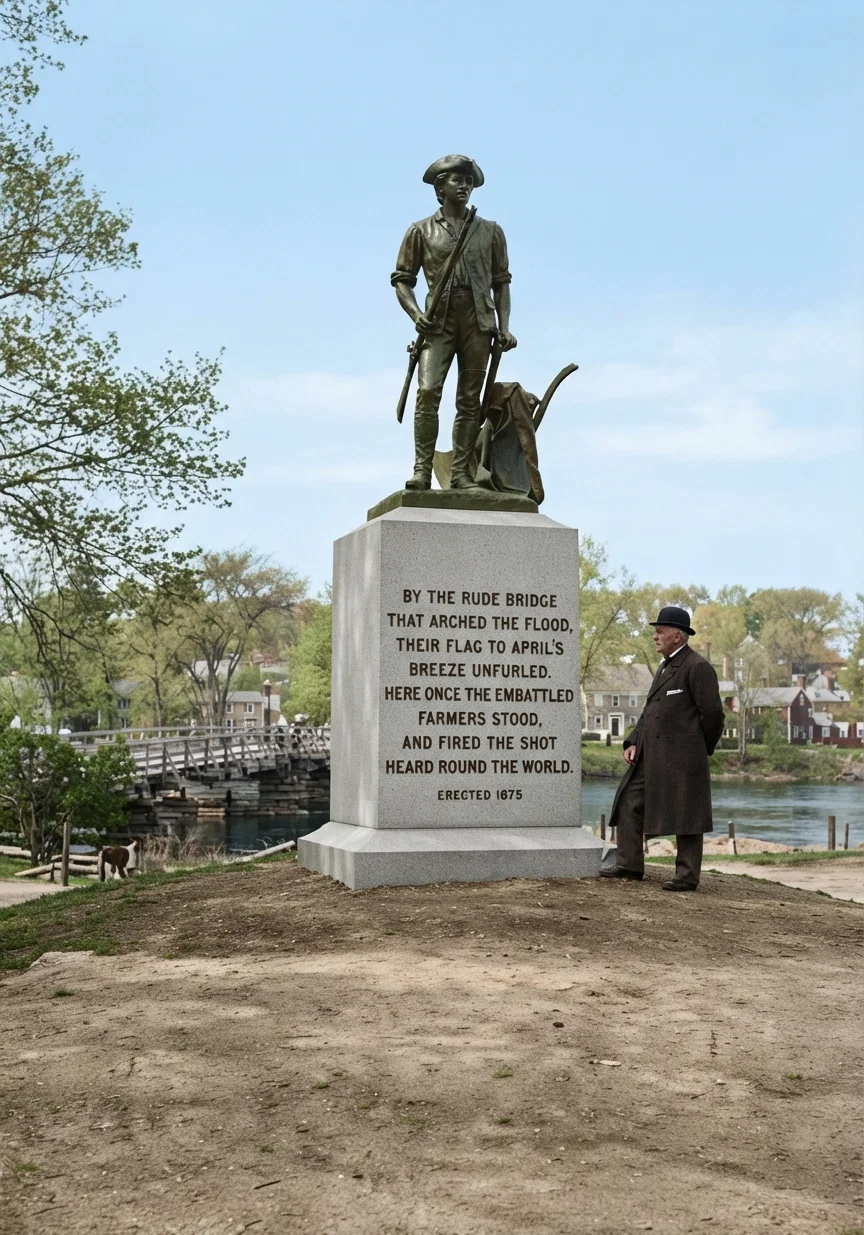
Statue of "The Minute Man" at the "Old North Bridge," near Concord, Mass., where the first conflict of the Revolution occurred, April 19, 1775. On the monument is this verse:

Jehovah Jesus, God's Way of Return.

In this promise to man and death-knell to the serpent is contained God's remedy for bringing back His exiled children, and doing for them what the law could not do, while yet he was a just God. This was the first Gospel sermon. This was the first ray of hope. This was truly the Seed which God had planted in Eden's garden through which man might feel that, tho a sinner, tho unable to do God's will in himself, tho having forfeited the gift to life, tho impossible to obey God's law, there was still a hope for him that he could do what the Lord wanted him to do.
This Seed was none other than the Lord Jesus Christ. Gal. 3 : 16. It was right there in Eden that the Lord Jesus declared to Satan that tho he had deceived man, and had led him away from God; tho he had brought wo, misery, and sorrow into the world; tho he had caused man to do on earth what he had done
heaven; and had brought rebellion into existence in this planet; tho he had made null and void Jehovah's law, there was a plan devised whereby man would be able to do God's will, and to be brought back into the favor of God, and to have accomplished in him what God desired originally to have done. Jehovah, with whom he had battled on heaven's plains and who had overcome him, would take the place of man, would come to earth as a man, would live the life of a man, would obey the law of God like a man, would die the death penalty for man, would eventually crush the head of Satan with every righteous man.

Old Testament Revealed Christ.

From that day forward God unfolded to Adam and to all his posterity what he would do for men in the person of His own divine Son; and every promise from that time onward, if man would but appreciate it, was God's unfolding his plan in Jehovah Jesus to reveal to man his help and power to do right by the new divine life in God's Son. This was manifest all through the Old Testament, in every offering which had shed blood, and in nearly all the experiences of the holy men of God.
We are told that Abel offered up a better sacrifice than Cain. Heb. 11 : 4. Wherein was it better?—It had blood, while Cain's did not.
But what was involved in this shed blood?—A testimony that Abel was righteous. But how could Abel be righteous? The Bible tells us, "There is none righteous, no, not one." Rom. 3 : 10. By the offering of this lamb, Abel by faith saw the life, the death, the obedience, the virtue, the efficacy of the Lamb of God which would bear away the sin of the world. He accepted this as his portion; and this divine life of Jehovah Jesus was imputed and imparted to Abel, and thus he became a righteous man.
This was also true of Noah. Of this patriarch we read, "But Noah found grace in the eyes of the Lord. These are the generations of Noah; Noah was a just man and perfect in his generations, and Noah walked with God." "By faith Noah . . . prepared an ark to the saving of his house; by the which he condemned the world, and became heir of the righteousness which is by faith." Gen. 6 : 8, 9; Heb. 11 : 7. But righteousness is found only in Jehovah Jesus: "This is His name whereby He shall be called: Jehovah our Righteousness." "Who of God is made unto us wisdom, and righteousness, and sanctification, and redemption." Jer. 23 : 6; 1 Cor. 1 : 30. Righteousness by faith, however, is contained in the Gospel (Rom. 1 : 16, 17); and this is the Gospel of Christ. Therefore, Noah was enabled to see Jehovah Jesus as his Saviour and Redeemer, living the life acceptable to God, fulfilling all the will of God, dying the death that he should have died to pay the penalty for sin, and living the righteous life which the law demanded. Noah accepted it, and thus became heir of the righteousness which is by faith.
Thus the cloud of witnesses might be multiplied, all of which shows that what the law could not do on account of the condition of man because of sin, Jesus Christ, the divine Son of God, who became the Son of Man, did for all who had faith in Him. He became the ladder uniting earth and heaven. Gen. 28 : 10-22; John 1 : 51. He became the Rock which was smitten. 1 Cor. 10 : 1-4. He became the great Judah, pleading that He mightbecome the surety in order to bring back the lost brother. Gen. 43 : 8, 9; Heb. 7 : 14. In the fulness of the time He became the helpless Babe, born in a stable and cradled in the manger. Gal. 4 : 4. He became the Mediator, the Middle-man, the God-man, that He might bring God to man, and might take man back to God. 1 Tim. 2 : 5. Bless God, Jesus Christ became the great Link which was lost in the chain that bound heaven and earth together. He is the All-in-all, and all is in Him. He came to do what the law could not do, in order that the world and universe might see what the law was intended to do, and what it will do when redemption shall have been completed and man is restored to a condition of obedience. Rom. 8 : 3, 4; 7 : 10; 3 : 21.