Our London Letter

4%

Pacific Press Publishing Association · Mountain View, California · Aug 23, 1910

FromSigns of the Times, Vol. 37, No. 33.

Read the full edition

Watchman, what of the night?

Our London Letter

From Our Own Correspondent

The New Ruler

THE change in the person of the monarch continues to be for the present the central point of interest in English public life. It has put a new aspect upon the constitutional crisis, and it has also brought to the front the question whether the form of the Accession Oath shall be changed, an issue in which all the churches are taking a lively interest.
So far there has been but little chance to discover what manner of king George V will make, but there is good hope that he will justify the favorable account given at his accession by those who were acquainted with him. He does not seem to care for prominence, but is devoting himself with considerable energy and thoroughness to the duties of his new position. In many ways he is evincing the kindly consideration for others that made his father so popular.
It was considered generally to be inadvisable to involve the new king in the political struggle that was in progress over the House of Lords. The strength of the two contending parties was so nearly equal that much would depend upon the course taken by the sovereign, and this fact made the situation a very delicate one for a new and inexperienced ruler. There was a strong feeling that a friendly attempt, at least, should be made to reach some conclusion satisfactory to all parties; and in response to the general demand, Mr. Asquith and Mr. Balfour met and agreed upon arrangements for a conference. Four representatives of each side were chosen, and the conference has now been in progress for several weeks. Whether anything in the way of a satisfactory compromise can be devised remains to be seen. Mr. Asquith has promised a statement on the subject in a week's time.

The Coronation Oath

While the accession of George V has for a time silenced controversy in the political world, it has had the opposite effect in the religious world. The proposal to change the form of the Declaration to be made by the king at his coronation is the cause. When King Edward was crowned there was a great outcry on the part of Roman Catholics, both in Parliament and in the press, against the language of the Declaration, which was said to be grossly insulting to Rome, inasmuch as it plainly insinuated that an oath which would be sacredly binding on the ordinary conscience was not sufficient to commit an adherent of the Church of Rome. Not only did the Declaration call upon the sovereign to renounce solemnly and sincerely, in the presence of God, the doctrine of transubstantiation, and to assert that the invocation and adoration of the virgin Mary and the saints, as practised in the Church of Rome, was both superstitious and idolatrous; it also exacted from the sovereign an explicit assertion that he made the Declaration in the plain and ordinary sense of it, as the words were commonly understood by English Protestants, "without any evasion, equivocation, or mental reservation whatsoever," and without any dispensation already granted him for this purpose by the pope, or any hope that such a dispensation would be granted in the future.
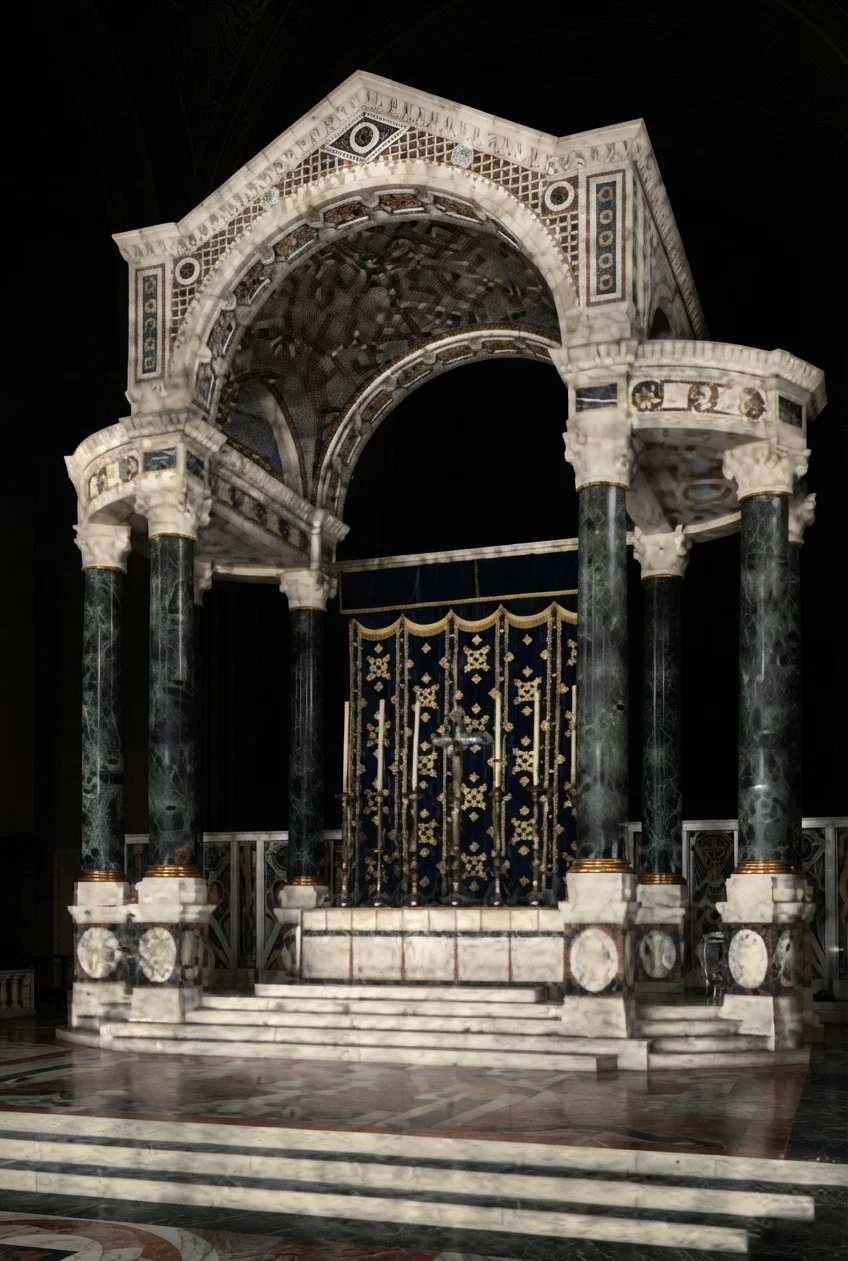
Baldachino of Westminster Cathedral
The men who framed this Declaration had a vivid remembrance of the experiences through which they had lately passed in the reign of James II, and they felt the imperative necessity of wording the Declaration in such a manner that it would be absolutely impossible for a papist to subscribe it. They felt that they were dealing with an utterly unscrupulous and mendacious power, with which all ordinary securities, however sacred, were valueless. They would have probably admitted without hesitation that the language of the Declaration was insulting, but they would have added that it was necessarily so in view of the character of the power with which they were dealing; that the Papacy by its course had forfeited all right to be considered as truthful and honorable in its dealings.
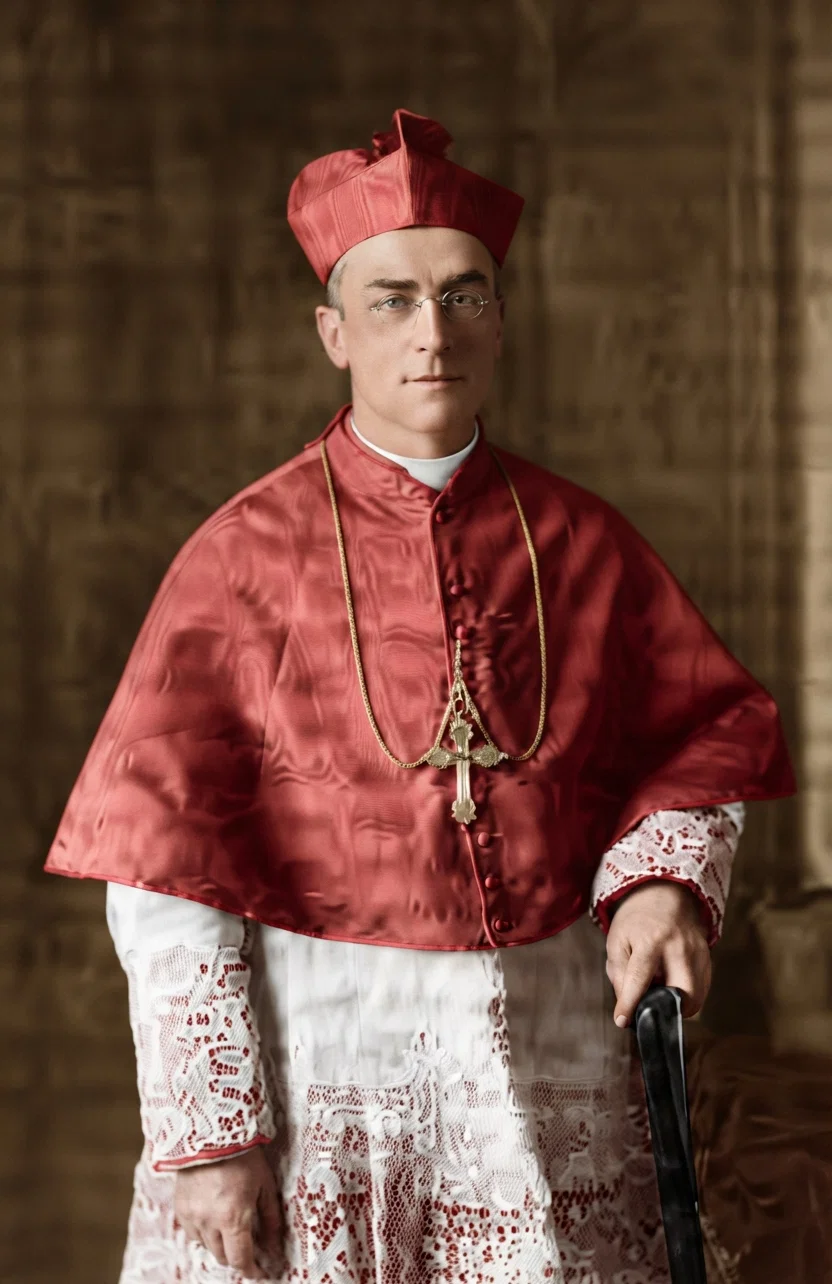
Dr. Bourne, Archbishop of Westminster
The ancient feelings of bitterness against the Papacy, however, have largely passed away; and when the outcry was raised nine years ago the Roman Catholics were encouraged to think that before another accession some change would be made in the terms of the Declaration. The time has now come to make good this undertaking, and the Liberal government has brought in a bill to revise the Declaration and omit all the phraseology offensive to Roman Catholics. The new form simply requires the king to declare himself a faithful member of the Protestant Reformed Church of England as by law established.

Not Satisfactory to All

The Roman Catholics profess themselves entirely satisfied with this change, and at first the larger part of the other churches appeared willing to assent to it. There is still, however, a considerable body of militant Protestants in England, and these are standing out stiffly against any concession to Romanism. Mass-meetings have been held, and much literature has been circulated calling on the people to resist the proposals of the government, and asserting that any weakening of Protestant safeguards will surely lead in time to the reestablishment of Rome in this country, and to the loss of civil and religious freedom.
It is an undeniable fact that the Church of Rome has greatly strengthened its position and influence in this country of recent years; and while this fact tells against the ultra-Protestant agitation, it at the same time confirms the opponents of the change in their conviction that the maintenance of the old form of Declaration is of vital importance to England.
The problem is further complicated by the fact that outside the Church of Rome there has developed general dissatisfaction with one feature or another of the proposed new Declaration. The "High Church" party of the Established Church, the ritualistic, Romanizing section, strongly object to being described as "Protestant." They hate this term, and detest its application to themselves. Onevery occasion they insist that they are the "Catholic" Church. There is a continual wordy warfare between the Roman Catholics and the Anglicans over the right to this title of "Catholic," and the Anglicans now say that to apply the term "Protestant" to their church by an act of Parliament will mean the surrender to Romanism of the very position they have been so warmly contending for.
On the other hand, the Nonconformist bodies object to the new Declaration on the ground that it requires the king to be a member of the Church of England as by law established. They demand freedom of conscience for the king, and ask that he be at liberty to profess himself a Methodist or a Baptist if he so desires. One argument that favors this contention is that, at the present time, the king of England becomes a Presbyterian whenever he journeys into Scotland, for by the constitution of the Established Presbyterian Church in Scotland the king is the head of that organization. It is only in a partial sense that he can declare himself to be a faithful member of the Church of England as by law established.
How the matter will end it is impossible to say at the present time. One thing is certain, there will be plenty of dissatisfaction whichever way the final decision goes. That is inevitable under a church and state régime. The whole discussion is largely one over "hollow forms." Notwithstanding the vigorous denunciations of the present Declaration, Rome has made substantial progress under it in this country; and Mr. W. T. Stead has pointed out that in the case of the prime minister, who wields enormous power in ecclesiastical matters, having the right to nominate the bishops and archbishops, no declaration at all is demanded.

Matters over Which Catholics Are Rejoicing

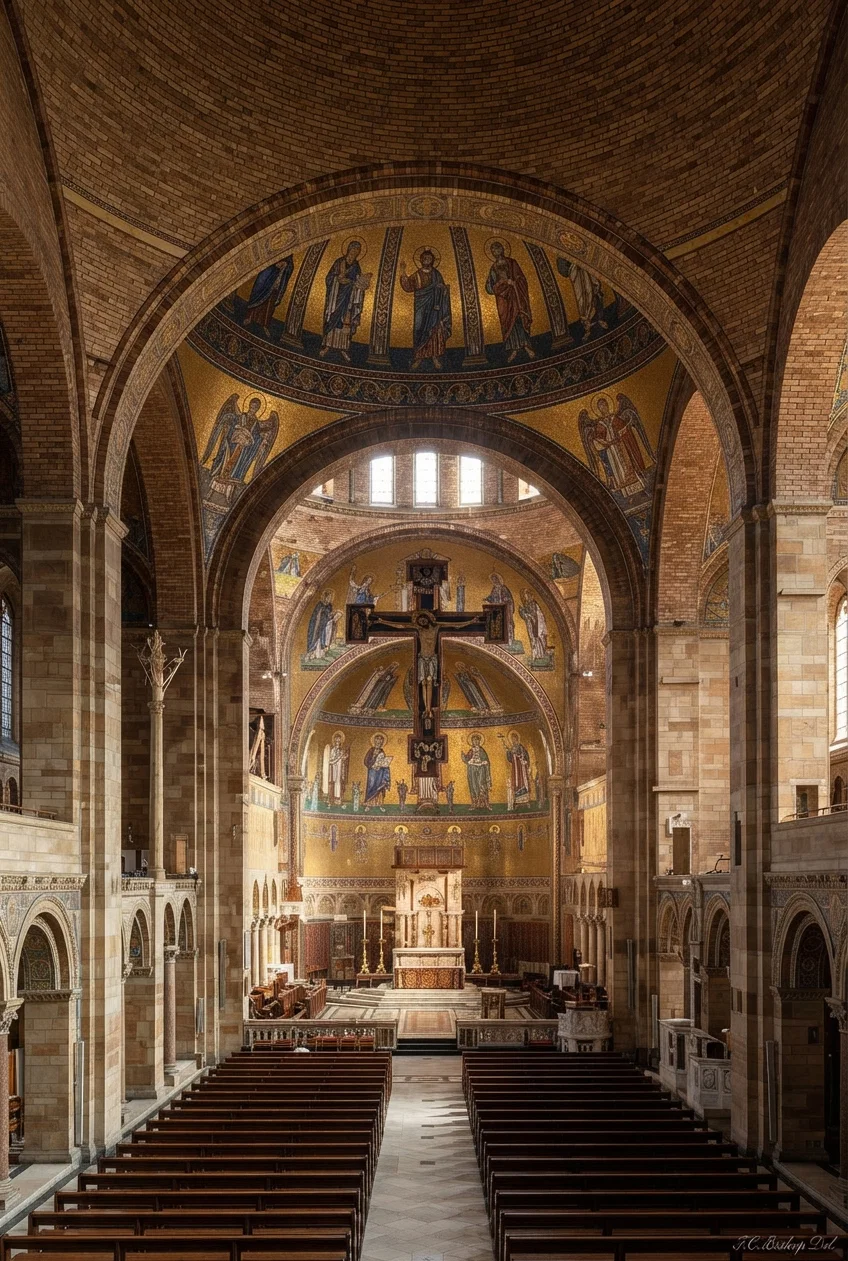
The Roman Catholic Church has been rejoicing greatly over the turn things have taken, and her orators have freely extolled the beauty of religious liberty under which so bright a prospect is now opening up before her in this country. That church has just been celebrating a threefold occasion for thanksgiving. One is the prospective change in the Royal Declaration; a second is the dedication of the new cathedral at Westminster, which was begun by the late Cardinal Vaughan, and which is still far from being completed. The dedication services were celebrated with great magnificence of ritual. The third is the sixtieth anniversary of the restoration of Roman bishoprics in England. It is just sixty years since Cardinal Wiseman was commissioned by the Papacy to set up again a Roman Catholic hierarchy in this country. Great annoyance was felt at the time at the presumption of this step, and an act of Parliament was promptly passed to prohibit the use of such ecclesiastical titles. But the act was never enforced, and from that day to this the Church of Rome has flaunted her ecclesiastical dignities in England as though she were the one acknowledged church of the land. Rome has never lost anything for want of audacity, and it is the knowledge of this that makes the Protestants who are familiar with the history of the past so unwilling to concede her the smallest advantage. They are retorting now to the Roman Catholic eulogists of religious liberty that the beauty of the principles might with profit be commended to the notice of the holy father as a guide in his dealings with the Spanish Government. There the Vatican is protesting vigorously against the smallest concessions to Protestant worshipers.

In the Military Realm

The agitation for the increase of armaments goes on. Military and naval experts declare that we are endangering our national security by not taking even more active measures for the strengthening of our forces. On the other hand, the reformers of the Liberal government hold up their hands in horror at the insane waste of money in such expenditure. Nevertheless, the government is impelled helplessly forward. On the 15th of July Mr. Lloyd George, the chancellor of the exchequer, said:
"Twenty years ago our national bill for armaments was £30,000,000; to-day it is £70,000,000. . . . The countries of the world are spending annually £450,000,000 upon this machinery of destruction. In twenty years there has been an increase of £200,000,000 per annum. All nations seem to be affected with an epidemic of prodigality which is sweeping over the land and sweeping to destruction. We take the lead, but, after all, we have got the greatest empire to defend; we have got that excuse. But if the nations increasingly spend their money upon matters that give neither sustenance nor support to their people on the road that leads to higher civilization, we will suffer. You may have newer and better and easier methods of taxation. It makes no difference. Until you drain this quagmire, the result will be that the money will sink out of sight without leaving a trace or an impression behind it. I think it is a great and a growing misfortune. No single nation is alone responsible, and we must look to the day when there will be a better understanding between the peoples."
Unfortunately, while dreams of future peace are indulged, the preparations for war are steadily increasing. If deeds speak louder than words, the world is certainly rushing on toward a struggle of unprecedented dimensions.
Westminster Cathedral