SECTION OF RAILWAY THROUGH JUNGLE IN INDIA. NOTE THE NUMEROUS TELEGRAPH WIRES ON THE SIDE.
A Network of Communicating Wires—
Postal Service Carried Even into the
Jungles—Remarkable Proficiency of Car-
riers—Find You Wherever You Are—
Facilities for the Messengers of His Coming
By G. W. PETTIT
LAST week Elder Pettit told of the network of railways that thread the great land of India. The whole country is brought into close intercommunication. His article this week, on the efficient telegraph and postal system, supplements what was said in the last issue, and helps to emphasize the transforming and civilizing work that is in progress. What a significant preparation for the world-embracing message of the Coming One! EDITOR.
THE use of the modern mail and telegraph systems has long been in vogue in India, but they are rapidly extending to the remotest parts of the country. Not only are the mails brought to almost every door in the cities and towns, but the delivery extends even to the jungle.
POSTAL SERVICE EVEN TO THE JUNGLES
When we consider that by far the larger part of the India population are wholly illiterate, there can not be any doubt that, on the whole, the business of this department of government is systematically and carefully handled. It is estimated that only about seven per cent of India's 317,000,000 souls can either read or write.
Some facts relative to the postal system in India will serve to show how successfully the work is carried on in spite of the fact that ninety-three per cent of the population can neither read nor write. During the year 1913, there were handled and delivered by the postal authorities 1,014,000,000 articles of mail. This included papers, letters, post-cards, packages, etc. Parcel-post, which is well established in the empire, extends to even the most isolated districts of the jungle. One may send by parcel-post anything from a large trunk to a paper of pins. The rates are very reasonable.
PHENOMENAL GROWTH
During the years 1879 and 1880 there were sent out 140,000,000 letters and less than 12,000,000 newspapers. The growth is shown when we compare this with the work done in 1913, when there were delivered by the postmen 890,000,000 letters and 60,000,000 newspapers. These figures strikingly testify to the comprehensiveness of its organization and the thoroughness with which the masses have been educated to use the postal service. Rural delivery is effected by means of branch post-offices supplemented by thousands of village postmen, who are practically projecting branch offices, in addition to delivery of mails, paying money-orders, and registering letters, etc.
THE POSTMAN WILL FIND YOU
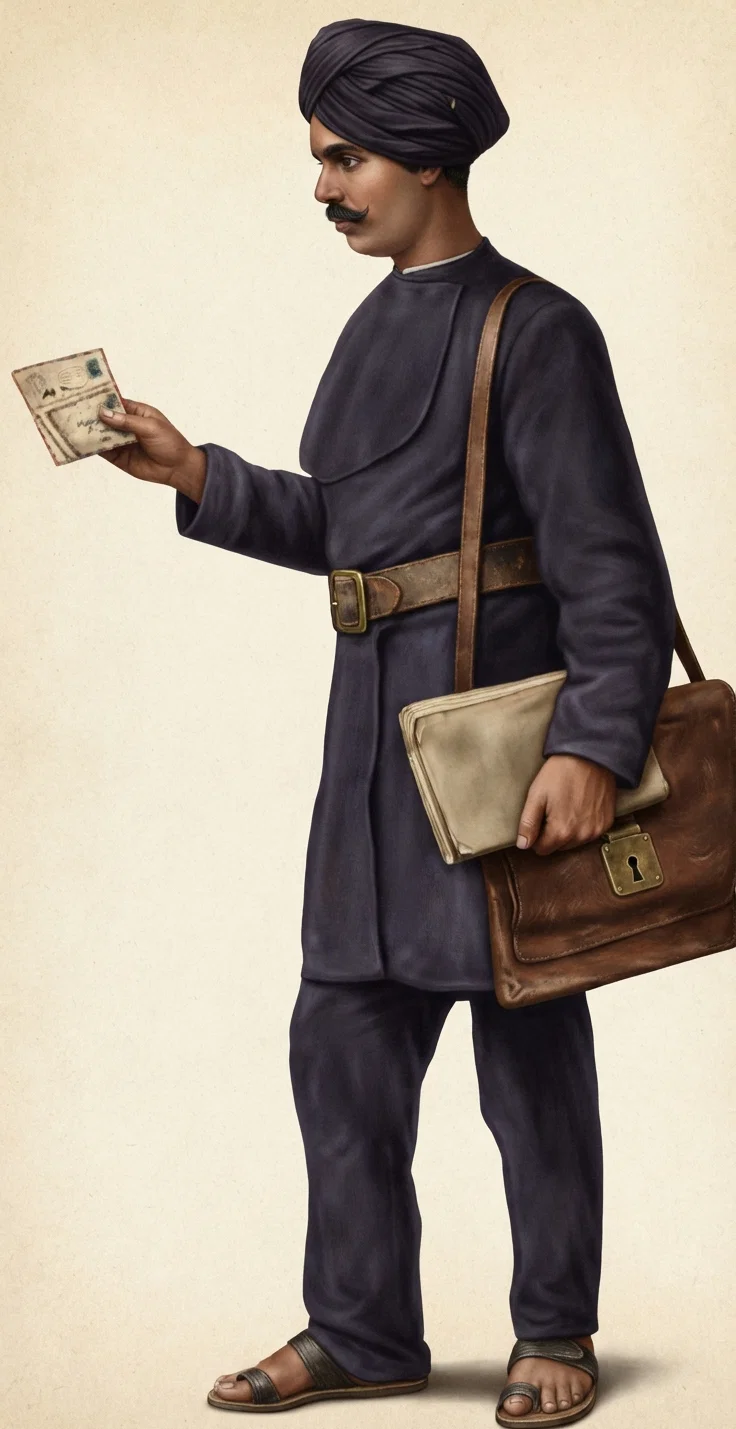
Many of these men have little education, being scarcely able to read in their own tongue, and can not read a line in English; yet in some way they hunt you up and deliver that letter or paper. We have been in various sections of the empire, but have never had reason to complain of the way these men did their work. After being in the country for a time, one loses all that uneasiness which is felt at first. Out of over two thousand articles, including letters, papers, etc., that have been addressed to us since we have been in India, we do not believe we have lost a total of one half dozen. These government servants seem to be perfectly reliable, and usually are very obliging men.
MONEY AND POSTAL SAVINGS-BANKS
There has been devised an excellent system of postal savings-banks throughout the country, where the native is encouraged to save from his meager earnings. A total of millions of pounds is thus deposited by the people of the country, mostly in small amounts.
We have an excellent system of "collect on delivery," which is very beneficial to the people. Too, we find that in our literature work we can make use of this to a great extent. One copy of a periodical is sent collect on delivery; and if the person to whom it is sent desires the paper for the year, he turns in to the postman the amount to cover the same, and this is returned to the office. The money sent by money-order is delivered to one's door, never in the shape of a money-order, but in cash.
I have been twenty-five miles away from the railway, out in the jungle, and in need of money, and have gone to the jungle post-office and sent a wire for money, and in a little while the money was delivered to my door. But little money is lost in this way, although millions of pounds is thus handled annually.
GOVERNMENT SUPERVISION AND FAST MAIL-TRAINS
The postmaster-general and his staff are able men, and are almost constantly on the road, inspecting, devising new methods, and working to unify the system. He and many of his staff are Europeans, as well as many of those who serve under him in the various presidencies. Each presidency has its postmaster-in-chief.706
The postmaster-general and the presidency postmaster-general have very great powers vested in them. They control not only his majesty's mail, but the mail-trains as well. The special mail-trains, though operated by the various railway companies, are under the orders of the government. These trains make close connection with the weekly mail-boats, and leave by order of the presidency postmaster-general. When a mail-boat pulls into port, these special trains stand on the track ready to take the mails in every direction to the ends of the empire. One train will be bound for Madras, or south India, and another for Calcutta, or east coast, and still another for Delhi, the north of India. The railways make all lines clear for these government mail-trains; and as soon as the mails are segregated, the postmaster-general of the presidency is notified, and at his discretion he may send them at once, or for any valid reason, may hold them. Generally they are quickly despatched, and go with maddened speed to the end of their line, making only a few stops in their rush to reach their destination. In order to serve the best interests of the people and the government, but few passengers are usually carried on these trains, and those for long distances only.
CHEAP POSTAL RATES
Letters cost one cent for any place within the bounds of the empire. Postal cards as used in America cost one half cent. Other rates are correspondingly cheap. Newspapers, however, are somewhat higher than in America, not
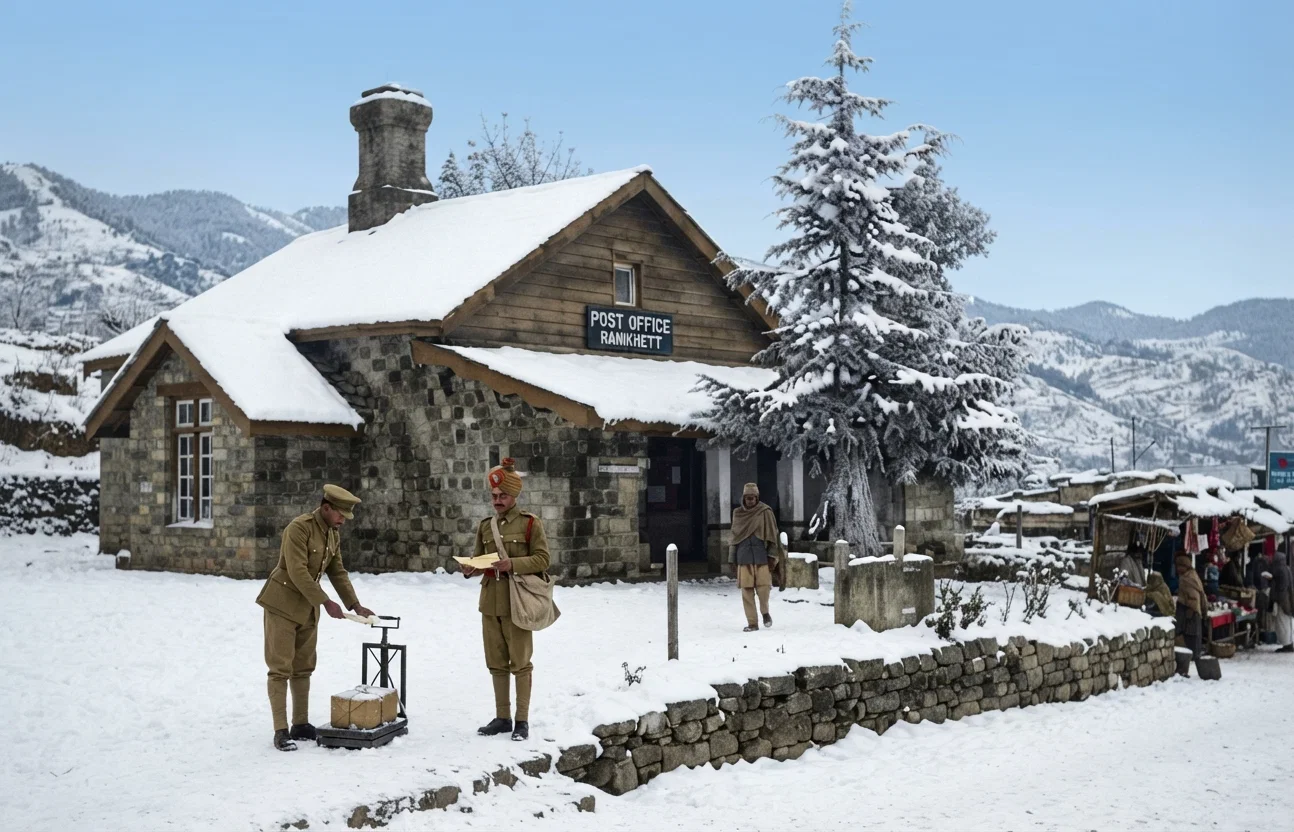
POST-OFFICE AT RANIKHETT, INDIA, COVERED WITH SNOW
being sent out by pound rates. Books, parcels, money-orders, and ordinary packages are sent by the ounce at a very reasonable rate.
THE TELEGRAPH
The telegraph is under government ownership, and directed by the postmaster-general. Almost every post-office of the country is a telegraph office. Thus the two serve together, and oftentimes it costs but little more to send by telegraph than by mail. While in the large cities we have separate telegraph offices, yet generally the post-office and the railway station are the only places in the city for sending telegrams or receiving them. The operators are usually young men of the country, and become very expert in the art of transmitting messages.
MILES OF WIRE, ALSO WIRELESS
During the year 1913, the telegraph system was extended by 2,284 miles of line and 11,691 miles of wire, giving at the end of the year 1913 a total of 78,862 miles of line, the total number of miles of wire being 311,034.
The first telegraph line in operation in India was used in 1851, and consisted of only eighty-two miles. In the year 1852 it was extended so there were 3,050 miles, and in 1857 there were 4,555 miles in use.
Radio telegraphy was first introduced in India by the government in the year 1905. It has been now extended and perfected so there are eight principal stations where messages may be sent to sea or over the mainland by private companies or individuals.
LOW RATES OF TELEGRAPH SERVICE
Distance does not increase the cost of telegrams in India. It is no more expense to send a message for a distance of 2,000 miles, than for one mile, just so long as it goes anywhere within the borders of Hindustan. The minimum rate is twelve words for twelve cents, to be sent to any part of the country. This, too, includes delivery within a radius of a few miles of the station to which the message is sent. Thus it will be observed that the rates have been reduced to
GENERAL POST-OFFICE AT CALCUTTA, INDIA
the lowest figure at which good service can be maintained. Nearly all telegraph lines are owned by the government, therefore there is no competition.
FOR THE SERVICE OF THE MISSIONARY
The value of these conveniences in the promulgation of the gospel of Christ to all India can not be fully estimated. A missionary can send a letter to a friend in the empire or across the waters with but little fear of loss. Letters not only help to keep the missionaries in isolated places of courage, but as well enable them to keep in touch with those for whom they have been laboring. In sickness or emergency, it often happens that the telegraph service of India is used to bring relief. When a worker has worked beyond his strength, in this trying field, and is compelled to make a change to save his life, the telegraph service, which is so cheap, is of vast importance, as another may be called to take the place, and thus the work moves on under such circumstances with but little interruption.
GOD LEADING THE WAY
Surely the hand of God has gone before us and provided these things for the accomplishing of a speedy work in India. They enable us to send literature to the ends of
this land at but little cost, and gospel literature has a very important part to play in reaching the masses in this land. Too, cable-grams may be sent from any part of the empire to England at very moderate rates.
While these things are much to the commercial world, no one so much appreciates the blessings that come through these agencies as does the missionary for Christ. When used with consecrated hearts, they help to bring about that glad day when Christ will return to reap the harvest of the earth.
"And I saw another angel flying in mid-heaven, having eternal good tidings to proclaim unto them that dwell on the earth, and unto every nation and tribe and tongue and people; and he saith with a great voice, Fear God, and give Him glory; for the hour of His Judgment is come: and worship Him that made the heaven and the earth and sea and fountains of waters." Rev. 14: 6, 7.
POST-OFFICE AT LUCKNOW, INDIA
"I saw, and behold, a white cloud; and on the cloud I saw one sitting like unto a son of man, having on his head a golden crown, and in his hand a sharp sickle. And another angel came out from the temple, crying with a great voice to him that sat on the cloud, Send forth thy sickle and reap; for the hour to reap is come; for the harvest of the earth is ripe. And he that sat on the cloud cast his sickle upon the earth; and the earth was reaped. And another angel came out from the temple which is in heaven, he also having a sharp sickle. And another angel came out from the altar, he that hath power over fire; and he called with a great voice to him that had the sharp sickle, saying, Send forth thy sharp sickle, and gather the clusters of the vine of the earth; for her grapes are fully ripe." Verses 14-18.
That day hastes greatly, and these things both serve as a sign of it and help to carry the good news of the coming Redeemer. The writer looks forward to that day, believing that from India will come forth a large number to stand with the faithful of all the earth on the sea of glass.