Man's Sin and Saviour

3%

Pacific Press Publishing Association · Mountain View, California · Aug 2, 1910

FromSigns of the Times, Vol. 37, No. 30.

Read the full edition

Man's Sin and Saviour

IV. Faith in Its Simplest Expression in the Patriarchal Age

SIN means death. "By one man sin entered into the world, and death by sin; and so death passed upon all men, for that all have sinned." Rom. 5:12. "And as it is appointed unto men once to die." Heb. 9:27.
And when a person dies, according to the concurrent testimony of every Bible writer, he ceases to live. He does not live anywhere at all. Sad reality! Hence we read of Hezekiah, "Set thine house in order: for thou shalt die, and not live." Isa. 38:1.
"And all the days that Adam lived were nine hundred and thirty years: and he died." "And all the days of Seth were nine hundred and twelve years: and he died." Gen. 5:5, 8. And thus it is written of every one, save Enoch, in that long list of patriarchs, as given in the fifth chapter of Genesis. His record follows:
"And all the days of Enoch were three hundred sixty and five years: and Enoch walked with God: and he was not; for God took him."
Well, well, that sounds more as we now talk concerning such as have died. I like that expression, you say, better than the two which precede,—the expressions concerning Adam and Seth.
Yes, it would seem so indeed, had Enoch died, and his body gone into the grave; but such was not the case. For "Enoch was translated that he should not see death; and was not found, because God had translated him." Heb. 11:5. Enoch never died at all. "God took him."
In order, therefore, to save us from death, and from the sin which caused it, "God gave His only-begotten Son." "Christ died for us."
"We see Jesus, who was made a little lower than the angels for the suffering of death, crowned with glory and honor; that He by the grace of God should taste death for every man." Heb. 2:9. And in this way,

Christ Became Man's Substitute

He bore our sins, our sicknesses, our death, in order that we might bear His righteousness, His health, His eternal life.
"For He [God] hath made Him [Christ] to be sin for us, who knew no sin; that we might be made the righteousness of God in Him." 2 Cor. 5:21.
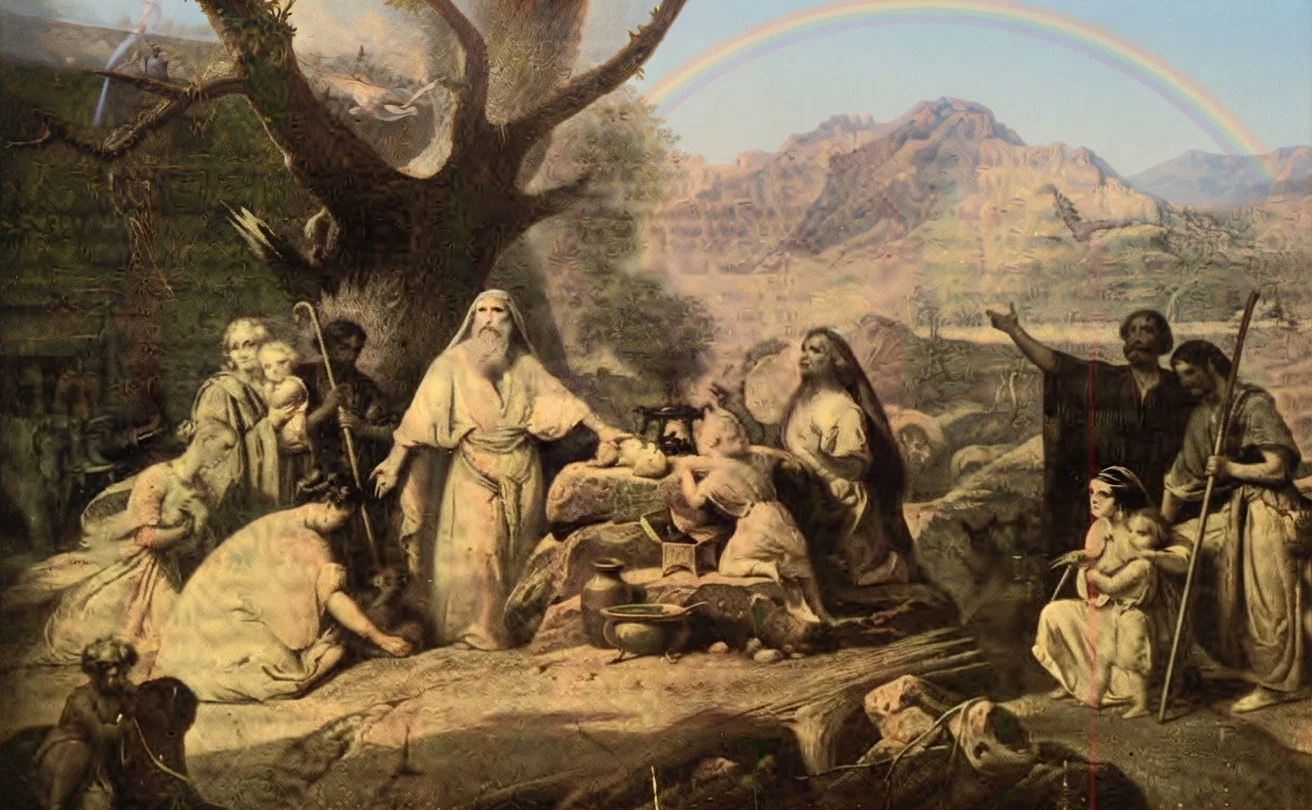
NOAH OFFERING SACRIFICE AFTER THE FLOOD
"Himself took our infirmities, and bare our sicknesses." Matt. 8:17.
"For when we were yet without strength, in due time ["according to the time," margin] Christ died for the ungodly." Rom. 5:6.
And this was all because "God so loved the world, that He gave His only-begotten Son, that whosoever believeth on Him should not perish [cease to exist], but have everlasting life." John 3:16.
We sometimes receive the testimony of men in reference to such things as they have seen and heard. And, "If we receive the witness of men, the witness of God is greater. . . . He that believeth on the Son of God hath the witness in him: he that believeth not God hath made Him a liar; because he hath not believed in the witness that God hath borne concerning His Son."
But what is the "witness" that God has testified, the which, if I refuse to believe, I have, to myself, made "God a liar"? I should tremble at the thought.
"And the witness is this, that God gave unto us eternal life, and this life is in His Son. He that hath the Son hath the life; he that hath not the Son of God hath not the life." 1 John 5:9-12, A. R. V.This, then, is the object of the shame He bore for us, His sufferings and death, — that we might be delivered from death, from sin which leads to death, and thereby share His righteousness unto life eternal.
To make the matter plain, that a Substitute had been provided, the Lord, in addition to the promise made to the guilty pair, on the first day of their transgression, provided a typical substitute for sinners, in the innocent lamb they were taught to offer.
In the first bleeding victim they were to "behold the Lamb of God, which taketh ["beareth," margin] away the sin of the world." John 1:29. Here, first, did they witness the agonies of death, and the sufferings of their divine Substitute. And as they beheld the innocent sufferer, their sorrow for sin became more real, and their repentance deepened.

Faith versus Works

"And in process of time it came to pass, that Cain brought of the fruit of the ground an offering unto the Lord.
"And Abel, he also brought of the firstlings of his flock and of the fat thereof. And the Lord had respect unto Abel and to his offering; but unto Cain and to his offering He had not respect. And Cain was very wroth, and his countenance fell." Gen. 4:3-5.
Here, at a very early date, the Lord allowed two principles to be demonstrated, — the principle of righteousness by faith, and that of righteousness by works; of salvation through Christ, and of self-salvation. Abel trusted in Another, Cain in himself. Abel’s offering caused repentance and heart-sorrow; Cain’s was followed by anger and wrath. And the failure of his self-appointed offering to meet the approval of God, engendered in his heart envy, jealousy, and murder.
And it was not primarily in the fact that Cain’s was an offering of fruit instead of a lamb, that he was not accepted of God. He had an entire misconception of the plan of salvation. Had it been possible for man to save himself, no Saviour would have been needed or given. "The wages of sin is death;" and nothing short of this can meet the demand of infinite justice. Man may meet this himself if he chooses; but having met it in his own person, he has no reserve of life with which to continue an existence. His career is ended. But in the person of his Substitute, the just penalty of an infinite law is met; the sinner’s enmity against God is taken away; and by his voluntary acceptance of pardon and grace, he is re-accepted into the family of God.

Faith Kept Alive by Sacrifice

In the same manner as that which was practised by Abel, the faith in a Redeemer to come was kept alive throughout the patriarchal age. Hence Noah, after the terrible Deluge was past, offered before God "of every clean beast, and of every clean fowl."
It was likewise true of the patriarch Abraham, that wheresoever he pitched his tent, "there he builded an altar unto the Lord, and called upon the name of the Lord." Gen. 12:8.
But never did Abraham understand so well the price paid for his salvation as when,
at the command of God, he was required to offer up his only-begotten son. Tho the act was not completed, tho the messenger of the Lord arrested his arm in the final act of this great drama, yet Abraham’s sorrow had compassed as much as if the final part had been accomplished. And Isaac, the willing partner in this great sacrifice, also understood better the voluntary offering of God’s dear Son for the saving of an ungrateful race.
And so great became Abraham’s faith in God and in His great plan of saving the race, that he was named the "father" of all who should believe. "And if ye be Christ’s, then are ye Abraham’s seed, and heirs according to the promise." Gal. 3:29.
Thence forward the "seed" of Abraham should play the greatest, if not the only, part in the plan of salvation. In reference to Christ, his "Seed" was the alpha and omega of salvation’s plan. But of his literal descendants, it was not so. It is true, however, that to these were committed "the lively oracles of God;" and therefore the study of God’s dealings with ancient Israel forms an important part in tracing the subject before us. This we hope to begin in our next.