Satan's Offer Accepted

4%

Pacific Press Publishing Association · Mountain View, Cal. · Oct 17, 1916

FromSigns of the Times, Vol. 43, No. 41.

Read the full edition

Satan's Offer Accepted

Christ Refused the Aid of the Civil Power

The Church Now Eagerly Seeking

What Her Lord Rejected

By William M. Healey
THE eternal principle and power by which God rules His kingdom is love. And it not only fills His whole kingdom, but permeates His own being; for "God is love." Those who do not possess this love have no acquaintance or connection with Him. "He that loveth not knoweth not God; for God is love." 1 John 4:8.
This love is not animal excitement, neither is it emotional nor sentimental feeling. It is an eternal principle, which underlies the law and the gospel of God, and when manifest in mankind, is a "willing mind" to obey the great principles of right, justice, and truth, even to the exercise of mercy, through which God gave Jesus Christ to die for sinners, that all who choose the way of God may be like Him, and share in His blessings. "Whosoever will, let him come."
No Sunday law, nor other religious law, will ever be forced upon others by those who love their neighbor as themselves. The very act of enforcing one's beliefs and dogmas upon another proves an unwillingness to accept the other's doctrines; and no one can be willing to be compelled to do that which he himself is unwilling to do. Therefore he is not doing to others as he would have others do to him.
From "Great Controversy"

No Appeal to Civil Power

THIS law of love was drawn out, by Christ, into two commandments. "Thou shalt love the Lord thy God with all thy heart, and with all thy soul, and with all thy mind. This is the first and great commandment. And the second is like unto it, Thou shalt love thy neighbor as thyself. On these two commandments hang all the law and the prophets." Matt. 22:37-40. These same commandments of love were taught by Moses. See Deut. 10:12; and Lev. 19:18.
That mankind might better comprehend the meaning of the words "Love thy neighbor as thyself," Christ said, "Therefore all things whatsoever ye would that men should do to you, do ye even so to them." Matt. 7:12.
Christ never appealed to civil government to compel people to follow Him. He made no effort to conquer by force. When accused before Pilate of claiming to be a king, He admitted the charge, but said: "My kingdom is not of this world: if My kingdom were of this world, then would My servants fight." The result of such a fight, the mob could easily conjecture by calling to mind their experience of a few hours previous, when Christ stepped toward them in the darkness, restraining His power, that He might be able to give Himself into their hands, and even then they staggered back, and "fell to the ground."

Kingdom Suffers Violence

THE disposition to compel people, by law and force, to be religious, is not the Spirit of the "meek and lowly Nazarene." It is the spirit of oppression and violence. Jesus said, "The kingdom of heaven suffereth violence, and the violent take it by force." This spirit manifested itself among the disciples of Jesus as they were passing through a Samaritan village, and the people refused to entertain them for the night, because they were going up to Jerusalem to worship, and the Samaritans held that Mount Gerizim was the proper place for the temple and for public worship.
The disciples were so incensed over this treatment, all on account of their religion, that Peter and John asked permission to call fire down from heaven, and burn up those people who differed from them in religious belief. To this request Jesus answered, "Ye know not what manner of spirit ye are of." Luke 9:55.
Between the Jews and the Samaritans it was a question of which place was sacred. To-day it is a question of which day is holy; and now, as then, the rebuke of Christ rests upon all who would use force to punish those who differ from them. It is not the Spirit of Christ that prompts the demand for a law to punish people for not observing a day as holy. "Now if any man have not the Spirit of Christ, he is none of His." Rom. 8:9.
Probably the greatest temptation offered Christ was, to accept the power of civil government to support the church. When Christ came forth, weak and emaciated, from His forty days of temptation, the devil asked Him to show His creative power, if He was Christ, by making the stones into bread. "Jesus refused, because there was no "word of God" for it. Next the devil took Him up to the dizzy heights of the pinnacle of the temple, and said: "It is written, He shall give His angels charge concerning thee: and in their hands they shall bear thee up, lest at any time thou dash thy foot against a stone." Then he asked Him to cast Himself down from the temple, and trust in the angels to take care of Him, if, as He claimed, He believed in the "word of God." Jesus replied, "It is written again, Thou shalt not tempt the Lord thy God." Matt. 4:6, 7. God had not promised His care and protection for those who would do presumptuous things.
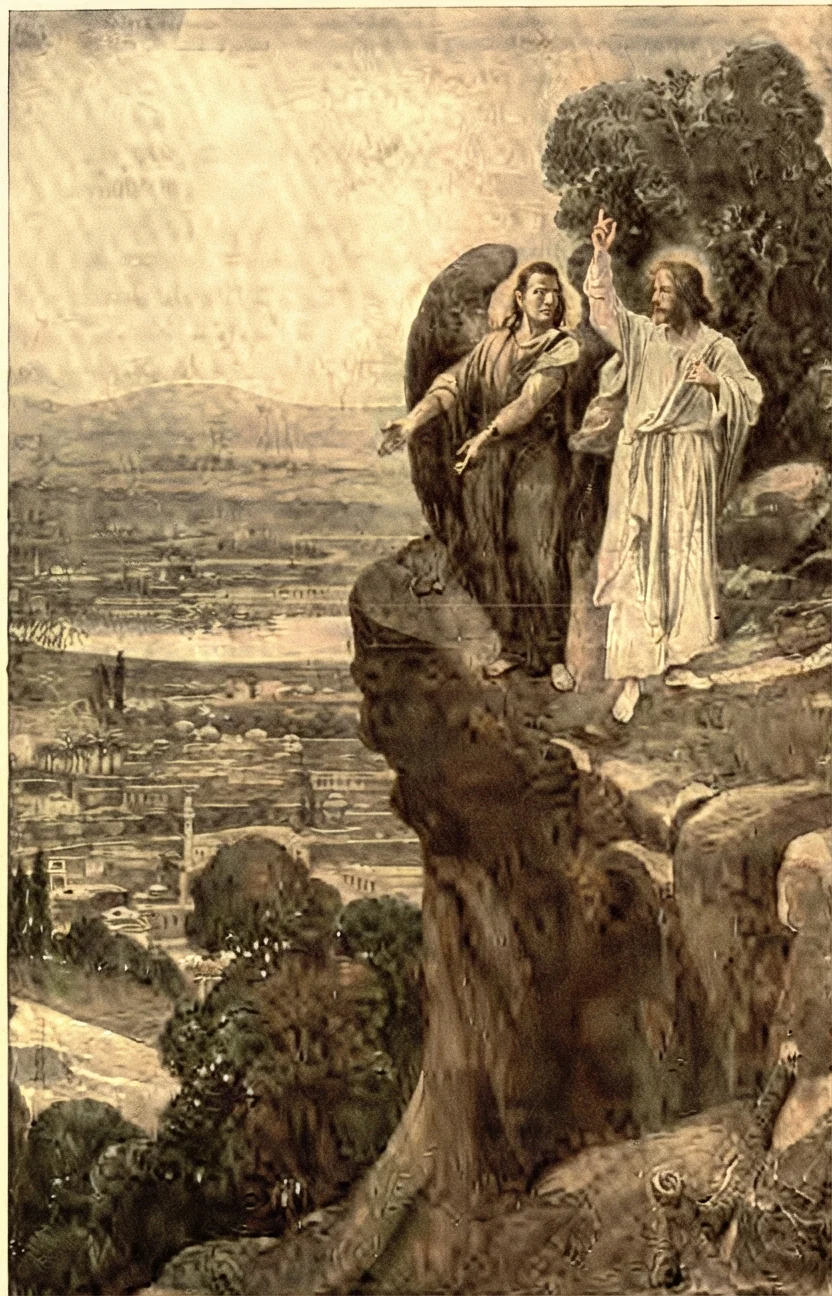
Lastly the devil took Him to the top of a high mountain, to present his greatest temptation, and "showed unto Him all the kingdoms of the world in a moment of time. And the devil said unto Him, All this power will I give Thee, and the glory of them: for that is delivered unto me; and to whomsoever I will I give it. If Thou therefore wilt worship me, all shall be Thine." Luke 4:5-7.

A Disastrous Union

JESUS had come to redeem a lost world, and He well knew the trials and sorrows that awaited Him and those who should follow Him. He foresaw the church rejecting Him, and its intrigue with civil authority for power to put Him to death. He beheld the wars and desolations that would come on the earth. He saw the millions of faithful martyrs that would suffer indescribable torture and death for His sake, by the church using civil law to enforce its creed.
How much better it would seem to be if Christ would accept this offer, and use earthly kingdoms to support His church, instead of having them arrayed against Him! This opportunity to stop the wars and strife among nations must have appealed to the sympathetic heart of the loving Saviour.
But there was a reservation clause in Satan's offer. He had not agreed to complete abnegation of his kingdom, but was determined to retain a place in it. Jesus spurned the offer, because such a union would destroy the church, taking from it the spirit of love, and adding the power of physical force.
The church afterward accepted that which Christ had rejected,—the aid of civil power to enforce its teaching,—and soaked the earth with the blood of millions of martyrs. They began the union of church and state in the time of Constantine in exactly the same way they are beginning it now, by enacting a Sunday law contrary to God's law, opposed to the gospel of love, and in violation of the principles of liberty.