WHILST few of one’s readers may be able to trace their origin, many are doubtless aware that the written Chinese hieroglyphics are reverenced almost to a point of superstitious worship.
At Changsha, Hunan, it is not uncommon to see small boxes or baskets hung on street walls marked “to receive paper.” One will also notice wads of paper stuck in niches of the wall or between cracks of boards. Men employ laborers who go the rounds tearing down all loose ends of posted advertisements; all of which is to save the written character from being trampled under foot. Paper thus collected is taken to one of the many small pagodas erected for the purpose, and there burned.
When many copies are required for books, etc., the original is written on very thin paper and pasted on a wooden block reverse side up. This brings the characters in clear view of the carver as he chisels them out. Ordinary-sized characters can be carved at the rate of from 100 to 200 a day by a good workman. A dull fluid ink is then rubbed over the slab thus prepared, and the paper placed over it. By rubbing the paper with a soft fiber pad the impression is made. This plan secures an exact copy of the original writing or drawing as the case may be. If it is a trifle slow, it has the merit of dispensing with compositors, and proof-readers are seldom required; above all, it is a very cheap process. We have had tracts prepared in this way which were sold with a tiny margin of profit. Of course the expense of distribution was additional.
Unfortunately, this Chinese method of printing from wooden blocks is not always used for the best purposes. The notorious Chou Han, of this prefecture, who circulated by the million his pictorial descriptions of “foreign devils” and their atrocities, used this device. One of these publications represented two foreigners, previously done to death on the Yangtse in 1891, as being exterminated by government soldiers. And we are told, another placard had a crucified pig to represent the scene at Calvary. There is a play on the words for “Lord” and “pig” in Mandarin. We are at present trying to arrange a meeting with this renowned character who is undergoing a life-sentence at Changsha.
Those Chinese who studied and mastered these hieroglyphics constituted the first of the four classes into which the Chinese, for convenience, are divided; namely, scholars, farmers, workmen, and shopkeepers.
Until more recent years, most of the literature in China was in the classic of ancient style, as represented by the Confucian Classics. This was not spoken unless in apt quotations to give a speaker vivacity. Then there was the official or court language called “Mandarin.” Civil officials are not usually appointed to office in their own province. Hence if a Cantonese were appointed to Changsha, or an Amoy man sent to Kansuh, their speech would not be understood of the people in their constituency. But in order that no misunderstanding should arise from their proclamations, Mandarin was used as the text. But such Mandarin and that used, for instance, in the Bible text, were in a large measure alike in name only.
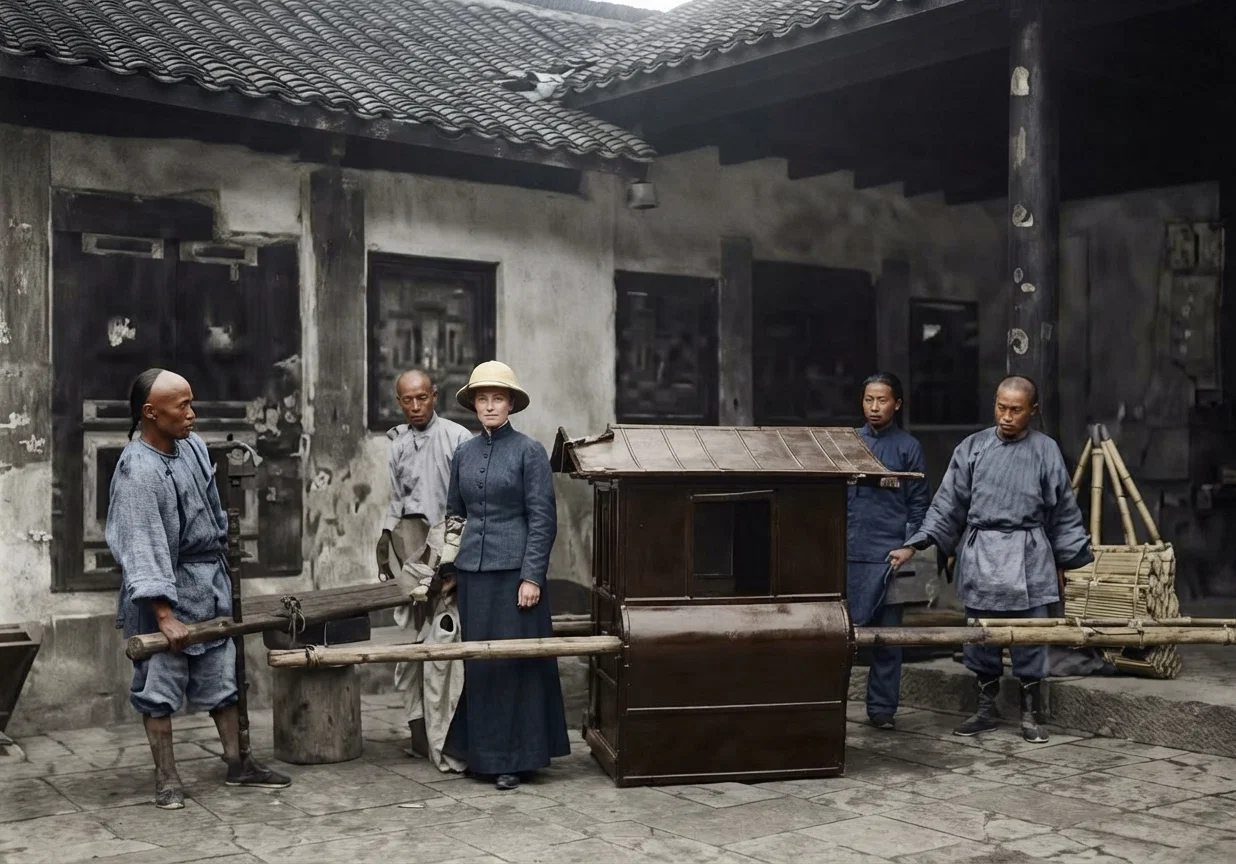
Lady missionary starting on an itinerary in Si-Chuen.
We are indebted to our predecessors for the translation of the Bible and other works into the most widely spoken of Chinese dialects called “Mandarin.” And inasmuch as it is reputed that more than two-thirds of China’s four hundred millions are acquainted with Mandarin, one may be pardoned for saying it is one of the world’s greatest dialects, if not the greatest. Chinese newspapers are now adopting it, but not altogether. While no two provinces may speak this Mandarin alike exactly, and as one has often found that the people separated by a few miles will differ in their local patois, yet those able to read will readily understand Mandarin, while the majority will obtain a fair idea of your meaning when you engage in conversation with them. Thus it is not difficult to see what an enormous field is covered by the word “Mandarin” when applied to Chinese literature. But let us not forget that the vast majority of men and comparatively few women being unable to read, they must still be reached by the human voice.
Tsoan Tsui, one of the latest helpers in Amoy.
That tracts sell readily will be seen. As a result of an eighteen-days’ trip into a district east of Changsha, nearly 3,000 tracts were sold. Had you been following the distributors, you would have observed little groups of people standing around one who had purchased a tract, and he would be reading aloud, thus giving the contents to many who had not purchased a book for themselves. The number of sales is by no means a criterion of the numbers who gather the contents of books.
May I close with an illustration which has ever been an encouragement to me? A missionary once knelt beside the emaciated body of an Oriental whose life was fast ebbing away. Every now and then the man would beat his breast with his hand clenched tightly as tho containing some prized treasure. When he had breathed his last, the missionary gently opened the clenched hand and a piece of very dirty paper fell out. After some trouble he eventually made out the translated text, “The blood of Jesus Christ . . . cleanseth . . . from all sin.” Somebody had made it possible to provide that little silent messenger. Was that “somebody” you?
We are grateful that our S. D. A. Mission Press is in operation, and trust our friends will rally to support it by prayers and offerings.