Conditions in Spain

8%

Pacific Press Publishing Association · Mountain View, California · Jul 12, 1910

FromSigns of the Times, Vol. 37, No. 27.

Read the full edition

Conditions in Spain

[We regret the delay of this article through oversight, but its information is just as cheering now. Thank God for the agitation. In it earnest, honest souls will learn the truth.—Editor.]
A CONSTANT state of unrest and dissatisfaction has prevailed in political circles in this country for many months. The Spanish ministry a few months since underwent two radical changes. We sincerely hope that these changes may result in bringing about much-desired reforms in some of the laws of the land. A great agitation is now on. Mighty issues are at stake. Important questions are freely discussed by the public press, and also by the greatest orators of the country.
The Roman Catholic element is wide-awake, and great mass-meetings have been held by the leaders of that church. Their object is to appeal to the ruling powers, that more stringent laws against religious tolerance may be made and enforced. They apparently realize that it is possible that the relation sustained by the Catholic Church to the Spanish Government may be somewhat altered.
The Republican party, and all of the liberty-loving element, are holding immense meetings and making great demonstrations in favor of religious liberty and other liberal laws. They are endeavoring to establish throughout the country non-Catholic schools. During the past few weeks a special campaign in favor of religious liberty has been begun by the leading Protestant societies of Madrid. In fact all Protestants of the country are given a part to act. Officially drawn up documents or petitions have been scattered from one end of the land to the other in all Gospel mission stations. These petitions call for religious liberty. They are soon to be presented to the central government. Thousands of citizens are placing their signatures on these petitions, thus declaring their disapproval of being bound under the iron hand of Rome.
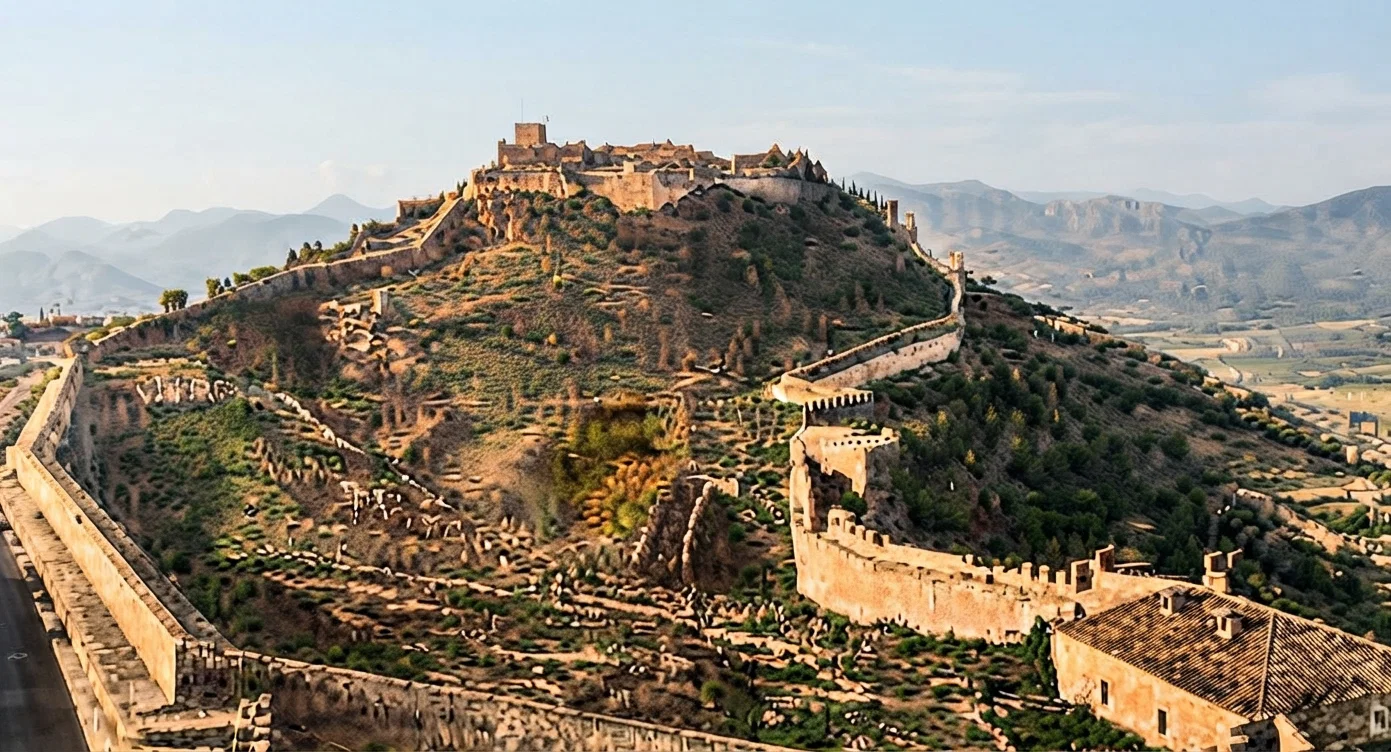
The Castle of Sapunto. This ancient fortress was once besieged by Hannibal, and here one of his most famous battles was fought. It is about fifteen miles north of Valencia. Spain has to-day many greater strongholds of sin to be besieged.
A company of able Protestant speakers are visiting the larger cities and conducting mass-meetings in favor of liberty of conscience. Such a meeting was held a week ago last evening in Valencia, and the theater where it was conducted was well filled.
We believe, these unusual movements in Spain are significant, and we trust that brighter days are before the Gospel missionary in this land which for so many centuries has been dominated by the errors and superstitions of Roman Catholicism. Should the Spanish Government grant the liberty sought, we can not believe that it would be permanent. We do believe, however, that it might be in vogue long enough for God's children to herald the great threefold message of Rev. 14:6-12 to every city, town, village, and hamlet of this fair land.
The same spirit which actuated the founders of the Spanish Inquisition is at work here to-day. Only a few weeks ago, at a large Catholic meeting held in Valencia, one of the most prominent speakers made the following statement: "My cry of protest is to pray the public powers to suppress Article XI of the government constitution [also mentioned other articles which he would have suppressed]; and to bring this about, to shed the last drop of blood, even the last cartridge. Just as our Lord shed His blood for the cause, so must we do the same."
The articles of the constitution referred to by the speaker, are those which grant the suppressed religious tolerance existing here to-day. Were these articles stricken from the constitution, one can readily appreciate what the conditions would be. The machinery of the Inquisition would be quickly set in motion. The power which ground the very life blood from many thousands of Spain's noble sons and fair daughters during the sixteenth century is alive here to-day. Romanism in Spain at the present time is very similar to Romanism in Spain during the sixteenth and seventeenth centuries.
While in some lands, in order to compete successfully with other religious bodies, Rome to-day is compelled to take on an outward modern aspect, in Spain such is not the case.
The great need here to-day is the Gospel of Christ in its purity. This is the only power by which the fetters of Romanism can be broken. "And he that hath My Word, let him speak My Word faithfully. What is the chaff to the wheat? saith the Lord. Is not My Word like as a fire? saith the Lord; and like a hammer that breaketh the rock in pieces?" Jer. 23:28, 29. FRANK S. BOND. Paterna (Valencia), Spain.