"Let the Revelation speak and tell what is truth. . . . Uplift Jesus as the center of all hope."
IV. The Triumphant Son of Man
MAN is a personal being, the creature of a personal God. We may not describe or seek to describe that Being of majesty infinitely imperial; of glory to mortals insupportable, unapproachable; of power unlimited, overwhelming; of love immeasurable, all-comprehending;
"Whom none can comprehend and none explore,
Being whom we call God and know no more."
Yet does He ever reveal Himself to us as a personal God. The prayer taught by our Saviour, "Our Father who art in heaven," is an expression in epitome of the teaching of the Scriptures of a personal God. Let the religio-infidel prate of anthropomorphism if he will; the Bible reveals a Father God, a Brother Saviour. It teaches that He has a throne somewhere in His universe; that while His all-pervading presence is everywhere by His Spirit, yet the personal God is somewhere as He is nowhere else; that at that center of light and love, of power and wisdom, countless messengers bow gladly before Him, and speed with dynamic wings on their errands of love and peace and blessing. That man might apprehend the same truth and in a little degree comprehend it, God sent His Son to this world. That Son became flesh, and dwelt among men in the form of man, ever teaching the Father's personality and loving over-providence of the children of men.
And this is in harmony with revealed scientific facts. There are no manifest operating energies of nature without a center from which they proceed. Light and heat do not break forth from vacant space; they radiate from a central source. The wireless cry of distress from the sinking ship is not evolved from emptiness; it is pulsated forth from a powerful battery, a center of electric energy, and it is caught not in space, but from space by other centers of energy, or centers responsive to energy.
THE REVELATION OF JESUS CHRIST
God, our God, is the great center of power, of energy, of life, of wisdom, of knowledge, of love, in the great unmeasured universe of His handiwork. The power of personal man in his very limited sphere is sometimes marvelous; God's power is infinite, immeasurable, and by His Spirit He is in constant touch with all things living in all parts of His dominion.
We do not understand, however, that the description given of our Lord in the lesson of this week is a literal description of His person. Human art would seek to make all things beautiful, symmetrical, and orderly even in symbol; but God's symbolism emphasizes truth, character, and moral lesson.
The Revelation is not alone a book of symbolism; it is a book of experiences. It records all the various phases of the trials and experiences of the church of God amid the turmoils and perils of earth, and it also throws great light upon our Lord's experience, and our experience in Him. To reveal these experiences Christ chose one who had drunk deeply of what He Himself had passed through. No novice could rightly witness of the suffering, power, and glory of the Master. The instrument must be one attuned to the deeper, tenderer minor chords of life as well as to its sweeter symphonies, its grand harmonies, its triumphant praises. He chose John the beloved disciple; yet John never boasts of the honor accorded him. He is "a servant."
(For article see page 6)
The Answer of the Text
[The answers to the questions are from the American Revised Version. Omitting questions, and disregarding sometimes the capitals at the beginning and the period at the close of an answer, the text may be read continuously. In notes and comments both versions are used without designation.]
1. Whom does John declare himself to be?
"I John, your brother and partaker with you in the tribulation and kingdom and patience which are in Jesus."
2. Where was he when he wrote the book, and why?
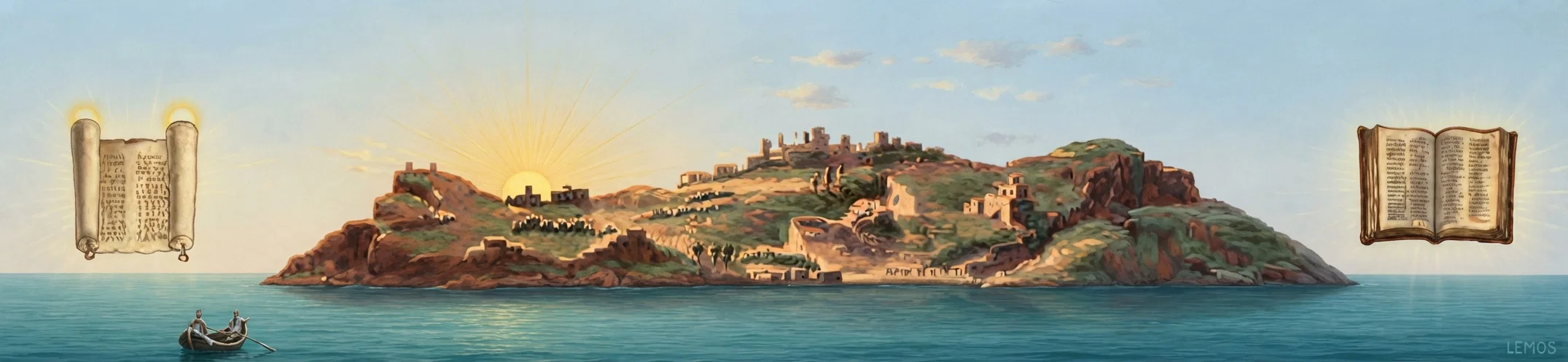
"Was in the isle that is called Patmos, for the Word of God and the testimony of Jesus."
3. What occurred to him on a Sabbath day?
"I was in the Spirit on the Lord's Day."
4. What did he hear in his vision?
"And I heard behind me a great voice, as of a trumpet saying, What thou seest, write in a book and send it to the seven churches: unto Ephesus, and unto Smyrna, and unto Pergamus, and unto Thyatira, and unto Sardis, and unto Philadelphia, and unto Laodicea."
5. As the prophet looked what did he at first see?
"And I turned to see the voice that spake with me. And having turned I saw seven golden candlesticks."
6. Who was in the midst of the candlesticks?
"And in the midst of the candlesticks One like unto a Son of Man."
7. How was He clothed?
"Clothed with a garment down to the foot, and girt about at the breasts with a golden girdle."
8. What further description is given?
"And His head and His hair were white as white wool, white as snow; and His eyes were as a flame of fire; and His feet like unto burnished brass, as if it had been refined in a furnace; and His voice as the voice of many waters. And He had in His right hand seven stars: and out of His mouth proceeded a sharp two-edged sword: and His countenance was as the sun shineth in his strength." 79. How did His glory affect the prophet?
"And when I saw Him, I fell at His feet as one dead."
10. What words of assurance were given?
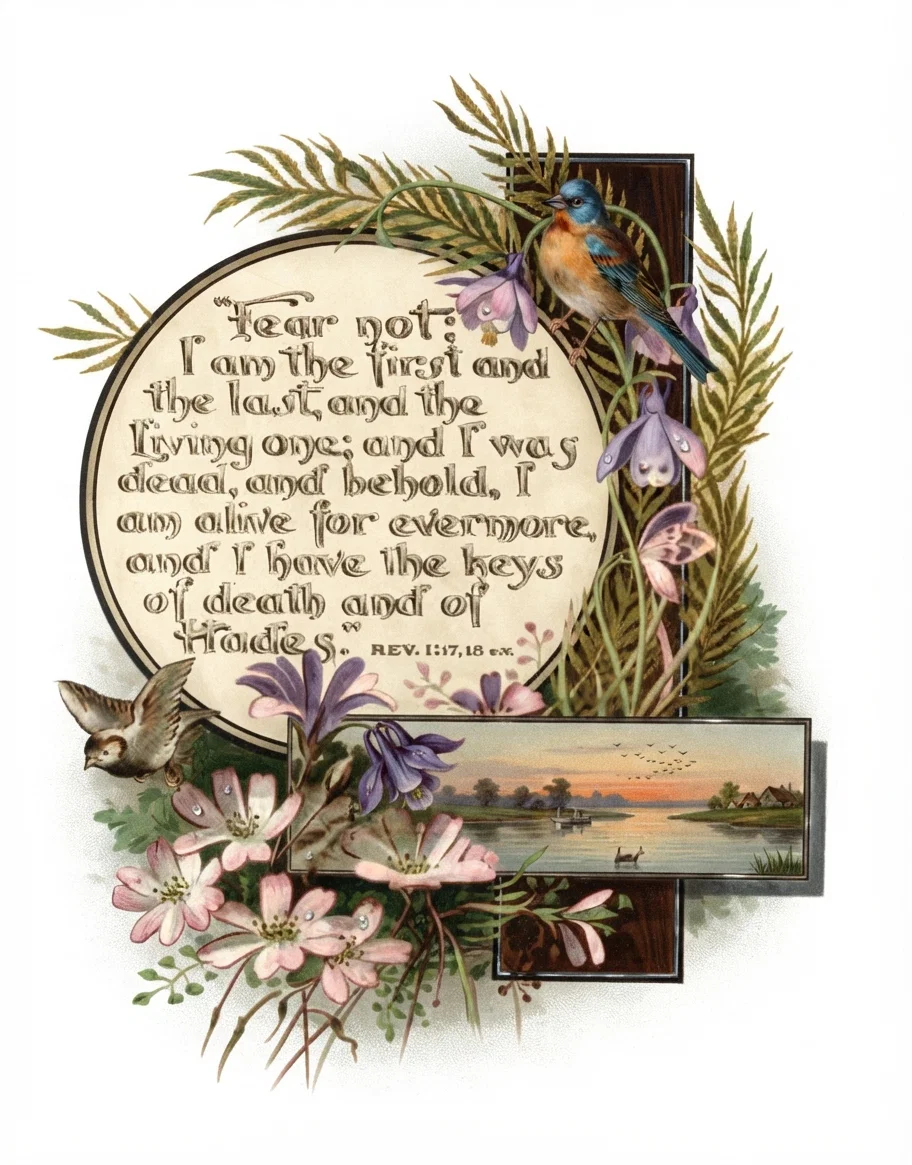
"And He laid His right hand upon me, saying, Fear not; I am the first and the last, and the living One; and I was dead, and behold, I am alive forevermore, and I have the keys of death and of Hades."
11. What instructions were given John?
"Write therefore the things which thou sawest, and the things which are, and the things which shall come to pass hereafter."
12. What symbols were explained?
"The mystery of the seven stars which thou sawest in My right hand, and the seven golden candlesticks. The seven stars are the angels of the seven churches: and the seven candlesticks are seven churches."