"Let the Revelation speak and tell what is truth. . . . Uplift Jesus as the center of all hope."
IV. The Triumphant Son of Man
MAN is a personal being, the creature of a personal God. We may not describe or seek to describe that Being of majesty infinitely imperial; of glory to mortals insupportable, unapproachable; of power unlimited, overwhelming; of love immeasurable, all-comprehending;
"Whom none can comprehend and none explore,
Being whom we call God and know no more."
Yet does He ever reveal Himself to us as a personal God. The prayer taught by our Saviour, "Our Father who art in heaven," is an expression in epitome of the teaching of the Scriptures of a personal God. Let the religio-infidel prate of anthropomorphism if he will; the Bible reveals a Father God, a Brother Saviour. It teaches that He has a throne somewhere in His universe; that while His all-pervading presence is everywhere by His Spirit, yet the personal God is somewhere as He is nowhere else; that at that center of light and love, of power and wisdom, countless messengers bow gladly before Him, and speed with dynamic wings on their errands of love and peace and blessing. That man might apprehend the same truth and in a little degree comprehend it, God sent His Son to this world. That Son became flesh, and dwelt among men in the form of man, ever teaching the Father's personality and loving over-providence of the children of men.
And this is in harmony with revealed scientific facts. There are no manifest operating energies of nature without a center from which they proceed. Light and heat do not break forth from vacant space; they radiate from a central source. The wireless cry of distress from the sinking ship is not evolved from emptiness; it is pulsated forth from a powerful battery, a center of electric energy, and it is caught not in space, but from space by other centers of energy, or centers responsive to energy.
THE REVELATION OF JESUS CHRIST
God, our God, is the great center of power, of energy, of life, of wisdom, of knowledge, of love, in the great unmeasured universe of His handiwork. The power of personal man in his very limited sphere is sometimes marvelous; God's power is infinite, immeasurable, and by His Spirit He is in constant touch with all things living in all parts of His dominion.
We do not understand, however, that the description given of our Lord in the lesson of this week is a literal description of His person. Human art would seek to make all things beautiful, symmetrical, and orderly even in symbol; but God's symbolism emphasizes truth, character, and moral lesson.
The Revelation is not alone a book of symbolism; it is a book of experiences. It records all the various phases of the trials and experiences of the church of God amid the turmoils and perils of earth, and it also throws great light upon our Lord's experience, and our experience in Him. To reveal these experiences Christ chose one who had drunk deeply of what He Himself had passed through. No novice could rightly witness of the suffering, power, and glory of the Master. The instrument must be one attuned to the deeper, tenderer minor chords of life as well as to its sweeter symphonies, its grand harmonies, its triumphant praises. He chose John the beloved disciple; yet John never boasts of the honor accorded him. He is "a servant."
(For article see page 6)
The Answer of the Text
[The answers to the questions are from the American Revised Version. Omitting questions, and disregarding sometimes the capitals at the beginning and the period at the close of an answer, the text may be read continuously. In notes and comments both versions are used without designation.]
1. Whom does John declare himself to be?
"I John, your brother and partaker with you in the tribulation and kingdom and patience which are in Jesus."
2. Where was he when he wrote the book, and why?
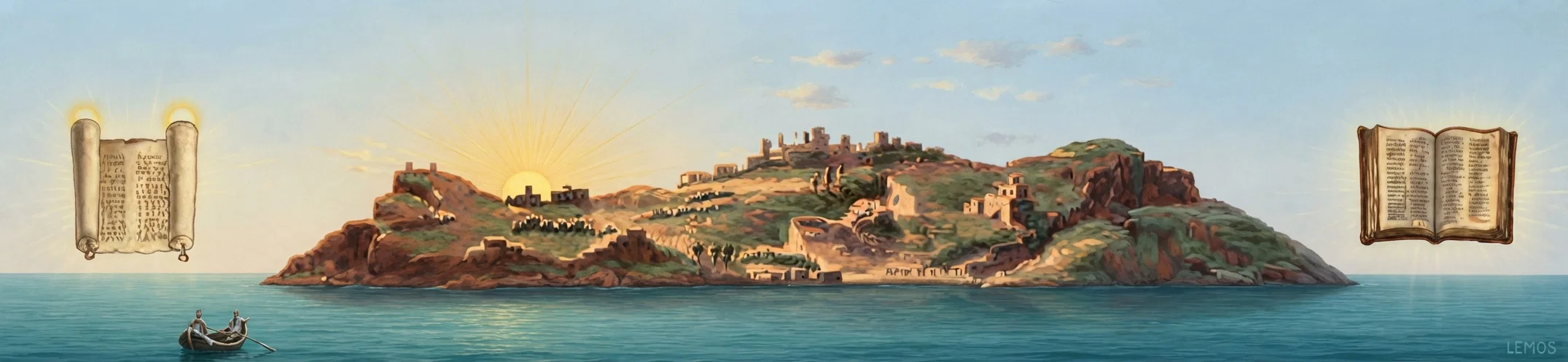
"Was in the isle that is called Patmos, for the Word of God and the testimony of Jesus."
3. What occurred to him on a Sabbath day?
"I was in the Spirit on the Lord's Day."
4. What did he hear in his vision?
"And I heard behind me a great voice, as of a trumpet saying, What thou seest, write in a book and send it to the seven churches: unto Ephesus, and unto Smyrna, and unto Pergamus, and unto Thyatira, and unto Sardis, and unto Philadelphia, and unto Laodicea."
5. As the prophet looked what did he at first see?
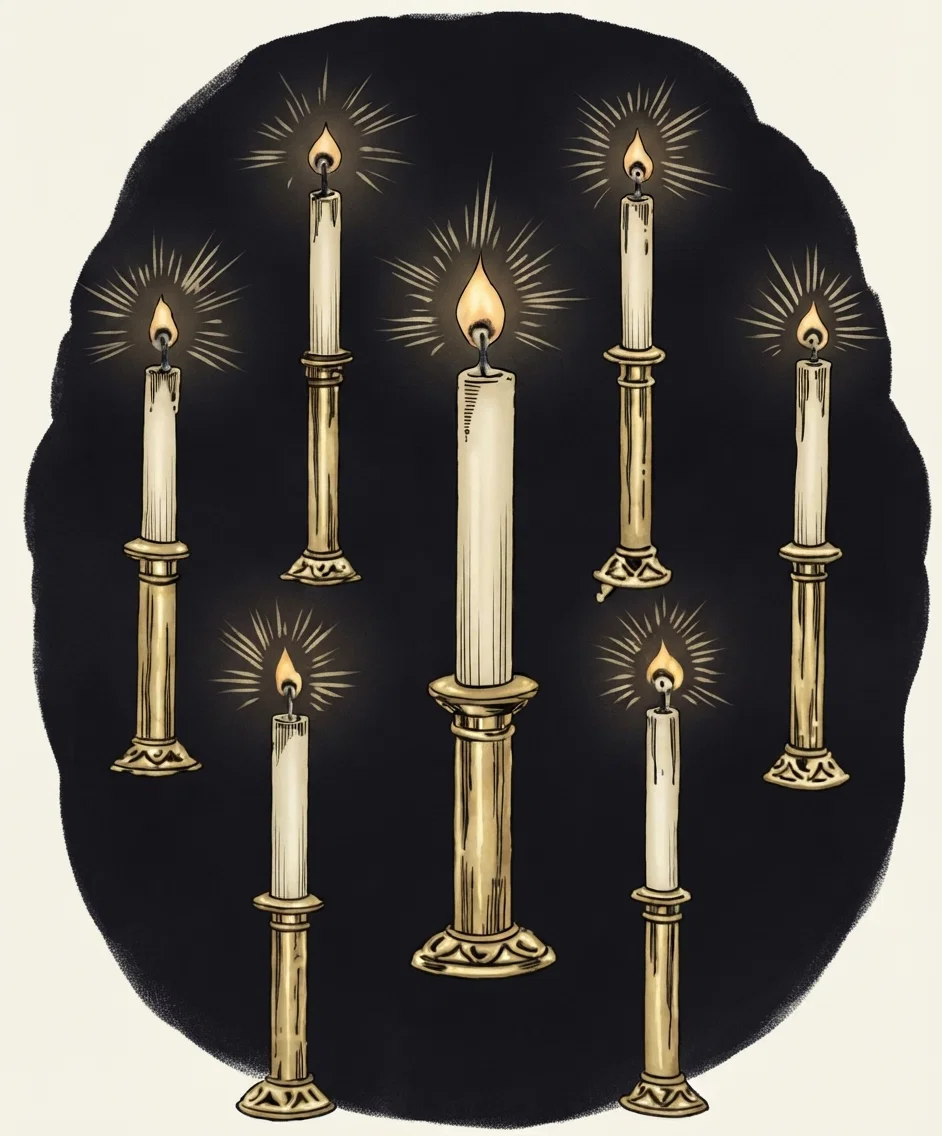
"And I turned to see the voice that spake with me. And having turned I saw seven golden candlesticks."
6. Who was in the midst of the candlesticks?
"And in the midst of the candlesticks One like unto a Son of Man."
7. How was He clothed?
"Clothed with a garment down to the foot, and girt about at the breasts with a golden girdle."
8. What further description is given?
"And His head and His hair were white as white wool, white as snow; and His eyes were as a flame of fire; and His feet like unto burnished brass, as if it had been refined in a furnace; and His voice as the voice of many waters. And He had in His right hand seven stars: and out of His mouth proceeded a sharp two-edged sword: and His countenance was as the sun shineth in his strength." 79. How did His glory affect the prophet?
"And when I saw Him, I fell at His feet as one dead."
10. What words of assurance were given?
"And He laid His right hand upon me, saying, Fear not; I am the first and the last, and the living One; and I was dead, and behold, I am alive forevermore, and I have the keys of death and of Hades."
11. What instructions were given John?
"Write therefore the things which thou sawest, and the things which are, and the things which shall come to pass hereafter."
12. What symbols were explained?
"The mystery of the seven stars which thou sawest in My right hand, and the seven golden candlesticks. The seven stars are the angels of the seven churches: and the seven candlesticks are seven churches."
9. I John, who also am your brother, and companion in tribulation, and in the kingdom and patience of Jesus Christ, was in the isle that is called Patmos, for the Word of God, and for the testimony of Jesus Christ.
10. I was in the Spirit on the Lord's day, and heard behind me a great voice, as of a trumpet,
11. Saying, I am Alpha and Omega, the first and the last: and, What thou seest, write in a book, and send it unto the seven churches which are in Asia; unto Ephesus, and unto Smyrna, and unto Pergamus, and unto Thyatira, and unto Sardis, and unto Philadelphia, and unto Laodicea.
12. And I turned to see the voice that spake with me. And being turned, I saw seven golden candlesticks;
13. And in the midst of the seven candlesticks one like unto the Son of Man, clothed with a garment down to the foot, and girt about the paps with a golden girdle.
14. His head and His hairs were white like wool, as white as snow; and His eyes were as a flame of fire;
15. And His feet like unto fine brass, as if they burned in a furnace; and His voice as the sound of many waters.
16. And He had in His right hand seven stars: and out of His mouth went a sharp two-edged sword: and His countenance was as the sun shineth in his strength.
17. And when I saw Him, I fell at His feet as dead. And He laid His right hand upon me, saying unto me, Fear not; I am the first and the last:
18. I am He that liveth, and was dead; and, behold, I am alive forevermore, Amen; and have the keys of hell and of death.
19. Write the things which thou hast seen, and the things which are, and the things which shall be hereafter;
20. The mystery of the seven stars which thou sawest in My right hand, and the seven golden candlesticks. The seven stars are the angels of the seven churches: and the seven candlesticks which thou sawest are the seven churches.
Notes and Comment
1. "The Tribulation."—Our word "tribulation" comes from tribulum, a thrashing instrument used to beat out the corn. The Greek word thlipsis means pressure, squeezing, affliction, oppression. Once John and James wished a high place in Christ's work, Jesus told them that they knew not the meaning of their request, and He then asked them if they were able to drink of the cup of which He would drink, and be baptized with His baptism. Confidently they said, "We are able." They did indeed drink of it. James was slain by the sword of Herod. John, tradition tells us, was cast into a caldron of boiling oil, out of which God saved him. Afterward he was banished to Patmos. It was part of life's discipline to fit him for better service. The kingdom of God is not entered by mere profession. It is "through many tribulations we must enter into the kingdom of God." Acts 14:22. The wheat must be separated from the chaff. The oil, the wine, must be pressed out. Tribulation worketh patience—endurance. Yet, tho enduring tribulation, he was yet in Christ, in the kingdom; for he had been delivered "out of the power of darkness, and translated . . . into the kingdom of the Son of His love." Col. 1:13. All these are in Jesus, and in Him are we brothers and partakers with all the good of all ages.
2. "The Word of God."—John was a preacher of that Word in word and life, and its mighty truth stirred up the hatred of hearts of evil. The words of Christ were, "If they persecuted Me, they will also persecute you." John 15:20. "The Testimony of Jesus."—Once John wanted the testimony, the witness, of Jesus to assure him a place of honor. Now he is banished to a desolate island because of it. It is generally held that John exercised a watch-care over the churches of Asia Minor, of which Ephesus was the largest. From this field, to silence his witness to Christ, the testimony of Jesus in him, he was banished to lonely Patmos. But both Word of God and testimony of Jesus were with him; and his desolate prison, designed to silence his message, became an audience-chamber of God, a sevenfold avenue for the light of life to reach the world.
3. "The Lord's Day."—We do not need to speculate as to what day of the week this was, if we will but take the Word of God, for loyalty to which John was banished. Surely Protestants—Christians—want no other testimony; and the Word is very clear, as these witnesses will assure us: (1) The Spirit of Christ, speaking through Isaiah the prophet (1 Peter 1:10, 11), designates the Sabbath as "My holy day." Isa. 58:13. Therefore the Sabbath is our Lord's holy day. (2) Jesus confirms this by declaring, "The Son of Man is Lord of the Sabbath." Matt. 12:8. (3) The eternal law of God declares that "the seventh day is the Sabbath of the Lord thy God." Ex. 20:10. Therefore there can be but one conclusion from the Word of God; namely, that the Lord's day is identical
with the eternal Sabbath of Jehovah. That seventh-day Sabbath immediately precedes the first day of the week. Mark 16:1, 2. The Bible knows no other Sabbath, no other weekly worship day. It is the day designated of God to honor both the Maker and Redeemer of the world; for creative power is manifest in both. The memorial of a finished creation became the window through which the prophet in vision could look forward through the mists and fog-banks of sin, over the persecutions and sorrows of centuries, to God's glorious recreation, and the evanishment of sin and death forevermore.
4. "Voice."—"Voice" is used for the speaker. It expresses his individuality. So John the Baptist was "the voice of one crying in the wilderness." John 1:23. The Good Shepherd is known by His voice. John 10:3. The trumpet voice carries us back to that time when it spoke from heaven the holy Decalogue. See Ex. 19:19; 20:1-17; Deut. 5:22. "Seven Churches."—Representing conditions in the entire church of God throughout the Christian dispensation. Local conditions in the churches named, and the order in which the churches were named, were typical of the whole church from that time to the end. "The then actual condition of these churches appears to have been providentially permitted to be illustrative of the moral and spiritual condition of all subsequent times."—Baley.
5. "Seven Golden Candlesticks."—Explained by our Lord as meaning the seven churches. Verse 20. Not themselves light, but receptacles, mediums, by which the light of God should shine to the world. Christ is the "Light of the world;" and when He dwells in humanity, those in whom He dwells become the light of the world. John 8:12; Matt. 5:14. He is the Word, the lamp, the light (Ps. 119:105; Prov. 6:23) personified (John 1:14). So His disciples should ever be "lights in the world," "holding forth the Word of light." Phil. 2:15, 16. Like John the Baptist they should be "burning and shining" lights. Only by the living Word in the lives of the members can a church meet God's purpose, and only by so abiding can her candlestick remain. Jesus Christ will furnish the oil and the light if the church is willing to be God's candlestick.
6. Son of Man.—O, the wonderful condescension of God. He who was from eternity, the Creator with the Father of the almost infinite universe, consented for the demonstration of God's love to become a brother to sinful men, was made "in all things" like them, took upon Him their sins, became sin for their sakes, that they might become the righteousness of God in Him, and be saved to all eternity to the praise and glory of God. This was the love of God in Jesus Christ. And now glorified He is still man tho God; and so He reveals Himself that we may faintly perceive what He will do for all who will identify themselves with Him. Once before, John saw Him glorified on the Mount of Transfiguration. Mark 9:2, 3.
7 "A Garment."—The long robe and the girdle around the breast indicate royal dignity, the royal priesthood of Christ. For Christ's robe and girdle see Dan. 10:5; Isa. 11:5; Eph. 6:14; the robe of righteousness, the golden girdle of truth.
8. "White as white wool," symbolizing not age or decay, but perfect purity. Dan. 7:9; Mark 9:3. "Eyes as flame of fire," piercing, penetrating, searching out iniquity, destroying sin. Rev. 19:12; Ex. 24:17; Jer. 17:10. "Feet as burnished brass," passing through the furnace of affliction, and emerging with greater, more manifest power and glory. "Voice" as many waters, denoting distinctiveness, fulness, power. Daniel has it "as a multitude" (10:6), and both are combined in Ezekiel (1:24). "Right hand," the hand of authority, of power and skill. "Stars," a circlet of symbolizing angels. Verse 20. "A sharp two-edged sword," the Word of God, the word of power. See Eph. 6:17; 2 Thess. 2:8; Heb. 4:12; Rev. 19:15. "As the sun shineth in his strength."—When the veil of sin is removed, the sun shall shine forth in its strength, seven times stronger than now. Isa. 30:26. The glory of Christ's face is not like the sun at midday, but like a sevenfold sun at midday. No wonder that John fell as one dead. No mortal could endure such surpassing glory.
9. "The Living One."—Jesus Christ, the Son of God, died. Men's creeds and hymns say and sing it, but men deny it. The glorified Christ does not leave us in doubt. "I was dead," He declares. "He poured out His soul unto death." "Christ died for our sins;" "He was buried." 1 Cor. 15:3, 4. We may not explain it away. It is repeatedly told that the Christ of God died. How He could do it, we know not; but we accept His word, "I was dead." All the wicked will sometime die and stay dead. Of the great arch-rebel it is said, after a certain time, "Thou shalt never-more have any being." Eze. 28:19. Christ came to bring to naught the devil and his works. Heb. 2:14. He will not fail to accomplish His object. In love He died in our behalf, to take away our sins. Our sins slew Him. But in the perfect righteousness of His perfect character is fulness of life, and the grave could not hold Him. Acts 2:24. He demonstrated that He was the Son of God in love in His dying. He demonstrated that He was the Son of God in righteousness and power in rising from the dead. Rom. 1:4. He is the Living One. He tunneled the grave with the power of life. He wrote on its dark portals to every believer, "Rest calm in hope, all ye who enter here." He is not in the rock-hewn tomb of Joseph; He lives forevermore, to lead every trusting soul from all the bondage of sin and error, from mortal assumption and erring tradition, on and on in soul-saving progress to the land that knows no death.
10. "Death and Hades."—Sin is the tyrant, enslaver. Death is the king. Hades is his realm. Hades is the abode of the dead, the great silent land where all sleep irrespective of character. Jesus, by conquering sin, conquered death and Hades. No longer will the dark hidden land hold God's children. And when the wicked are destroyed in Gehenna, the hell of punishment, then all of sin and its prison-houses and keepers will be forever destroyed. Christ's resurrection was the pledge of universal and eternal triumph and righteousness and life.
11. "Write the things."—The Revelation deals with the entirety of Christ's work in connection with the conflict of the ages and triumph over sin. It therefore includes all that John saw of what was then as well as what should come to pass thereafter. It always makes, too, living connection with the past.
12. "Seven Stars."—For the candlesticks, see note 5. The stars represent angels. The word is used in the Revelation as meaning a heavenly messenger.8God gives angels, heavenly beings, supervision over individuals, companies, churches, nations. And so over these conditions God has heavenly spirits to take charge. He works through them in sending instruction to His earthly servants. Each one of these heavenly angels, then, stands as representing the church or that condition of the Christian church to which the letter is addressed. It is the church, however, that is ever intended. "He that hath an ear, let him hear what the Spirit saith unto the churches."
Did God Know?
By W. H. Wild
THE question, "Did God know, when He created man, that he would fall?" is going its rounds among Christian people. Some think He did not know. Others think He did. To the law and to the testimony. They prove very clearly, to my mind, that He did know. We read in Acts 15: 18, "Known unto God are ALL HIS WORKS from the beginning of the world." This text certainly dates away back to Gen. 1: 1, before man was created. Now, if all God's works were known to Him when He created the heaven and the earth, surely the whole plan of salvation was known to Him. All His works are included in that plan. He knew the works of Abel, of Abraham, and of all His holy prophets and apostles. His works embrace the preaching of the Gospel in the old dispensation as well as under the new, by patriarchs, prophets, and apostles. And His greatest work was in sending His beloved Son down here to die. How, then, is it possible for Him to know all this and not to know that man would fall?
We read in John 2: 25 that He (Christ) needed not that any should testify of man; for He knew what was in man. If He knew what was in man, if He knew man's thoughts "afar off," before they entered his mind, then surely He must have known the thoughts of Eve before she fell, and also Adam's thoughts before and after they fell. If not, then His knowledge was limited, and He could not be omniscient. See also Ps. 139: 2. Were not all the works in the ceremonial law the works of God, especially the works of the sanctuary?—Most surely they were. Well, we are told that God knew those works before Adam sinned. Then surely He knew that Adam would fall. Reader, do you want any more proof? If so, read Isa. 46: 9, 10: "I am God, and there is none like Me, declaring the end from the beginning, and from ancient times the things that are not yet done." This ought to be enough to satisfy every lover of truth.
W. H. WILD.
Hinsdale, Illinois.
Our Bible Reading
Perpetuity of the Law
1. What is the nature of God's law?
"The LAW OF THE LORD IS PERFECT, converting the soul: the TESTIMONY OF THE LORD IS SURE, making wise the simple." Ps. 19: 7.
"Wherefore THE LAW IS HOLY, and the commandment holy, and JUST, and GOOD." Rom. 7: 12.
"For we know that the law is spiritual." Rom. 7: 14.
2. Of what is that law a definition or standard?
"My tongue shall speak of Thy Word: for ALL THY COMMANDMENTS ARE RIGHTEOUSNESS." Ps. 119: 172.
3. What does the prophet say concerning God's righteousness?
"Lift up your eyes to the heavens, and look upon the earth beneath: for the heavens shall vanish away like smoke, and the earth shall wax old like a garment, and they that dwell therein shall die in like manner: but My salvation shall be forever, and MY RIGHTEOUSNESS SHALL NOT BE ABOLISHED. Harken unto Me, ye that KNOW RIGHTEOUSNESS, the people in whose heart is MY LAW; fear ye not the reproach of men, neither be ye afraid of their revilings. For the moth shall eat them up like a garment, and the worm shall eat them like wool: but MY RIGHTEOUSNESS SHALL BE FOREVER, and My salvation from generation to generation." Isa. 51: 6-8.
4. What does the psalmist say concerning the unshakable perpetuity of God's law?
"The works of His hands are verity and judgment; all His commandments are sure. THEY STAND FAST FOREVER AND EVER, and are done in truth and uprightness." Ps. 111: 7, 8.
5. What assurance does Jesus give us?
"Think not that I am come to destroy the law, or the prophets: I am not come to destroy, but to fulfil. For verily I say unto you, TILL HEAVEN AND EARTH PASS, ONE JOT OR ONE TITTLE SHALL IN NO WISE PASS FROM THE LAW, till all be fulfilled." Matt. 5: 17, 18.
6. How does He elsewhere speak of it?
"And it is easier for heaven and earth to pass, than one tittle of the law to fail." Luke 16: 17.
7. What does the apostle Paul say of this law and its relationship to faith?
"Do we then make void the law through faith? God forbid: yea, WE ESTABLISH the LAW." Rom. 3: 31.
8. How does another apostle speak of its integrity?
"If ye fulfil THE ROYAL LAW according to the SCRIPTURE, Thou shalt love thy neighbor as thyself, ye do well: but if ye have respect to persons, ye commit sin, and are convinced of the law as transgressors. For whosoever shall keep the whole law, and yet offend in one point, he is guilty of all. For He that said, Do not commit adultery, said also, Do not kill. Now if thou commit no adultery, yet if thou kill, thou art become a TRANSGRESSOR OF THE LAW. So speak ye, and so do, as they that shall be judged by THE LAW OF LIBERTY." James 2: 8-12.
9. With what great truth is it elsewhere coupled?
"Here is the patience of the saints: here are they that keep THE COMMANDMENTS OF GOD, and THE FAITH OF JESUS." Rev. 14: 12.
10. Of what then may we be assured?
"Concerning THY TESTIMONIES, I have known of old that THOU HAST FOUNDED THEM FOREVER." Ps. 119: 152.
H. A. ST. JOHN
By H. A. St. John
A Biblical Paradox—No. 2
"WHEREFORE, my beloved, as ye have always obeyed, not as in my presence only, but now much more in my absence, work out your own salvation with fear and trembling. For it is God which worketh in you both to will and to do of His good pleasure." Phil. 2: 12, 13.
What a beautiful paradox, and how manifestly true. God must first work in us both to will and to do of His good pleasure, and then we work out what He works in. Thus we may understand how we may be workers together with God in the best and highest sense. How blessed such a fellowship. Then everything in our lives, whether we eat or drink, or whatsoever we do, will be to His glory here, and He will at last take us to dwell with Him in glory hereafter. Reader, is God working in you? and are you diligently working out His good pleasure?
H. A. ST. JOHN
Life's Lesson
EACH for himself must read life's lesson. Each
Must live alone his life. Each one must tell
What life's experience has brought to him.
Not what we get, but what we long for, makes
Or mars our lives. It is not happiness
Alone that makes life blest. Sometimes we hope
For that which One who knoweth all our hearts
Holds back, that thus we may some lesson learn,
Some page divine may read through bitter tears,
While He, knowing the future, turns the leaves.
Teach us, dear Lord, not to be satisfied
With earthly joys, but to be willing first
To suffer much, if need be, to fulfil
The higher law of living—to love much
And live not for ourselves alone.
— Unknown.
God’s Law in the Judgment
MEN may ridicule and reject God's law now, but they will not when they meet it in the judgment.
Following Our Leader
By Ellen G. White
THE psalmist says, "Thy Word is a lamp unto my feet, and a light unto my path." The lamp does not reveal every portion of the path, illuminating it to the very end of the journey, but it shines as a lamp unto the feet of the obedient. Jesus said, "He that followeth Me shall not walk in darkness, but shall have the light of life." What we need to do is to follow the Leader. Having confidence in our Guide, let us advance step by step as obedient children of the light. He who follows Jesus will not be turned aside into the path of transgression, altho he sees others taking a course in opposition to the revealed will of God, and altho natural inclination would impel him to keep company with those who do evil. He has set his mind with determined purpose to do the will of God, and comes to the Guide-book with a teachable spirit, with a heart that prefers truth to error, and the favor of God rather than the friendship of the world. Such will enter in at the strait gate, and walk in the narrow path that leads to life.—Mrs. E. G. White.
THE readings for the week cover two books, Galatians and Romans. The first was written to a mixture of Christians, largely composed of Gauls. Galatia was called the Gaul of the East, a comparatively small district of Asia Minor. The Gauls had dwelt in that section from about the third century before Christ; were subjugated by the Romans B.C. 189. Living in a great highway of commerce, they became mixed with Greeks and Romans, and to some extent with the Hebrews. The church was founded in A.D. 52 by Paul.
THE epistle to the Galatians was written to correct the teaching of the Judaizers who had insisted on certain ceremonial observances for justification. The apostle takes up the very nature of justification itself, and shows that it is entirely independent of law, but when one is justified and regenerated it brings him into harmony with the law; consequently he works out obedience to the law in his own heart and life.
THE church of Rome was probably founded by Jews and proselytes from Jerusalem who were converted on the Day of Pentecost; others of course were added to them; hence the numerous salutations in the epistle in Romans 16. Many of these may have met the apostle Paul on his travels. It is quite similar in some respects to the epistle to the Galatians, but much longer, and dwells more fully on the philosophy of justification by faith; but it shows just as strongly and clearly that one is justified only by faith in Christ, and that true justification and regeneration lead to implicit obedience to the will of God. Reading Romans after Galatians if we read the two carefully, we may be able to see more clearly the striking parallels between the two epistles.
O Give Thanks unto the Lord
"GRATITUDE," says Hosea Ballou, "is the fairest blossom which springs from the soul; and the heart of man knoweth none more fragrant." Gratitude is expressed in thanksgiving and in kindlier, richer deeds toward the giver of good.
On the other hand, ingratitude is ever considered one of the basest of sins, yet it is a question if there is one more common. Not so much perhaps between neighbor and neighbor, or friend and friend, or child and parent, tho in these relations it is frequently seen. How often we observe a fond father or a devoted mother lavishing their best upon a son or a daughter, only to be repaid by gross ingratitude. Shakespeare well said,
"How sharper than a serpent’s tooth it is
To have a thankless child."
Carry the thought higher. All humanity are common children of God the Creator. Life is a gift from Him. The shining sun with its life-giving beams of light, the common air, needed every moment, the blessed common rain which waters the earth and makes it bring forth bread for the sower and reaper,—every blessing of every moment is from Him, the Giver of all good.
"Sing unto Jehovah with thanksgiving;
Sing praises upon the harp unto our God,
Who covereth the heavens with clouds,
Who prepareth rain for the earth,
Who maketh grass to grow upon the mountains.
He giveth to the beast his food,
And to the young ravens which cry."
Ps. 147: 7-9.
"He sendeth forth springs into the valleys;
They run among the mountains;
They give drink to every beast of the field;
The wild asses quench their thirst.
By them the birds of the heavens have their habitation;
They sing among the branches.
He watereth the mountains from His chambers:
The earth is filled with the fruit of Thy works.
He causeth the grass to grow for the cattle,
And herb for the service of man;
That He may bring forth food out of the earth,
And wine that maketh glad the heart of man,
And oil to make his face to shine,
And bread that strengtheneth man’s heart."
Ps. 104: 10-15.
"O that men would praise Jehovah for His loving-kindness,
And for His wonderful works to the children of men!
And let them offer the sacrifices of thanksgiving,
And declare His works with singing."
Ps. 107: 21, 22.
It is good to the individual soul to give thanks always. It opens the heart for greater blessing, it opens the mind to perceive constant common blessings which the selfish, ungrateful soul absorbs as a matter of course, but never sees, never appreciates. Common, constant blessings demand constant gratitude to the Giver; true gratitude will manifest itself in constant, daily thanksgiving. And true thanksgiving will refine, purify, exalt character, and find true joy in rendering obedience to the great Bestower of all blessing.
But above all other gifts of God, the Gift which includes all others, the Gift most slighted by the children of men, is the Gift of His only-begotten Son, Christ Jesus our Lord. That Gift stayed the power of self-chosen sin and death, the rightful and just wage of all mankind. That Gift purchased every blessing we enjoy, every one of which was forfeited by our sin. That Gift brings to every soul not only the common blessings of every-day physical life, but He brings with open hand to each child of Adam the precious boon of righteous character and eternal life.
Surely we should thank God every day; and it is well, nay, highly fitting, for communities to meet together as in the old Hebrew days, or the days of the Pilgrims, and together recount God’s mercies, and render to Him the praise and honor due, always remembering, as God’s children from olden time have been commanded, the poor, the sick, the needy, the destitute.
"Whoso offereth the sacrifice of thanksgiving
glorifieth Me;
And to him that ordereth his way aright
Will I show the salvation of God."