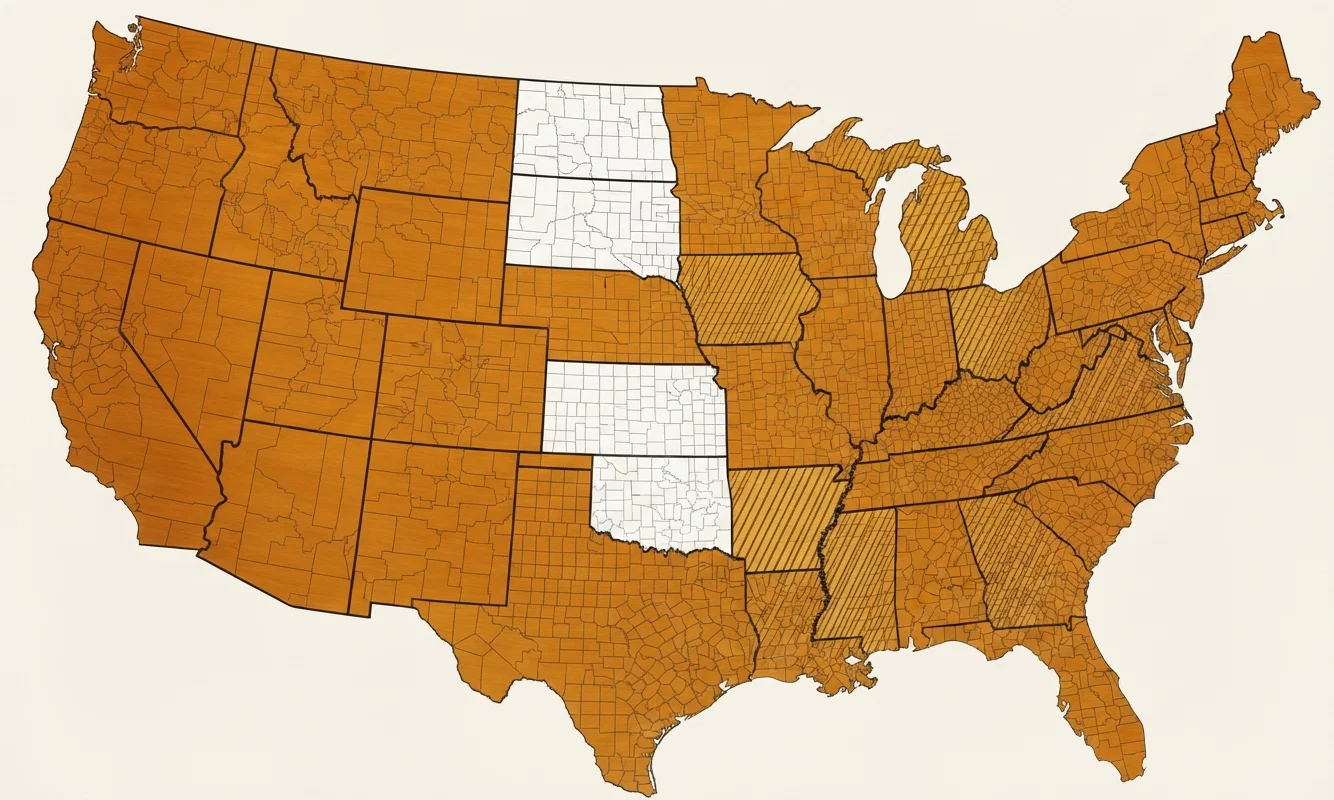
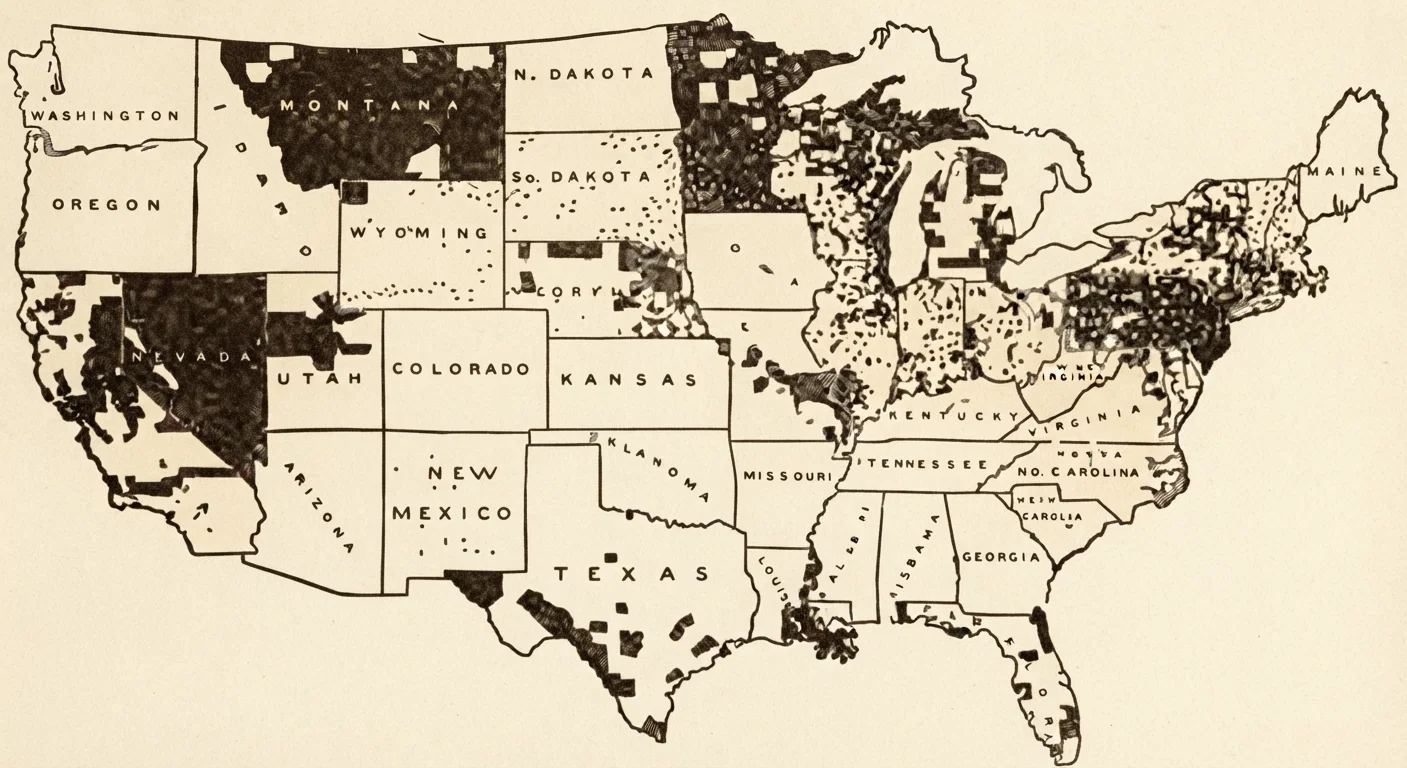
Left: Wet and dry map of the United States by states, January 1, 1893.
Right: Wet and dry territorial map, January 1, 1916. Such is the progress of prohibition.
Sixty million people in the United States live under prohibition laws.
One half of all the people now living in licensed territory in the United States live in four states,— New York, Pennsylvania, Illinois, and New Jersey.
One half of all the saloons in the United States are located in fourteen cities.
There are fewer saloons south of Mason and Dixon's line than there are in the city of Chicago.
Thirty-six states of this Union have fewer saloons in the aggregate than the city of New York.
Prohibition's Onward March
Eighty-Eight Empty Jails
The Hon. Arthur Capper, governor of Kansas, says:
In assessed valuation, prohibition Kansas not only is the richest state, but the assessed value of wealth is twice as high in Kansas as in the United States as a whole. It is of record that no state in the Union has a higher per capita of wealth or a lower per capita of liquor consumption.
The per capita liquor consumption in the whole country is $21. In Kansas it is $3.04. Thus Kansas saves thirty million dollars every year directly through prohibition. The indirect gain is not subject to computation, but is certainly greater still.
Kansas is not usually counted among the great manufacturing and industrial states, and it cheerfully admits that agriculture is its chief resource; but Kansas, by the last census, was the fourteenth manufacturing state, and its manufactured output was larger in value in proportion to the people employed in manufacturing enterprises than that of any other state except one. The Sante Fe Railroad says that labor is more efficient in Kansas than in other states traversed by this great system.
Putting the facts concretely, Kansas is —
The state which sends more boys and girls to university, college, and public school, in proportion to population (census 1910), and fewer men and women to prison and jail, than any other state in the Union.
The state which has the lowest percentage of crime, poverty, immorality, insanity, imbecility, and drunkenness.
The state which has the highest per cent of home owners. The last census showed Kansas first in home-owning citizens.
The state which has the largest per capita of wealth — $1,629.61 for every man, woman, and child within its borders.
The state in which banks and not saloons cash the workingman's pay checks, the same banks which in 1907, the panic year, sent the East fifty million dollars.
The state with fewer millionaires and fewer paupers than any other state.
The state which has one of the lowest death rates in the United States, only seven to the thousand, a percentage constantly decreasing.
One of the two states of the Union having the smallest number of persons who cannot read and write — less than two per cent of its population.
The state which was first successfully and completely to wipe out the abominable saloon traffic.
The state which for thirty-five years has not had a legalized saloon nor brewery, and now has eighty-eight city and county jails that are empty, thirty-two counties without a pauper, forty-eight counties out of one hundred and five which did not send a prisoner to the penitentiary last year, and twenty-two counties in which there have been no criminal prosecutions for more than a year.
Thirty-two counties in Kansas abandoned their public farms last year. According to the latest report of our State Board of Control, only 898 paupers were being cared for at county institutions.
When we banished the saloon in Kansas, the licensed segregated vice district went with it. Then we realized, as we never had before, that the saloon was and had always been the breeder of the gambler and the prostitute. The gambling house and the house of prostitution are so closely connected with and so dependent on the saloon, that when the saloon is compelled to move out of a community, they must go, too, as they have gone in our state. As Governor Stubbs, a former governor of Kansas, has said before me, prohibition is the doctrine of self-defense.
Every governor of Kansas for twenty years has said that prohibition is a great success.
Every state official who has spoken says that prohibition succeeds.
More than seven hundred Kansas editors and newspaper men in the state convention unanimously indorsed prohibition.
Every political party in Kansas favors the prohibitory law.
No minister in Kansas ever opens his mouth in favor of returning to the licensed saloon, nor any teacher.
The mothers of Kansas say they are satisfied to have their boys grow up without seeing the open saloon. They are not demanding that saloons be licensed in Kansas.
The president of the Kansas Retailers' Association says that prohibition pays.
The temperance society of the Methodist Church asked bank presidents in Kansas what they thought of prohibition. One hundred and sixty-six favored the law, while only six expressed doubts of its wisdom.
During its last session, the legislature, by unanimous vote in both houses, went upon record in a series of strong resolutions telling what prohibition has done for Kansas, and emphatically approving it.
Saloon cities which send out advertising literature do not boast of the large number of saloons within their borders, but cities in Kansas put "no saloons" first.
The desire of the people of Kansas is that you shall hear and know the truth about Kansas under prohibition, and then draw what conclusions may to you seem warranted.
If Russia can abolish a $450,000,000 per annum revenue from drink, while engaged in the most devastating war in history, and yet declare the surpassing prosperity of her people, it would seem that the United States, which claims to be civilized and Christian, would abolish her revenue of less than half that amount in time of peace.