VIEWED from a temporal and politic standpoint, it was to no mean education that Nebuchadnezzar called the royal Judean youth. In many respects it would compare favorably with much of the education of to-day. In fact, some of the things then known in natural science are now lost to the world, and neither Yankee ingenuity nor European persistence have been able to restore them. Let us sketch briefly the educational evidences of that age which have come down to us in the histories they left behind.
Babylonia was the great educational world center. Great universities were established at Borsippa, a suburb of Babylon, and at Ur, or Orchoe. The great Babylonian libraries which existed were written by the Chaldeans and by the Magi.
“The contents of the inscriptions [in these libraries],” says the “Schaff-Herzog Encyclopedia,” “as well as the materials inscribed, are most various. Stone slabs, gems, clay tablets, glass, and metals are all employed; and the subject-matter is historical, mythological, religious, official, commercial, astronomical, and mathematical.”
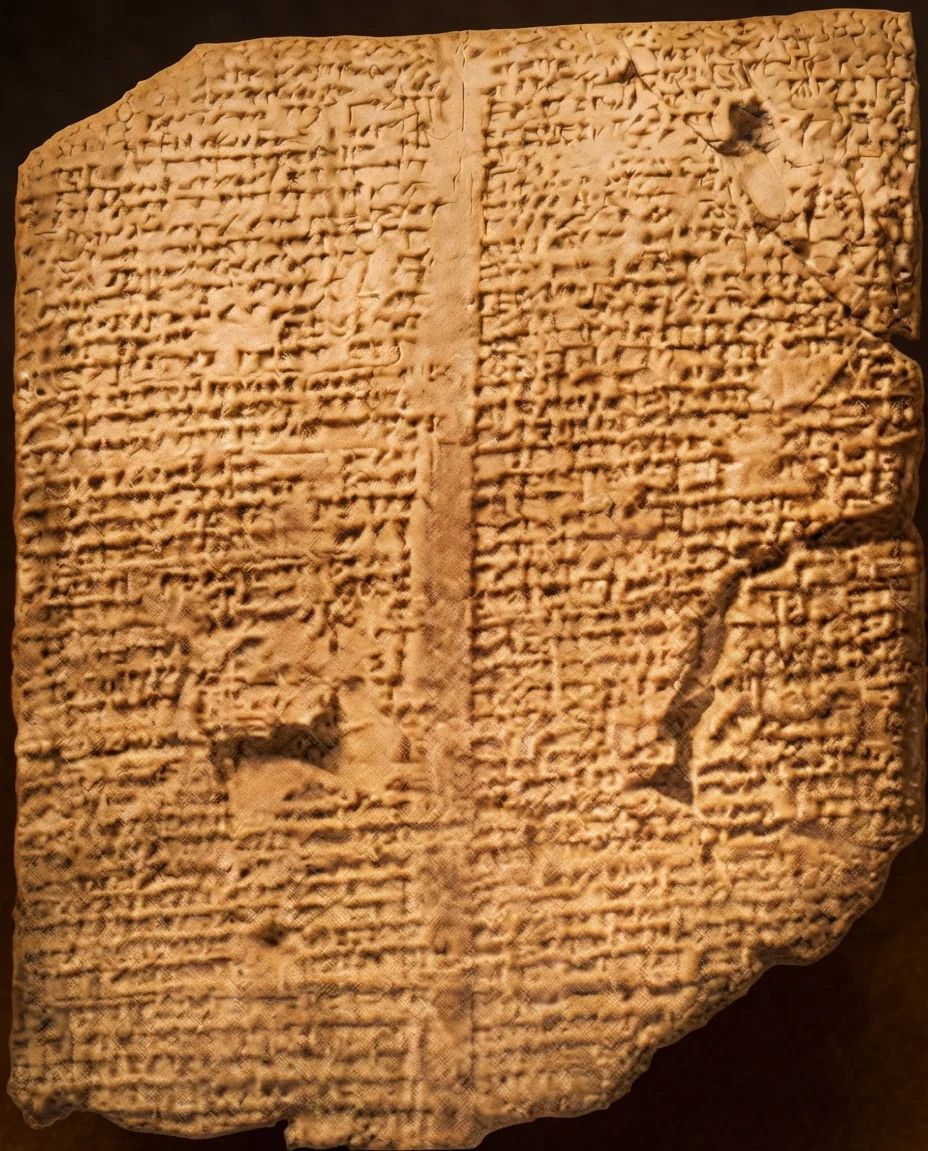
Clay tablet inscribed with the text of the Babylonian chronicle of chief events in the reigns of the kings who ruled in Babylon B.C. 744-669.
Art, the finest of which has perished, was manifest in various lines. Their sculpture, painting, and coloring shows them to have possessed no small knowledge of metallurgy and chemistry. The stones used in sculpture, which were bored, shaped, or engraved, were not merely the softer kind of rock, but the harder kinds, such as carnelian, agate, quartz, jasper, syenite, loadstone, and green feldspar. To cut these, emery must have been used, as well as rapidly revolving drills and disks, such as lapidaries now use. The work, “sometimes exceedingly delicate,” shows a complete mastery over
tools and material, and it indicates that either the eye was much better then than now, or else powerful magnifying glasses were used. In fact, a lens has been found in Assyria, and it is well-known that glass was used and cut into various shapes in Babylon.
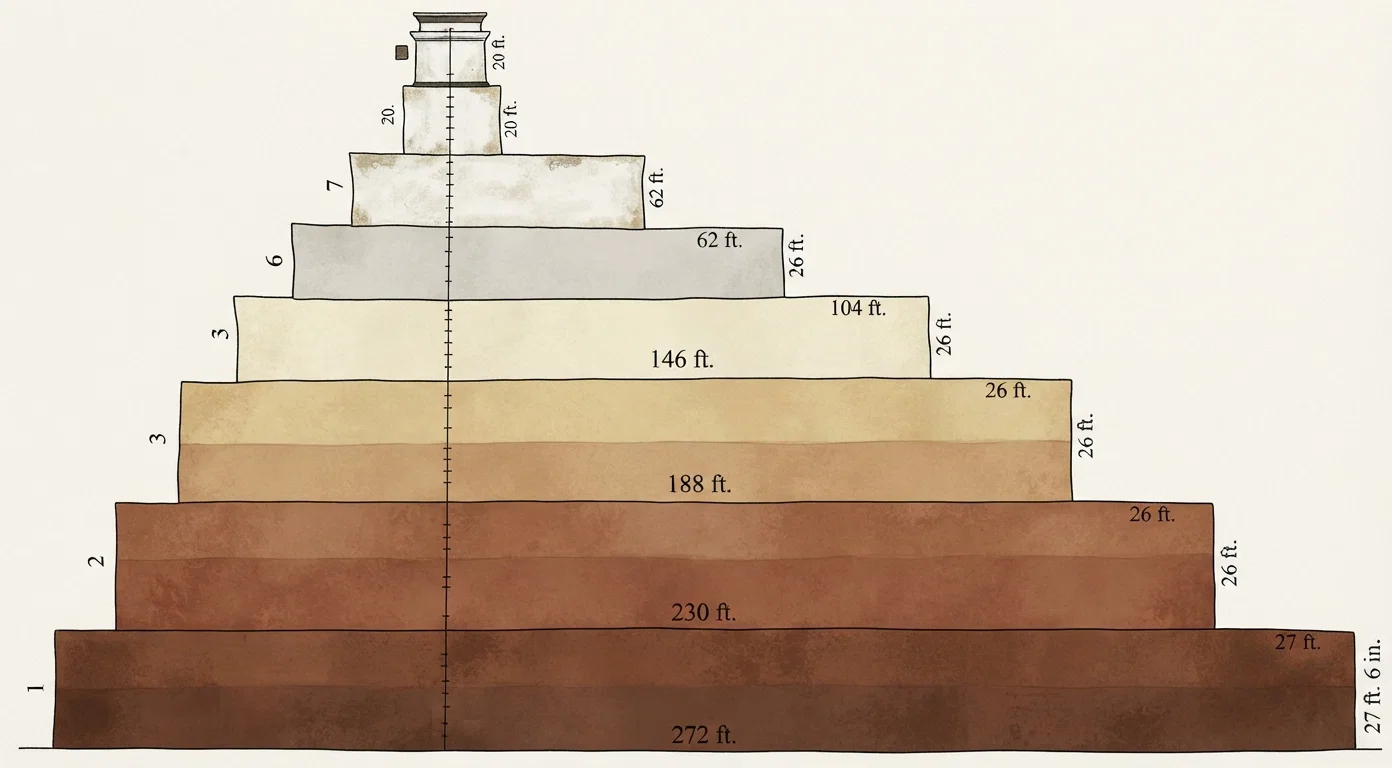
Temple of the Seven Spheres at Borsippa, Thought to Be the Tower of Babel.
In metals, gold and silver, bronze and copper, lead and iron, were used. Solid, massive gates were cast of bronze. The pottery is of excellent quality. Their textile fabrics were of great celebrity even as early as the days of Joshua (Joshua 7:21), standing in the ancient world as do the fabrics of Turkey and Persia now. These fabrics were in wool, cotton, and linen.
Rawlinson tells us that in mechanical art they “decidedly excel the Egyptians,” and “may challenge comparison with the most advanced nations of antiquity,” falling “little if at all short of the Greeks and Romans.”
In astronomy they distinguished between fixed stars and planets, mapped out the heavens into constellations as they exist to-day, computed eclipses, and learned the relative distances of moon and planets.
All these things were taught in their universities. The practical application of the wisdom of the wise men of Babylon is evidenced in the great works of the city of Babylon itself. The men who projected and directed in the construction of these works in that mighty city were not novices. In the days of Daniel, ancient sun-temples had been, or were being, repaired; golden royal palaces, exceeding imagination in their barbaric splendor, had been erected. Colossal and beautiful hanging gardens, containing rocks and forest trees, had been constructed by Nebuchadnezzar in the heart of the city, that his wife, a royal mountain maiden, might enjoy the beauties of the country in the midst of the most luxurious metropolitan life. By mighty moat and wall the city was fortified against all known weapons of war which might be wielded by an attacking foe. This wall was said to be sixty miles in length, fifteen miles on each side of the city, three hundred and fifty feet high, and eighty-seven feet thick. On either side of the Euphrates River, which flowed thru the city, was there a wall equal to one-half the cubic contents of the outer wall.
A Noble Purpose.
It was this city, “the glory of kingdoms, the beauty of the Chaldees’ excellency” (Isa. 13:19), that Nebuchadnezzar surveyed when
Studies in the Book of Daniel.
(Continued from Page 9.)
in his pride of heart he exclaimed: “Is not this great Babylon, that I have built for the
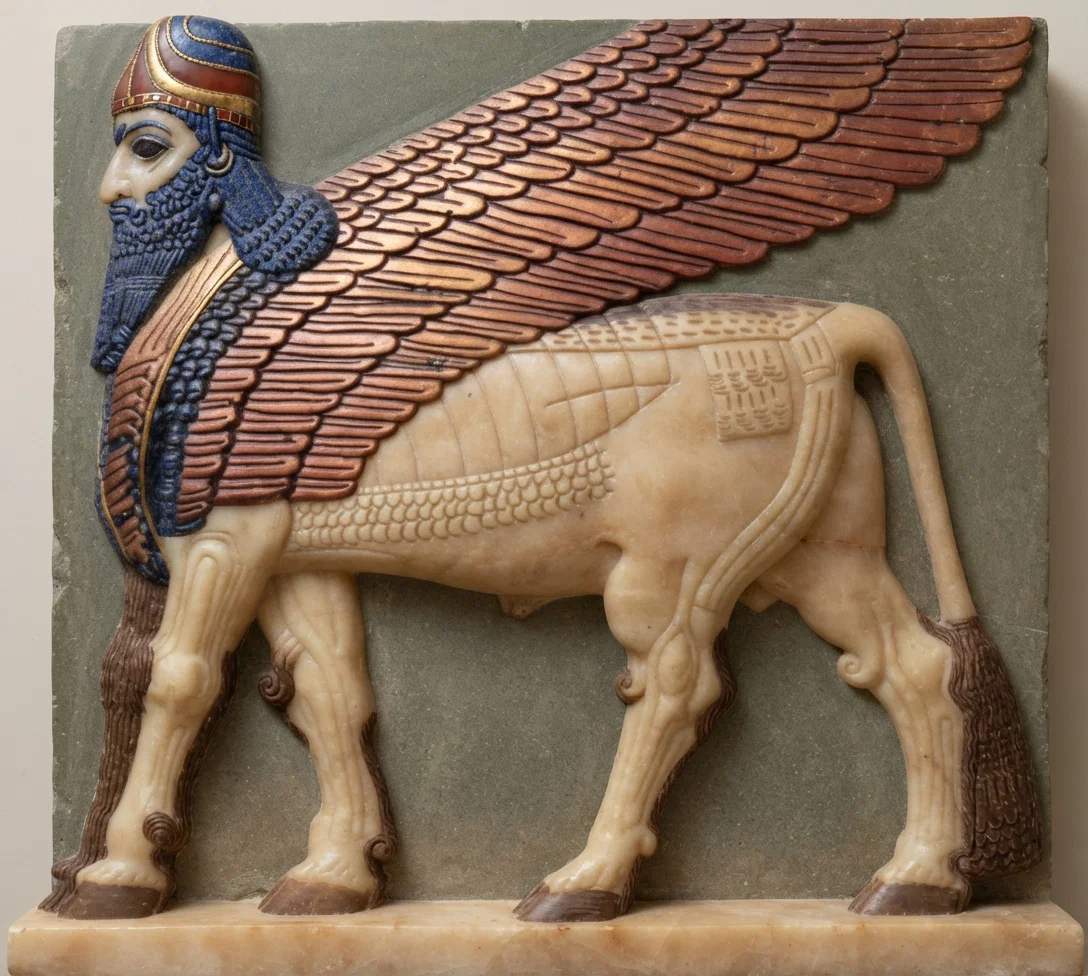
The Winged Man-Headed Ox from Nimrod.
house of the kingdom by the might of my power, and for the honor of my majesty?” Dan. 4:30. It was to this mighty city, teeming with works of art and grandeur, that the children of exile, mourning for desecrated Zion, were carried, there to witness, even in their humiliation, to the truth of God’s word. Nebuchadnezzar purposed that those he had selected should be educated in the best schools the world new. How the news of the king’s purpose struck the Judean youths is thus recorded:
“But Daniel purposed in his heart that he would not defile himself with the king’s dainties, nor with the wine which he drank; therefore he requested of the prince of the eunuchs that he might not defile himself. Now God made Daniel to find kindness and compassion in the sight of the prince of the eunuchs. And the prince of the eunuchs said unto Daniel, I fear my lord the king, who hath appointed your food and your drink: for why should he see your faces worse looking than the youths that are of your own age? so would ye endanger my head with the king. Then said Daniel to the steward whom the prince of the eunuchs had appointed over
Daniel, Hananiah, Mishael, and Azariah: Prove thy servants, I beseech thee, ten days; and let them give us pulse to eat, and water to drink. Then let our countenances be looked upon before thee, and the countenance of the youths that eat of the king’s dainties; and as thou seest, deal with thy servants. So he harkened unto them in this matter, and proved them ten days. And at the end of ten days their countenances appeared fairer, and they were fatter in flesh, than all the youths that did eat of the king’s dainties. So the steward took away their dainties, and the wine that they should drink, and gave them pulse.” Dan. 1: 8-16, A.R.V.
There were several reasons why Daniel and his fellows could not thoroly enter into the plans of the king: (1) They could not drink of the wine of the king, the wine of Babylon. Was it not typical of the spiritual wine of Babylon, which makes all the earth drunken? Rev. 14:8. (2) They could not be partakers of the unwholesome rich viands of which royalty was partaker. Service to God demanded strong, healthful bodies and clear minds; and the word of God had taught them, as doubtless their own observation, that the “dainties” of the ruler were “deceitful meat;” that “wine is a mocker,” and that princes should “eat in due season, for strength and not for drunkenness.” Prov. 23:1-3; 20:1; Eccl. 10:17. The school of the prophets, which at least in a perverted form they had doubtless attended, embraced within its compass the education of the whole man, physically, mentally, morally. In fact, the foundation of all was the word of God. Therein are found the best rules of sanitation and hygiene, the instruction as to the best dietary that was taught in the ancient world, and it is the wonder and guide of enlightened sanitarians to-day. And that people—the Hebrews—who have but blindly, superstitiously, half-heartedly followed those instructions, are among the healthiest peoples in the world.
Babylon knew but little of all this. Luxuriousness and lasciviousness reigned in her courts. Luxury fosters lasciviousness, weakness of body, grossness of mind, hardness of heart, and ultimate ruin and decay. These things were taught or countenanced or permitted in the Babylonian system of education, and the Judean princes, loyal to God, remembered the words of their wisest king: “Be not among wine-bibbers; among riotous eaters of flesh; for the drunkard and the glutton shall come to poverty [of both soul and body]; and drowsiness shall clothe a man with rags.” Prov. 23:20, 21. “Look not thou upon the wine when it is red, when it giveth his color in the cup, when it moveth itself aright. At last it biteth like a serpent, and stingeth like an adder.” Prov. 23:31, 32. Remembering this, they nobly refused to defile themselves with the king’s meat or with the wine which he drank.
[The study of chapter one will be concluded next week. The results of the two systems of education will be set forth.]