Porto Rico

7%

Pacific Press Publishing Company · Mountain View, California · May 6, 1908

FromSigns of the Times, Vol. 34, No. 19.

Read the full edition

Porto Rico.

Its Climate and Productions.
THE island of Porto Rico, ceded to the United States by Spain under the treaty of Dec. 11, 1898, is one of the great volcanic ranges that constitute the Greater and Lesser Antilles, it being the easternmost of the four largest of these islands. It is separated from Santo Domingo on the west by the Mona Passage and from the Virgin Islands on the east by the Virgin Passage. It lies about 450 miles east and slightly south of the southernmost point of Cuba, seventy-five miles east of Santo Domingo, and forty miles west of the Danish island of St. Thomas. It is well within the tropics and contains, according to the Bulletin 302 of the United States Geological Survey, 3,435 square miles and includes some tiny islands adjacent.
Being of volcanic origin, the central part of the island consists mostly of high hills or small mountains, the largest of which are the Loquillo Mountains which contain El Yunque (the anvil), the highest summit. This summit reaches a height of 3,790 feet.
Encircling these hills is a belt of playas, or plains, at some points six or seven miles wide, and at other points almost entirely lacking. It is on these plains that we find the fine sugar lands which at the present constitute the principal wealth of the island. However, we must not forget to note, for it is frequently the cause of comment, that some of the mountain slopes which are nearly vertical are cultivated, productive crops of tobacco and cane being raised on declivities on which an American farmer would hardly risk his limbs. Cultivation in such cases is carried on wholly by hand. The average rainfall in the north is fifty and in the south 100 inches. From the mountains flow down into the plains streams of crystal gurgling waters to carry life and moisture to the plant life below. These streams number a thousand which are worthy to be named, thirty-eight of them being rivers of considerable size.
The climate of Porto Rico is remarkable for its freedom from extremes. One writer has said of it that it is “a perennial May-day” and when it is considered that the temperature generally ranges between 70 and 82 degrees, it is easy to see why he called it thus. There is never a hint of frost, and, quoting again from our voluble author, we find that “The winters are as soft as the moonlight of summer. No ice of nature is ever seen in the island except on rare occasions, when a vagrant blast from the North, sweeping along the upper atmosphere, drops down on the vaporous air of the mountains and shivers it into hailstones. There is hardly an hour that one absolutely needs clothing to keep him warm. The Indians went naked thru the winter months; and even now many of the little children never have a stitch of clothing on them the entire year.”
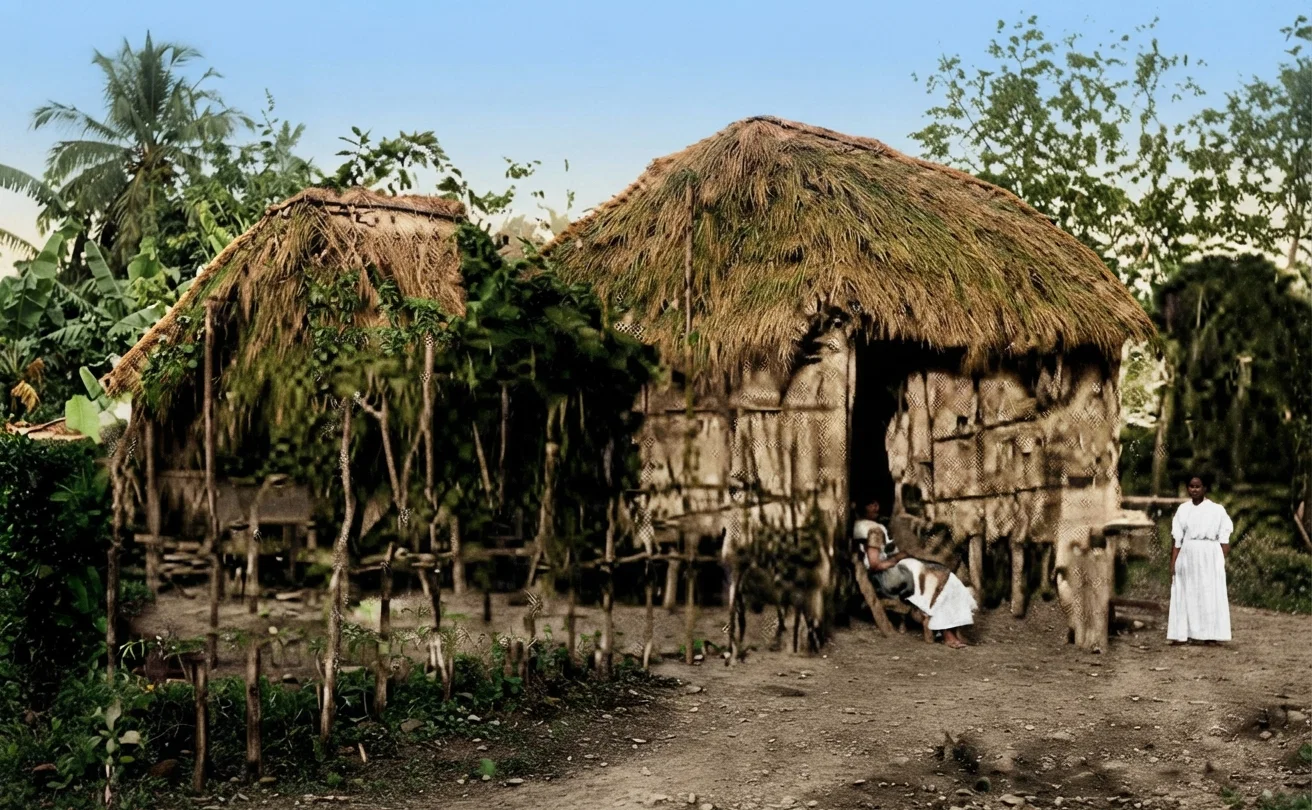
A Native Home, Porto Rico.
When the island was discovered, it was very poor, according to history, the Indians only raising enough of such articles as yams, maize, yucca, etc., to appease their hunger. But this was not the fault of the soil, but the lack of cultivation; for that it was not poor in natural wealth is proved by the fact that a little scratching here and there caused it to produce sufficient with the addition of the fish that they caught, to support 150,000 of the Indian inhabitants (some authorities give twice that number). At that time there were no pineapples, coffee, sugar, coco-palms, orange trees, or plantain, but the soil being capable of almost infinite production, in time all of these products were introduced. To-day the coco-palm is one of the ornaments of the island, and the plantain one of its necessities. Some one has said that a hundred years ago, if a stranger had been dropped down from the skies with no other capital than health he might have married the next day and maintained a family without serious difficulty. Of course he would not have the luxuries of life, except leisure, of which he would sadly have plenty.
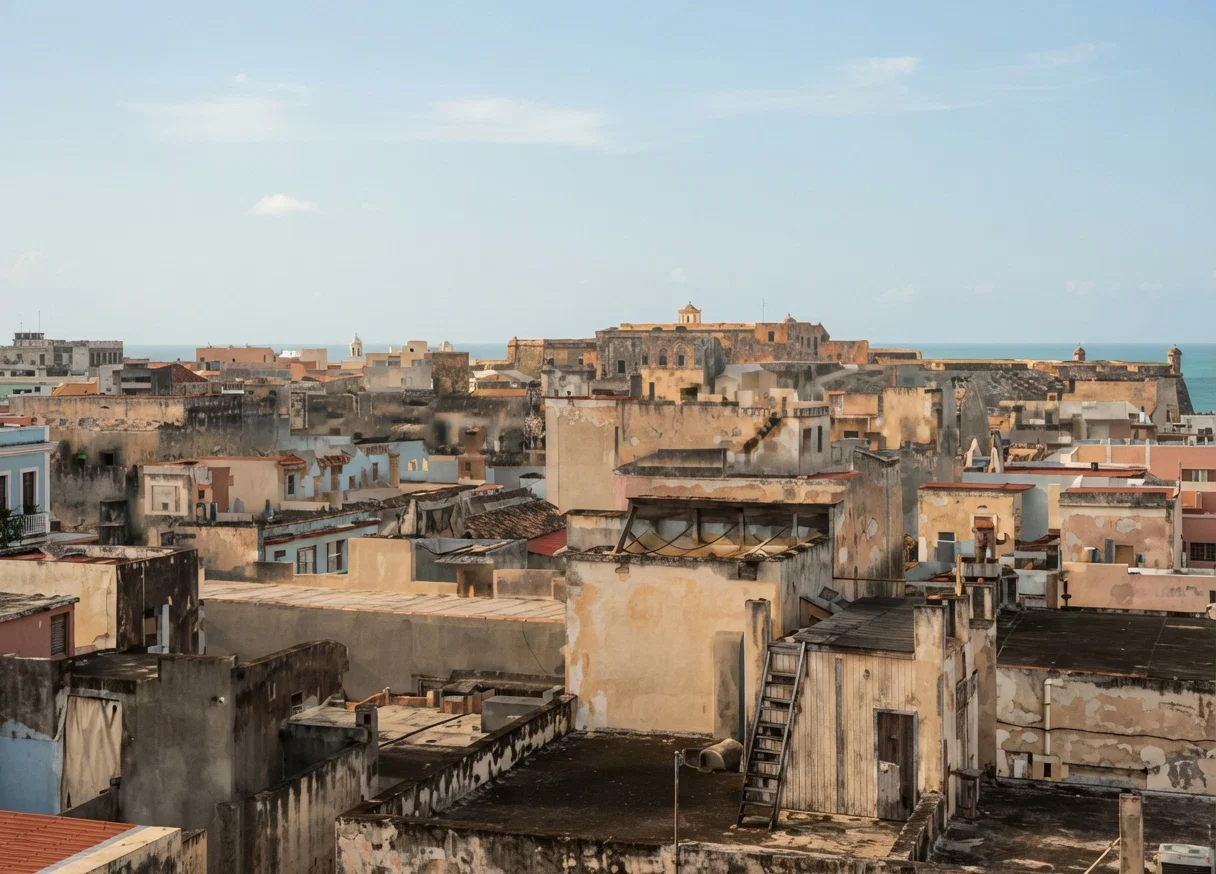
Panorama of San Juan, Porto Rico.
For two or three hundred years coffee has been the chief export, and was grown with very little work and brought a magnificent price in European markets. Everywhere in the island were vast estates, the owners of which collected vast fortunes. This continued until the cyclone in 1899 which was so terrific that in some cases it completely demolished the large estates and greatly damaged all of them. This, coming shortly after the change of government, resulted in a number of years of financial distress, but while complaints of “hard times” are still heard, the statistics show a condition of general improvement in every line of industry. While the coffee does not bring so good a price, owing to the change of government and duty imposed in the European markets, where it once went free, still there will be a better grade of cultivation, and coffee will ever be one of the great industries of the island.
The cane land is being constantly improved, and the results to those owning it are most flattering. There are in operation thirty sugar-mills.
Ten thousand acres of land are now planted to orange trees which in the future promise to be a successful department in the industries here; pineapples have proved to be a successful crop, and five canning factories are already being operated.
One of the increasing industries is the weaving of palm hats, the export of which amounts to something like $125,000 a year.
For the twelve months ending June 30, 1906, the total trade of the island was $45,085,195, or, approximately $10,000,000 greater than any similar period in its history; while the total trade of the year ending June 30, 1907, is estimated at $55,000,000 and the production of principal commodities for the same period is: Sugar .......................$17,000,000 Coffee ....................... 5,000,000 Cigars ....................... 5,000,000 Molasses ..................... 700,000 Fruits and nuts ............. 500,000 Other leading articles .... 2,000,000