On Sunday, the first day of October, Cardinal Gibbons, as is his custom on the first Sunday of each month, preached to his people. And on this particular Sunday his discourse was a sort of prelude to his "jubilee" celebration, which was to begin two weeks later.
In the course of this discourse the cardinal expressed his opposition to the election of United States senators by popular vote, and to the referendum and the recall of judges that is so strongly advocated in many quarters. He also spoke in terms of grateful praise of the demonstration in Baltimore in his honor last June, which was attended by President Taft and leading members of the coördinate branches of the Government. Passing from these matters, he spoke of the
Growth of the Catholic Church
in America during the fifty years that he has officiated as priest, bishop, archbishop, and cardinal. The substance of his remarks upon this topic, as given in the press reports, is the following:
In 1861, the archbishops and bishops of the United States numbered 48. The priests were 2,064. The number of churches with priests attached was 2,042, and the Catholic population was estimated at 1,860,000. The number of archbishops and bishops to-day in charge of sees amounts to 96, just twice as many as existed in 1861. The priests amount to 17,000, an increase of over eightfold. There are 13,500 churches, nearly a sevenfold increase. We have about 15,000,000 church-members, eight times as many as existed in the United States in 1861.
But the progress of religion in our country is to be estimated not only by the augmentation of the numbers of its communicants, but also by a more efficient coördination and discipline. The clergy, in 1861, were as detached squadrons compared to the compact and well-marshaled army of to-day. Half a century ago the prelates and clergy labored under many adverse circumstances. In widely extended parts of the country they had to minister to the faithful scattered often without churches wherein to worship, and without Catholic schools. They had but scant resources to sustain them. Frequently they had to contend with deep-rooted prejudices.
Parochial Schools the Rule
Now, thank God, we have in most places parishes well organized. Churches have multiplied from the Atlantic to the Pacific. Parochial schools have become the rule instead of the exception in the large centers of population. A generous laity are usually able and always willing to aid our missionaries. An unfriendly feeling indeed still exists in some quarters, as the result of long-standing traditions and biased education. But the mists of prejudice are gradually disappearing before the sunlight of truth.
The increase in numbers of the Catholic Church in America is not more strikingly significant than her increase in power and influence. When the cardinal was ordained a priest in 1861, the sentiment was strong that it would never do to allow the Catholics to become dominant in political matters. It was considered that her past history was such that it would not be for the safety of the State ever to permit of such a thing. And so there were many Protestants who held the view that Catholicism might be allowed perfect freedom in her spiritual realm, but that the age had reached a frame of mind that would never allow her to become a political power.
But there has been a growing sentiment, during this last fifty years, among the Protestant churches themselves, that they should take a large hand in politics and be a dominant power there. And if it is all right for the Protestant churches to become a political power, there is no law of logic that will not admit that it is just as right for the Catholic to do so. One of the main points that is made by many in demanding the federation of churches, is that they may be able to bring the united power of all the churches to bear on the politicians, so that they may secure their demands. And since the Catholic has the best equipped and most thoroly trained organization for attaining political ends, it should be easy to see which will be in the lead when the grand march is fully under way.
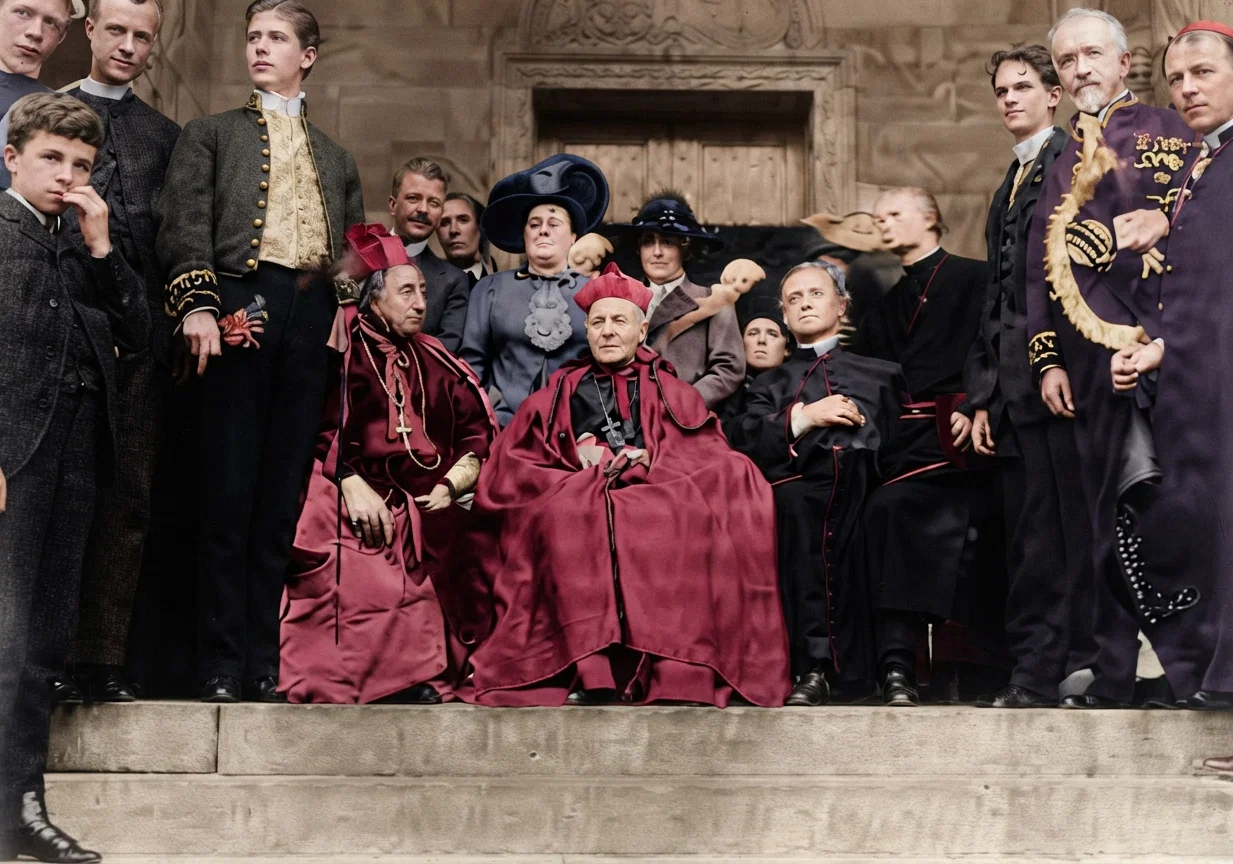
Watching the Laymen's Parade at Cardinal Gibbons's Jubilee. The cardinal in the center, Apostolic Delegate Falconio at the cardinal's right, Archbishop Farley at his left. (Photo by Paul Thompson, New York.)
There are many great evils in this age that need to be corrected. And many able and well-meaning men in both the Catholic and the Protestant churches are strongly advocating that the power of the church will have to be invoked. When the church has given herself to the work of leading the individual to Christ, she has always been a mighty power for good in the world; for society as a whole can not be any better than the individual units of society, and it is for the individual that the church must work. Whenever she has entered politics and tried to do church work by political methods, she has invariably met with dismal failure. Tyranny, oppression, and cruel martyrdom have ever been the fruitage of the church-and-state régime. A thing that has this invariable history, is not worthy of another trial. No man nor body of men has any right to demand of the State anything as churchmen that they would not ask as individual men or citizens. Legislation must be for the man, not the religionist. T.