By Prof. F. E. Hinkley, of Harvard University, Observer at Arequipa, Peru
"And they that be wise shall shine as the brightness of the firmament; and they that turn many to righteousness as the stars forever and ever." Dan. 12:3.
THE margin of our Bibles permits the use of "teachers" in place of "wise"—"And they that be teachers shall shine as the brightness of the firmament; and they that turn many to righteousness as the stars forever and ever."
This, of course, refers to those who teach the truth and lead others to accept it, just prior to the time when the events recorded are to be fulfilled.
Like many others, this marvelous promise, and a conception of its magnitude, can be more clearly understood through the study of the structure of the universe and of the stellar worlds themselves.
While the astronomer's understanding of the spheres is above that of the average reader, all human minds seem weak and limited, and the imagination fails, when they come to contemplate the great fact of creation. But let us see if we can not become a little better acquainted with these monarchs of the skies, in the likeness of which the teachers of righteousness are to shine forever and ever.
Stars Innumerable
The sun of our solar system is one of these stars. It is true that from the highest point of view the sun is only one of a multitude, a single star among millions, thousands of which, most likely, exceed it in brightness, magnitude, and power.
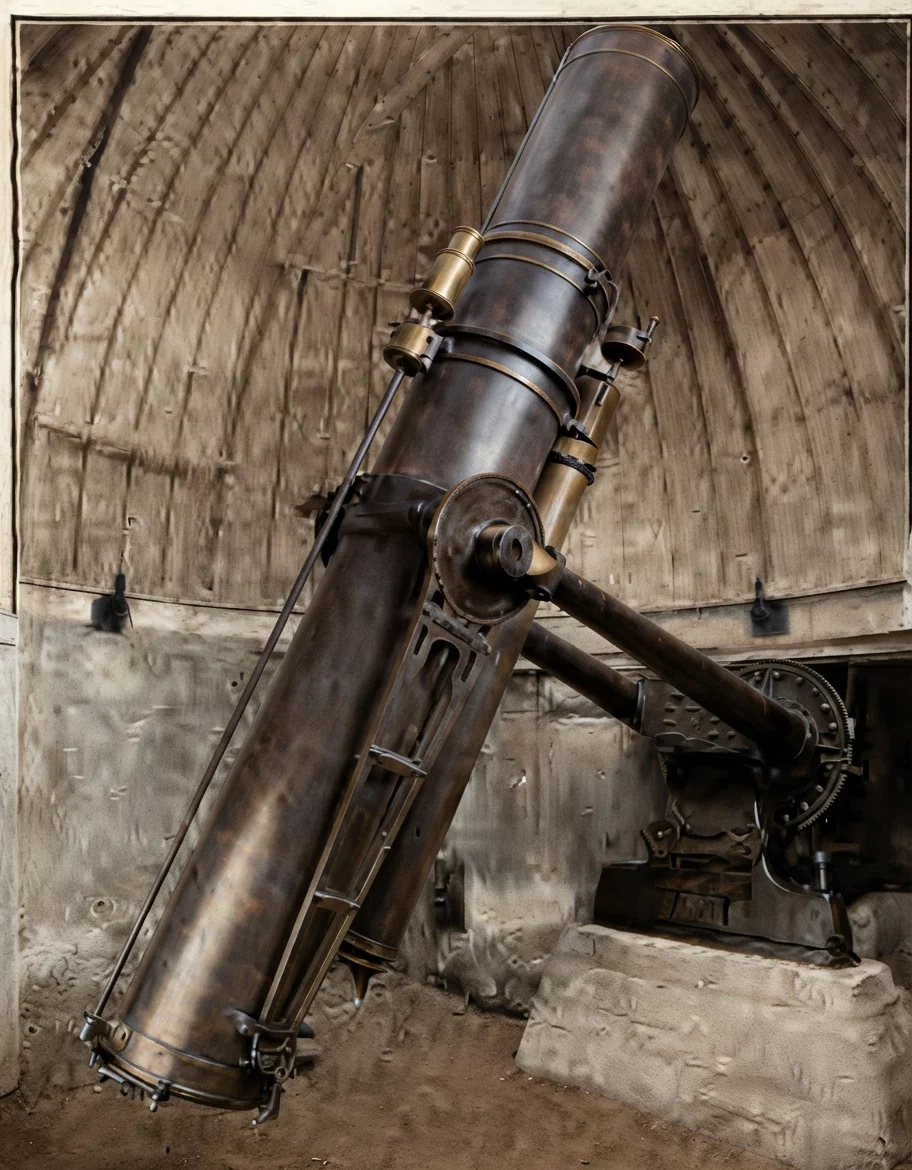
Bruce 24-inch telescope in the Harvard Observatory at Arequipa, by which are taken the portraits of the stars
Far away in the unfathomable depths of space, so far that they appear as mere points of light, blaze other suns of vaster size and greater glory. Alpha Centauri, our sun's nearest neighbor, located near the Southern Cross, is a star whose brilliant light must traverse space as light only travels,—186,000 miles a second,—for a period of more than four years to reach us; and yet this southern star is less than half the distance to the next nearest star, 61 Cygni.
Other systems and constellations more remote are flooding the celestial spaces with their never-ending light, which consumes hundreds of years in reaching this planet of ours. There are stars in the heavens so distant that the most powerful telescope ever constructed can not collect enough of their rays to impress their image upon the human eye. No man, without prophetic vision, has ever seen these stars, and probably not many of them will ever be seen from this planet. And yet those very stars are known to astronomers and the position of many of them is marked on the celestial map.
Southern station of the Harvard Observatory, Arequipa, Peru, El Mista in the background. The mountain is 19,200 feet high; the observatory, 8,050, the highest in the world. One station is maintained, we believe, at 13,400 feet, and another at 15,700 feet. See also cut on previous page.
How this can be, you do not need to ask, for you already know that the weak ray of light, which can not make itself felt upon the retina of the eye, can impress its image on the photographic plate if given time enough.
Thousands upon thousands of stars, utterly invisible to man, can be photographed as you are photographed, but the process is a much longer one.
The imagination becomes bewildered when contemplating the unnumbered millions of worlds, systems, clusters, and constellations that lie within the field of vision of the most powerful telescope, and beyond this we are reasonably certain that other worlds and systems of vaster proportions travel the boundless space.
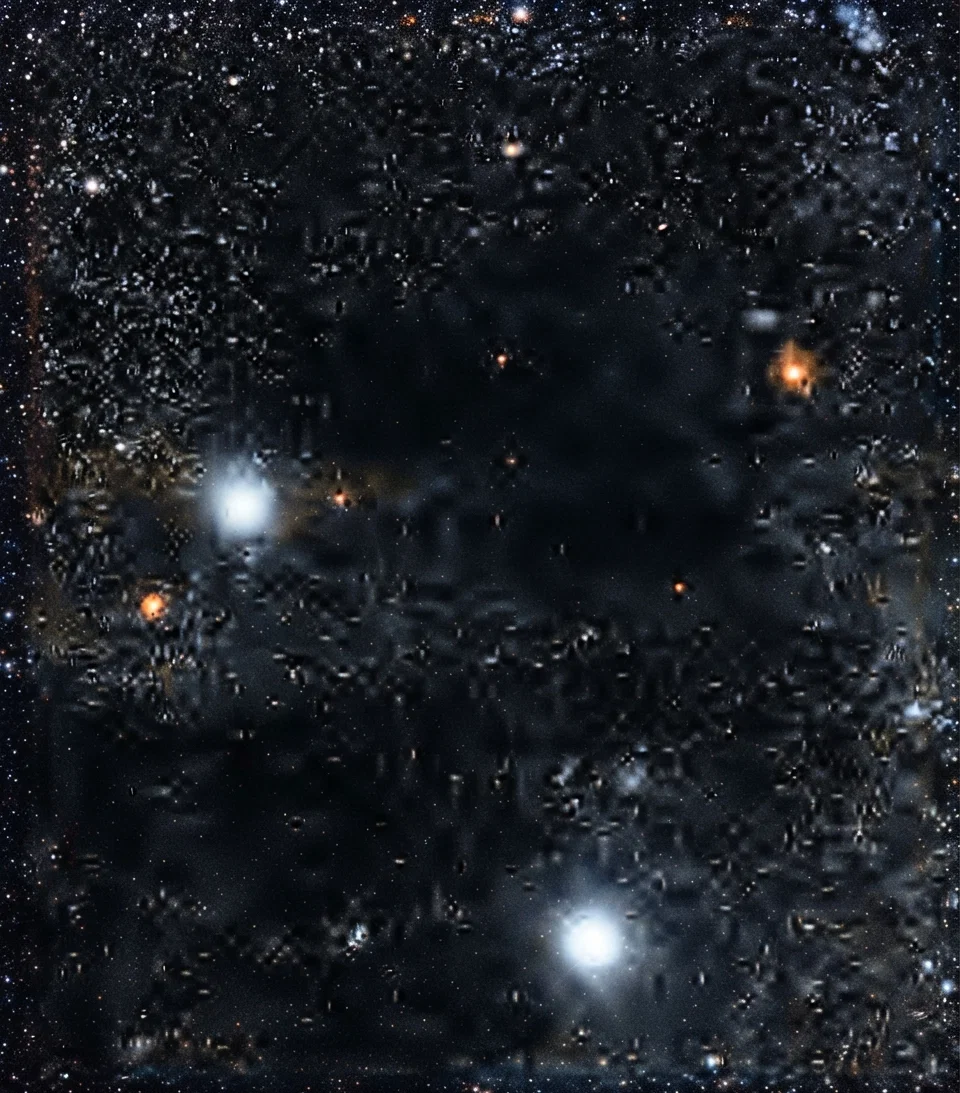
The Southern Cross, really a part of the constellation Centaurus. The camera unduly magnifies two of the stars as they would appear to the naked eye.
Turning again to the Word of God, we are able, through the study of His works, to see new beauty and get a clearer understanding of that wonderful truth which declares that the host of heaven can not be numbered. And with this view comes a new conception of how vast will be the
multitude of the redeemed in heaven that shall walk in white.
One Star Differeth from Another
Another passage of Scripture will help us to see what modern astronomy was long in appreciating—that one star differs from another, as there will also be a difference in the glory of the redeemed: "There is one glory of the sun, and another glory of the moon, and another glory of the stars: for one star differeth from another star in glory." 1 Cor. 15:41.
The stars visible to the naked eye are faint and pale compared with those disclosed by the telescope, but they differ obviously in brightness.
"The differences of brightness are due, first, to difference of distance; second, to difference of dimensions, or light-giving area; third, to difference of brilliance of the light-giving surface, depending upon difference of temperature and constitution." The fact is, stars are very unequal in their actual brightness; and in consequence, the apparent magnitude of a star gives us no13clue to its distance. Among the nearer stars there are some scarcely, if at all, visible to the naked eye; while among the brighter ones are several whose distances are immeasurably great.
There is another difference in the stars besides that of brightness. One star differs from another in color. Some systems are white, some blue, some green. Three or four among the brightest strike the eye by their ardent glow, others are tinged with yellow, and the white light of several has a bluish gleam like that of polished steel. Reddish tints are the most noticeable, and seem to have been the only ones noticed by the ancients.
Some of these shining orbs that rule the skies, are single like our own sun. Others are double. That is, what appears to us like one star is divided into two with the help of a more or less powerful telescope. Others are triple, and some quadruple.
The Stars Are to Shine Forever
Since sin obtained a foothold upon this fair earth of ours, age and decay have borne witness that change is a natural consequence of broken law. Science, however, looks upon it as something entirely different; and through a misconception of what the divine revelation is to man, it has voiced its theories, until it would have us believe that these shining orbs in the skies will some day become cold and lifeless—no longer fiery and radiant, giving heat and light to their families of planets. But God's Word declares that they will shine "forever and ever," "not one faileth;" and in the undimmed glory of these stars, which shine as brightly as in the beginning, is a prophecy of eternity, embracing those who turn many to righteousness, who are to shine as the stars "forever and ever."