Old Folks

5%

Pacific Press Publishing Association · Mountain View, California · Nov 18, 1913

FromSigns of the Times, Vol. 40, No. 44.

Read the full edition

Old Folks

I SUPPOSE that very few whose eyes rest upon these two suggestive words, will be at all willing to admit that the term applies to them, no matter what their age may be. Of course it may apply to the other man or to the other woman, in all appropriateness; never to ourselves. Strange, isn't it?
I remember hearing a splendid old man attempt to describe his feelings the first time he ever heard the words applied to himself. It had given him a shock that he had never forgotten. Why? — Because old age is suggestive of feebleness and decrepitude and death.
Age is the reaping time; and I tell you, if only the sowing were better done in youth, — I mean, rather, if only better seed were sown, — the reaping time would not be so much dreaded. If a field of briars and thistles has been planted, how can we expect to reap roses? If in the summer-time we fill our storehouses with gall and vinegar, then how can we expect to feast on nectar through the long, cold days of winter? If we have brought up children to forget the honor due to gray hairs, and to make a jest of old age, how can we reasonably expect them to make an exception in our own case, when we ourselves reach the time of the sear and the yellow leaf?
I remember reading a pathetic story, years ago, of a cruel young man who was caught in the act of beating his aged father. When a friend undertook the part of peacemaker, and remonstrated with the inhuman youth, the old man tearfully replied: "Let him alone, my friend, for my poor son is only administering a punishment which I richly deserve. Listen: Fifty years ago I also beat my poor old father."
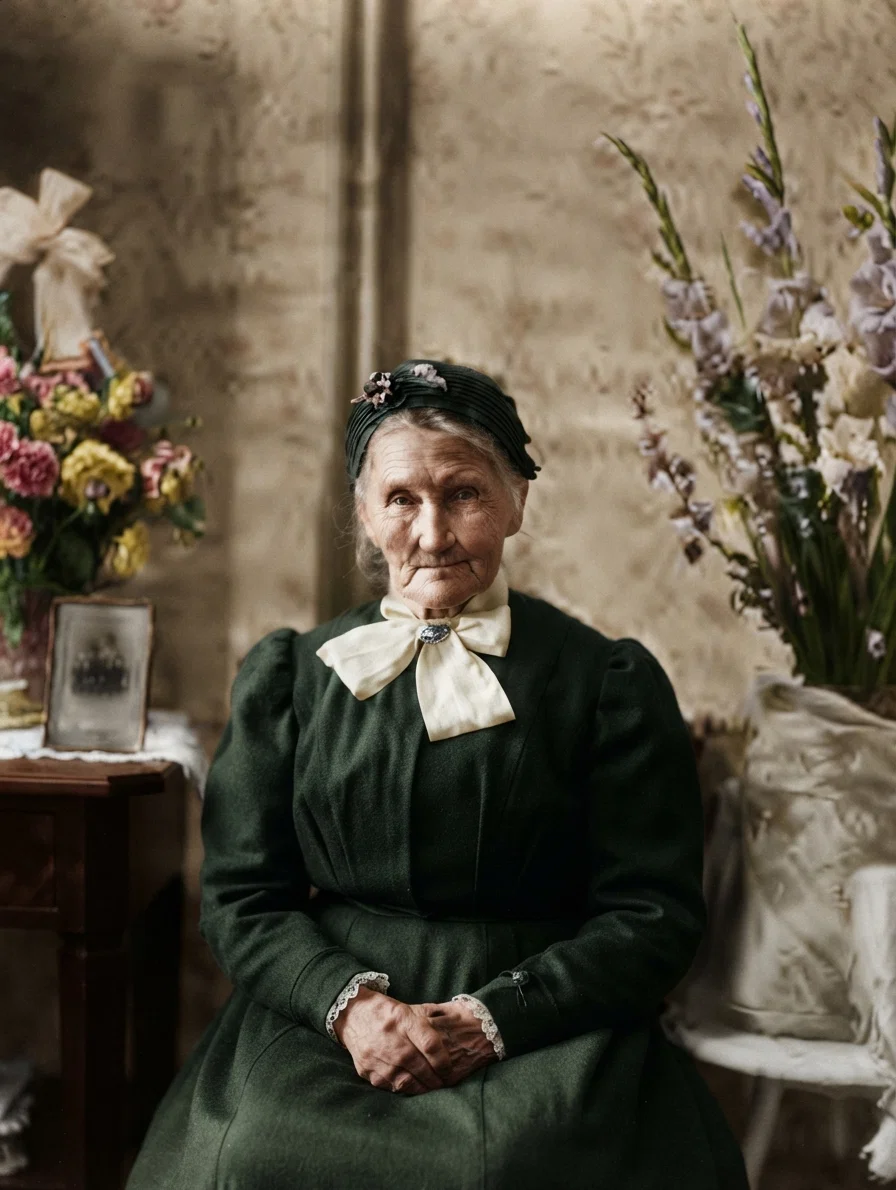
MISS JOHANNA BERNS
MISS JOHANNA BERNS
"Whatsoever a man soweth, that shall he also reap," is a law which has proved itself true in every generation since man has lived.
Yes, the term "old folks" too often suggests only bent forms and wrinkled brows, and an unlovely, crabbed, and jealous disposition.
Shall I describe to you the mental picture which these two words, "old folks," ought to suggest? They ought to be synonyms for the words "purity" and "beauty of spirit" and "sweetness of disposition" and "loving-kindness" and "charity." The words "old folks" ought to suggest all these beautiful qualities of mind and heart, as truly as the mention of an evening in June would suggest a mind picture of a lovely sunset.
I once read an account of the suicide of a beautiful and fashionable woman of great wealth and social prominence. "What could have been the cause of the rash deed?" was a question that was in everybody's mouth. She was favored with an abundance of the good things of this life. She was beautiful and cultured. There was apparently not a single wish of her heart but was gratified.
Ah, yes, there was one thing more desired than any other; and this wish she might not gratify: She could not forever remain young. With all her accumulated millions, she could not prevent the passing of one little moment, one rushing hour, nor turn backward one single wheel in the racing, whirling, spinning, hurrying chariot of time — not one.
And this thought — the certainty of this fact — instead of leading this poor butterfly of fashion to make a wiser and better use of her days, led her to cut short the little span of life, with her own foolish hands. It is as if some person of great wealth had offered to supply our every need for forty years; but because he would not agree to do so for a hundred years, we refuse to accept his generosity at all!
This poor silly woman had discovered her first gray hair; and this was the only reason that she had left to her distracted and sorrowing family, as an excuse for her awful deed.
"Well, but," you say, "old age has its peculiar trials, which are characteristic of no other time." Verily: this is equally true of every period in life. Even the prattling babe in its mother's arms has its own little troubles, its own peculiar disappointments and heartaches; and every boy and girl knows what it is to weep bitter tears of sorrow — sorrow which to them is as real as any that comes with later years.
And if every period in life has its sorrows, it also has its own joys, its own happiness. "But," some one protests, "I don't see how there can be any comfort at all in old age." Well, there is, or at least there ought to be.
When the little child is overcome with sorrow, it finds relief in mother love and sympathy. So in old age, when the brow is furrowed, and the tottering form is bent, and the joys of earth life are withered and dead, the aged child of God may the oftener fly to the loving Father, whose ears are always open to listen to the feeblest murmur. "As one whom his mother comforteth, so will I comfort you." Isa. 66:13.
Ah, then, when the dreary hills of age, with their caps of snow, loom up before us in the near distance, let us calm our fears, take a firmer hold of our Father's hand, and trudge bravely on.
Catherine, the wife of Philip Melanchthon, chose for her daily prayer one of the most beautiful verses in the Bible: "Now also when I am old and gray-headed, O God, forsake me not; until I have showed Thy strength unto this generation, and Thy power to every one that is to come." Ps. 71:18. Beautiful confidence! Faith sublime! Will the high and holy One refuse to answer such a petition put up from an honest and humble heart? — Never! "Can a woman forget her sucking child? . . . Yea, they may forget, yet will I not forget thee. Behold, I have graven thee upon the palms of My hands." Isa. 49:15, 16.
"So let me live, as the moments fly, Wisely and well, as the years go by, That when my dull ear hears the roar Of the breakers beating the farther shore, And when my dim eye sees the light Of the snowy cliffs on the shores of night, Then, with a quiet, sweet content, I may look back on a life well spent, When eternity comes, and time is o'er, And I shall have journeyed from shore to shore." MRS. L. D. AVERY-STUTTLE.