Motives Are Respected in Application of Moral Law—In Operation of Physical Law Motives Are Not Considered—Fire Will Burn a Righteous Man as Quickly as the Worst Outlaw—Some Exceptions to the Rule
MORAL laws appeal to the intelligence, and apply to intelligent creatures only. In their application, motives are respected, but individual accountability is required. They are supported by rewards and penalties. Physical laws apply to both animate and inanimate objects. In their application motives are not considered. They have to do with
CAUSES AND EFFECTS
and antecedents and consequences. God is the first great cause of all natural law. "He maketh His sun to rise on the evil and on the good, and sendeth rain on the just and on the unjust." Matt. 5:45. These words of Christ reveal the fact that natural law, though operated directly from the throne of God, does not regard motives.
FIRE BURNS THE MARTYR AND THE CRIMINAL ALIKE
Fire burns a martyr as readily as it burns a criminal. Floods destroy the property of Christians and sinners without discrimination. Drought consumes both alike. Cold freezes the missionary exposed to it as well as the outlaw. Sickness and death come upon all alike; and the effects of sinful heredity are visited upon both classes, although physical law determines that a life of virtue tends to repair the effects of heredity, even as an open-air life is beneficial to one with tubercular tendencies.
Hence the extreme effect of sinful heredity to the third and fourth generations is visited upon the haters of God only. In the third generation of a life of vice may be seen a tendency to insanity. In the fourth generation idiocy is common. While, as in the operation of natural law, corn planted produces corn, potatoes produce potatoes, likewise seeds of virtue sown produce after their kind; thus according to the natural law in the spiritual realm, the Word sown in the heart so completely changes the individual during one generation as to reflect His image fully. "But we all, with open face beholding as in a glass the glory of the Lord, are changed into the same image from glory to glory even as by the Spirit of the Lord." 2 Cor. 3:18.169
THUS THAT MOSES ENDURED
According to the same natural law in the spiritual realm, the trials of life are greatly lessened by beholding Jesus, and by looking forward by faith to the eternal reward. It was thus that Moses "endured, as seeing Him who is invisible" (Heb. 11: 24-27), and Abraham obeyed, and endured all privations consequent upon a perfectly surrendered Christian life, "for he looked for a city which hath foundations, whose builder and maker is God." Heb. 11: 10.
Paul sums up the principle operating in the natural law of spiritual growth as follows: "For all things are for your sakes, that the abundant grace might through the thanksgiving of many redound to the glory of God. For which cause we faint not; but though our outward man perish, yet the inward man is renewed day by day. For our light affliction, which is but for a moment, worketh for us a far more exceeding and eternal weight of glory; while we look not at the things which are seen, but at the things which are not seen: for the things which are seen are temporal; but the things which are not seen are eternal." 2 Cor. 4: 15-18.
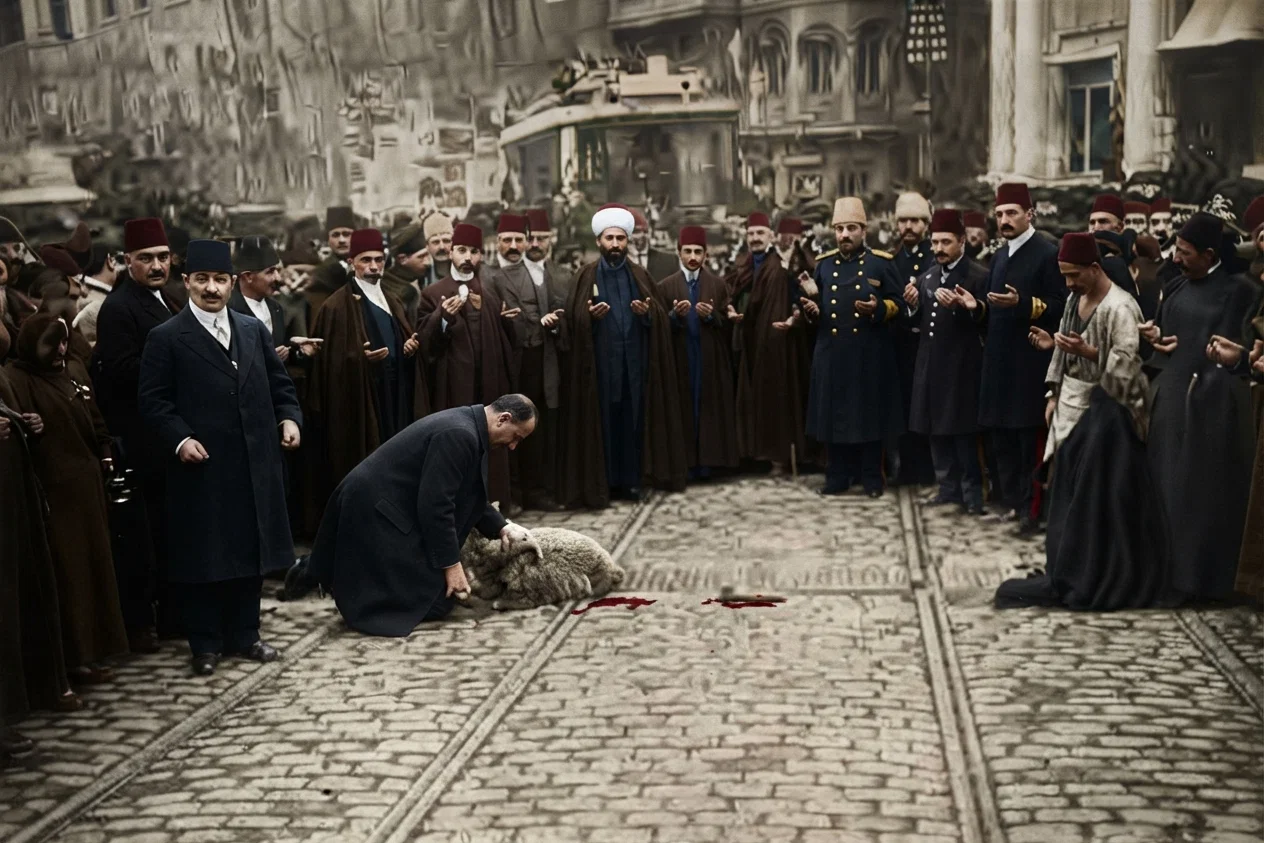
Photograph by Underwood & Underwood, N. Y.
SOME NOTABLE EXCEPTIONS
From these observations, it is clearly evident that though God is the author of both physical and spiritual law, He operates in harmony with law in all His relations, both to animate and inanimate nature. Rewards and penalties, in the administration of moral law, are distributed according to the motives prompting actions; but effects and consequences follow causes and antecedents in the administration of natural law, without regard to motives. There are notable exceptions, which we call miracles, such as the three Hebrews in the fiery furnace, and Daniel in the lions' den, where natural law is restrained from taking its regular course. These exceptions prove the rule.
OBEDIENCE TO PHYSICAL LAWS COMPULSORY
It is a universally accepted hypothesis of science that law controls the operation of all force. The heavenly bodies are governed by law. The balancing of the planets and their motions are all under the direction of law. The law that governs them is "the word of His power," called "gravitation." The balancing of the clouds is in conformity to law. Light, heat, and sound are all produced in strict accord with the most exacting laws. All chemical combinations of the elements act in the same conformity to law as the universe of planets.
The heavenly bodies can no more choose their relations to the laws of gravitation than they can solve problems in mathematics. Water, steam, electricity, and radium are subject to man's control only when he learns the secret of their laws and complies with their demands. The electric current, misdirected, kills instead of serving man. Water, which is a great blessing when rightly used, becomes an agent of destruction when the lungs are broken by it. Gravitation, which holds the universe in poise, hurls a workman to death who accidentally loses his balance on a high scaffold.
Thus may it be seen that physical laws disregarded cause death, regardless of motives. Enforced obedience is therefore the law of the physical world. The consequence of any failure of the physical law which controls the movements of the heavenly bodies would be instant destruction. Perfect obedience alone insures the harmony and safety of the universe.
Since physical laws are enforced without regard to choice or motives, there can be no accountability in their operation. Hence the verdict of Christ in response to the question: "Who did sin, this man, or his parents, that he was born blind? Jesus answered, Neither hath this man sinned, nor his parents: but that the works of God should be made manifest in him." John 9: 2, 3.
NATURAL LAW REVEALS THE CREATOR
Take a drop of water from a stagnant pool, and, placing it under the microscope, behold the almost infinite number of real, living, moving organisms contained in it. It has been estimated that "in a single drop of water, four thousand millions would have room to exercise at will." Dr. Burr says:
"Another characteristic of nature, deserving of notice, is the perfection of its details. The exquisite finish of nature in its minutest parts is about as wonderful as its vastness and variety. Scan that leaf. Examine the wing of that butterfly. Let the tinted and polished antennae of that moth glitter in the focus of your instrument. Subject to the most skilful notice of science and art the smallest veins of any animal or vegetable. Push the analysis just as far as possible, and submit that last visible minimum of organization in the crystalline lens of the cod, with its five millions of muscles and sixty thousand millions of teeth, to the most searching criticism of the superbest microscope. What exquisite details! What elaborate refinement of workmanship!"
PERFECT IN SMALLEST MINUTIAE
"In masterpieces of human painting, the main points only are cared for, while all the subordinate are too rude to bear close inspection. Not so with the works of nature. A real landscape you may analyze to your heart's content, and inspect its details as critically as eye, armored with lens, can do, without finding workmanship growing less exquisite the further you push inquiry. A real man—you may descend to the minutest particulars of his organization, and get as near its primary elements as an Ehrenberg with his superb instruments and practised vision can carry you, without finding the least falling off from that delicacy of execution which appears on the larger masses and outlines of the body.
"So everywhere among natural objects—the great and the small, the outline and the minute filling up, as far as utmost optical resources can carry our observation, are wrought with apparently the same overflowing outlay of attention and skill. It is not so in a few instances merely, nor in a thousand—it is so universally. That there are any so preposterous as to think that this feature of nature makes positively against the idea of a sparrow-watching, hair-numbering, and thought-weighing God, is, of course, not to be imagined. Of course, it is a feature that fully harmonizes with such an idea."
JUST WHAT WE SHOULD HAVE EXPECTED
"A nature finished exquisitely, down to the most infinitesimal of its details, is just what one would have predicted from a God of this description. Announced the fact that He was about to create, and expectation would have stood on tiptoe to look for just such a nature as we see. A God for whose vision nothing is too small, who necessarily gives as complete attention to the affairs of an atom as to those of an empire, who can concentrate His almightiness with as much freedom and accuracy on a mathematical point as on a world, who is embarrassed no more by unlimited multiplicity than by unlimited minuteness of details, who can with equal ease paint a landscape on the point of a needle,—say, if you please, forty thousand of such landscapes at once, with all their innumerable and minima particulars, back to the reticulated eyes of a single butterfly,—can with ease do this, and roll a solar system on its triumphant path about the Pleiades; do I not know that a Being with such a striking attribute as this, would surely give it expression in His works?"—"Ecce Coelum," pages 168-170.
IT PROCLAIMS AN ALL-POWERFUL GOD
The minute detail of natural law in the infinitely small things, as well as its unlimited majesty as seen in the movements of millions of suns and systems in the universe, proclaims an all-powerful God of infinite wisdom as its Author.
The most delicate cambric needle, placed under the microscope, appears rough and feathery, while the sting of the wasp appears perfectly smooth. Such is the contrast between the works of God and the works of man, that man's imperfection appears in his most perfect170work, while the minutest details of the work of God bear evidence of His perfection, wisdom, and power.
The same God who cares for mighty rolling worlds and vast planetary systems, cares for the little sparrow, paints the lily, and to assure man of His constant care, says: 'But the very hairs of your head are all numbered. Fear ye not therefore, ye are of more value than many sparrows.' Matt. 10: 30, 31. What marvelous evidence of an all-wise and almighty Creator is revealed by the infinite works of God!
R. C. P.