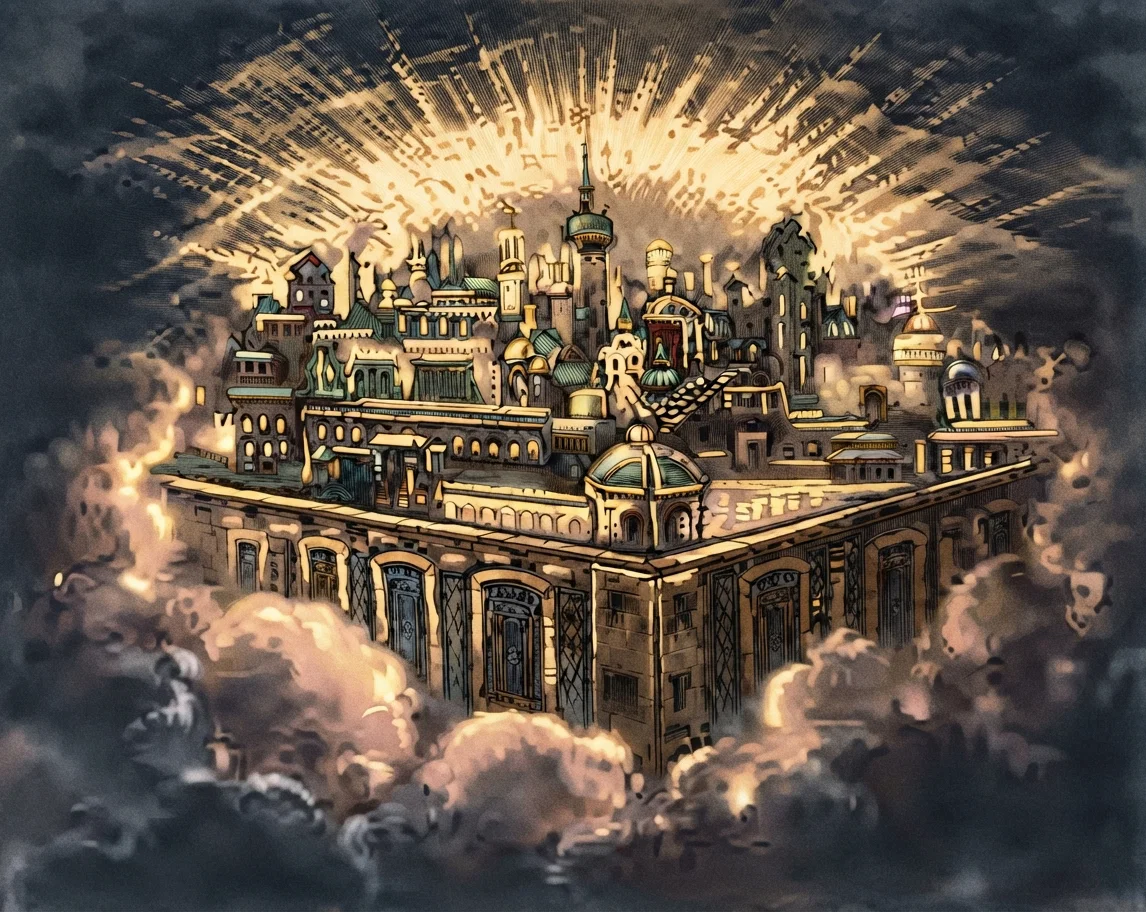
THROUGH ABRAHAM WE HAVE THIS PROMISE—THE WORKING OUT OF A GREAT PLAN—THE ETERNAL CITY, THE OBJECTIVE
By ALLEN MOON
"AND the Lord said unto Abram, after that Lot was separated from him, Lift up now thine eyes, and look from the place where thou art northward, and southward, and eastward, and westward: for all the land which thou seest, to thee will I give it, and to thy seed forever. . . . Arise, walk through the land in the length of it and in the breadth of it; for I will give it unto thee." Gen. 13:14-17. This promise God has sworn to fulfil literally to Abraham and his seed. The Lord, who was willing to show to the heirs of salvation the immutability of His promise, confirming it by an oath, gave also to Abraham and to his seed many infallible signs of His regard for His promise and oath.
BATTLE WITH THE FOUR KINGS
In Abraham’s day, not long subsequent to the giving of this promise, Chedorlaomer and three confederate kings invaded the land of Canaan, and carried away captives, including Lot, Abraham’s brother’s son, and many of the women of the land. Abraham, on hearing of this invasion, took his trained servants, and pursued after the four kings and their armies, and overtook and conquered them, and brought back all the captives and the spoil.
As Abraham was returning from the defeat of the kings, Melchizedek, king of Salem, went out to meet him. He brought forth bread and wine, for he was at the same time priest of the most high God. Melchizedek had been endowed with a priesthood by Jehovah. Although not in the line of any priesthood by inheritance, the office was directly conferred on him. The name "Salem" means place of peace. Melchizedek, being king of Salem, was therefore king of peace. And as he was king of peace and priest of the most high God, Abraham recognized in him the type of the Son of promise through whom all the world should be blessed, and he accepted the bread and the wine as emblems of the body and blood of the eternal Son. In short, Abraham had before him a complete miniature of the eternal kingdom,—the king, the subjects, and the territory, and Salem, the capital; also the mediator or priest of the most high God. To complete the figure, there must have been in the little city righteous subjects over whom Melchizedek ruled; and Abraham paid tithes in recognition of the divine offices, and also accepted the blessing of the representative of the Son of God.
THEY WENT INTO THE LAND OF PROMISE
It was near the city of Salem that the Lord had met with Abraham and promised him the land. Abraham was at a loss to know the full import of God’s promise. After Melchizedek met him, the Lord confirmed His promise by an oath; but in answer to Abraham’s inquiry, the Lord told him that his seed should be strangers four hundred years in a land not their own, and in the fourth generation his seed should come again into the land where he then was. This promise was literally fulfilled in type to a portion of the seed of Abraham. In the fulness of time, the Lord delivered the Israelites, as the seed of Abraham were called, from the bondage of Egypt; and after forty years’ wandering in the wilderness, all that remained were brought into the land of promise. But Abraham and several generations of his descendants were in their graves before Israel returned to Canaan. Three generations never saw the land of promise, but were all the while in bondage in Egypt.
After the majority of the nations of Canaan had been destroyed according to divine direction, Joshua proceeded to divide the land by lot among the twelve tribes, and these in turn allotted it to the families of the tribes.
JUDAH RECEIVED THE LAND OF SALEM BY LOT
In the division of the land by lot, the land on which Abraham pitched his tent after his separation from Lot, and on which he built an altar and worshiped God, and where the Lord met him and made the promise, fell to the tribe of Judah. In Judah’s portion also was situated the little city of Salem, which had come to be known as Jebus, or Jebusi, because it had fallen into the possession of the Jebusites after the days of Melchizedek. The children of Abraham recognized the city of Melchizedek, and it very soon was known as Jew-Salem, or Jerusalem.
The south border of the land of Benjamin was near to the city of Jebus, as we read: "And the border went up by the valley of the son of Hinnom unto the south side of the Jebusite; the same is Jerusalem: and the border went up to the top of the mountain that lieth before the valley of Hinnom." Joshua 15:8.
THE PORTION WHERE ABRAHAM’S ALTAR WAS
It may be of interest to note here that the portion of Canaan which fell to Judah, the tribe from which the Saviour was to descend, was also the portion in which Abraham built his altar, in which he was called to offer his son Isaac, in which he received the promise, and in it was also the city over which Melchizedek reigned.
Judah and Benjamin failed to dispossess the Jebusites of this little city until the days of David. When Israel demanded a king, and the Lord granted their request, the first man chosen was a Benjaminite. Although the Lord had specially prepared him, within a short space of time Saul twice sorely displeased Him by his acts of rebellion; and the second time, the Lord rejected him from being king, and he soon perished in battle.
DAVID ESTABLISHED JERUSALEM AS CENTER OF WORSHIP
The Lord now directed the prophet to anoint David, of the tribe of Judah, of the city of Bethlehem, to be king over His people Israel. The first act of David after he was anointed and was established in the kingdom, is recorded as follows: "And David and all Israel went to Jerusalem, which is Jebus; where the Jebusites were, the inhabitants of the land. And the inhabitants of Jebus said to David, Thou shalt not come hither. Nevertheless David took the castle of Zion, which is the city of David. . . . And David dwelt in the castle; therefore they called it the city of David." 1 Chron. 11:4-7. Perhaps this was the same castle occupied by King Melchizedek. At any rate, it was in the very city where he reigned in the days of Abraham.
WORKING OUT OF A GREAT PLAN
All the foregoing reveals the working out of a great plan on the part of Jehovah, for He chose Jerusalem to place His name there. David soon removed the ark of God to Jerusalem, and prepared to build a temple of worship on the site of the throne of Melchizedek. This work was consummated by Solomon. The system of worship, in the hands of the Levitical priesthood, was transferred to the temple on Mount Zion. The name "Jerusalem," which still retained the significance of the original "Salem," was expressive of the character of the final abode of saints, as well as that of God. The psalmist wrote, "In Salem also is His tabernacle, and His dwelling-place in Zion." Ps. 76:2. The prophet, speaking for the Lord, said, "For Zion’s sake will I not hold my peace, and for Jerusalem’s sake I will not rest, until the righteousness thereof go forth as brightness, and the salvation thereof as a lamp that burneth." Isa. 62:1.
THE TRUE CITY OF PEACE AND RIGHTEOUSNESS
This refers not to the old city of brick and stone, but to the true place of peace and righteousness. He continues: "The Gentiles shall see thy righteousness, and all kings thy glory: and thou shalt be called by a new name, which the mouth of the Lord shall name. Thou shalt also be a crown of glory in the hand of the Lord, and a royal diadem in the hand of thy God." Verses 2, 3.
The Jerusalem of precious stones, and gates of pearl, with streets of gold, will truly be a royal diadem; and "thou shalt no more be termed Forsaken; neither shalt thy land any more be termed Desolate: but thou [Jerusalem] shalt be called Hephzibah, and thy land Beulah: for the Lord delighteth in thee, and thy land shall be married. For as a young man marrieth a virgin, so shall thy sons marry thee." Verses 4, 5.
This Jerusalem will be a new creation of God, but it will be connected with land; and as the families of Israel received the land about Jerusalem for an inheritance, so likewise247the ransomed, in a much fuller sense, will marry the land, for He says: 'Be ye glad and rejoice forever in that which I create: for, behold, I create Jerusalem a rejoicing, and her people a joy. . . . And they shall build houses, and inhabit them; and they shall plant vineyards, and eat the fruit of them. They shall not build, and another inhabit; they shall not plant, and another eat: for as the days of a tree are the days of My people, and Mine elect shall long enjoy the work of their hands.' Isa. 65:18-22.
JOHN SAW THE CITY COMING DOWN
John the revelator saw the holy city coming down from God out of heaven, and he describes it as having twelve gates, and in them the names of the twelve tribes of the children of Israel. To Ezekiel the prophet was given a vision of the apportionment of the earth to the twelve tribes; and of the eternal city he says: 'The gates of the city shall be after the names of the tribes of Israel: three gates northward; one gate of Reuben, one gate of Judah, one gate of Levi. And at the east side . . . three gates; and one gate of Joseph, one gate of Benjamin, one gate of Dan. And at the south . . . three gates; one gate of Simeon, one gate of Issachar, one gate of Zebulun. At the west . . . three gates; one gate of Gad, one gate of Asher, one gate of Naphtali.' Eze. 48:31-34.
Of the new earth he says: 'Moreover from the possession of the Levites, and from the possession of the city, being in the midst of that which is the prince's, between the border of Judah and the border of Benjamin, shall be for the prince.' Verse 22. Then follows the description of the division of the land—the earth—among the tribes northward and southward and eastward and westward from the city.
THE MOUNT OF OLIVES SHALL CLEAVE
Another prophet says, speaking of the Prince: 'His feet shall stand in that day upon the Mount of Olives, which is before Jerusalem on the east, and the Mount of Olives shall cleave in the midst thereof toward the east and toward the west, and there shall be a very great valley; and half of the mountain shall remove toward the north, and half of it toward the south. . . . And it shall be in that day, that living waters shall go out from Jerusalem. . . . And the Lord shall be King over all the earth: in that day shall there be one Lord, and His name one.' Zech. 14:4, 8, 9.
'Now to Abraham and his seed were the promises made. . . . And if ye be Christ's, then are ye Abraham's seed, and heirs according to the promise.' Gal. 3:16, 29. The Gentiles, being grafted into the twelve tribes, share in the promise to Abraham and to his seed. Abraham and the twelve tribes of spiritual Israel will literally inherit the earth, according to the promise of God.