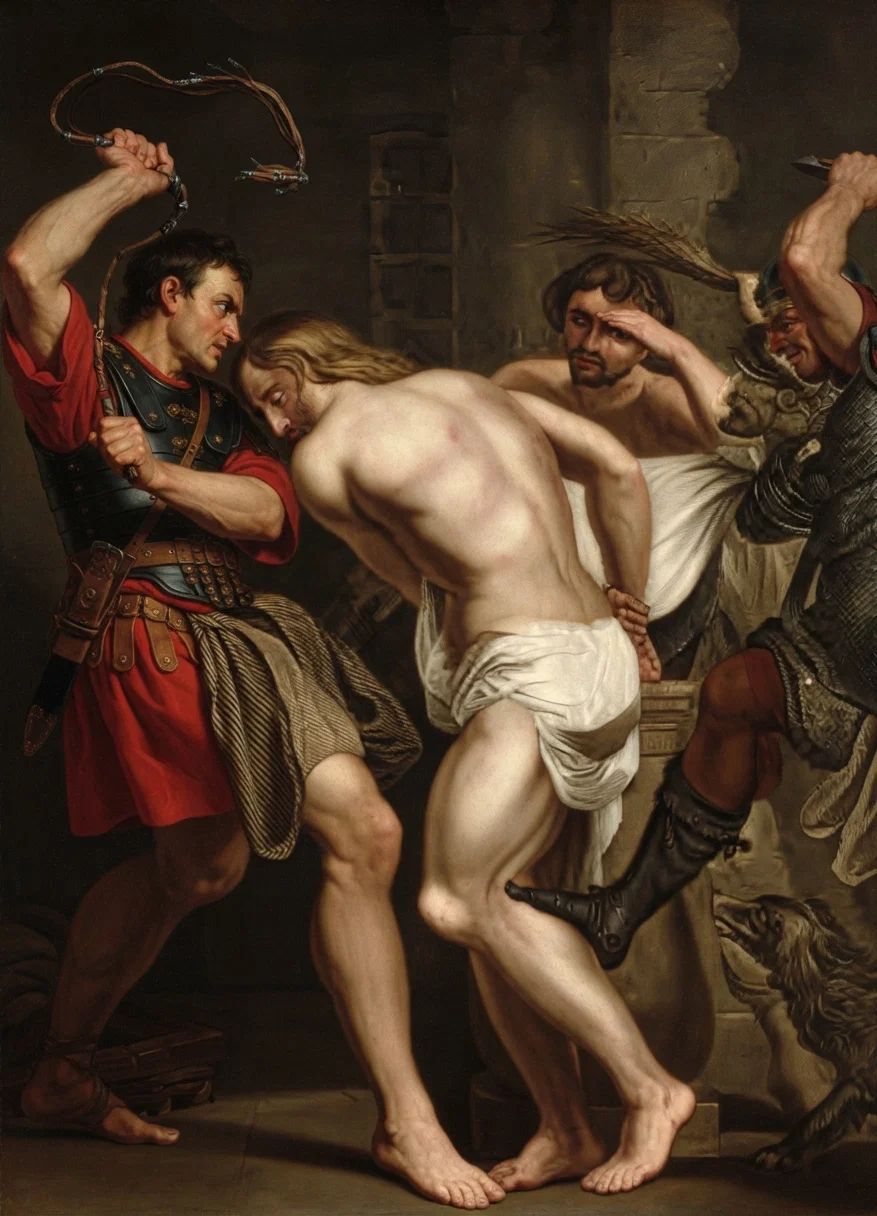
"WHO WAS TREATED AS WE DESERVE, THAT WE MIGHT BE TREATED AS HE DESERVES," FOR BY "HIS STRIPES WE ARE HEALED."
WHAT is justification? — It is that governmental act of God's grace, absolving the repentant sinner from all past sins, regarding him innocent, righteous, and freed from the penalty of violated law, through the merits of Christ's atoning blood. "If the Son therefore shall make you free, ye shall be free indeed." Sin is a violation of God's law — the highest law in the universe — and a capital offense. "The wages of sin is death."
The penitent sinner believes on the Lord Jesus Christ, and God pardons his sins, remits the punishment he deserves, receives him into favor, and treats him as though he had not sinned. "Being justified by faith, we have peace with God through our Lord Jesus Christ," "who was treated as we deserve, that we might be treated as He deserves," "suffering the death which was ours, that we might receive the life that was His," for by "His stripes we are healed."
INNOCENT IN HEAVEN'S SIGHT
Thus the repentant sinner has his sinful life removed, and the sinless life of Christ imputed for all past sins, and he becomes an innocent child in Heaven's sight, "born again, born from above."
Now the question comes, How can this condition be retained? First, let us consider some of the steps by which we obtained justification. We saw ourselves sinners when measured by the law of God, and repented of the sins, and confessed them, and by these steps were "cleansed from all unrighteousness" — sin. Now see Gal. 2: 17, 18: "But if, while we seek to be justified by Christ, we ourselves are found sinners, is therefore Christ the minister of sin? God forbid. For if I build again the things which I destroyed, I make myself a transgressor."
Here we see the necessity presented of not again committing the confessed sins; for the commission of sin negatives the justified state, and any professed Christian who lives in the commission of sin is a sinner, and not a saint. "He that saith, I know Him, and keepeth not His commandments, is a liar." "We know that whosoever is born of God sinneth not." "Whosoever committeth sin transgresseth also the law." "In this [committing sin or not] the children of God are manifest, and the children of the devil." "He that committeth sin is of the devil." "My little children, these things I write unto you, that ye sin not. And if any man sin, we have an advocate with the Father, Jesus Christ the righteous." However, no state of grace admits of committing sin. All sin is forbidden, and he who commits sin is of the devil.
A state of justification implies freedom from the guilt of sin by renewing, assisting grace in the performance of all God's requirements. "Whosoever is born of God doth not commit sin; for His seed remaineth in him: and he can not sin, because he is born of God."
HOW OBTAINED AND HOW KEPT
Justification is obtained by faith; but one who retains justification will perform every known duty, by the imparted strength of Christ Jesus. The minimum of salvation is salvation from sinning; the maximum is salvation from the inclination to sin.
"If we confess our sins, He is faithful and just to forgive us our sins, and to cleanse us from all unrighteousness." No one can believe with the heart to righteousness, sinlessness, or so as to obtain justification, while living in the practise of any known sin, or in the neglect of any known duty; for the moment he does what he knows to be sin, or neglects what he knows to be duty, faith, by which he is justified, lets go its hold upon God, and he loses his justification, until he retraces his steps, and by repentance and believing faith in Christ, confesses his sin and is again pardoned.
POWER TO BECOME SONS OF GOD
Justification carries with it entire submission and implicit obedience to God; the will is right at the moment of regeneration; and it must remain right, or wilful sin will be the result. "As ye have therefore received Christ Jesus the Lord, so walk ye in Him." It is impossible to retain justification by any less consecration and faith than that by which we obtained it. "Faith without works is dead." Hence it becomes necessary for us to manifest our faith by our works. "He that saith he abideth in Him ought himself also so to walk, even as He walked;" and John 1: 12 says that "as many as received Him, to them gave He power to become the sons of God." As we receive this power, we are enabled to live and work as sons, not as mere hired servants.
There is a vital union between justifying faith and an obedient spirit. Conscious confidence and conscious guilt can not coexist in the same heart. "Beloved, if our heart condemn us not, then have we confidence toward God. And whatsoever we ask, we receive of Him, because we keep His commandments, and do those things that are pleasing in His sight." 1 John 3: 21, 22. While obedience makes faith perfect, disobedience destroys it.
Salvation comes by an appropriating faith; and such faith, or trust, can be exercised only when there is a consciousness of complete surrender to God.
PERFECT OBEDIENCE
A justified state can exist only in connection with a serious, honest intention to obey all the commands of God.
The standard of justification is placed too low by many professors of religion to-day. They seemingly forget that believers can not commit sin without forfeiting the justified state, and building again the works once destroyed, and "laying again the foundation of repentance from dead works."
If we would retain the covering of the sinless life of Christ, there must be continued obedience to all the known will of God; for that life will not cover one unconfessed, unfor-saken sin.
INCONSISTENT WITH SUPREME LOVE
The commission of sin, any sin, is inconsistent with supreme love to God. First John 5:3 says, "This is the love of God, that we keep His commandments"; and if we love God supremely, we will not knowingly displease Him for the sake of pleasing ourselves. Whom we supremely love, we desire to please; and all sin is an offense against the law of love — love to God and love to man. Matt. 22: 40.295Perhaps a distinction, to some extent, should be made between sin committed by deliberate thought, or set purpose — the willing sin — and sin committed by sudden impulse, under strong distraction and temptation. Nevertheless we must overcome every tendency to sin, both inherited and cultivated. There is no excuse permitted us of God for the commission of any sin. The plan of salvation contemplates complete freedom from the power of sin, in whatever form it may appear.
THE SPIRIT OF DISOBEDIENCE
The real spirit of disobedience is ever one and the same, for every precept, for all times, and under all circumstances. Every sin alike is a violation of the same obligations, outrages the same law, insults the same Lawgiver, evinces the same rebellious spirit, and incurs the same fearful curse pronounced against the lawbreaker. "Whosoever shall keep the whole law, and yet offend in one point, he is guilty of all" (James 2: 10), and is made subject to death.
THE SPIRIT OF OBEDIENCE
The real spirit of obedience is ever one and the same, for every precept, for all times, and under all circumstances. It has regard to God's authority as supreme, and submits the whole being to that authority. Every act of true obedience has reference to the same obligations, regard to the same law, respect for the same Lawgiver, evinces the same submissive spirit, and secures the same gracious reward in the divine favor and blessing. Hence he who has the true spirit of obedience in regard to one precept of the law, has it toward all the rest. "He that is faithful in that which is least is faithful also in much." Luke 16: 10.
To sin knowingly in one thing, and really to obey God in another at the same time, is utterly impossible. All true obedience involves supreme loyalty to divine authority; and one who obeys thus, can not knowingly disregard or reject one iota of that law. God forbids all sin, and each precept of the law has an equal obligation. Any disobedience rejects and insults that divine authority, and lays the foundation for unlimited disobedience.
BALKING AT ONE REPUDIATES ALL
One cherished sin separates from God; and a spirit of disobedience in the heart in regard to one precept of God, vitiates for the time any true obedience. Hence real obedience to God in one thing, and persistent disobedience in another thing, can not exist at the same time.
One may, under the pressure and distraction of powerful temptation, as already stated, for a moment commit sin, while really obeying God in other things; but under no circumstance will he permit that sin to stand. He will immediately put it away, and an urgent petition will ascend to God that he may never be overtaken again by a like temptation, and fall. Having submitted himself to God, the true spirit of repentance and obedience is in his heart, and he will resist the devil, who will flee from him.
LOVE DOES NOT EXCUSE SIN
The garment of Christ's righteousness will not cover one sin. Even though God is love, that love will not excuse sin. Sin caused Satan to be cast out of heaven, Adam out of the garden of Eden, Cain to be banished from the presence of God. It brought death to the antediluvians, in the Flood; and it will ultimately cause the earth to be burned with fire, and those who cling to sin will be destroyed with it.
"For not the hearers of the law are just before God, but the doers of the law shall be justified." Rom. 2: 13. "The just shall live by faith." "Whom He justified, them He also glorified." They are found "without fault before the throne of God."