WHAT is the Christian hope? This is a Bible question, and should have a Bible answer.
In considering this question, we should not confound the present, the Christian life, with the future, the Christian hope.
A PRESENT SALVATION
The gospel offers not only ultimate, final salvation — that is, salvation from the wages of sin — but present salvation; namely, salvation from sin itself. Final, ultimate salvation comes after this life is past. It is the reward that is given to God's people at the coming of the Lord Jesus Christ. Present salvation is the victory over sin, the power to overcome temptation, the growth in grace, that comes to the Christian day by day and hour by hour. The former is a subject of hope, the latter a matter of daily experience.
In his letter to the Colossians (1:23), the apostle exhorts those to whom he writes that they "be not moved away from the hope of the gospel," and in verse 27 he calls it "the hope of glory." In his letter to Titus (2:13), Paul refers to the same thing as "that blessed hope," and in the same verse connects it with "the glorious appearing of the great God and our Saviour Jesus Christ."
WHAT IS THE "BLESSED HOPE"?
But these texts still leave the inquirer in doubt as to just what is the "blessed hope" that is realized at the appearing of our Lord and Saviour Jesus Christ. Light is shed on this subject, however, by Rom. 8:18-23:
"For I reckon that the sufferings of this present time are not worthy to be compared with the glory which shall be revealed in us. For the earnest expectation of the creature waiteth for the manifestation of the sons of God. For the creature was made subject to vanity, not willingly, but by reason of him who hath subjected the same in hope, because the creature itself also shall be delivered from the bondage of corruption into the glorious liberty of the children of God. For we know that the whole creation groaneth and travaileth in pain together until now. And not only they, but ourselves also, which have the first-fruits of the Spirit, even we ourselves groan within ourselves, waiting for the adoption, to wit, the redemption of our body."
A PLEDGE OF THE RESURRECTION
The Spirit is the "earnest," or pledge, "of our inheritance" (Eph. 1:14). It is that which gives victory over sin day by day; and this victory is the assurance of that for which "we ourselves groan within ourselves, waiting for the adoption, to wit, the redemption of our body."
In other words, a living, growing Christian experience, wherein Christ through the Spirit gives victory over sin, is the assurance, or pledge, of the resurrection of our body if we die, or of the change to immortality of our body if we live to see the Lord come in the clouds of heaven. Therefore the resurrection of the dead is an essential part of the hope of the gospel.
The gospel holds out the hope of immortality through Christ. Modern theology has substituted for this the heathen hope of natural, inherited immortality. "Ye shall not surely die," said the tempter. "Man does not really die," says modern theology. "That which seems to be death and which we call death is only transition," says the present-day theologian. But the apostle boldly declares: "If the dead rise not, then is not Christ raised: and if Christ be not raised, your faith is vain; ye are yet in your sins. Then they also which are fallen asleep in Christ are perished." 1 Cor. 15:16-18.
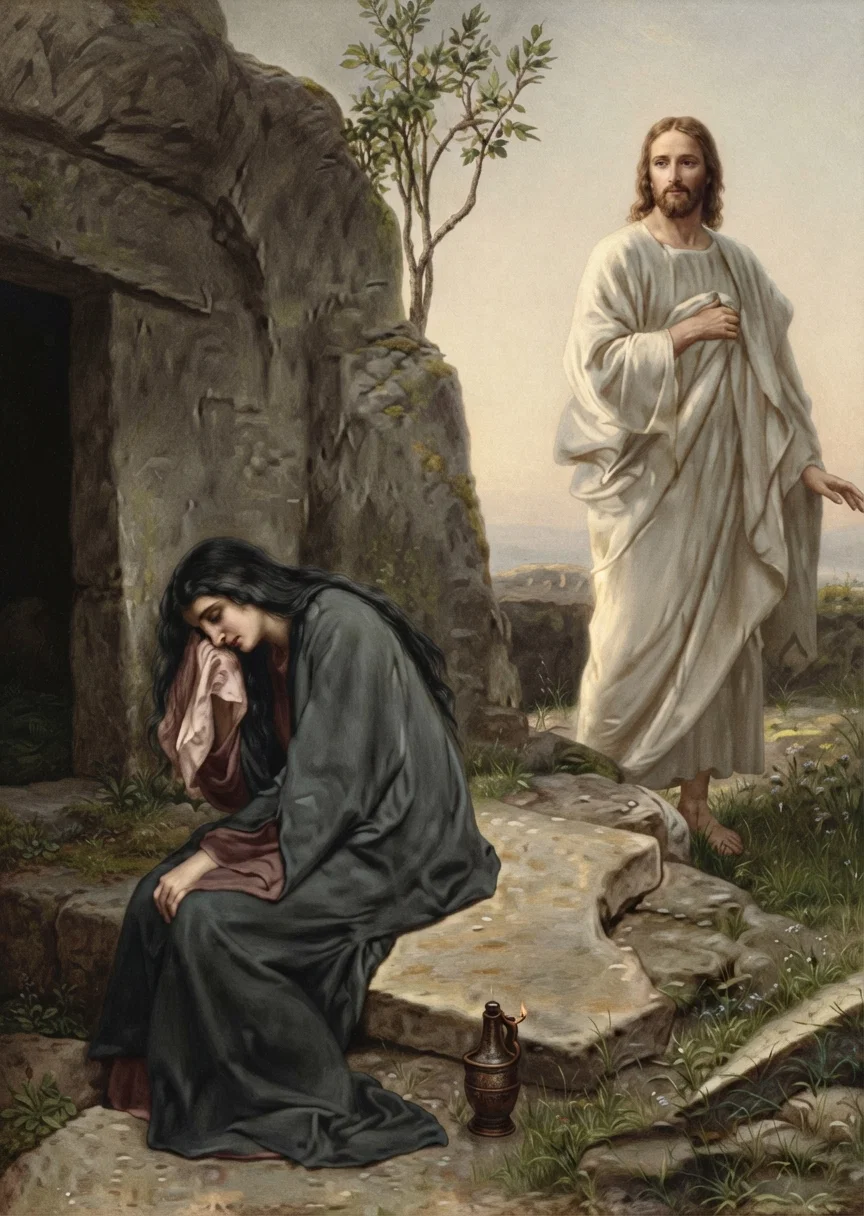
"Woman, why weepest thou?" "Because they have taken away my Lord." "She turned herself back, and saw Jesus standing."
NOT A NEW THING
Nor was the apostle introducing something new. In preaching the resurrection, he was only teaching a doctrine that had long been not only one article in the creed of the Jews, but the hope of the fathers. The promise of the resurrection was bound up in the promise to Abraham. That this was not and is not a novel or unscriptural view is evident from a number of considerations.
Rabbi Eliezer the Great, supposed to have lived just after the second temple was built, applied Hosea 14:8 to the pious Jews, who seemed likely to die without seeing the glory of Israel, saying: "As I live, saith Jehovah, I will raise you up in the resurrection of the dead; and I will gather you with all Israel."
The Sadducees are reported to have asked Rabbi Gamaliel, the preceptor of Paul, whence he would prove that God would raise the dead. In reply he quoted Deut. 9:5: "The land . . . which the Lord swore unto thy fathers." He argued that as Abraham, Isaac, and Jacob had it not, and as God can not lie, they must be raised from the dead to inherit it.
Rabbi Simai, at a later date, made a similar argument from Ex. 6:4, insisting that the law asserts in this place the resurrection from the dead when it says, "And I have also established My covenant with them, to give them the land of Canaan"; for, he adds, "It is not said to you, but to them."
Mennasseh Ben Israel said: "It is plain that Abraham and the rest of the patriarchs did not possess that land: it follows, therefore, that they must be raised in order to enjoy the promised good, as, otherwise, the promise of God would be vain and false."
PAUL DEFENDS THE RESURRECTION
But above and beyond these opinions of good but uninspired men, is the testimony of the apostle Paul. In his defense before the council the apostle said: "Men and brethren, I am a Pharisee, the son of a Pharisee: of the hope and resurrection of the dead I am called in question." Acts 23:6.
Subsequently to Agrippa he said, touching the same matter: "And now I stand and am judged for the hope of the promise made of God unto our fathers: unto which promise our twelve tribes, instantly serving God day and night, hope to come. For which hope's sake, King Agrippa, I am accused of the Jews. Why should it be thought a thing incredible with you, that God should raise the dead?" Acts 26:6-8.
It thus appears that the Christian hope is the hope of a resurrection to eternal life through faith in our Lord Jesus Christ. And the pledge of this hope is the divine Spirit permeating the daily life and giving victory over the besetments of the flesh, over the carnal mind.
"Create in me a new, clean heart, O God,—
A heart to meekly bow before Thy rod.
Remove the crimson stains that sin has made,
And from Thy book make all my guilt to fade.
"Give me Thy Spirit, pledge of life,
And daily, hourly victory in the strife
That all must have with deadly sin
Who victory through Thy grace would win."