A Token of Personal Experience — The Form in Harmony with the Purpose
EVERY step in the way of salvation is a walking with Christ. We are crucified with Him; we die with Him to self and sin; we are buried with Him by baptism; we rise to walk with Him in newness of life; we are made to sit with Him in heavenly places in spiritual experience; and if faithful to the end, we shall reign with Him in glory. In the ordinance of baptism left with the church by Christ's commandment, we are taught as by an object-lesson this fundamental truth of dying with Christ and rising again with Him.
IT PICTURES DEATH AND BURIAL
The very word "baptism," as spoken by the Lord Jesus, and as written by inspiration of the Spirit of God, gives the picture of the death and burial of the sinner to the old life, and the resurrection to a life of righteousness; for the meaning of the word is "to plunge," "to immerse." Speaking of the meaning of baptism, the apostle Paul wrote:
"We are buried with Him by baptism into death: that like as Christ was raised up from the dead by the glory of the Father, even so we also should walk in newness of life. For if we have been planted together in the likeness of His death, we shall be also in the likeness of His resurrection." Rom. 6: 4, 5.
Baptism is a profession of faith in the Saviour who went down into the grave for us, and who rose again for us. The profession is set forth in the solemn act that has in it "the likeness" to the great fundamental fact of redemption, Christ's own burial and resurrection.
OUTWARD TOKEN OF REAL EXPERIENCE
This ordinance, with all its likeness to that of which it is the memorial, is an outward token of the actual experience of the believer in dying to sin and being raised to a new life by the power of divine grace.
The perversion of the ordinance into sprinkling, and that in infancy, takes away the divinely appointed object-lesson. It substitutes ceremonialism for the living experience. This is evident; for the innocent babe, not yet held accountable, can have no experience of believing and repenting, which are the divinely stated conditions for baptism. Therefore the great commission reads, "He that believeth and is baptized," etc.
HOW THE CHANGE IN FORM CAME
The change in form evidently came about concurrently with the change in apprehension of the true meaning of this Christian ordinance. Dean Stanley, one of the brightest scholars of the Church of England, dean of Westminster, wrote in his "Christian Institutions" that it was not until the third century, in church history, that "we find one case of the baptism of infants." On the change in the form of the ordinance from immersion to sprinkling, he says:
"What is the justification of this almost universal departure from the primitive usage? There may have been many reasons, some bad, some good. One, no doubt, was the superstitious feeling, already mentioned, which regarded baptism as a charm, indispensable to salvation, and which insisted on imparting it to every human being who could be touched with water, however unconscious."
Ceremonialism was taking the place of experience. As men lost sight of the real death to sin and the resurrection to righteousness, of which baptism was the divinely appointed likeness and confession, the merit was attributed to the mystical touch of the water. Then how natural that in the case of a dying person unable to be carried to the water for baptism, the water should be brought and poured or sprinkled upon the person, in order that its mystical power might take away sin? Then very naturally must have come the next step. If the physical touch of the water could purge every sin away, why should not the infant be plunged into the regenerating waters?
A PROCESS OF CENTURIES
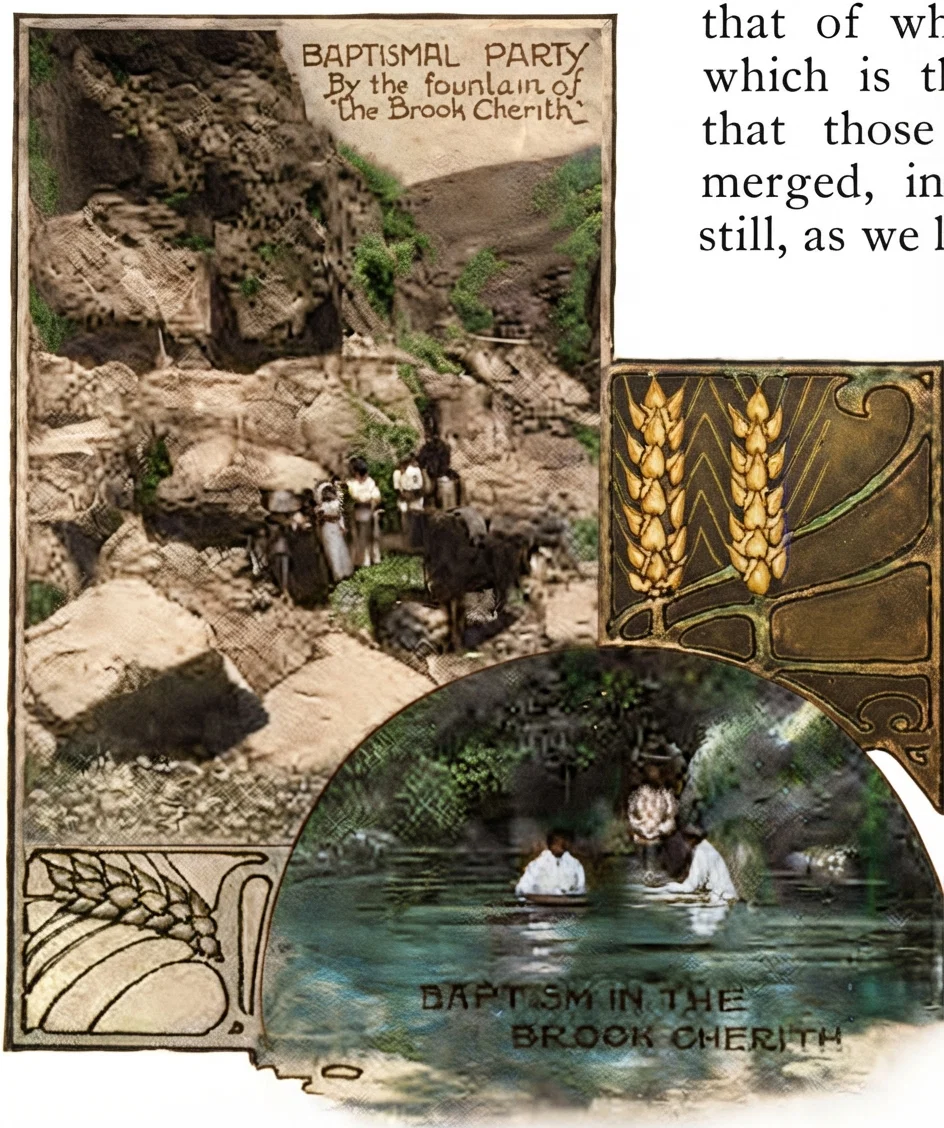
The perversion of the form, however, was a process of centuries. Dean Stanley says of this: "For the first thirteen centuries, the almost universal practise of baptism was that of which we read in the New Testament, and which is the very meaning of the word 'baptize,'—that those who were baptized were plunged, submerged, immersed into the water. That practise is still, as we have seen, continued in the Eastern churches.
We are taught as by an object-lesson this fundamental truth of dying with Christ.
In the Western church it still lingers among Roman Catholics in the solitary instance of the Cathedral of Milan; among Protestants in the numerous sects of the Baptists. It lasted long into the middle ages. . . . But since the beginning of the seventeenth century, the practise has become exceedingly rare. With the few exceptions just mentioned, the whole of the Western churches have now substituted for the ancient bath the ceremony of letting fall a few drops of water on the face.
"The reason of the change is obvious. The practise of immersion, though peculiarly suitable to the Southern and Eastern countries for which it was designed, was not found seasonable in the countries of the North and West. Not by any decree of council or parliament, but by the general sentiment of Christian liberty, this remarkable change was effected. Beginning in the thirteenth century, it has gradually driven the ancient Catholic usage out of the whole of Europe. There is no one who would now wish to go back to the old practise. It followed, no doubt, the example of the apostles and of their Master. . . . But, speaking generally, the Christian civilized world has decided against it. It is a striking example of the triumph of common sense and convenience over the bondage of form and custom."—"Christian Institutions," pages 21, 22.
From the point of view of mere historical research and ecclesiastical record the dean's conclusion may satisfy some. However, when he declares that this change in the divinely appointed form was a triumph of common sense and convenience, he really charges Christ and the apostles with not having used good judgment in the original institution of the ordinance. But the divine institution of it was to teach the great lesson that the Christian life is not a form, and that at the beginning of it there must be the death to sin, and the resurrection by the power of the Holy458Spirit. To teach this lesson, the Lord Himself commanded the ordinance in the "likeness" of His own resurrection. The reformation from error and apostasy to which God is calling believers in these last days includes the call to follow the Lord Jesus Christ in baptism; and those who follow Christ's example in this will find in it the blessing that always attends loving obedience to the divine precepts.