It Was Formed to Be Eternally Inhabited—It Is Definitely Promised to the Righteous
By ARTHUR G. DANIELLS
THIS is the first of three articles by Elder Daniells on the general subject of the future of our earth. Next week he will give attention to the time when the promises spoken of in this article will be fulfilled. He will also speak of the manner of their fulfilment, and incidentally present the part that the temporary desolation of the earth will play in the great transformation and renovation of our planet.
WHAT is to become of the earth on which we dwell? Will it continue to exist, and revolve in space as at present, or will it be destroyed? If it is to continue, of what use will it be? Will it be inhabited? If so, by whom? If it is to be destroyed, what reason can be given for such a strange act?
To the thoughtful, the above inquiries must be of deep interest. There is but one source from which it is possible to get anything like a satisfactory answer to these questions, and that is the word of God. Nature can give no light regarding them.
CREATED TO BE INHABITED
The object for which the earth was created is thus stated by the prophet Isaiah: “For thus saith the Lord that created the heavens; God Himself that formed the earth and made it; He hath established it, He created it not in vain, He formed it to be inhabited: I am the Lord; and there is none else.” Isa. 45:18. It appears, then, that the design of God in creating the earth was that it should be inhabited. By whom? Let the psalmist answer: “The heaven, even the heavens, are the Lord’s: but the earth hath He given to the children of men.” Ps. 115:16. Again: “What is man, that Thou art mindful of him? and the son of man, that Thou visitest him?” “Thou madest him to have dominion over the works of Thy hands; Thou hast put all things under his feet: all sheep and oxen, yea, and the beasts of the field; the fowl of the air, and the fish of the sea, and whatsoever passeth through the paths of the seas.” Ps. 8:4, 6-8.
MAN PLACED IN POSSESSION OF ALL
From this we learn that when the earth and all pertaining to it had been created, man was created and placed in possession of all. This is further confirmed by the words of Moses in Gen. 1:26-30. Here is man, made in the image of God, standing at the head of all that is living on the earth. This world, in all its beauty and extent, is his dominion. He is rightful possessor and ruler of all. He of course must govern, and be governed, by the laws of his wise and just Creator. What a wonderful gift to man—a beautiful world, unstained by sin!2
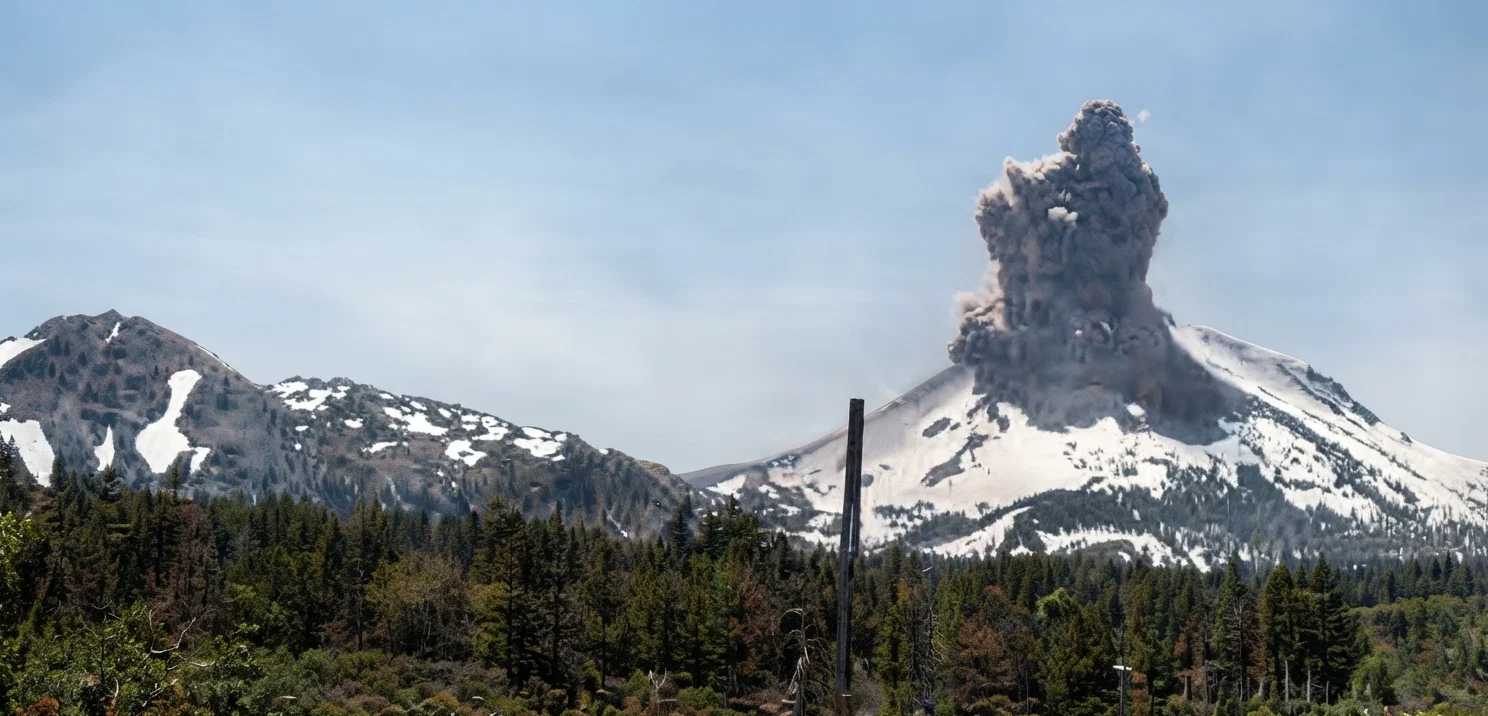
AMERICA’S VOLCANO, MOUNT LASSEN, CALIFORNIA, IN ERUPTION
The wise man says, "The earth abideth forever." Eccl. 1:4. God said to our first parents, "Be fruitful, and multiply, and replenish the earth." Hence it is certain that had man been loyal and true to the requirements of God, he, with his posterity, would have lived in this happy and holy estate throughout the ceaseless ages of eternity.
MAN LOST HIS DOMINION
But in time a sad and much regretted change took place. The tempter came. Man sinned, and lost his innocence, his life, and the dominion of the earth as given to him at the beginning. Paul, after referring to man's first dominion as stated by the psalmist, says: "Thou hast put all things in subjection under his feet. For in that He put all in subjection under him, He left nothing that is not put under him. But now we see not yet all things put under him." Heb. 2:8. At first all things were put in subjection under him; but at present this is not the case. He has lost his dominion. It has passed from him.
A USURPER AND DECEIVER ENTERS
To whom did the dominion pass? Was it not to the one who deceived man, and caused him to sin? When Jesus came to earth to carry out a very important part in the plan of redemption, Satan met Him at the very beginning of His work, and exerted all his satanic power and cunning to defeat Him. He tempted the Son of God by offering to Him all the kingdoms of the world and the glory of them, saying, "For that is delivered unto me; and to whomsoever I will I give it."
Here Satan asserted his claim to the ownership of the earth, which he won by conquest. Jesus did not dispute it, but seemed to recognize its truthfulness, and afterward called him "the prince of this world." John 14:30. Paul called him "the god of this world." 2 Cor. 4:4.
From these considerations it seems evident that when man was taken captive, his "dominion" passed into the hands of the captor; and that the captor, for a time, has at least limited control of this world.
THIS POWER AND USURPATION TO BE OVERTHROWN
That a decided change will in time take place, when every vestige of power will be taken from him, the Bible clearly teaches. Jesus Himself announces, "For the Son of man is come to save that which was lost." Matt. 18:11. Man was lost, and his dominion also was lost. Therefore Jesus came to save both man and his dominion—the earth.
For this reason Micah says: "And Thou, O Tower of the flock, the Stronghold of the daughter of Zion, unto Thee shall it come, even the first dominion; the kingdom shall come to the daughter of Jerusalem." Micah 4:8.
SHALL INHERIT THE EARTH
The Bible abounds in promises to the effect that the righteous shall inherit the earth. As we read these promises, it will be seen that many of those passages which state that this earth shall be the home of the saved, also declare that it shall not be the home of the wicked. Let the reader observe the striking contrast everywhere drawn between the righteous and the wicked.
David says to the righteous: "Fret not thyself because of evil-doers, neither be thou envious against the workers of iniquity. For they shall soon be cut down like the grass, and wither as the green herb." "For evil-doers shall be cut off: but those that wait upon the Lord, they shall inherit the earth. For yet a little while, and the wicked shall not be: yea, thou shalt diligently consider his place, and it shall not be. But the meek shall inherit the earth; and shall delight themselves in the abundance of peace." Ps. 37:1, 2, 9-11.
WHEN THE WICKED ARE "CUT OFF"
According to these statements, it is evident that so far as the present life is concerned, prosperity is as likely to attend those who serve Satan as it is to attend those who serve the living God. Jesus says His Father "maketh His sun to rise on the evil and on the good, and sendeth rain on the just and on the unjust." But it is not to the present that we are pointed for consolation and hope. Our minds are directed to the future, when the wicked "shall be cut off"; then the righteous "shall inherit the earth," and dwell therein forever.
On this point Solomon says: "For the upright shall dwell in the land, and the perfect shall remain in it. But the wicked shall be cut off from the earth, and the transgressors shall be rooted out of it." Prov. 2:21, 22. Here it is plainly stated that the wicked shall not inherit the earth. Now inasmuch as the wicked do at present inhabit the earth the same as the righteous, all such statements must have reference to a future state. We therefore conclude that God does not intend to destroy our earth at the close of probation, but that He will make it the everlasting abode of all who have "washed their robes, and made them white in the blood of the Lamb."
The expressions, "The earth abideth forever," "The perfect shall remain in it," "The righteous shall never be removed," etc., are emphatic, and can not be set aside.
WILL THE EARTH BE DESTROYED?
But, it is asked, does not the Bible teach that when the work of the gospel is finished, the earth will be burned up and destroyed? How can it teach that, and at the same time teach that it will abide forever, and that the righteous shall inhabit it forever, and never be removed? The Bible writers tell us of a great burning day when the earth will be on fire, but none of them state that it will be burned up.
No doubt the apostle Peter comes nearer to conveying such a thought than any other writer of the Scriptures; but a careful reading of his words will show that he does not say that the earth will be burned up.
Here is what he says: "But the day of the Lord will come as a thief in the night; in the which the heavens shall pass away with a great noise, and the elements shall melt with fervent heat, the earth also and the works that are therein shall be burned up." 2 Peter 3:10. This verse states a number of facts: 1. That the day of the Lord will surely come; 2. That when it does come, the elements shall melt with fervent heat; 3. The earth also, in addition to the elements, shall melt with fervent heat; 4. And the works that are therein shall be burned up. And so John says, "For this purpose the Son of God was manifested, that He might destroy the works of the devil." 1 John 3:8.
WE LOOK FOR A NEW EARTH
Thus it is seen that the melting of the earth and the complete destruction of its works is a part of the great plan of redemption.
The apostle adds, "Nevertheless we, according to His promise, look for new heavens and a new earth, wherein dwelleth righteousness." 2 Peter 3:13.
A new or renewed earth will come forth from this purifying fire. Of this change the psalmist says: "Of old hast Thou laid the foundation of the earth; and the heavens are the work of Thy hands. They shall perish, but Thou shalt endure: yea, all of them shall wax old like a garment; as a vesture shalt Thou change them, and they shall be changed." Ps. 102:25, 26.
In another place we are told how the earth will be changed: "Thou hidest Thy face, they are troubled: Thou takest away their breath, they die, and return to their dust. Thou sendest forth Thy Spirit, they are created; and Thou renewest the face of the earth." Ps. 104:29, 30.
From the purifying fires of the great day of God, the earth will come with its face renewed; and the blight and mildew of sin will have been removed, the works of Satan destroyed, and the earth in its renewed state and Eden beauty will be given to the saints of the Most High, who shall possess it through the ceaseless ages of eternity.
IT WAS PROMISED TO ABRAHAM
On this ground, and this only, is it possible to understand God's promises to and dealings with Abraham and his posterity. On one occasion "the Lord said unto Abram, after that Lot was separated from him, Lift up now thine eyes, and look from the place where thou art northward, and southward, and eastward, and westward: for all the land which thou seest, to thee will I give it, and to thy seed forever." Gen. 13:14, 15.451
That the world, and not Palestine only, is here promised to Abraham, is stated by Paul in Rom. 4:13: "For the promise, that he should be the heir of the world, was not to Abraham, or to his seed, through the law, but through the righteousness of faith." Of course Palestine is included in the promise. This positive promise to Abraham that he should possess the world forever was renewed by the Lord at a subsequent time. Gen. 17:1-8. Although Abraham was at this time in the land of Canaan, the Lord reminds him that he is there as a stranger and not as an heir.
THESE PROMISES FOR THE FUTURE
The same promise was confirmed to Isaac and Jacob. Gen. 26:3-5; 28:13. But none of these promises have ever yet been fulfilled. Speaking of Abraham and the promise to him, Stephen says: 'And He gave him none inheritance in it, no, not so much as to set his foot on: yet He promised that He would give it to him for a possession, and to his seed after him, when as yet he had no child.' Acts 7:5.
There is no mistaking this statement. Abraham never received one foot of this earth in fulfilment of the promises we are now considering. What, then, shall we conclude—that the Lord will not do as He has promised, or that the promise had reference to a future time? This is all made plain by Paul in his letter to the Hebrews: 'By faith Abraham, when he was called to go out into a place which he should after receive for an inheritance, obeyed; and he went out, not knowing whither he went. By faith he sojourned in the land of promise, as in a strange country, dwelling in tabernacles with Isaac and Jacob, the heirs with him of the same promise: for he looked for a city which hath foundations, whose builder and maker is God.' Heb. 11:8-10.
THE ETERNAL CITY PROMISED
Let us note the facts here stated: 1. Abraham was called into a country which he should afterward receive for an inheritance; 2. He dwelt in this land to the day of his death, as in a strange country; 3. He looked forward to a city, the New Jerusalem, whose builder and maker is God; 4. He and his sons died, 'not having received the promises, but having seen them afar off'; 5. They 'confessed that they were strangers and pilgrims on the earth.' How evident that the promises were for the future, and that those to whom they were given so understood them!
Finally Paul says, 'These all, having obtained a good report through faith, received not the promise: God having provided some better thing for us, that they without us should not be made perfect.' Verses 39, 40. The better way provided is that all the heirs shall receive the inheritance at the same time. And who are the heirs?—'If ye be Christ's, then are ye Abraham's seed, and heirs according to the promise.' Gal. 3:29. The heirship extends to all who shall overcome.
This is the rest that remains for the people of God. O, blessed rest that remains for the worn and weary toilers in the Master's vineyard! O, blessed home that awaits the pilgrims and strangers of this sin-cursed earth! O, delightful day, when shall be gathered from all parts of the world, and from all ages of human history, that 'great multitude, which no man could number,' to receive from the Lord God this earth, blooming as it did when first given to man!
To this great event, and for this priceless gift, have all the patriarchs, prophets, apostles, and martyrs looked with longing, tearful eyes. And lo, the day draws on apace!
'How bright the vision! O, how long
Shall this glad hour delay?
Fly swifter round, ye wheels of time,
And bring the welcome day.'