The Great Message Progressing in German East Africa
Mission Schools Pushing a Strong Educational Work
Consecrated Men and Women Yielding Up
Their Lives to Advance the Work
By L. R. CONRADI
THIS article was mailed by Elder Conradi from Hamburg shortly before the breaking out of the war. He had promised us a number of articles telling of the interesting missionary operations of our European division, in Africa; but this war will leave him for some time with his hands and heart so full that he may not be able to continue this writing until things settle.
This article shows something of the splendid work begun. This work and the workers in that field are cut off from support while the awful European war lasts, as was stated in our issue of last week. Our friends in America will have to send them funds, or they will be left in a starving condition. We will not permit them to suffer. From our abundance in this favored land, we must send them what they need, until normal conditions prevail again, and they can be supplied from the European treasury. While this war is on, all the means that Europe has will be consumed within her own borders.
Funds intended for the relief of those workers in Africa may be sent to the treasurer of the Pacific Press Publishing Association, Mountain View, California. EDITOR.
WITH the increase of our members and finances in the German Empire, the desire grew to send missionaries to the German colonies. German East Africa, in size nearly twice as large as the German Empire itself, but with a population of only eight millions, presented the most favorable opening. Even then our eyes turned to the Victoria Nyanza, and to the large and populous country on the western side of the lake; for this territory joins Uganda, where the gospel has attained such wonderful achievements.
"THE VALLEY OF PEACE"
The governor of German East Africa advised us not to enter that field, as it was mostly ruled by native sultans, and the Roman Catholics had already obtained great influence there. He directed us to the South Pare mountains, midway between the coast and the Kilima-Njaro mountains. Two of our missionaries, Brethren Ehlers and Enns, explored the land, and found a suitable location at about 3,000 feet elevation in a valley, and called the station Friedenstal, or "the Valley of Peace."
The Pare people are but a small tribe. Most of them live scattered here and there in little settlements, far up in the valleys of the mountains. Their language had not been converted into writing. Their only covering was skins of animals; and their huts, having no windows nor chimneys, and being low, were unfit for dwellings. Only mountain paths led to these small settlements. Our missionaries had hardly built their homes when a mission fifty miles north claimed this territory.
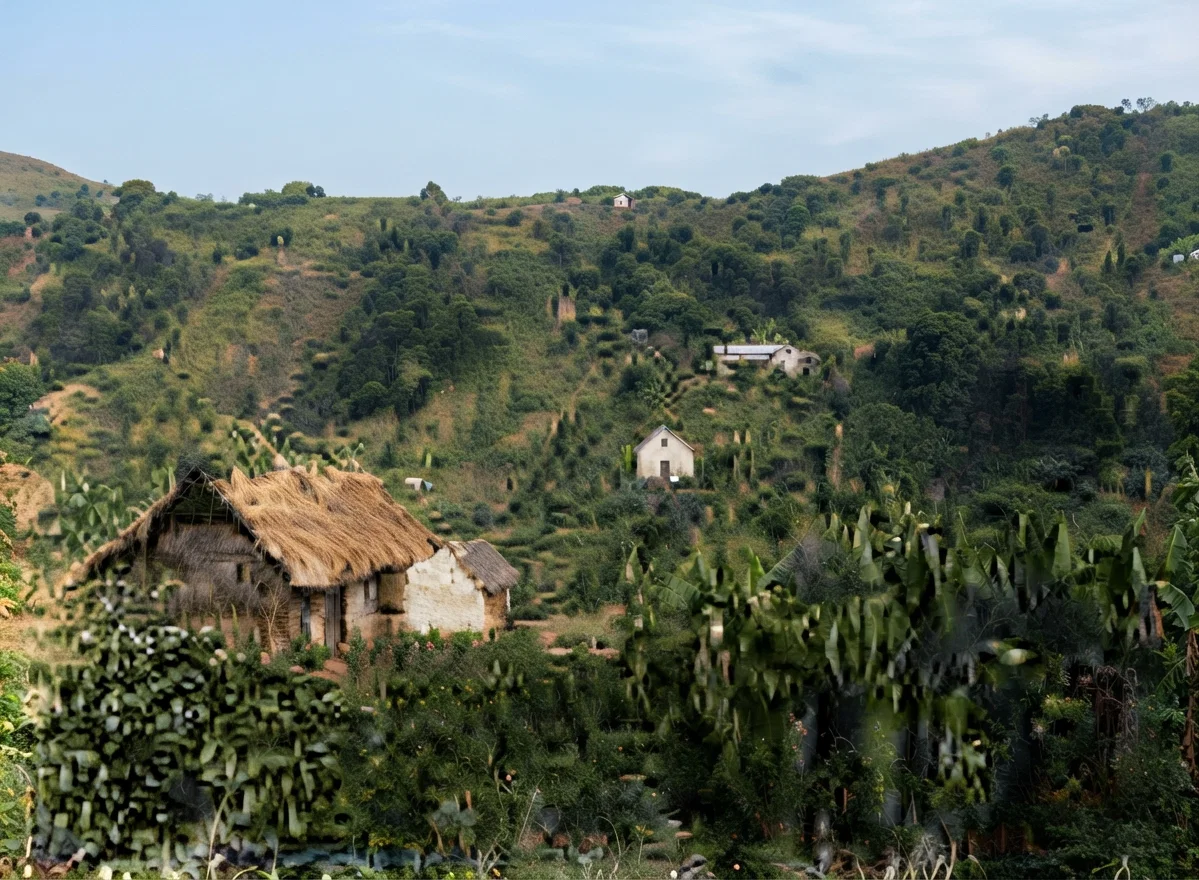
Mission Station, German East Africa. Photograph taken from Brother Sanders's grave.
Six months later, the writer went out there, with further workers and their wives, and plans were laid for three stations among the 25,000 people in South Pare. Since, a fourth one has been added.
TRANSFORMATIONS AND SUCCESSES
Seeing the great need of having missionaries trained as linguists, we sent several to the Oriental Seminary in Berlin. Four years later, when I visited this field again, the railway, which at the time of my first visit went only fifty miles into the interior, carried us as far again, and we were then within a day's journey of our field. Three good mission buildings and schools had been erected. Good roads had been made. Five hundred children had been gathered into the schools. A grammar had been written, also a small primer. Some hymns had been translated, and there were six converts — all young men.
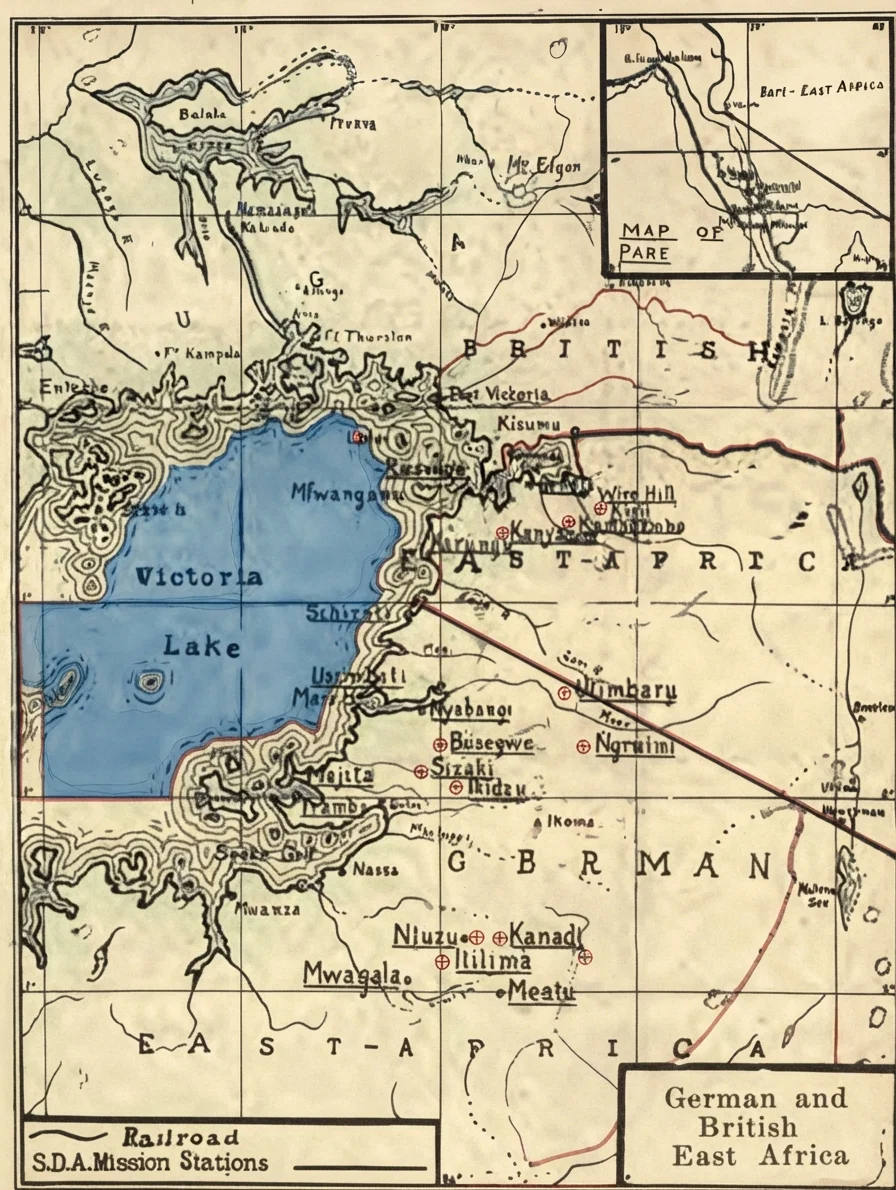
GERMAN EAST AFRICA
When I visited the same field in the winter of 1912-13, there was a still greater change. The railway now passed at the very foot of our mountains; and several hundred pupils, with their teachers, met me at the station, and accompanied me up the mountains.
On the Sabbath mornings, hundreds of natives, in clean white linen, came from every direction to the Sabbath-school, having received their first impulse in our day-schools.
STILL CLOTHED WITH SKINS
At the time for the sermon, hundreds of the older people, still covered with skins, would come, being influenced by their children. On my first visit, we could only make ourselves understood by signs. At the second, I could tell the people, through our interpreters, what Christianity had done for us and for other people in far-off lands. Also I could point to scores of their own sons and daughters, in their very midst, who had experienced the converting power of Christ, and who gladly arose as witnesses of the truthfulness of my preaching.
As we moved on from station to station, we would find every few miles an out-school; and from a hundred to two hundred pupils, with their teacher, greeted us and bade us welcome. Chiefs came with their presents, and some even desired that we start schools in their villages, because their children had to go so far.
THE PROGRESS OF TWELVE YEARS
Twelve years have passed, and what a change has been wrought among this heathen mountain tribe! Four churches have been established, 225 young people have been baptized, as many more are preparing for baptism, some forty teachers have been educated, and not less than 2,300 pupils are in our schools. A number of books have been translated, and parts of the Gospels. A translation of the entire New Testament is nearly completed. Several of their young people, who had done good work as teachers and soul winners, gladly accepted a call to the Victoria Nyanza, where they have become successful helpers for our missionaries.
The mission efforts of our German brethren inspired also our English brethren, and in 1906 a mission site was selected on the eastern shore of the Victoria Nyanza, about twenty miles from the terminus of the Uganda railway. When I went there two years later, a good station had been built up, and some students gathered in. We looked up sites for two other stations, and one station was built. But somehow we did not succeed in obtaining others until the last visit of the writer. Then the British government sold us one of its old military stations; and since that time, four other sites have been secured, and building operations have been commenced on them.
Six of these stations are among the Kavirondos. One is among the Kisiis. Our missionaries have worked up a grammar, a small hymn-book, and a primer. A small printing-press has been secured, and a paper is published in the Kavirondo language. Portions of the Bible have been translated. About fifty young people have been converted, and about five hundred young people are in the schools. In order to facilitate travel, and to convey the goods for our missionaries, a nice sailing vessel, the Kavirondo, has been built.
A VAST TERRITORY OCCUPIED
In 1908 a site was secured in the German territory adjoining. Since then eleven new sites have been secured, and stations put up and manned. Some seventy converts have been gathered out, speaking three different languages. Considerable linguistic work has been done. Over two thousand children are enrolled in their schools.
Thus a vast territory, extending over all the eastern side of the lake and some fifty miles south, has been occupied, and probably nearly a million people have been brought under the influence of our message. But the work is only begun. We have reaped only the first-fruits. Our missionaries had spent most of their time in learning the language,573and in becoming acquainted with the ways of the natives, and putting up their homes, schools, and meeting-houses. They also spent time to cultivate the land, growing some cotton, maize, etc. There are about one hundred native helpers now, and a corps of thirty-five white workers.
If, under the trying circumstances and the difficulty of commencing mission operations with a small and inexperienced force, three hundred and fifty souls could be gathered out in from six to ten years, what might we expect in the near future under altogether more favorable conditions?
LIVES ARE SACRIFICED
Seed must be sown ere we can expect a harvest; and the more plenteously we sow, the greater the harvest. In mission work, we have not only to sow the seed of truth in the hearts. On account of the fatal climate, men and women have even to lay down their lives. But every life sacrificed is a precious seed sown, which yields an abundant harvest.
Christ Himself was the first seed, laid in the earth, and sprang forth to life eternal, bearing a harvest which no man can measure. His followers must expect the same. There are in German East Africa not less than six graves of noble pioneers of this field, and two more in Germany. But alongside these graves in Africa, church buildings are raised, filled with the precious fruit of the seed thus sown.
THE DRAWING POWER
It is the love of Christ shining forth in these missionaries which draws souls to Him. And what God has done in Uganda, on the northern shore of the Victoria Nyanza, we have a right to expect that He will do among the Kavirondos, the Kisiis, the Majitas, the Wasukumas, and others, on the eastern shore of the same lake, and among the Wapares near the coast.
Surely we have every reason, from the results thus far attained, to be of good courage, to increase our gifts, to send forth more of our sons and daughters, and to expect great things of our God.