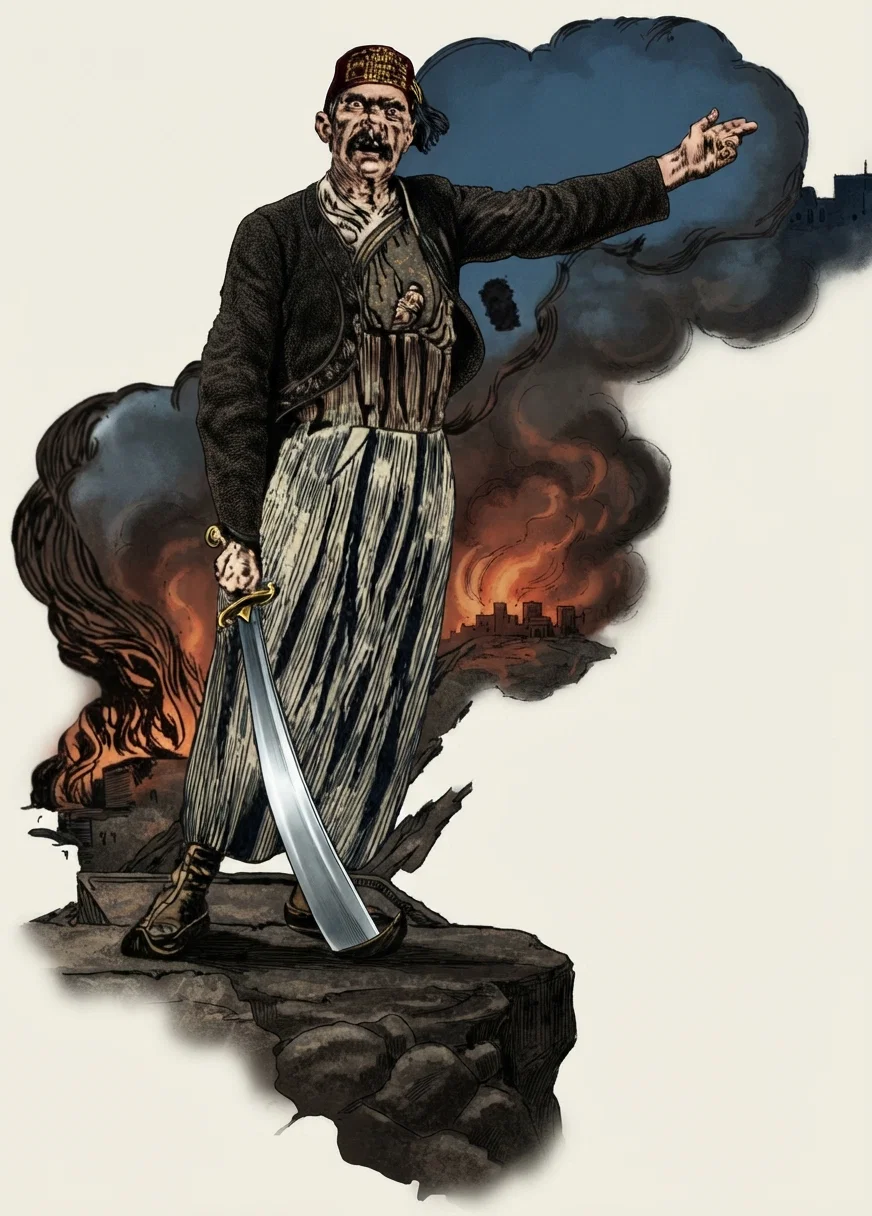
MOVEMENTS OF THE TURKISH POWER, AND THE SIGNIFICANCE — SIGNED BY THE "STANDING" ARMY— THE KING OF EGYPT
MOVEMENTS OF THE TURKISH POWER, AND THEIR SIGNIFICANCE — SIGNAL FOR THE “STANDING UP” OF THE KING OF KINGS
By LUCAS ALBERT REED
Query No. 1.—Against whom will the world powers move in the great final war?
Answer.—Against the Turk in Palestine. The thirty-sixth and thirty-eighth chapters of Ezekiel, the third chapter of Joel, and the twelfth chapter of Zechariah indicate that it will be Jerusalem and the country immediately contiguous to it that will bear the brunt of the final attack of the nations, and that this will take place just before Christ comes. The same truth is conveyed in Rev. 16: 12-16,—that it is near Jerusalem the nations gather for the final war—“the war of the great day of God, the Almighty.” Verse 14.
Query No. 2.—When the great nations shall enter upon their campaign against Turkey, what assistance will Turkey have in opposing them? Will Turkey be in a confederacy with other nations, and be aided by them?
Answer.—No. Turkey will be entirely alone when the great campaign against the Ottoman Empire engages the great powers of Europe; for the prophecy declares, “He shall plant the tents of his palace between the seas at the glorious holy mountain; yet he shall come to his end, and none shall help him.” Dan. 11: 45, A. R. V., margin. He will have no aid. He will be overpowered in the struggle, and come to his end. This shows an important change in the attitude of the nations toward the sick man of the East. In the past, Turkey has been aided; and but for the help England has offered the Ottoman Empire in past years, apparently she would long ago have come to an end.
When Napoleon fought desperately to break through the territory of Turkey, and to establish a branch of the French empire at Constantinople, it was the fleet and armies of England that defeated his ambitious plans. And when Russia, in her military victories of 1878, would have secured great advantages over Turkey, she was balked by the powers led by England, and failed to gain any decisive advantage. Over and over again Turkey has been aided, but her days of receiving help will cease. How significant were the words, coming recently from highest authority in England, that if Turkey entered the present war against England and Russia, it would be the signing of her own death-warrant! October 1 the newspapers chronicled the following incident:
“Turkey, the London Daily Telegraph says it understands, is about to make a demand concerning the station of certain British war-ships with which it will be impossible for Great Britain to comply, and it is likely, therefore, to bring Turkey into the European war.
“The Telegraph instances many indications of the Turkish policy, such as the Ottoman government’s ambiguous conduct in relation to the German cruisers Goeben and Breslau, the invitation to German officers to go to Constantinople, the mobilization of Turkish troops in Syria, and the closing of the Dardanelles, and adds:
“If Turkey chooses war, let her clearly understand that it will mean the end not merely of Turkey in Europe, but of Turkey in Asia, and that the allied powers will exact the fullest retribution.”
Query No. 3.—Is there any significance to the removal of Turkey from Europe?
Answer.—In one way only. While the prophecy does not say anything about Turkey’s removal from Europe — that is, the changing of its capital from Constantinople — it does say something about the final establishment of that capital at Jerusalem; and it declares that “he shall plant the tents of his palace between the seas at the glorious holy mountain.” Dan. 11: 45, A. R. V., margin. In other words, he will establish his capital some day at Jerusalem. This making of Jerusalem the capital city of the Mohammedan empire is a sign that the end of Turkey and Mohammedanism is imminent, and it is a sign that Christ at that time takes His kingdom. As the Scriptures declare, “At that time shall Michael stand up,
the great Prince who standeth for the children of thy people.”
The words “stand up” are a Hebrew expression used in other places in the eleventh chapter of Daniel to express the beginning of a king’s reign. For example, in the prophecy regarding the rise of Alexander we read, “A mighty king shall stand up.” Verse 3. Again farther on we read, “One shall stand up in his place.” Verse 7. Of the rise of one of the emperors of Rome the prophet says, “Then shall stand up in his place one that shall cause an exactor to pass through the glory of the kingdom.” Verse 20. And again, “In his place shall stand up a contemptible person.” Verse 21.
In all of these instances, the expression means an aggressive action on the part of a ruler, in which he manifests his sovereignty. Understanding the significance of the expression as used in the first verse of the twelfth chapter of Daniel, we see that the moving of the Turkish capital to Jerusalem is a signal that Christ will immediately thereafter assume His power as King of kings, and Lord of lords, and will exert His sovereignty against all who oppose Him.
Studying this matter from the book of Revelation, we find that the first marks of Christ’s sovereignty exerted in the world will be the beginning of His judgment in the pouring out of the seven last plagues, as described in the fifteenth and sixteenth chapters of that book. This is a work of judgment, a work in which God begins to manifest His opposition or wrath against hardened rebellion. But during the seven last plagues, we find that Christ has ceased His sacrificial work in the heavenly sanctuary. Rev. 15: 8. This of itself explains the work of Christ thereafter to be that of King.
According to the prophecies of the Old Testament, Christ was to be Prophet, Priest, and King. In giving the Old and the New Testament, part of which was a record of His own life upon earth, He acted as Prophet, and met the full significance of His name in this particular. For nearly two thousand years in the heavenly sanctuary He has acted as Priest. The book of Hebrews plainly tells us that “we have such an High Priest.” But the prophecies as clearly tell us that Christ is to be King,—King of kings, and Lord of lords. This office of Christ is yet to be filled. And when Turkey moves its capital to Jerusalem, we have the sign in earthly events that Christ ceases His service as Priest, and takes up the office of King.
Of marvelous significance, then, to all humanity is the history of the Ottoman Empire. As we will show next week, the sign is not an arbitrary one. It reveals a great triumph among the nations on the part of antichrist, and shows that a crisis has been reached, in the history of the world, which necessitates aggressive and decided action on the part of God through His Son.
Query No. 4.—After the moving of the Turkish capital to Jerusalem, what is the next event pointed out in prophecy, to which God’s people should give heed?
Answer.—The driving of the Turk out of Mesopotamia, or the destruction of his power in that territory, is represented in the symbols of the prophecy as the drying up of the waters of the river Euphrates. Rev. 16: 12. Outside of Europe, the Euphrates645Valley is one of the most important portions of Mohammedan territory. But there are three areas of note within the Turkish dominions, and two of these are mentioned in the prophecies. For example, to the north is the territory contiguous to Constantinople. A little way south are the head waters of the Euphrates and Tigris rivers. These flow south into the Persian Gulf, forming long and fertile valleys. Also to the south and west is Palestine, with Mecca and Medina still farther south.
According to the prophecies, the Mohammedan power is first driven out of Europe, because the prophecy declares that he removes his capital to Jerusalem. Under the sixth plague (Rev. 16: 12), the Mohammedan power loses the Euphrates Valley; and under the seventh plague, the last event of earthly history, Jerusalem is taken by siege and assault. But as the nations are about to drink the cup of victory, it becomes to them a cup of trembling, or a "cup of reeling." Zech. 12: 2, 3. The very moment when the nations capture the city of Jerusalem, God chooses as the time for intervention, because this very moment proves to be the time chosen by a world-wide apostasy for the destruction of God's people throughout the earth. And God speaks with a mighty voice from His throne, shaking the heavens and the earth, and bringing ruin to the apparent triumph of rebellion. See Eze. 38: 18-23; Rev. 16: 17-21; and Heb. 12: 26-28.