Actual Experiences with the King of Beasts — Marvelous Deliverances of Active Missionaries Pioneering in Africa
By ROSS C. PORTER
THE writer of this article was in charge of our work in Africa for a number of years, and hence writes from the standpoint of his own experience and personal observation. When attending our General Conference in Washington, D. C., last year, he was asked to make his headquarters in China and take the oversight of our work in the Asiatic Division, and he is now in that field.
WHEN we decided to open a new mission station in northwest Rhodesia, it was necessary to travel two hundred miles by ox team from Livingstone, the terminus of the government railway, to the locality in which it was thought best to open the work.
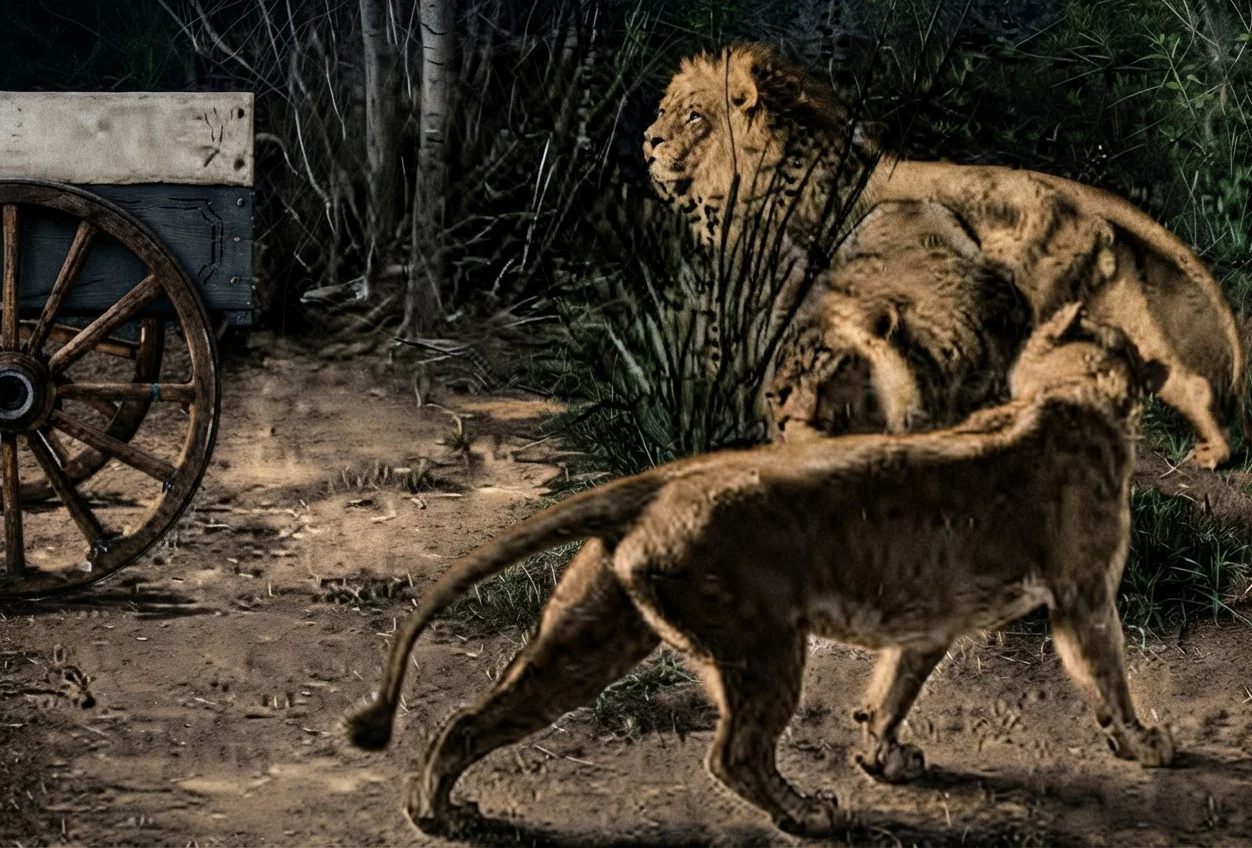
LION'S NIGHT VISIT
Camping in the wagon was customary in pioneer life in that country, and our missionary and his family followed the usual custom. One night, in crossing a river where there was no road, the oxen, being tired, were unable to pull the wagon from the river. It was an undesirable place to camp, as there was a jungle along the bank, which makes a convenient hiding-place for lions. But the wagon was fast, and it seemed that there was no alternative; so spreading their bed upon the sand near the wagon, the missionary and his wife were soon asleep. The next morning, they found the footprints of a lion within twenty-five feet of their heads. It had come that near, and looked them over, then turned away without disturbing their slumbers. In this circumstance they had the assurance of divine protection, which was an encouragement to them on their mission.
On reaching the location for which they started, they found five thousand acres of farm and grazing land, watered by two river branches forming a junction upon it, and in the center there bubbled a famous spring of pure cold water, which was sufficient to irrigate abundantly twenty acres of as fertile and beautifully situated land lying just below it, as could be found in the country. Here the mission farm was staked, and after the price was learned from the government, 5,000 acres was purchased at sixteen cents an acre.
On visiting the station, I was invited by two Catholic fathers, who were operating a mission two miles away, to come and dine with them. I accepted the invitation, and in company with our mission superintendent, visited their mission. While at dinner, we talked of the progress of mission work in Rhodesia, and of its early history, and the conversation finally turned to experiences in the development of the two stations that were represented in our party.
HOW THE CATHOLIC FATHERS VIEWED IT
I was intensely interested in the statement of the Catholic father who related the providential way in which our mission site had been taken from them and given to us. The story as told by Father Moran, and confirmed by Elder W. H. Anderson, our superintendent, follows:
"We had come to this locality some months in advance of your superintendent, spied out the land, selected the farm you now occupy, staked it, returned to Livingstone, and made application to the government for the location. Afterwards we met the commissioner of railways, who is a Catholic, and were informed that we had made a mistake in our location, as the government was just beginning the survey of an extension of the railway up another valley, forty miles distant from our location.
"Acting upon his advice, we canceled our application for the choice location you now occupy, made a trip up the other valley, located our station, and returned to Livingstone to make application for it to the government. Before we sent in the application, the railway commissioner informed us that he had just received notice from the government surveyors that they had completed their survey of the road-bed, and they were going over into the valley forty miles distant, and they would survey back down that valley in hopes of finding a more desirable location for the road.
"Again acting upon the commissioner's advice we hastened back to restake the location we had canceled. When within one day's drive of the place, we camped for the night near another camper who was headed for Livingstone. During the evening, we learned that our camp neighbor was your superintendent, and that he was just returning from having staked the same farm for a mission station that we were hastening to secure. An overruling providence had taken the place from us and given it to you. Providence seems to favor your mission enterprise more than ours."
It was an undesirable place to camp, as there was a jungle along the bank, which makes a convenient hiding-place for lions.
After I had related this story before a large audience in a camp-meeting in Los Angeles, California, last year, the government surveyor for the South African railways stepped forward, and handing me his card, confirmed the story of the changing of the railway survey, and added, "I was the government surveyor in that expedition." The railway now runs across the corner of our mission farm.
A LION CROUCHED BEFORE HIM
While on this pioneer journey, Elder Anderson was one evening walking behind the wagon, rifle in hand, expecting to shoot a deer for the native boys' supper, when he was suddenly confronted by a lion. The beast was in a crouching position, and within springing distance of the wagon trail. It was too close range to shoot with safety, as a wounded lion at that distance is most ferocious.
He had little time for thought. Either he must act or the lion would. His two fearless dogs — boar hounds — were at his side awaiting orders. He gave them the word, and they bounded toward the lion as if it were a domestic animal.
With two bounds one landed upon the lion's back and began biting at its groin. With three bounds the other dog caught the ferocious beast by one of the hind legs. Surprised by the daring advances of the dogs, the lion turned to fight them, and the missionary escaped to the wagon after firing a couple of shots into the air to intimidate the lion.
The dogs soon came up, and Elder Anderson was greatly surprised to find that no trace of wounds could be found on either of them.
After traveling four miles, thinking they were a safe distance from danger of attack by the lion, they camped for the night. They tied all the oxen to the wagon chain, and while eating their supper the lion came up, stealing its way in the darkness. The oxen sprang up, and swung around to the wagon for protection.
In the middle of the span were a yoke of untrained two-year-old bullocks; and as they were unaccustomed to this hasty swing, the one on the outer side of the chain pulled out too hard, and breaking his halter, circled out from the others.
Immediately the lion caught him by the neck, and throwing the young ox, weighing only about six hundred pounds, over his shoulder, made off with him about thirty rods, where he lay down and enjoyed his evening feast.
As it was dangerous following a lion after night, and as he had sufficient with which to satisfy his hunger, they anticipated no further danger and retired and slept undisturbed.
THE PROSPEROUS WORK ESTABLISHED
Our Barotseland station has since developed a strong training school for teachers and evangelists, and a regularly organized system of outstations encircles a large sec13tion of northwest Rhodesia. These outstations are conducted by trained native teachers and evangelists. They receive monthly visits from the foreign superintendent, or his assistant, in order to keep the work up to a proper standard. As the foreigners have the language, the occasions of these visits are made times of special evangelistic effort, which often results in the conversion of a number of the heathen people who reside in the vicinity of the outstation.
It is not unusual that persons walk hundreds of miles to enroll as students in our mission schools. The Barotseland Mission is now entirely self-supporting.
Visiting some of these outstations in company with the superintendent and his wife, we went into camp one night, and found that we were followed by a large animal, either a lion or a leopard. Although we arranged for the camp-fires to be kept burning, the boys on watch were soon fast asleep. Twice during the night we were aroused by the oxen springing to their feet and swinging around to the wagon for protection. This is always an indication that some animal has approached too close.
STUDYING THE LION FROM A TREE TOP
The following night, the superintendent and the writer climbed a tree under which a lion had secreted a seven hundred pound eland cow, in order that we might study the movements of the king of beasts in his native home. He approached the place soon after dark for his first feed. We could hear him coming at a distance of twenty-five or thirty rods by the deep grunt that he gave every few paces.
He came against the wind. The old hunters say that a lion always travels against the wind when seeking his prey. The reason is that he may scent animals in his way before they are aware of his approach.
He lay for about an hour within seventy-five feet of our hiding-place before venturing to eat his evening meal. We could hear his deep breathing, otherwise there was not a movement or a sound to be heard. When he arose in grass four feet high and moved around to the carcass and lay down to eat, his movements were as noiseless as those of a cat. When he began eating, the strong ribs of the eland were crushed as readily as a dog would crush the bones of a fowl.
His second visit was at the midnight hour as accurately as the cockcrowing. He came this time as before.
The third visit was at three o'clock, with cockcrowing precision. But the moon had arisen, and this time there was not the slightest sound of grunt or purr to announce his approach. He was more shy under the moonlight. He was within seventy-five feet of us, unobserved, with both of us watching for his coming, under the clear moonlight, at the precise moment that he arrived. At the slightest sound of clearing my throat, he bounded away, and for two hundred rods we could hear him springing with rapid strides to a place of safety.
VERY SHY OF THE LIGHT
From this experience, we learned that light is a great means of protection from wild animals. They seldom attack in the light unless wounded or driven to do so by extreme hunger, or by being driven into a corner and pressed. It is not the embers of a camp-fire that keep them in abeyance, but the light. Lanterns will serve the same purpose as the camp-fire, and there is less danger of their going out through neglect, leaving the sleeping campers exposed to the danger of attack.
THE LION'S MOUTH WAS CLOSED
As a rule, when making this round of the outstations, lions were seen. Sometimes they seemed determined to make trouble, but our missionaries were always protected.
One afternoon when Mr. C. Robinson, then assistant superintendent, was traveling on foot, looking up a site for a new station, he saw a path leading into some tall reed grass where appeared to be a spring. Being very thirsty, he turned aside into this path and found a cooling spring, drank, then started back toward the trail.
He had but started when he was confronted by a fierce-looking lion facing him directly in his path. His boys, carrying his gun, ammunition, and equipage, had fallen behind a short distance, so he was unarmed.
He was singing when he turned in to the spring, and he continued singing after drinking, as he turned toward the trail, so met the lion with a song. He had passed very close to the beast, which, driven by hunger, had doubtless hidden by the spring, watching in daylight for his prey.
The boys, coming up from the other side, and seeing the missionary unarmed, exposed to such danger, quickly threw down the guns and camp equipage, and nimbly climbed trees for safety. From their safe retreat they watched, expecting to see the missionary slain by the lion. When they saw him walk steadily forward toward the king of beasts, continuing to sing a hymn of praise to God, and saw the lion quietly turn around as he approached, and leave the path, so that the missionary passed in safety, they said surely the Lord had closed the lion's mouth, as in the days of Daniel.
PROPOUND IMPRESSION ON THE NATIVES
Their report of this experience produced a profound impression upon the natives. The missionary felt that it was an evidence of God's care for His work and workers, when He sends them forth with the closing gospel message.
THREE THOUSAND CONVENE
Our British Central African station has a regular attendance of two hundred students at the main station, with one thousand eight hundred in attendance at its thirty-eight outstations. Three thousand convene each Sabbath to worship God under the influence of that station and its outstations.
These are only a sample of the work of our mission stations in the dark continent. From the deadly West Coast, through German East Africa and British Africa, British Central Africa, Belgian Kongo, North and South Rhodesia, Basutoland, Zululand, Kaffraria, and the South African colonies, our line of missions are steadily pouring forth their rays of heaven-sent light. Their advance is extraordinary. It can be explained upon no other basis than the triumphant march of the final advent message on its mission to every nation and kindred and tongue and people.