Three Kingdoms Fall Before It—A “Little Horn” with Stout Look—“The Eyes of a Man”—A Persecuting Power—Assumes Right to Change the Bible—Time It Was to Continue—Its Apparent Destruction
By JEAN VUILLEUMIER
In reading this article, keep in mind that Elder Vuilleumier presented last week that portion of the prophecy of the seventh chapter of Daniel which tells of the four world monarchies that were to exist, and that the last one of the four was to be broken into ten parts. The prophet saw that among these ten kingdoms, another power would arise. The last named, the ecclesiastical empire, is the subject of this article.
Next week, the theme will be the eternal kingdom that is soon to supplant all these governments of earth. Incidental mention will be made, in the article, of the reestablishing of the papal power that seemed broken in 1798.
“I CONSIDERED the horns, and, behold, there came up among them another horn, a little one, before which three of the first horns were plucked up by the roots: and, behold, in this horn were eyes like the eyes of a man, and a mouth speaking great things.” “Then I desired to know the truth concerning . . . the other horn which came up, and before which three fell, even that horn that had eyes, and a mouth that spake great things, whose look was more stout than its fellows.” Dan. 7: 8, 19, 20.
The foregoing describes the vision the prophet had concerning that mysterious power.
INTERPRETATION IS GIVEN
“Thus he said, . . . And another shall arise after them [the ten kings]; and he shall be diverse from the former, and he shall put down three kings. And he shall speak words against the Most High, and shall wear out the saints of the Most High; and he shall think to change the times and the law; and they shall be given into his hand until a time and times and half a time.” Verses 23-25.
Let us briefly compare the salient point of this prediction with a few historical facts that will show the marvelous exactness of this vision.
Next to the division of western Europe into the different states, living side by side for over a thousand years, the most conspicuous fact in the history of the Middle Ages and of modern times is the supremacy of the bishop of Rome. This power, both political and ecclesiastical, answers exactly to the description of the eleventh horn, which represents another king, different from the other ten, endowed with almost superhuman insight, surrounded with greater pomp, whose utterances are more startling even than its deeds, who lays its hands upon the saints of God and upon His law, who is to exercise a supremacy over Europe nearly until the coming of Christ.
THREE KINGDOMS FALL BEFORE THE RISING PAPACY
“Before which three of the first horns were plucked up by the roots.” Verse 8. Few persons are acquainted with the fact that the triple crown worn by the pope represents really three kingdoms that had to yield their place to the growing papacy, at the end of the fifth and the beginning of the sixth century; namely, the Heruli in 493, the Vandals in 533, and the Ostrogoths in 538.
SMALLER AND YET GREATER THAN THE TEN
“That horn . . . whose look was more stout than its fellows.” Verse 20. “At the outset, the bishops of Rome were very humble and retiring, having nothing else in view but the propagation of the religious, moral, and democratic teachings of the Nazarene. They played no rôle in the state until the time when Constantine, after making Christianity the religion of the empire, made Constantinople the new capital of the Roman world. . . . The bishop of Rome, protected by the emperor, gained influence over the masses, and this influence grew still more during the invasions of the barbarians. . . . Great is the contrast between the humble beginnings of this Christian republic and the spectacle offered by Christianity a few centuries later—that of an absolute monarchy, in which the clergy forms a separate class, enjoys special privileges, and in which the bishop of Rome, heir to the authority of the councils, sovereign arbiter of nations, assumes the right of governing consciences, of distributing kingdoms, and of ruling over both soul and body.” (“Larousse Dictionary,” article “Papacy.”)
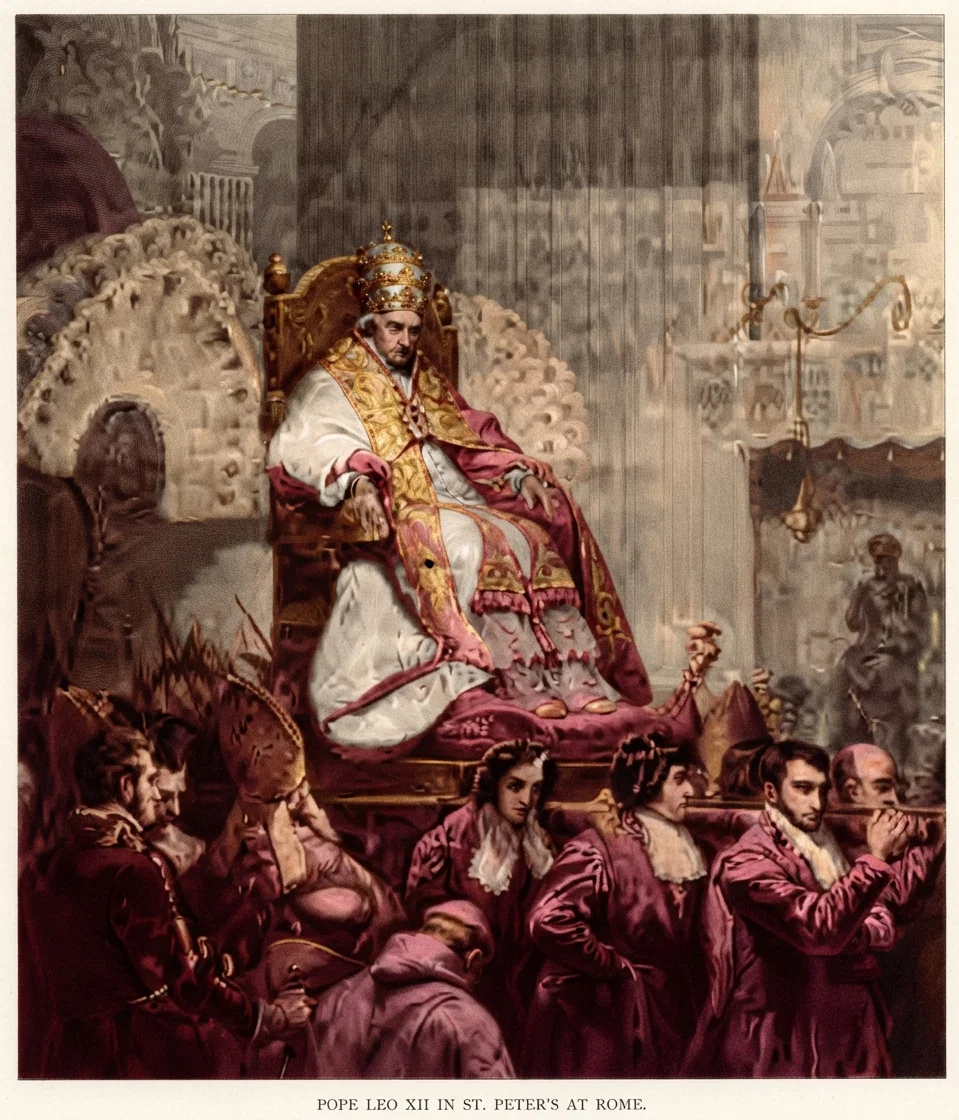
POPE LEO XII IN ST. PETER'S AT ROME
A MARVELOUS INSIGHT
“In this horn were eyes like the eyes of a man.” Verse 8. Heir of the shrewd diplomacy of the Roman Senate, the papal government has for hundreds of years exercised its policy with astuteness and sagacity. This wisdom can be attributed to four main factors: the confessional, the celibacy of the clergy, Jesuitism, and the unbroken papal succession,—factors that have enabled the papacy to place itself in intimate relationship with the common people, and to follow up its schemes from generation to generation.
ASTOUNDING WORDS
“In this horn” was “a mouth speaking great things. . . . And he shall speak words against the Most High.” Verses 8, 25. It is a well-known fact that the pope is commonly called by his followers “holy father,” “most holy father,” “sovereign pontiff,” “head of the church,” all of which are the names of God the Father and of Jesus Christ. John 17: 11; Eph. 1: 22. In Heb. 8: 1, the words “high priest” are translated “sovereign pontiff” in some Catholic versions.
Pope Gregory VII says, in his “Maxims,” “There is only one name in the world, that of the pope.” This is what the apostles Peter and Paul said of Jesus Christ. Acts 4: 12; Phil. 2: 9. Pope Martin V called himself “the most holy and happy, who is the arbiter of heaven and the lord of earth, . . . the master of the universe, the father of kings, the light of the world.” Again these are names and prerogatives that belong to God alone, and the usurping of which, on the part of a man, brands him as a blasphemer.
With reference to earthly powers, the popes have made utterances that no other human being has ever dared to make. In his “Maxims,” just quoted, Pope Gregory VII wrote: “All earthly princes must kiss the pope’s feet. . . . He has the right of deposing emperors.” Innocent III compared his power in relation to that of other kings to the light of the sun as compared with that of the moon.
PAPAL GRANDEUR
“Whose look was more stout than its fellows.” Dan. 7: 20. Several kings had to experience the bitterness of these claims. Robert, king of France, excommunicated by Pope Gregory V, had to humble himself to the dust before him in order to retain his throne. Henry IV, emperor of Germany, had to take the famous trip to Canossa before he could resume his imperial dignity. His son, Henry V, and Frederick I, called Barbarossa, went through the most humiliating ceremonies in the presence of Popes Pascal II and Adrian IV respectively.
The culmination of papal grandeur was reached under Innocent III, in the beginning of the thirteenth century, half way between the rise and the fall of papal supremacy. “The pontificate of Innocent III is only a moment in history,” says Larousse Illustrée. “But what a moment! . . . What glory! Everything around it is magnificent, as if to enhance the brightness of this throne of thrones occupying the center of the scene. . . . The pope is not only the greatest of popes; the other kings, the events, the genius of the century, everything, is in harmony with his grandeur.”423
A PERSECUTING POWER
"The same horn made war with the saints, and prevailed against them." He "shall wear out the saints of the Most High." Verses 21, 25. Sadly notorious are the barbarous persecutions organized and carried on by the papal government for more than a thousand years. The massacres of Waldenses, of Albigenses, Hussites, and Calvinists, the Saint Bartholomew, the "holy Inquisition," the dragonades, the revocation of the edict of Nantes, are too well known to require more than a passing mention.
The victims of persecution under pagan Rome have been estimated at three millions, while the victims of papal Rome for conscience' sake, according to a moderate estimate, mount up to fifty millions.
HERETICS MUST BE EXTIRPATED
Far from denying the facts of history branding her as a persecuting power, the papacy has erected persecution and bloodshed against heresy as a dogma; to wit, clause 5 of the act of abjuration (June 2, 1697) of Frederick Augustus, a Saxon prince, when he took the throne of Poland under the name of Augustus II: "I profess that . . . all heretics . . . must be extirpated by sword and by fire without exception or consideration, and that they must all be sent to hell body and soul."
A similar declaration is embodied in the oath of allegiance of all the Roman bishops. Intolerance and persecution as a doctrine is taught to-day by many authorized Catholic books and periodicals, and preached from Catholic pulpits.
LAW OF GOD CHANGED BY THE PAPACY
"He shall think to change the times and the law." Verse 25. This accusation of the prophecy is corroborated by the papacy itself. The above quoted abjuration, framed by the high clergy, says:
"I profess that a decree made and proclaimed by the pope, however new it may be, whether or not based on the word of God, is of divine origin, and must, as such, be respected by believers, more highly than a command of the living God." (Clause 2.)
"I profess that the reading of the Bible is the origin of all pernicious sects and associations, as also the fertile source of all blasphemies." (Clause 6.)
"I profess that the Roman pontiff has the power to change the Holy Scriptures, to add thereto, and to take from." (Clause 10.)
From such assertions, we may confidently expect that the papacy has not failed to change the law of the Most High.
What are these changes? Read the Ten Commandments in the Roman Catholic catechism "prepared and enjoined by order of the third plenary council of Baltimore" (Boston, 1885), and compare them with the divine text in Exodus 20. The wording of those holy statutes spoken by the voice of God on Mount Sinai has not been faithfully transcribed in this catechism for the Catholic people who have no access to the Bible.
THE COMMANDMENTS MUTILATED
The second, third, fourth, fifth, and tenth commands are mutilated. The second is joined to the third, and the tenth cut in two, thus changing the numbering, so as to make it match with European catechisms, where the second commandment is completely left out. In the second commandment, the words "Thou shalt not bow down thyself to them" (graven images) are changed into "Thou shalt not adore them," which is an unwitting admission that to bow before an image is to adore it.
The fourth commandment, numbering more than ninety words in the Bible, has only seven in the catechism. All specifications about Sabbath keeping, all mention as to what day of the week is the Sabbath, and all reference to the creation of the world as a basis for the commandment, are left out. In the explanation of the second commandment, the same catechism justifies the invocation of saints, the honors paid to relics, and the kneeling before pictures, images, and crucifixes. And in the explanation of the fourth commandment, it justifies "the church" in "commanding us to keep the Sunday holy instead of the Sabbath."
TWELVE HUNDRED SIXTY YEARS OF SUPREMACY
"And they [the law and the saints] shall be given into his hand until a time [one year, or 360 days, a Jewish year] and times [two years, or 720 days] and half a time [half a year, or 180 days,—in all, 1,260 days]." Verse 25. These are prophetic days, each of which represents a literal year, according to the rule given in Eze. 4: 6. The whole period, therefore, equals 1,260 literal years, during which the papacy was to exercise its baneful power over the saints and the law of God.
The supreme power of the pope was asserted by churches, bishops, and councils as early as the fourth century. From that time onward, the Roman emperors of the East ordered, in their laws, that all should "embrace the religion of the Roman pontiff." In 534, Pope John thanked the emperor Justinian for "submitting all things to him," the pope, and for "publishing an edict requiring the destruction of heretics." In 538, Vigilius caused Pope Silverius to starve to death, and became pope in his place, thanks to a party in the empire which had pledged to elevate him above the council.
The year 538 A. D., therefore, is the starting point of papal supremacy. This supremacy European nations accepted and submitted to until the end of the eighteenth century, when it disappeared in a storm, but not without having undergone a process of decay.
FORCES THAT OVERTHREW IT
The Reformation of the sixteenth century gave the papal theocracy an irreparable blow. In the eighteenth century, the prestige and influence of the church were seriously undermined by the philosophical movement led by Rousseau and Voltaire. At that time, most of the Catholic kingdoms of Europe expelled the Jesuits; and in 1773, Pope Clement XIV was compelled to sign the suppression of this order, loathed by all intelligent people.
And now a great storm breaks out. The French Revolution in 1793 vents its rage upon the French clergy, and in 1798 upon the pope himself. In February of that year, Rome was entered by the French, and the pope was taken away as a captive, while a republican government was proclaimed in the "eternal city." Pius VI, at the advanced age of eighty-two, and though afflicted with many infirmities, was driven through Italy in a carriage, carried in a litter over the bitter cold passes of the Alps, and finally left in Valence to die, 1799.
The papacy remained beheaded for nearly a whole year. Thus exactly 1,260 years after it had begun, this power that had been lent the papacy to lord it over the world, had suddenly disappeared. Thus, through a long course of centuries, had every detail of this prophecy met its fulfillment, bringing us finally to the threshold of eternity, and proving to us the absolute certainty of God's promises.