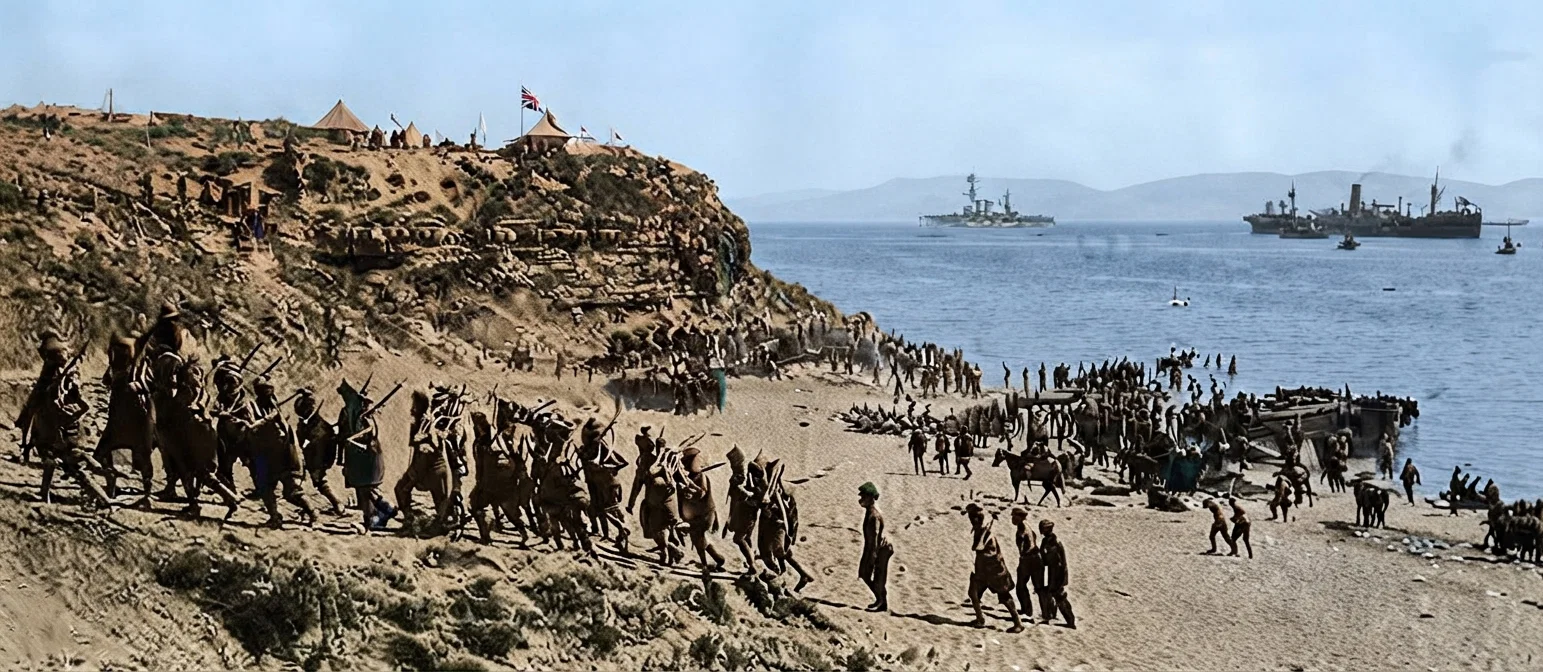
ALLIES LANDING AT THE DARDANELLES UNDER COVER OF GUNS OF THE BATTLESHIPS
THE FALL OR THE RESURRECTION OF THE TURK
By Albert M. Dart
Definite Points in Turkish History — How They Fulfill Prophecy
By ALBERT M. DART
IT is an evidence of God's love for the human family, that in the last days of earth's history, events attracting the attention of all the world most strikingly fulfill prophecy. The Ottoman empire is notably illustrative of this point.
THE WHOLE WORLD INVOLVED
Mr. Ed. Tallichet, editor of the French magazine Bibliothèque Universelle, published at Lausanne, in writing upon "Fall or Resurrection of the Ottoman Empire, Which?" at the time the Young Turks came to the front a few years ago, said:
"The above question applies not only to Turks, but to the entire world; for the present crisis contains the winding up of all that has occurred since the beginning of the Christian era. . . . Constantinople has become again what it was for a long time, the center and pivot of the world. . . . The recent Turkish revolution has entirely changed the political situation of the world — not only of the Mediterranean world, but of the universe."
ONE OF THE LAST MOVES ON EARTH
Dear reader, do you know that the exit of the Turk from Europe is one of the last moves among nations before the second advent of Christ and the end of the world?
Prophecy makes this fact plain. And as Mr. Tallichet says — and his statement is confirmed by many other statesmen of repute and by fact — the whole world is involved in the Turkish problem. Therefore in Turkish history to-day, viewed from the standpoint of Bible prophecy, the whole world is warned of God of the end of the world.
With what concern, then, does the student of prophecy look upon the fierce bombarding of the Dardanelles and the preparation of the Turk to leave Constantinople?
We will now further consider the points in Turkish history mentioned in our last article; namely, the Turk's establishment as an independent power; the loss of his independence; his expulsion from Europe; and his establishment at Jerusalem, where he comes to his end.
THAT "SINGULARLY ACCURATE" DATE
"A nail in a sure place" is found in the statement of the historian Gibbon where he says that Othman invaded the territory of Nicomedia July 27, 1299, and pronounces it a singularly accurate date.
For 150 years from this date, the attacks of the Mohammedans on Constantinople fulfilled the prophecy of the fifth trumpet, — the first woe trumpet of Revelation 9, which states that their power was to hurt men five months.
The prophecy also says that "they had a king over them, . . . whose name in the Hebrew tongue is Abaddon, but in the Greek tongue hath his name Apollyon ["a destroyer," margin]."
Othman had organized the roving bands of Saracens, and they went forth in their characteristic destructive manner.
Five months — 150 years — from Gibbon's singularly accurate date, July 27, 1299, brings us to July 27, 1449, at which time the Greek emperor having died, his brother Constantine ascended the throne only by consent of Amurath, the Turkish sultan. Thus was Constantinople virtually in the hands of the Turks, and the "destroyer" went forth not only to "hurt men" but to slay.
And now the prophecy points out the period of Ottoman supremacy, "an hour, and a day, and a month, and a year."
A year is 360 days. A day for a year, prophetic time, would be 360 years; a month, on the same reckoning, would be 30 years; a day, one year; and an hour, 15 days, — all amounting to 391 years and 15 days. Ottoman supremacy began July 27, 1449. 391 years and 15 days from this date would reach to August 11, 1840.
FULFILLED TO THE DAY
This date marks the end of Ottoman supremacy, in accordance with the prophecy — another of the interesting points in Turkish history.421On August 11, 1840, the sultan of Turkey surrendered his independence to England, Russia, Austria, and Prussia, who had undertaken the settlement of difficulties existing between Egypt and Turkey.
An ultimatum had been drawn up by these powers, and placed in the hands of the sultan of Turkey on the very date above named. Just prior to 1840, students of prophecy had taken the position that the Turk would lose his independence on that date, and they so published it to the world. Thus the world, at this point, had an opportunity to see the hand of God in Turkish history.
HIS EXPULSION FROM EUROPE
The next point of special interest is his expulsion from Europe. Prophetic information on this point is found in the eleventh chapter of Daniel. No extended study of the prophecy is possible in this article, only allusion to prominent points.
In the first part of the chapter, Persian and Grecian history is briefly sketched by the angel. The work of Alexander the Great is thus mentioned:
"And a mighty king shall stand up, that shall rule with great dominion, and do according to his will. And when he shall stand up, his kingdom shall be broken, and shall be divided toward the four winds of heaven; and not to his posterity, nor according to his dominion which he ruled: for his kingdom shall be plucked up, even for others beside those." Dan. 11: 3, 4.
This prophecy was fulfilled in the division of Alexander's kingdom, after his death, among his four generals, who fell to quarreling, the territory eventually being divided between what prophecy mentions as the "king of the north" and the "king of the south."
KINGS OF NORTH AND SOUTH
Territorial lines indicated the kingdom. The occupant of Constantinople and adjacent countries is denominated by the angel "the king of the north"; of Egypt, "the king of the south."
Since the Turk to-day is in possession of Constantinople, he is the prophetic "king of the north," of whom the prophecy says: "But tidings out of the east and out of the north shall trouble him: therefore he shall go forth with great fury to destroy, and utterly to make away many. And he shall plant the tabernacles of his palace [seat of government] between the seas in the glorious holy mountain [Jerusalem]: yet he shall come to his end, and none shall help him." Dan. 11: 44, 45. Here the expulsion of the Turk from Europe and his establishment at Jerusalem are pointed out.
DELIVERANCE COMES THEN
All will see that this cannot occur without much trouble — world-wide trouble. This is also mentioned by the prophet: "And at that time shall Michael stand up, the great Prince [Christ] which standeth for the children of thy people: and there shall be a time of trouble, such as never was since there was a nation even to that same time." Dan. 12: 1.
O, to be delivered at such a time! What nation will unfurl her banners for our safety? What flag shall we seek? All nations are involved in the deadly conflict. The horrors of war, with modern possibilities for destroying men's lives, make the stoutest heart shudder. Whither shall we flee?
Listen, reader: "And at that time thy people shall be delivered, every one that shall be found written in the book."
The awful day is near. It would almost seem that complications and rapid developments might rush us on to the last great battle with no more than a brief cessation of war. Are the arms of the Saviour thrown around you in shelter? Can He write your name in His book? — Not if you are at variance with His law; for in that blessed land to which the delivered go at that time, there are no more tears, sorrow, pain, nor death; and all these are the result of sin — the transgression of God's law.
Never did the truths of prophecy stand out more clearly than to-day. Can we meet, at the Judgment bar, Him who died for us, and say we did not know?
The din of battle around Constantinople, viewed by the spirit of prophecy, says in tones louder than cannon's roar, "Prepare to meet thy God."