NEBUCHADNEZZAR was on the throne of Babylon, the grandest ruler of the most glorious kingdom of earth. His reign had been prosperous. His martial triumphs had been great from the beginning, but of these he did not boast. His inscriptions, unlike those of the Assyrian kings, do not speak of war and conquest. They tell us of the great buildings of state erected, the great temples built to honor the gods; the temples restored, enlarged, and embellished; of the restoration of the tower of Babel; of the great canals and reservoirs, regulating the water supply, and irrigating the otherwise barren land in the tropical valley; of the mighty walls and strong gates and hanging gardens,—of all these he has left us chronicles; in these the mighty emperor boasted, but not of war.
Sixteen years, according to the Septuagint and Arabic, had passed since the Divine Teacher, thru the dream and its interpretation by Daniel, had taught the proud king that God is the Revealer of secrets, the Ruler of kings, and that the disposal of the kingdoms of the world rests with Him. The Gospel thus preached had profoundly affected the king. He outwardly acknowledged the power of God to reveal the secrets of the mind, and greatly honored His prophet. But it did not wean Nebuchadnezzar from his own vainglory, nor lead him to accept the converting, regenerating, creative power of God.
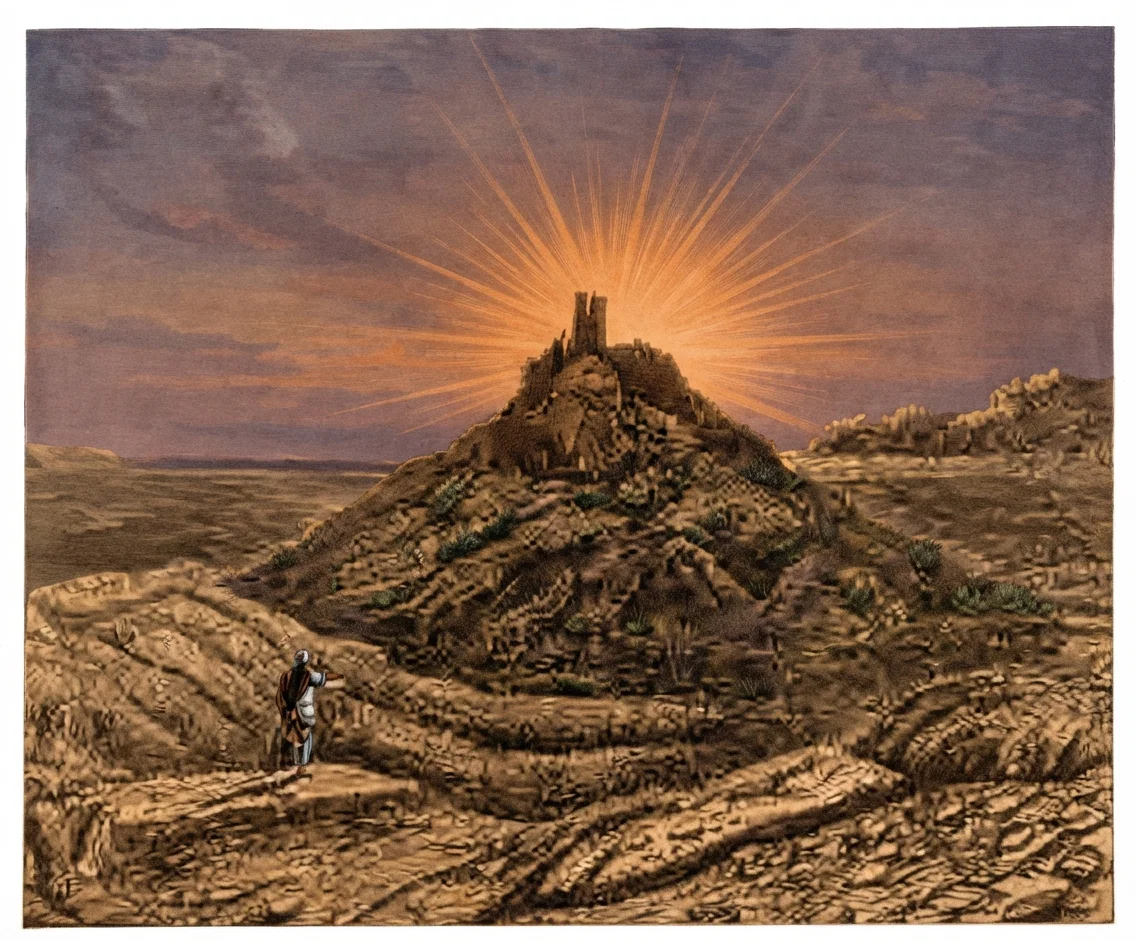
Birs-Nimrod, near Babylon. See Foot-note.
He has confidence in himself. Is he not great Nebo's son, who bears the exalted name of "the governor of the world," "the god of science," etc.? Does not his own name signify "Nebo-protects-the-crown"? Is there not joined with Nebo the father of Nebo, great Marduk, the tutelary god of Babylon? Does he not honor Shamash, the great sun-god? "Surely," thought the proud king, "my kingdom shall stand forever."
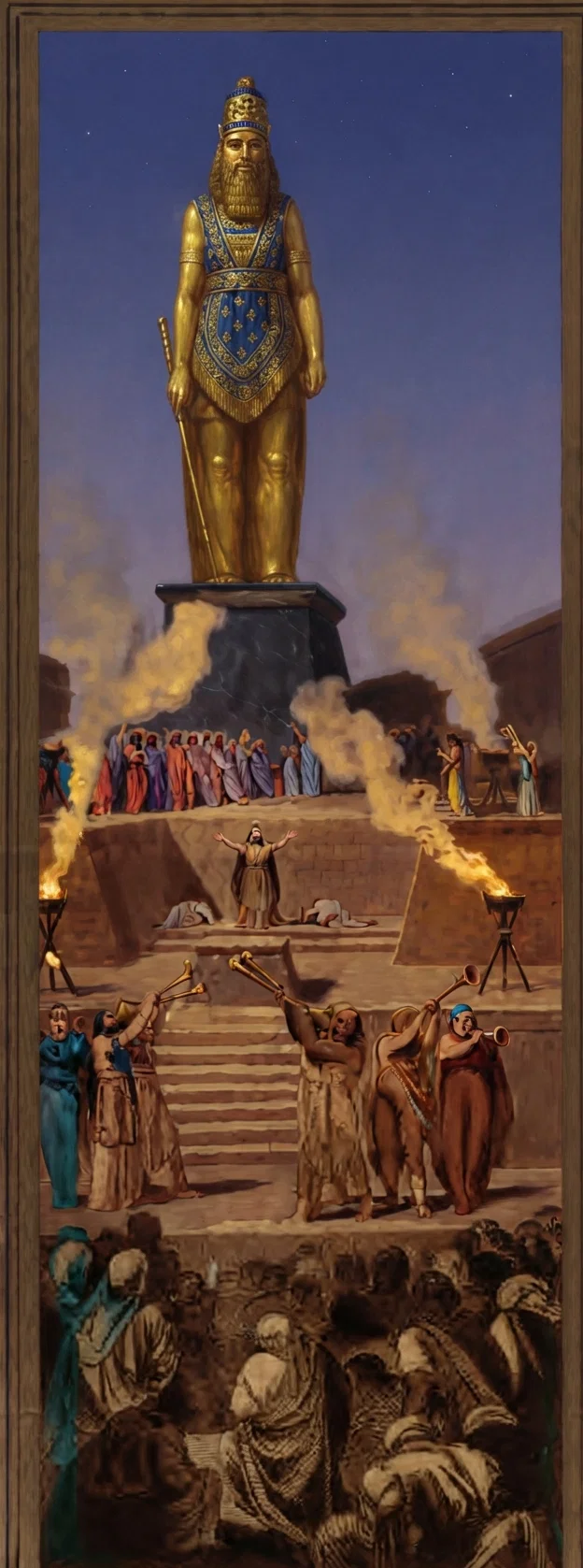
Did he think this?—He did; and he demonstrated his thought by duplicating the image of his dream in excellent form and commanding height; but not of different metals. Remembering the words of the prophet, "Thou art the head of gold," he arrogated to himself and Babylon, not only the whole world, but all time,—the whole image was of gold, for all the world to worship. This is the record:
"Nebuchadnezzar the king made an image of gold, whose height was threescore cubits, and the breadth thereof six cubits; he set it up in the plain of Dura, in the province of Babylon. Then Nebuchadnezzar the king sent to gather together the satraps, the deputies, and the governors, the judges, the treasurers, and the counselors, the sheriffs, and all the rulers of the provinces, to come to the dedication of the image which Nebuchadnezzar the king had set up. Then the satraps, the deputies, and the governors, the judges, the treasurers, the counselors, the sheriffs, and all the rulers of the provinces, were gathered together unto the dedication of the image that Nebuchadnezzar the king had set up; and they stood before the image that Nebuchadnezzar had set up. Then the herald cried aloud, To you it is commanded, O peoples, nations, and languages, that at what time ye hear the sound of the cornet, flute, harp, sackbut, psaltery, dulcimer, and all kinds of music, ye fall down and worship the golden image that Nebuchadnezzar the king hath set up; and whoso falleth not down and worshipeth shall the same hour be cast into the midst of a burning fiery furnace. Therefore at that time, when all the peoples heard the sound of the cornet, flute, harp, sackbut, psaltery, and all kinds of music, all the peoples, the nations, and the languages, fell down and worshiped the golden image that Nebuchadnezzar the king had set up." Dan. 3: 1-7. A.R.V.
The image, covered with burnished gold, together with its pedestal over one hundred feet in height, over ten feet across its shoulders, doubtless erected on an eminence in the broad plain, must have been an imposing spectacle. In its glittering splendor it could easily be seen from all parts of the vast throng of the representatives of all nations, gathered at the summons of the king to its dedication. In that worship nothing is to be wanting to make it imposing. It was the worship of Babylon; it was the king and state deified; it was the expression of Chaldean patriotism; it was the exaltation of the creature to the throne of the Creator. Nebuchadnezzar was the one law; the image representing him and the kingdom, the one god for that occasion.
Like all the gods of man's devising, it was the god of force. Its form and splendor could compel admiration, but not love and devotion, which are always voluntary. These essential elements of true service and worship were wholly wanting. They are wholly wanting in the system of every false god. Their place must be supplied, and it was done, as ever before and since, by force-made fear. "Whoso falleth not down and worshipeth shall the same hour be cast into the midst of a burning fiery furnace."
Liberty versus Slavery.
It would seem that the king of great Babylon was free; he thought himself free to do as he chose. But he was a slave to self, to superstition, to folly, to the god of this world. No truly free man can ever seek to enslave others. Of that vast throng, nearly all those representative men were slaves to the same superstitions, or to slavish fear of consequences should they refuse to worship.10Yet the glorious freedom of the Gospel of God is not without its witnesses. Daniel is doubtless absent, but his three companions, educated in God, are there. They obey the king's summons to be present. But when the vast throng prostrated themselves before the god of gold, the devotion of some was not so centered upon their affected worship that they could not watch the hated worshipers of the true God, the three noble young men who of all the multitude stood erect.
These false worshipers, less concerned over their own souls than the non-conformity of others, remind the king of his decree, and tell him of the "certain Jews" whom he has exalted to rule, yet who in ingratitude "have not regarded thee; they serve not thy gods, nor worship the golden image which thou hast set up." Verses 8-12.
The king, favorably disposed toward them, calls Shadrach, Meshach, and Abed-nego, and asks them, "Is it of purpose . . . that ye serve not my god, nor worship the golden image which I have set up?" He was willing to receive from them any apology or excuse, and he laid before them once more the opportunity. He would go thru the program a second time. He would again have his sacred concert of praise to his gods, at which time they could bow to the image. But if not, he warns them again that they should be cast "the same hour into the midst of a burning fiery furnace;" and then he throws out this challenge: "Who is that god that shall deliver you out of my hands?" Verses 13 to 15.
Not Expediency, but Principle.
The Hebrews might have reasoned, "Righteousness is not in form, but in heart; it is of the spirit, not the letter, the flesh, the body. Why should we bring a spirit of discord into this great congregation? Truly Babylon is great, and they are patriotic; why enrage the king and endanger our lives? We can bow with the throng, and at the same time worship God."
Thus many have reasoned in times of testing, but not these. They were in Babylon and amid that great congregation in the plain of Dura for a purpose. They had learned of God that purpose. They were there to witness for God and to preach the Gospel to Babylon and her subject nations. They were there because Israel had compromised truth and righteousness in the past; they now must not compromise it in mind or heart, or even seem to compromise it. They were there to lose their life, if need be, for truth's sake. Their Ruler was greater than the king of great Babylon, their mission incomparably greater than the herald of the king's worship. Moreover, God had chosen them to answer the king's challenge, and demonstrate His power to deliver. Their hearts, their lives, are devoted to His service; and therefore they reply:
"O Nebuchadnezzar, we have no need to answer thee in this matter. If it be so, our God whom we serve is able to deliver us from the burning fiery furnace; and He will deliver us out of thy hand, O king. But if not, be it known unto thee, O king; that we will not serve thy gods, nor worship the golden image which thou hast set up." Verses 16 to 18.
Words worthy of perpetuation thru the ages; worthy to be framed in letters of gold; aye, worthy to be—purposed of God to be—engraved in principle on every heart. They not only said, "As we believe God will deliver, we will serve God," but "If He does not deliver, if the furnace devours us, we will serve Him still. He is Lord of life; His power reaches beyond the furnace ashes."
We know the result. The infuriated king, feeling insulted and his favor rejected, commands the furnace to be heated equal to his sevenfold fury. He calls on his mightiest men to bind the unresisting Hebrews, and cast them into the heated mass. It is done.
Nebuchadnezzar's Image of Gold in the Plain of Dura.
The fierceness of the heat slays the strong slaves who cast the bound free men into the furnace. The men who serve the God whose power is over every element fall down bound in the fire. This is the extent of the king's power with the most destructive agent he can use.
But lo! there is a change in the scene. The king sees not, as he gazes, the blazing garments, and their burnt, shriveled forms. But one thing the fire devours—the bands of earth's bondage. Four beings appear, the fourth the shining Angel of Jehovah. Verses 19 to 28. The Septuagint reads of the children of faith that they "walked in the midst of the flame, singing praises to God, and blessing the Lord. And Nebuchadnezzar heard them singing praises."
"Then Nebuchadnezzar the king was astonished, and rose up in haste: he spake and said unto his counselors, Did not we cast three men bound into the midst of the fire? They answered and said unto the king, True, O king. He answered and said, Lo, I see four men loose, walking in the midst of the fire, and they have no hurt; and the aspect of the fourth is like a son of the gods." Verses 24, 25.
The king calls them forth from the furnace; they come, and, lo, upon them is found no evidence of fire in any way. Verses 26, 27. The God of heaven and earth is Himself "a devouring fire" (Ex. 24:17; Heb. 12:29); but His presence devours only sin and that which is identified with sin, thus becoming sin. When Israel's sin was confessed and placed upon the head of the burnt-offering, the people were free from sin,—the offering represented their sin. God's presence is manifested in fire that devours the offering, and the people praise their Saviour. Lev. 9:22-24. But when the priests, Nadab and Abihu, came into God's presence identified with unrighteousness, the fire of God's presence devoured them. Lev. 10:1, 2. Even so God's presence, which blessed Barnabas, separated from sin, slew Ananias and Sapphira, identified with sin. Acts 4:36, 37; 5:1-10. The men cast by the infuriated king into the fiery furnace were whole-hearted men, free in Christ Jesus, filled with the purifying presence of God. God dwelt in them. The Angel of the covenant, the Son of God was with them; how could the fire harm them?
The Result.
Unlike Pharaoh, the king received, in part at least, the lesson. His vain boasting in the challenge,—"Who is that god that shall deliver you out of my hands?"—had been strikingly answered, and to his complete satisfaction. Here are his words:
"Nebuchadnezzar spake and said, Blessed be the God of Shadrach, Meshach, and Abed-nego, who hath sent His Angel, and delivered His servants that trusted in Him, and have changed the king's word, and have yielded their bodies, that they might not serve nor worship any god, except their own God. Therefore I make a decree, that every people, nation, and language, which speak anything amiss against the God of Shadrach, Meshach, and Abed-nego, shall be cut in pieces, and their houses shall be made a dunghill; because there is no other god that is able to deliver after this sort." Verses 28, 29.
He acknowledges God and the Messenger that He sent; he declares that faith in God's word on the part of His servants, who "delivered [Septuagint] their bodies, that they might not serve nor worship any god, except their own God," could change the king's word; and that there "is no other god that is able to deliver after this sort."
But the king, tho convinced, was not converted. He supplements his knowledge with a foolish decree against all who speak anything amiss against God. "Christian rulers," so-called, have made similar decrees. (Continued on page 12)
From all the manifestations of God's power thru the Hebrews, from his conversations with the three young men, it seems reasonable enough to conclude that the king believed "the Fourth" to be the Son of God whom they served, instead of a mere son of the gods.9#### Studies in the Book of Daniel.
(Continued from Page 10)
"Christian churches," so-called, have clamored for them. Such ones have yet failed to learn the lesson that the service of God is heart-service, and that men can curse God in their hearts as well as by their lips. He seemed to think that such a decree would bring him favor with God. But God needs no supplementing decrees to preach His Gospel. He would not have carried to the world in teaching or law that His service is an enforced service. It must be voluntary, of choice, love-imbued.
Nevertheless, Nebuchadnezzar had taken another step in Gospel teaching. He had learned a third lesson. God could not only teach and impart knowledge and science; He could reveal secrets; He could deliver as could no other god, not even Nebo, the god of science, or great Marduk, Ea, or Shamash, the sun-god. He therefore exalts the three young Hebrews, and justly gives them rule, according to the Septuagint, "over all the Jews in his kingdom." Verse 30.
There is a lesson to us; for Daniel's prophecy, we must remember, was written for "the last days," "the time of the end."
In the last days great Babylon will rule over all the kings of the earth. All nations will be made drunken with "the wine of her fornication." See Rev. 14:8; 17:1-5, 18; 18:2, 3. Thru her influence over the nations a last-day image is to be set up to the evil system of the beast power—a symbol of the organic union of church and state. Penalties even to death will be pronounced upon those who refuse to worship. Rev. 13:11-18. On the other hand, God calls to His worship, and warns against the worship of the beast and its image. Rev. 14:6-14. As truly as men were tested in the days of Babylon of old, so surely will they be tested in these days of modern Babylon. It is the worship of the golden image representing tradition, popularity, expediency, wealth; or the worship of God in the face of death. And as truly as God delivered then so will He deliver now those who trust in Him. He is the great Deliverer, mighty to save, even to the uttermost. He delivers from the most cruel bondage of all—from the slavery of sin and self. This was the lesson to Nebuchadnezzar and every sinner: "Jesus saves." And all who are saved from sin will be saved from all sin's power to persecute, from all sin's consequences, to inherit forever His everlasting kingdom.