A Vivid Recital of Tragic Desolations A Horrible Tumult in the Night
SYNOPSIS.
This interest-gripping prophecy of the seven trumpets portrays the downfall of nations during the Christian era. The first article of the series, in our issue of August 29, gave a general view of this desolation as it began to unroll before the ancient prophet. The trumpets were shown to be the symbols of war, referring definitely to the mighty irruptions from the barbaric hordes that swept over the Roman Empire, dethroning her from the position of proud mistress of empires. The first trumpet symbolized the wars waged by the renowned Alaric and his victorious Goths. Hail, fire, and blood falling upon the earth is the prophetic description. Rome was pillaged, was humbled in the dust.
EDITOR.
The eternal city opened her gates; and for fourteen days, it was plundered with a degree of rapacity which the Visigoths of Alaric had not approached.
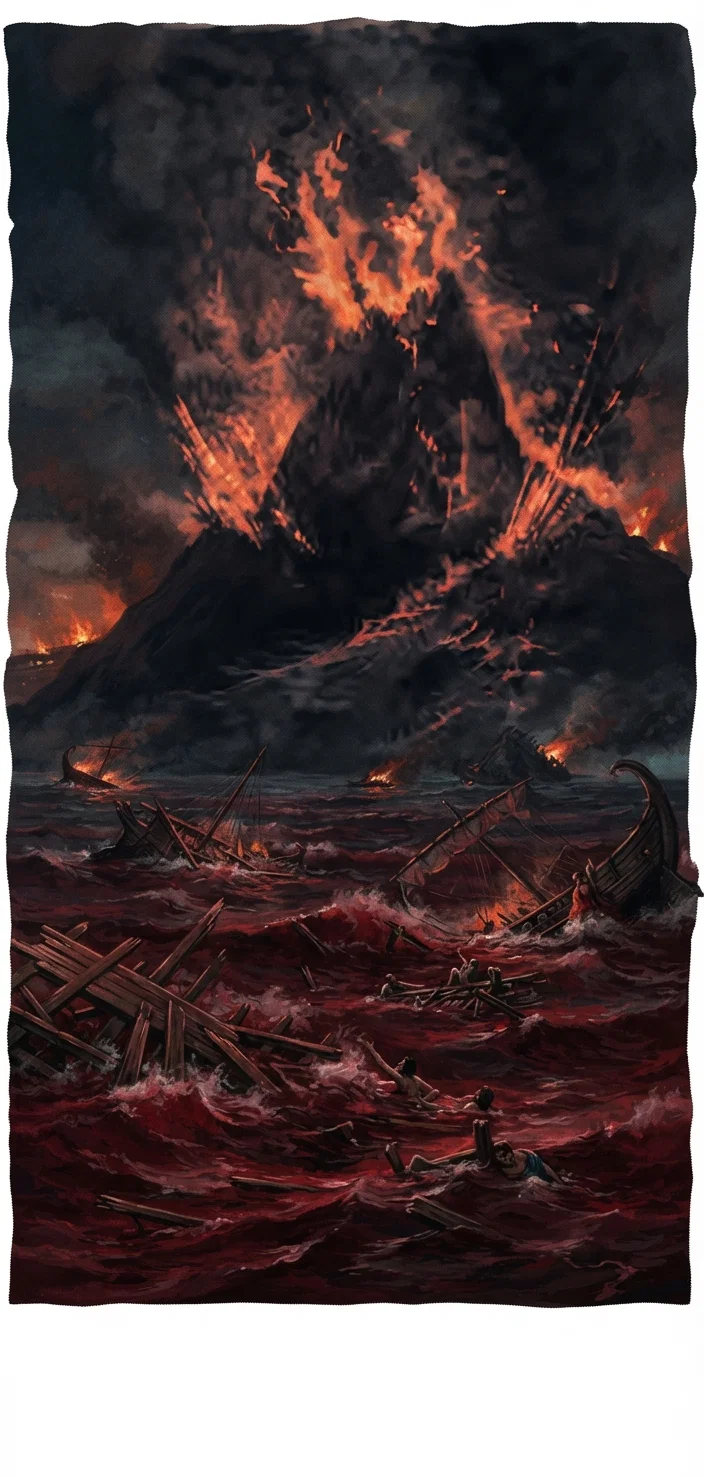
"AND the second angel sounded, and as it were a great mountain burning with fire was cast into the sea: and the third part of the sea became blood; and there died the third part of the creatures which were in the sea, even they that had life; and the third part of the ships was destroyed." Rev. 8: 8, 9.
This partially symbolic language describes the depredations of a great sea power. It was fulfilled to the very letter, although none of the barbarian tribes knew anything about naval warfare.
The Vandals had been in Spain twenty years, when, upon the invitation of Count Boniface, the Roman governor of the African provinces, the entire nation set sail for Algeria. This was in the year 429. They soon found an ally in the original inhabitants of the country, the Moors. Another ally was the Donatists, a sect that the Catholics had been unable to convince of their errors, and had therefore cruelly treated. Gibbon describes the persecution of the Donatists by the Catholics as follows:
"Three hundred bishops, with many thousands of the inferior clergy, were torn from their churches, stripped of their ecclesiastical possessions, banished to the islands. . . . Their numerous congregations, both in cities and in the country, were deprived of the rights of citizens and of the exercise of religious worship. . . . The distracted country was filled with tumult and bloodshed, . . . and the calendar of martyrs received on both sides a considerable augmentation. Under these circumstances, Genseric, a Christian, but an enemy of the orthodox communion, showed himself to the Donatists a powerful deliverer, from whom they might reasonably expect the repeal of the odious and oppressive edicts of the Roman emperors."
"The long and narrow tract of the African coast," says the same historian, "was filled with frequent monuments of Roman art and magnificence. . . . The country was extremely populous; . . . and the annual exportation, particularly of wheat, was so regular and plentiful that Africa deserved the name of the common granary of Rome and of mankind. Of a sudden, the seven fruitful provinces, from Tangier to Tripoli, were overwhelmed by the invasion of the Vandals. . . . Careless of the distinction of age or sex or rank, they employed every species of indignity or torture to force from the captives a discovery of their hidden wealth."
"This devastation," says Posidonius, an eyewitness, "embittered the last days of Saint Augustine. He saw the cities ruined, the country desolated, the inhabitants killed or put to flight, the churches deprived of priests, the virgins and monks scattered. . . . Those who fled into the woods, into caverns and rocks or strongholds, were seized and killed or starved to death. Out of such a large number of churches in Africa, only three remained whose cities were not ruined: Carthage, Hippo, and Cirtha.
"The Vandals tore up the vines and the fruit trees, especially the olive trees, so that the inhabitants, hidden in the mountains, could find no food. Public edifices which escaped the flames were razed. In some cities, there did not remain a single man."—Chateaubriand, "Etudes Historiques," pages 427-440.
Into the City of Sin
THE capital of the country, the famous city of Carthage, was only conquered in 439. This "Rome of the African world" "was rich in all the appliances of the highest civilization, in schools of art, in schools of rhetoric, in schools of philosophy." "Yet this was the city of which the great African, Augustine, had said, 'I came from my native town to Carthage, and everywhere around me roared the furnace of unholy love.'"
"Houses of ill fame swarming in each street and square, and haunted by men of the highest rank and what should be venerable age; chastity outside the ranks of the clergy a thing unknown and unbelieved, and by no means universal within that inclosure; the darker vices, the sins of Sodom and Gomorrah, practiced, avowed, gloried in,— such is the picture which the Gaulish presbyter (Salvian) draws of the capital of Africa.
"Into this city of sin marched the Vandal army, one might almost say, when one reads the history of their doings, the army of the Puritans. With all their cruelty and all their greed, they kept themselves unspotted by the licentiousness of the splendid city. They banished the men who were earning their living by ministering to the vilest lusts. They rooted out prostitution with a wise yet not a cruel hand. In short, Carthage, under the rule of the Vandals, was a city transformed, barbarous, but moral."—Hodgkins, "Italy and Her Invaders."
Upon entering the city, Genseric gave severe orders to check the covetousness of the soldiers; he forbade massacre and plunder; but it was to keep for himself all the wealth of the people. An edict was issued which enjoined all persons to deliver their gold, silver, jewels, and valuable furniture. He protected the houses of the people, but he destroyed the churches and the theaters, reserving a few churches after plundering them. Some of them were abandoned to the Arians, and some were converted into barracks for his soldiers.
Resolved to Create a Navy
BUT this dark storm which was desolating the Roman provinces of Africa was only a partial fulfillment of the second trumpet. It was now to take the aspect of a naval war, in exact fulfillment of the prophetic prediction.
"Genseric," says Gibbon, "had acquired a rich and fertile territory which stretched along the coast above ninety days' journey from Tangier to Tripoli; but their narrow limits were pressed and confined, on either side, by the sandy desert and the Mediterranean. The discovery and conquest of black nations that might dwell beneath the torrid zone could not tempt the rational ambition of Genseric; but he cast his eyes toward the sea; he resolved to create a naval power, and his bold resolution was executed with steady and active perseverance."7
The Vandal Mountain in the Roman Sea
(Continued from page 6)
"The woods of Mount Atlas afforded an inexhaustible nursery of timber; his new subjects were skilled in the arts of navigation and shipbuilding; he animated his daring Vandals to a mode of warfare which would render every maritime country accessible to their arms; the Moors and Africans were allured by the hope of plunder; and, after an interval of six centuries, the fleets that issued from the port of Carthage again claimed the empire of the Mediterranean."
Sicily, the pearl of the sea, was conquered, Palermo was sacked, and frequent descents were made on the coast of Lucania (lower Italy). The fleet of Genseric became the nightmare of the people living on the coasts of the sea. "Genseric seemed great," says Chateaubriand, "because he was treading on ruins. In one of his expeditions, everything was ready; he had himself embarked, not knowing whither he was going. 'Master,' said the pilot, 'toward what nation wilt thou direct the war?'—'Toward those,' said the old Vandal, 'against whom the wrath of God is kindled.'"
Ravaged Most Barbarously
ITALY was already cruelly conscious of the presence of the Vandals on the territory of the empire. The loss of the province of Africa was in itself a great calamity to all the peninsula. Africa being the granary of Italy, the free distribution of wheat to the people of Rome, Milan, Ravenna, and other cities, had led the people of the country to abandon agriculture almost altogether. Consequently the sudden stoppage of the annual tribute from the plains of Africa caused a cruel famine and a new reduction of the population.
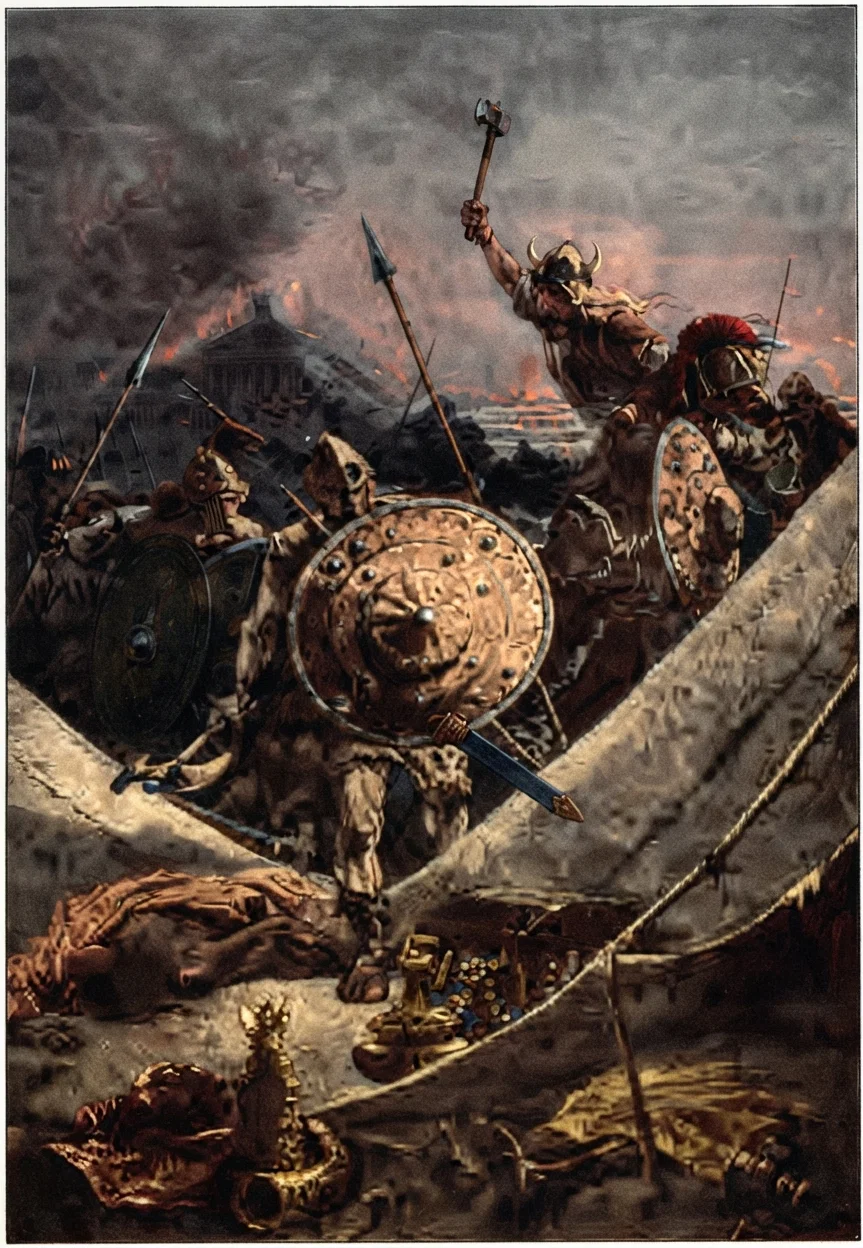
Nor was this all. The empress Eudoxia, hard pressed by the usurper Maximus, called the king of the Vandals to her aid. Genseric was not long in accepting the invitation; and in 455, the terrible corsair landed his army at Ostia, Rome’s harbor. The eternal city opened her gates; and for fourteen days, it was plundered with a degree of rapacity which the Visigoths of Alaric had not approached. Genseric ordered the careful transportation of public and private treasures to his ships. The sacred instruments of Jewish worship, the golden table and the golden candlestick, which had been offered in spectacle to the Romans four centuries earlier by Titus, were transferred from Rome to Carthage by the barbarian chief. Sixty thousand captives, and the empress Eudoxia herself, with her two daughters, were placed in captivity. "A great mountain burning with fire" had been "cast into the sea; and the third part of the sea" had become "blood."
The emperor Majorion resolved to crush the power of the Vandals. Three years were devoted to the construction of a fleet of three hundred ships. This fleet took its position in the large bay of Cartagena, on the Spanish coast. But Genseric made a sudden and unexpected attack upon it, and sent the Roman ships to the bottom or captured them.
Made Horrible Havoc
THE emperor of the West now turned to the emperor of the East for help. A new fleet was equipped, at the cost of thirty million dollars. This fleet was composed of eleven hundred ships. Genseric asked for a five days’ truce; and then, the wind having become favorable, he took advantage of the night to send great barges, loaded with inflammable material, toward the Roman ships. Fire soon roared with violence through the imperial fleet; and in the midst of the tumult of this horrible night, the disciplined ships of Genseric made terrible havoc of what had been spared by the fire.
"And there died the third part of the creatures which were in the sea, even they that had life; and the third part of the ships was destroyed." With absolute exactness, the second trumpet was fulfilled.
After this terrible battle, Genseric became more than ever the "tyrant of the sea"; and "before he died in the fullness of glory," as says Gibbon, "he beheld the final extinction of the empire of the West."
The second trumpet was over. Five more trumpets were yet to be heard.