Norfolk Island

6%

Review and Herald Publishing Association · Takoma Park, Washington, D. C. · Aug 1, 1912

FromReview and Herald, Vol. 89, No. 31.

Read the full edition

Norfolk Island

C. H. PARKER
Dotted, like beautiful gems, all over the mighty bosom of the South Pacific, lie islands of every description, size, and shape. These, separated by a large expanse of water from the continents and from one another, are little kingdoms of their own, having customs and practises peculiar to themselves, yet connected by blood relationship to all the rest of the world. God "hath made of one blood all nations of men for to dwell on all the face of the earth, and hath determined the times before appointed, and the bounds of their habitation."
Such is Norfolk Island, which has been separated by an infinite hand and a munificent providence. It is one of the smallest islands, being only seven miles long by three miles wide, and containing only thirteen square miles; yet it has a history second to none. The beginning of its history would seem to cloak its future in a cloud of gloom, as it was used by the British government as a penal station.
In 1856 the increasing population of Pitcairn Island rendered it necessary that the islanders should find a wider home. The British government therefore offered them houses and land on Norfolk Island, as they had removed the convicts to Port Arthur, Tasmania. Of course the people shrank from the idea of leaving Pitcairn, when it was first proposed, but finally consented, and were landed on Norfolk Island, hundreds of miles from their old home, in June, 1856. Moses and Mayhew Young, with their wives and families, became so homesick for their old home on Pitcairn that they returned the same year. A few others returned later. The rest remained. Of the married couples who came from Pitcairn, only six persons still survive on Norfolk.
The whole coast of the island is steep and rocky, and landing is possible only at two or three places. There is a rise of a few hundred feet to an elevated plateau in the middle of the island.All the residents have their allotted portion of land, mostly fifty acres, which has been subdivided among their children, cutting down the acreage of many to five. Nearly all live "in the country," as they term it. The whole island is formed of undulating hills, steep but well grassed, never rocky nor broken. The cleared lands are beautifully green; and as the noble pines were left standing, the whole island looks like a magnificent park. Every hollow, known locally as a valley, is filled with dense vegetation,—bananas, oranges, peaches, passion fruit, persimmons, lemons, pomegranates, guavas, rose-apples, quinces,—while on the level parts and the more gentle slopes grow melons, strawberries, beans, peas, vegetables, and maize in abundance. The soil is wonderfully fertile, and supplies everything needful but clothes. Every one owns at least one horse, and all, from the age of two, ride or drive. Sheep, cattle, pigs, and poultry are very plentiful. Poverty, as we understand it, is unknown, though actual cash is very little in evidence. The people are a happy, light-hearted race, extremely hospitable, and much given to social intercourse and pleasure of all kinds.
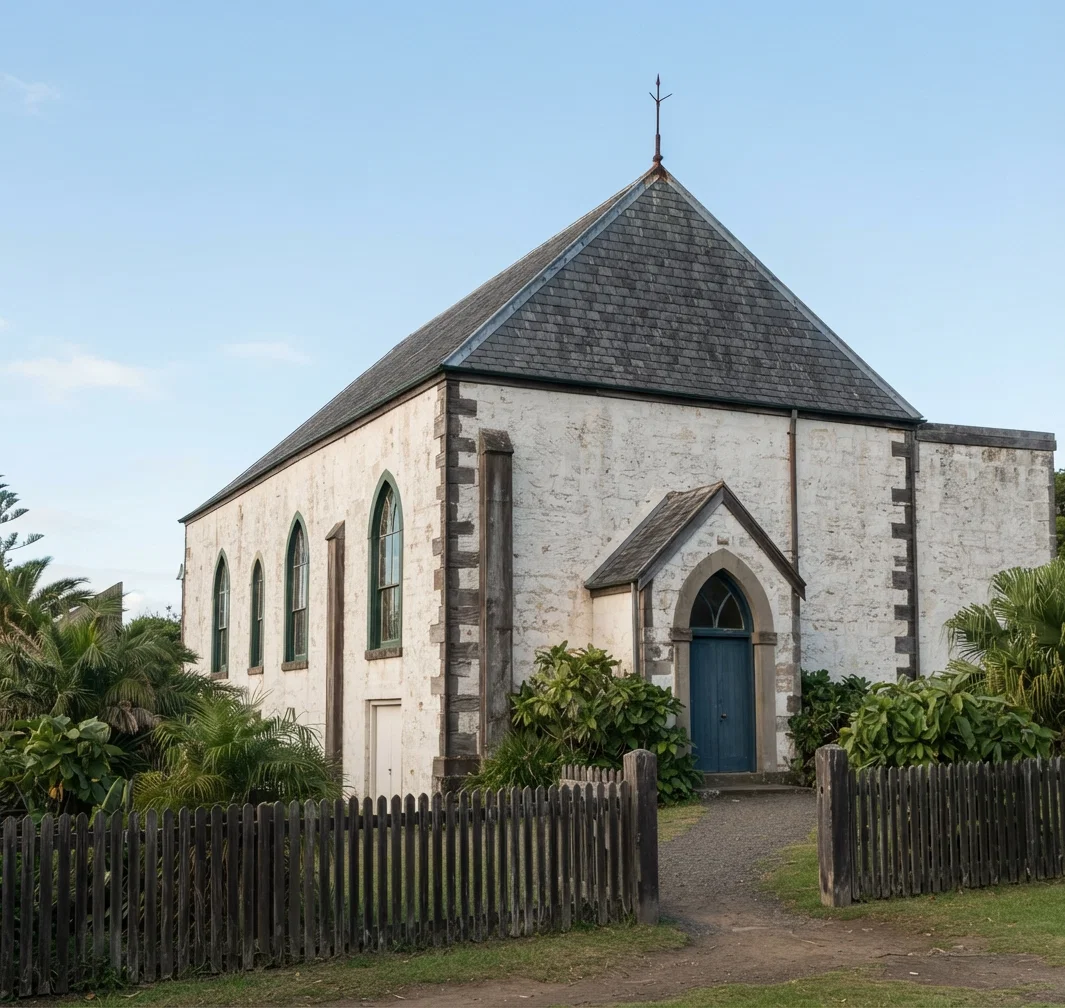
SEVENTH-DAY ADVENTIST CHURCH, NORFOLK ISLAND
You may drive for hours along good roads until you can hardly realize that you are on an island containing only thirteen square miles. These roads were formed in convict times. But the glory of the island is its famous avenue of pines, an excellent road bordered on both sides by a regular, close row of giant pines, running for more than a mile through beautiful green lands, giving here and there peeps of the sea on one side, and of Mt. Pitt, with its thick growth of pines, palms, and tree-ferns, on the other. This avenue leads to the Melanesian mission, which is the headquarters for the work of the English Church in Melanesia. Here they bring boys from different parts of their mission field, and educate them for teachers.
Mt. Pitt is the highest point of the island, being 1,000 feet high, and from its summit presents a beautiful view of the island, surrounding sea, and of Philip and Nepean Islands, which are but a short distance away.
There are about 900 inhabitants, all told, upon the island. Spirituous liquors are not allowed. No exporting is done, except whale-oil, as the fruit trade of Sydney, Australia, has, by a high tariff, practically barred its doors against the importation of the island's products. Therefore, the people have to depend in a large degree on home consumption.
There are three churches on the island—English, Methodist, and Seventh-day Adventist. Each has one central place of worship, which is at Kingston, the old prison site.
The third angel's message was introduced into this island on the visit of the "Pitcairn." The whole island was much agitated over the truths taught. A number identified themselves with the message, some of whom are still alive and faithful. A church was organized in May, 1895.
Alfred Nobbs, son of Pastor Geo. H. Nobbs upon whom the mantle of John Adams fell, was the schoolmaster of the island, and accepted the tenets of this faith in the year 1891, becoming the devoted elder and pastor of the church. He served well and faithfully, carrying on the work through the most troublous times of its effort for a foothold. He never faltered in the battle until he was called by the great Captain to rest from his arduous labors, Sept. 26, 1906.
In December, 1894, Brother and Sister Stephen Belden, of America, joined Brother Nobbs in his labors. Brother Belden labored well and faithfully until he fell at his post of duty, Nov. 4, 1906, just one month and ten days after the death of Brother Nobbs. Sister Belden still clings to the people of their choice, like Ruth to Naomi.
Brother H. Mitchell and wife, of South Australia, took up the work laid down by these two faithful workers; but they were compelled, after three years of earnest labor, to leave the island on account of the failing health of Sister Mitchell. A year ago last January Brother A. H. Ferris and wife were appointed to this island, and they have been working earnestly and perseveringly since coming here. Their labors and ministrations of love are much appreciated, and their hands are full to overflowing with work for this dear people. The seed sowing of past years is beginning to be reaped.
Thus the message is going from one continent to another, and from one island to another. Lately the standard has been raised on Lord Howe Island, which is the only island between here and Sydney. Now we are bearing it on to the New Hebrides, from which place we trust soon to flash the signal along to other island fields. Soon the gathering call will have sounded to all nations.