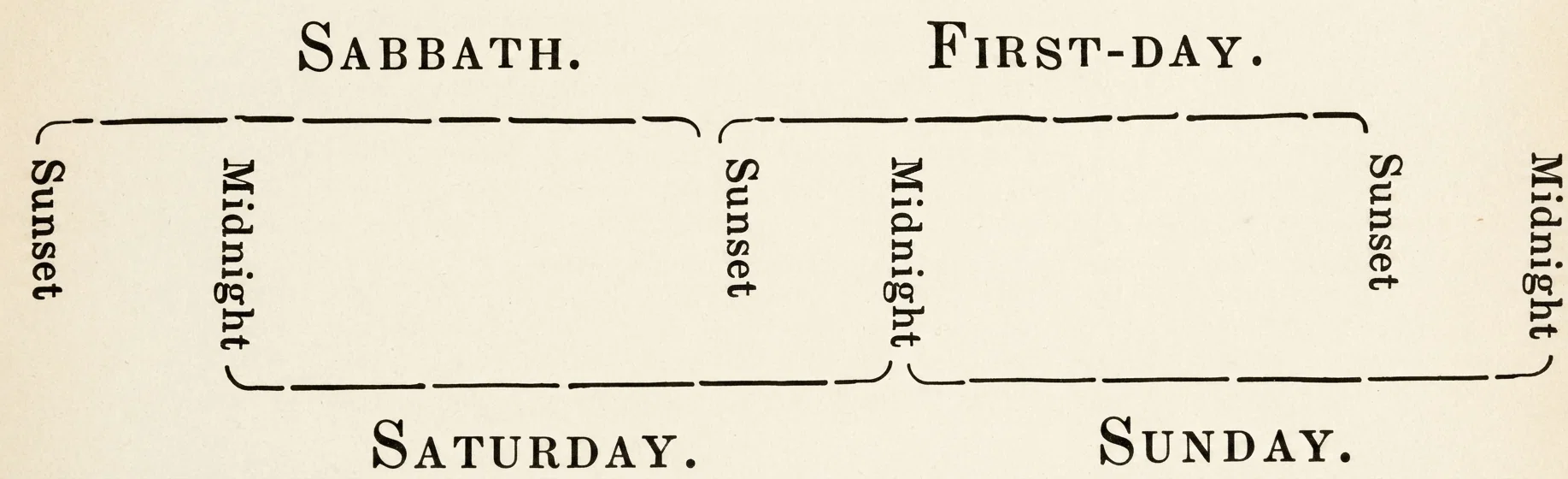
In the Bible the evening and the morning constitute a day. In Roman time, (the method of reckoning in common use,) it is not so, the order being reversed. And not only is the order reversed, but the time for the commencement of the parts of the day is changed. Without bearing this in mind there will be confusion in reckoning the true time, as the Roman Saturday is not identical with the seventh day of the Bible, and the Sunday is not the same as the first day of the week. The following diagram will illustrate this:
By this it will be seen that the Sabbath commences about six hours, or from sunset to midnight, before Saturday does. The Sabbath is a portion of time so named by the Creator, commencing and ending with the setting of the sun. Saturday was so named by the Romans, and denotes a portion of time from midnight to midnight, embracing about three-fourths of the seventh day, and about one-fourth of the first day of the week.
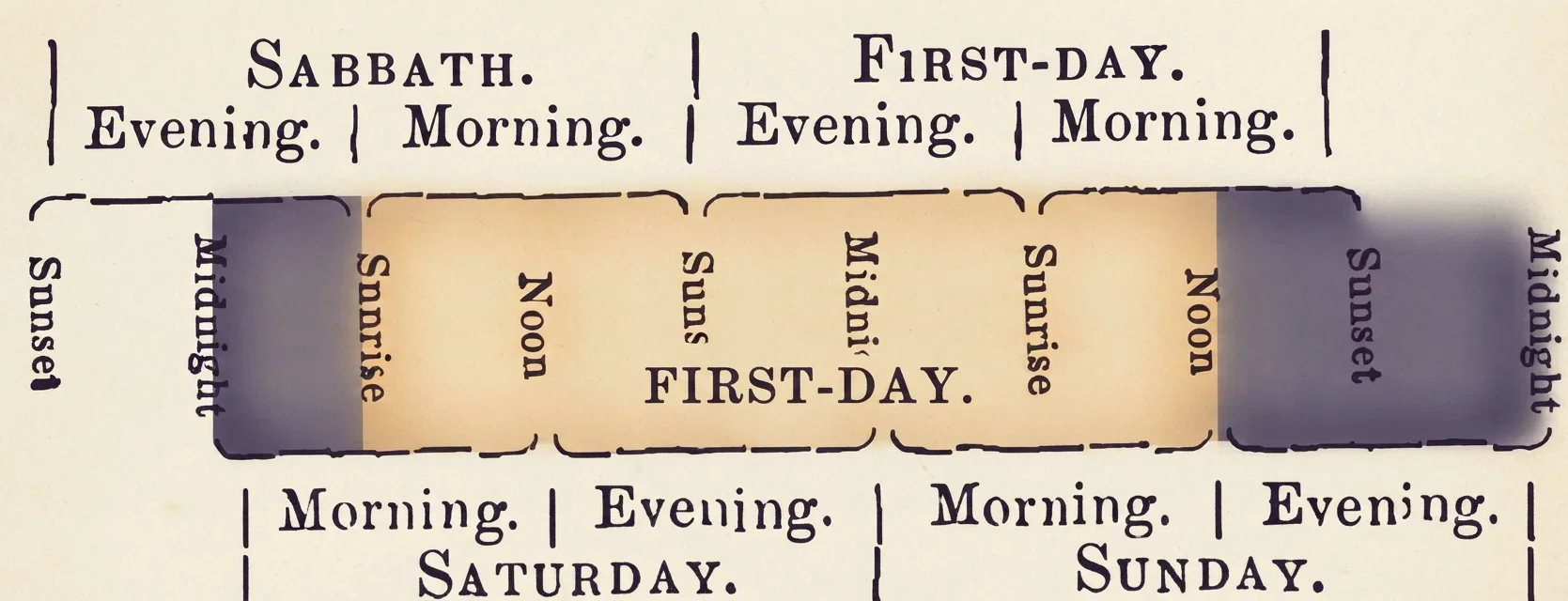
But the greatest confusion exists in regard to the evening. And to this it seems necessary to call attention as there are many Sabbath-keepers who have not fully considered this, and therefore would not understand an appointment or the report of a meeting given according to true time. The following diagram will show the difference between the evenings of the true and common time:
Sabbath evening commences on the Roman Friday afternoon at sunset, while Saturday evening commences at noon of the seventh day, about eighteen hours afterwards. A meeting on the evening of the first day of the week, [Acts xx, 7,] will be on a Saturday night. A Sunday evening meeting would be on the evening of the second day of the week.
Would it not be well to adopt the true reckoning amongst Sabbath-keepers? It seems necessary to prevent confusion, as all acknowledge and speak of the Sabbath evening as commencing at sundown on Friday P. M. If the others are reckoned differently there must be a break somewhere, and an explanation given to prevent misunderstanding. It seems wrong to call the Lord's Sabbath Saturday, but in reality it is equally wrong to call any of the days of the week by their heathen names. The Review is published on Fifth-day; this was adopted in 1853. Early writers on the Sabbath strenuously objected to following the customs of the heathens in this respect; and it is evident that if the proper method had been preserved, Sunday superstition would not be so deeply rooted as it now is. It is even, in some cases, difficult to make people understand that there is a difference between Sunday and Seventh-day. This misuse of terms is favored by advocates of Sunday-keeping, as may be seen by referring to Dr. Edward's Sabbath Manual. On this subject Dr. Owen wrote as follows:
"Among Christians this name, viz., Sunday, was not in common use, but by some was rejected, as were also the rest of the names of the days used among the Pagans. So speaks Augustine, wishing that Christians did not call the names as Pagans do. Jerome would not have the days of the week called after the idols and planets, but First-day, Second-day, Third-day, Fourth-day, Fifth-day, Sixth-day, Seventh-day or Sabbath-day; and he rejects the use of the ordinary names of the heathen. Philastus makes the use of them among Christians almost heretical. The popish Rhemist, on Rev. i, 10, condemns the name of Sunday as heathenish; and Polidore Virgil, before them, saith, 'It is both a shame, and matter of great lamentation, that before now the days have not been called by Christian names, that the heathenish gods might not have had among us such a standing monument.' Indeed, among sundry of the ancients, there occur many severe expressions against the use of the common planetary names; and at the first relinquishment of heathenism, it had no doubt been well if these names of Baal had been taken away out of the mouths of men, especially considering that the retaining of them hath been of no use nor advantage. I must add, that the severe afflictions, and contemptuous reproaches, poured out against them who abstain from using them, argue a want of charity; since certainly there is an appearance of warranty in them who use not heathenish names, sufficient to secure them from contempt and reproach. For it is given as the will of God. Ex. xxiii, 13. 'Make no mention of the names of other gods, neither let them be heard out of thy mouth.' And it cannot be denied, that the names of the days of the week were names of the gods among the heathen. The prohibition is renewed in Josh. xxiii, 7. 'Make no mention of the names of their gods, nor cause to swear by them, neither serve them, nor bow yourselves unto them; which is yet extended, in Deut. xii, 3, to a command to destroy and blot out the names of the gods of the people, which by this means are retained. Accordingly, the children of Reuben, building cities, formerly called Nebo and Baalmeon, changed their names, because they were the names of the heathen idols. Num. xxxii, 38. And David mentions it as a part of his integrity, that he would not take up the names of idol gods in his lips. Ps. xvi, 4."