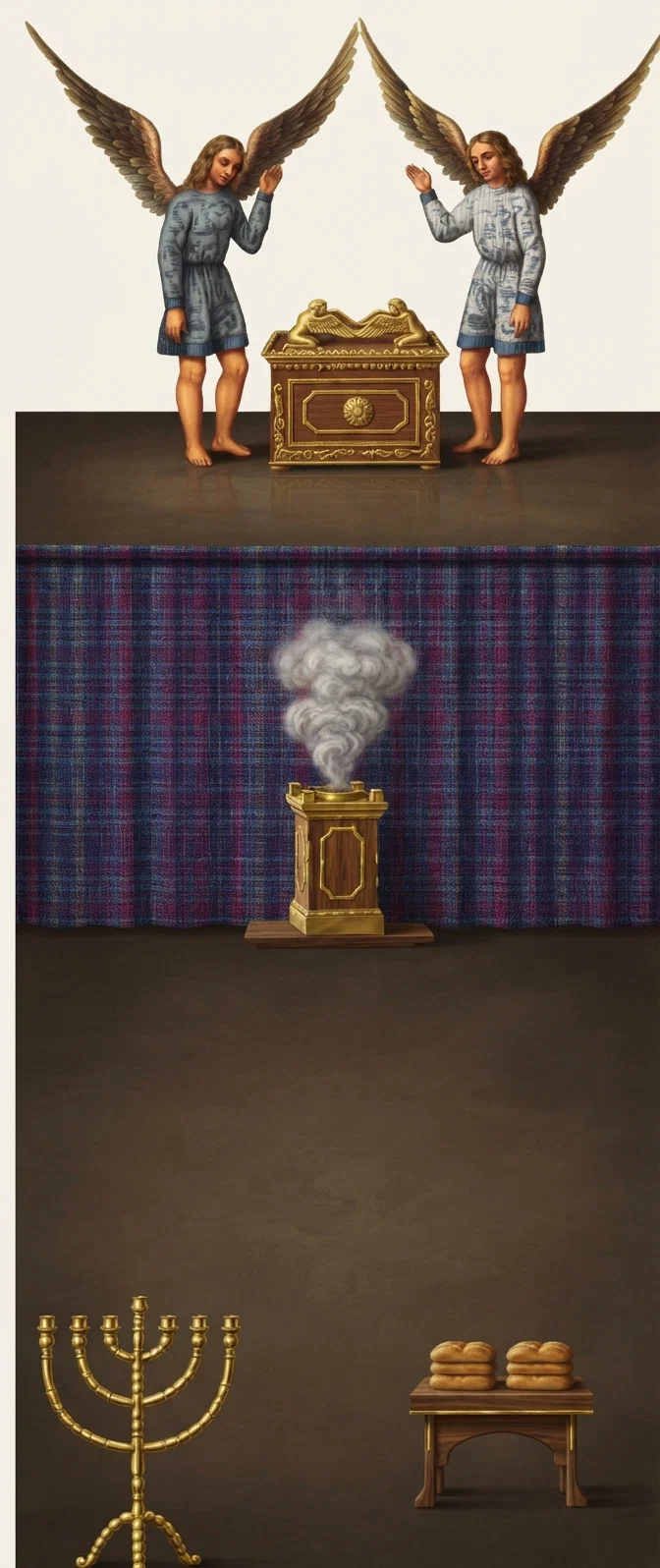
We have now reached a point in the course of our investigation, where we are led to inquire, What is the Sanctuary, and what is the nature of its cleansing? We have briefly noticed the mass of testimony that clusters about, and centers in, 1844, as the termination of the prophetic periods; and whatever were our expectations of the events to transpire at that time, it is certain that all the ground we had upon which to base them was the declaration of the
NOTE.—The above illustration is projected on a scale of four cubits to an inch, from the size of the tabernacle as erected by Moses in the wilderness. It is true that the large cherubim were not erected in the Most Holy Place, till it was permanently located in Solomon's temple, when the proportions of the Sanctuary, in length, breadth and height, were enlarged to double the size in which they had formerly existed. We have chosen however to take the dimensions of the tabernacle for a standard, and reduce the cherubim to one half their size to correspond, in order to give more prominence to the furniture. We have not represented the high priest in his yearly ministration before the ark, since as he entered in from the Holy Place he would only present his back to the beholder, and necessarily hide the ark from view.
angel to Daniel, "Then shall the Sanctuary be cleansed," or the announcement of that messenger of the Apocalypse, "The hour of his judgment is come."
We have seen that the evidence which determines the commencement and the reckoning of the 2300 days, so as to bring their termination in the year 1844, can neither be annulled nor evaded; consequently the efforts that have been made by two classes, the one to remove the original date for the commencement of the days, and the other to render them null and void, by disconnecting them from the 70 weeks, have no light nor truth in them. We say, therefore, that the subject of the Sanctuary as it was then held, demands a reconsideration.
The course of reasoning, by which we were led to look for the personal appearing of the Lord at the end of the days, by considering the earth, or some part of it, the Sanctuary, and its cleansing a regeneration by fire, to be preceded by the coming of the Son of man, has been already noticed. Was this incorrect? In determining this, the first thing to be ascertained is,
What is the Sanctuary? To learn what the Sanctuary now is, it will be necessary to go back to the fountain head of revelation and see what has been recognized by the Bible as the Sanctuary, in times past. The apostle Paul in his epistle to the Hebrews, introduces the subject fairly before us. In chap. viii, he contrasts two covenants, the first and the second, the old and the new, under the latter of which we now live. He then opens in chap. ix, as follows:
"Then verily the first covenant, had also ordinances of divine service, and a worldly sanctuary. For there was a tabernacle made; the first, wherein was the candlestick, and the table and the shew-bread; which is called the sanctuary; and after the second vail, the tabernacle which is called the Holiest of all; which had the golden censer, and the ark of the covenant, overlaid round about with gold, wherein was the golden pot that had manna, and Aaron's rod that budded, and the tables of the covenant; and over it the cherubims of glory shadowing the mercy-seat," &c. Verses 1-5.
The Apostle here tells us that the tabernacle, thus ordained, was the sanctuary of the first covenant. Turning back to the records of the times during which the first covenant was in force, do we find any mention of such a building as is here described by Paul? Yes, the most explicit. Let us briefly notice it:
The word of promise which God had left, for the children of Israel, while buried in Egyptian bondage, that he would surely visit them, and bring them out of the land of Egypt, [Gen. 1, 24.] had been fulfilled, and they were delivered. In the song of triumph which Moses sung upon that occasion, he said, The Lord is my strength and song, and he is become my salvation: he is my God, and I will prepare him an habitation. Ex. xv, 2. In this we receive the first intimation of that building which God would afterwards cause to be erected, that he might dwell among his people. In verse 17 of the same chapter, is the first occurrence of the word Sanctuary which we find in the Bible.
Pursuing the sacred record we find in the twenty-fifth chapter of Exodus and onward, more definite information respecting the sanctuary; namely, the commission which God gave to Moses for its erection. In the third month after their departure from Egypt, the children of Israel came to the wilderness of Sinai. There Moses was summoned up into the mount to an audience with his Maker. He remained there forty days and forty nights. During this time he was shown the pattern of the Sanctuary and all its sacred vessels, and received full instructions concerning them.
A particular description of the tabernacle, as erected by Moses, we need not enter into. It is minutely set forth in Exodus, chaps. xxv-xxxi. Suffice it here to say that it was a structure of extraordinary magnificence formed of upright boards overlaid with gold, thirty cubits long, about ten in width, and ten in height. At the east end, which was the entrance, there were five pillars of shittim wood, whose chapters and fillets were overlaid with gold, having hooks
of gold, standing on five sockets of brass. Over the tabernacle thus erected were thrown four different coverings. The first and inner curtain was composed of fine linen embroidered with figures of cherubim, in blue, purple and scarlet. This formed the magnificent ceiling. The second covering was made of goat's hair; the third of ram's skins dyed red; and the fourth and last, of badgers' skins. The east end was enclosed with a richly embroidered curtain, suspended from the pillars before mentioned.
The sacred tent was divided into two apartments by means of a vail suspended from four pillars of shittim wood overlaid with gold, set in sockets of silver. In what proportion the Sanctuary was thus divided, we are not informed, but it is supposed to be the same as was afterwards observed in the temple. 1 Kings vi.
In the first apartment, or holy place, were three things worthy of notice; the golden candlestick, the table of shew-bread, and the altar of incense. In the second apartment or most holy place, were also three things to claim attention: the ark, the mercy-seat, and the cherubim. It was above the ark over the mercy-seat, between the cherubim, that God manifested his presence, and from whence he communicated with his people. Ex. xxv, 22. And so David prays, "Thou that dwellest between the cherubims, shine forth." Ps. lxxx, 1.
It is to be observed that neither the holy nor most holy place had any window; hence in the first apartment there was need of the candlestick with its seven lamps; and in regard to the second where God dwelt, Solomon said, "The Lord said that he would dwell in the thick darkness." 1 Kings viii, 12.
Before the door of the tabernacle was placed the brazen laver, and the altar of burnt offering, and around the whole was erected the court with its curtains of fine twined linen.
In the second year after Israel had departed from Egypt, in the first month, on the first day of the month, the tabernacle was reared up. And Moses spread abroad the tent over the tabernacle, and he put the testimony (the tables of ten commandments) into the ark, and the mercy-seat upon it, and brought it into the tabernacle, and set up the vail; he placed the table of shew-bread, and golden candlestick, in the first apartment, and lighted the lamps before the Lord; he put the golden altar of incense before the vail and burnt sweet incense thereon; and on the altar before the door of the tabernacle he offered the burnt-offering and the meat offering, as the Lord commanded. Then a cloud covered the tent of the congregation, and the glory of the Lord filled the tabernacle. Ex. xl.
We have now before us the sanctuary as Moses erected it in the wilderness of Sinai 1490 years before Christ. With its ark of the covenant, its mercy-seat, and glorious Shekinah, it constituted the heart and center of Israel's religious worship, under that typical system.
The children of Israel were at this time in the period of their wandering; and therefore the sanctuary as first given to them was adapted to their condition: being so constructed that it could be easily taken down and borne with them in their journeys, and immediately erected wherever the Divine Presence, which accompanied them in a cloud by day, and a pillar of fire by night, should direct them to pitch their camp. Num. ix, 15-23.
From its entrance into Canaan, it is easy to trace the history of this building till it was embodied in the larger and more glorious structure of the temple of Solomon. We trace it down to the period when it was overthrown by Nebuchadnezzar, and suffered to remain in ruins during the 70 years of the Babylonish captivity. From the time that it was rebuilt by Zerubbabel, we follow it, until the days of our Saviour, by whom it was declared forever desolate. We trace it, after this event, through its brief, but nominal existence, to the year A. D. 70, when we forever lose sight of it in that destruction, by which it was overwhelmed through the violence of the Roman soldiers.
This was the sanctuary of the first covenant. There can be no doubt on this point with any who yet have confidence in divine revelation. It is directly declared to be such by the apostle Paul; and of the one hundred and forty-two times of the occurrence of the word in the Old Testament, it refers in almost every instance to this building. The main question at issue then, is, What is the Sanctuary of the second or new covenant? This next claims consideration.