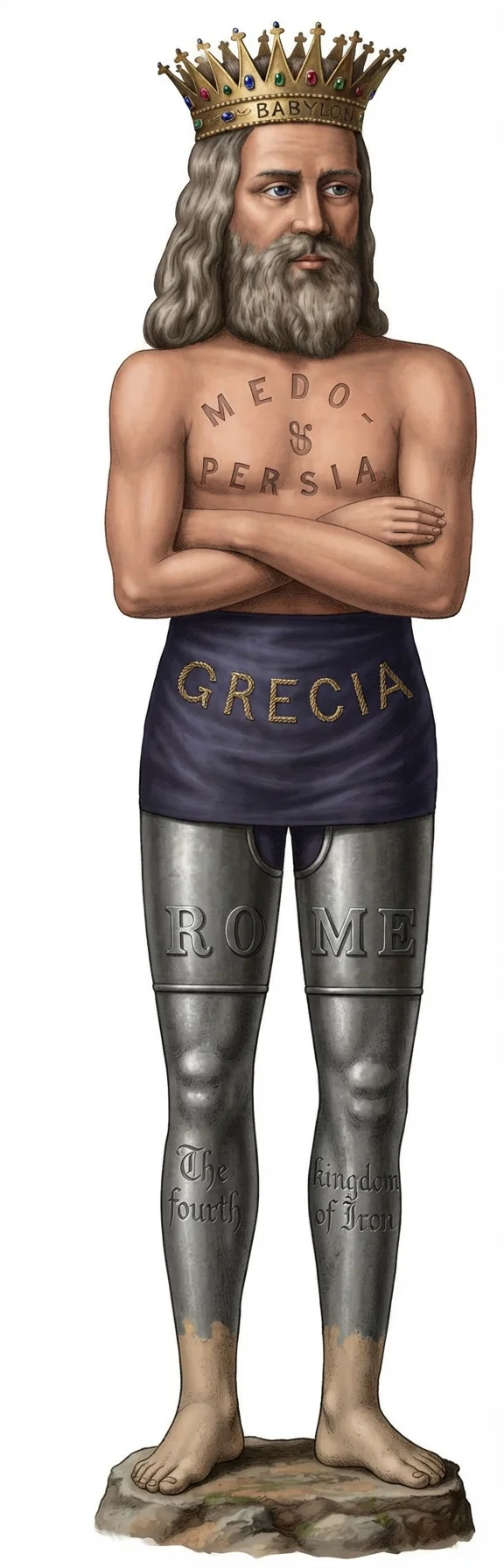
HAVING shown that the legs of iron of Dan. ii, and the little horn of chap. viii, symbolized Rome, the fourth great empire of the world; and having traced that power down to the commencement of the christian era, it only remains that we notice some further specifications of the prophecy which have their application since that time.
Said the Prophet, [Dan. ii 40,] "And the fourth kingdom shall be strong as iron . . . and as iron that breaketh in pieces and subdueth all these, shall it break in pieces and bruise." This is a fit emblem only of the Roman power, "the invincible fortitude, hardiness, and force of which," says Scott, "perhaps were never equalled. By wars and conquests the Romans bore down all opposition, and reduced almost every kingdom or state in the known world into some kind or degree of dependence."
But the Prophet continues: "And whereas thou sawest the feet and toes part of potter's clay, and part of iron, the kingdom shall be divided: but there shall be in it of the strength of iron, forasmuch as thou sawest the iron mixed with miry clay. And as the toes of the feet were part of iron, and part of clay, so the kingdom shall be partly strong and partly broken."
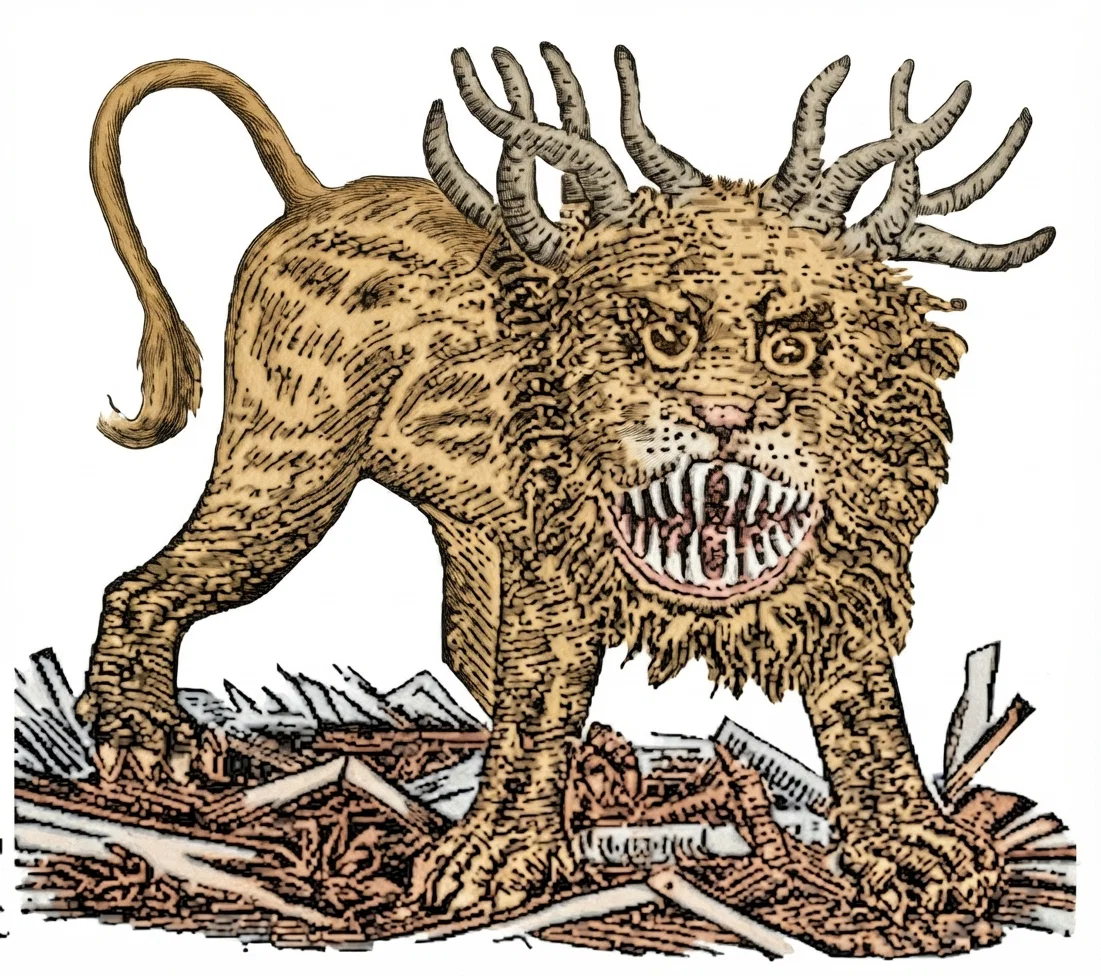
"The kingdom shall be divided." In considering this item of the prophecy, we are brought once more to the symbols of the seventh chapter, in which the fourth kingdom is set forth by a great and nameless beast dreadful and terrible, and strong exceedingly, which had great iron teeth, which devoured and brake in pieces, and stamped the residue with its feet; and it had ten horns. Verse 7. The ten horns are declared plainly in verse 24, to be ten kings which should arise out of this kingdom. Here we have the same divided state of the empire as is signified by the ten toes of the image. This is now the subject of our consideration: Did ten kingdoms arise out of the Roman empire, as contemplated by the prophecy? We answer, There did; and cite the reader for proof to the records of history:
It is well known that Rome fell beneath an overwhelming irruption of Barbarians from the north. They were fierce and warlike tribes, given to rapine and plunder. The wealth of the provinces of the south presented an alluring bait for their avarice; and the effeminacy of the people brought on by a long course of corruption and luxury, rendered them an easy prey to their unimpaired valor. Being given to pillage, and led on from place to place, by the hope of spoil and the love of plunder, and warring frequently upon each other, it is difficult to assign them at first for any considerable period, a fixed location. Suffice it to say that between the years 350 which is marked by the establishment of the great Gothic Kingdom, and 483, when the Roman empire was in its last stages of decline, they had appropriated to themselves the territory of Europe; and from them have descended the people that at present inhabit it. But the nations engaged in this work of invasion and subversion, were ten, according to the prophecy, and are enumerated by Marchiaval, Bishop Lloyd, and Dr. Hales, as follows:
1. The Huns. 2. The Ostrogoths. 3. The Visigoths. 4. The Franks. 5. The Vandals. 6. The Suevi. 7. The Burgundians. 8. The Heruli and Rugii, or Thuringi. 9. The Anglo-Saxons, and 10. The Lombards.
Concerning these kingdoms, Scott remarks, "They are indeed reckoned up in different ways by different writers, according to the date assigned to their enumeration; but in general it is clear that they were nearly the same with the principal kingdoms in Europe at this day; excepting some of the more northern regions, and those possessed by the Turks. It is however certain that the Roman empire was divided into ten kingdoms: and though they might be sometimes more and sometimes fewer, yet they were still known by the name of the ten kingdoms of the western empire."
The question may here arise in some mind, how it happens, since Rome conquered the world, that the ten horns are confined to Europe, and embrace none of their conquests in Africa or Asia. The following from Dr. Nelson, will clear this part of the subject of all difficulty:
"The learned of the earth have praised one of their own number, for one particular trait of character belonging to him in full measure. They have said that Sir Isaac Newton would not indulge in wild speculations and vain conjecture. It is stated that in all his astronomical and philosophical researches, every doctrine which he advanced was built on fact, and that further than this he would not proceed. He seems to have preserved this feature of his mind while writing on prophecy. I never understood one fact concerning the ten horns of the fourth beast, until I read and closely noticed a passage of this philosopher's writing, concerning that beast. I knew that the Roman empire was divided, and that ten kingdoms had existed in Europe as fragments, or horns of that beast; but I did not know why eastern countries, over which the Roman empire had extended, were not included. I knew that in Europe, for twelve hundred years, ten horns had been visible, but if Asia should be taken into the reckoning, the number of horns must be extended. The astronomer saw clearly enough why the kingdoms of Europe alone were to constitute the body and the horns of the beast. His words we will transcribe, for the sake of those who may wish to understand plainly this interesting part of history.
"All the four beasts are still alive, though the dominion of the three first be taken away. This corresponds with the declaration of the twelfth verse that although their dominion was gone, they had their lives prolonged for a season and a time. The nations of Chaldea and Assyria are still the first beast; those of Media and Persia are still the second beast; those of Macedonia, Greece, Thrace, Asia Minor, Syria, and Egypt, are still the third; and those of Europe on this side are still the fourth. Seeing therefore the body of the third beast is confined to the nations on this side of the river Euphrates and the body of the fourth beast to the nations on this side Greece, we are to look for all the four heads of the third beast among the nations on this side the Euphrates, and for all the eleven horns of the fourth beast among the nations on this side of Greece, and therefore, at the breaking of the Greek empire into four kingdoms, we include no part of the Chaldeans, Medes, and Persians, in those kingdoms, because they belonged to the bodies of the two first beasts. Nor do we reckon the Greek empire seated at Constantinople among the horns of the fourth beast, because it belonged to the body of the third." — Sir Isaac Newton.
"This is plain as the astronomer's doctrine of gravitation. I pity the man who does not read; and I pity the man who hastily reads his Bible, but is too ignorant to enjoy the wonderful picture so plainly delineated in these few verses."
This part of the prophecy completes the image. From the starting point given us by the Prophet, we have come down past the head of gold, the breast and arms of silver, the belly and sides of brass, the legs of iron, until by these last revolutions the weakened state of the empire as set forth by the clay of the feet, and its division as signified by the toes, were fully accomplished; and the image stands complete before us. The words of the Prophet now come home with stirring power. "In the days of these kings shall the God of heaven set up a kingdom." The next event in this chain of prophecy, is the crushing blow of the Stone cut out without hand, which descends upon the feet of this great image of earthly kingdoms, and dashes it in pieces. Like a statue in solemn anticipation of its doom, it has been for long years awaiting this event. We are persuaded that it is not far in the future.
Another question may here arise which perhaps demands a passing notice. In the days of these kings, the God of heaven was to set up a kingdom. We turn our eyes to Europe at the present day, and behold a variety of kingdoms, petty sovereignties, and dependencies. The question has been asked, Where are the ten kingdoms? Have they passed away? or has the time passed in which the fifth kingdom should have been set up? In reply to this we quote again from Nelson:45
"Some have asked how it could be said that ten kingdoms have existed to represent ten horns, in a part of the earth once under the dominion of Rome when so many changes have been constantly going on in Europe, and when so many of them have been at times, as it were, consolidated into one. We may reply at any time to such an inquiry very fairly, that the ten horns have been there; that making a kingdom tributary does not take away its existence. If there should have been at times, eleven, twelve or more horns there for half a century or longer, this does not make it untrue that ten were there. Such inquiries as have been made, and such objections as have been urged, seem to many, unworthy of an answer; but if a puerile cavil should appear weighty and important in the view of the unthinking, or the uninformed, for his sake it needs an answer. Let us then pass briefly through an illustration which may aid us in understanding each other.
"Suppose some feeble people should be suffering from the almost constant invasions of numerous and ferocious enemies. Suppose a powerful and benevolent prince sends them word that he will, for a number of years—say thirty—maintain for their safety, along their frontier, ten garrisons, each to contain one hundred well armed men. Or suppose he is actuated by different designs and moved by other motives; no matter how this is, so that his word is out for the support of a given number of fortifications containing a thousand soldiers. Suppose the forts are built and remain a few years, when two of them are buried to the ground and rebuilt without delay; has there been any violation of the sovereign's word? No, there was no material interruption in the continuance of the walls of strength; furthermore, the troops, the most important part of the safeguard, are still there. Again, suppose the monarch sends and has two posts of strength demolished, but adjoining the spot where these stood, and immediately, he has other two buildings erected, more capacious and more desirable; does the promise still stand good? We answer in the affirmative, and we believe no one would differ with us. Finally, suppose in addition to the ten garrisons, it could be shown that for several months during the thirty years, one more had been maintained there; that for one or two years out of the thirty, there had been there eleven instead of ten fortifications; shall we call it a defect or a failure in the original undertaking? Or shall any seeming interruption, such as has been stated, destroy the propriety of our calling these the ten garrisons of the frontier? The answer is, No, without dispute."
"So it is, and so it has been, respecting the ten horns which were to represent ten kingdoms of Europe, once under the Roman sceptre. They have been there for twelve hundred and sixty years. If several have had their names changed according to the caprice of him who conquered, this change of name did not destroy existence. If others have had their territorial limits changed, the nation was still there. If others have fallen while successors were forming in their room, the ten horns were still there. If during a few years out of a thousand, there were more than ten—if some temporary power reared its head, seeming to claim a place with the rest, and soon disappeared, it has not caused the beast to have less than ten horns."
This quotation removes at once every chance for cavil, and all ground for objection. For over thirteen hundred years those kingdoms have been in Europe. In the days of these kings shall the God of heaven set up a kingdom. There are other prophecies to be noticed hereafter, which, through the development of further particulars, bring us down more definitely to our own time. But on the present point we wish to enquire, Would the Prophet thus accurately predict the existence of four great kingdoms, and be mistaken in regard to the fifth? The better judgment of every man will answer, No! As surely as four great kingdoms have successively borne rule over the earth, so surely will the God of heaven set up a fifth, which will never pass away. It will not be left to other people as these have been, but the saints shall possess it forever and ever. As surely as the image has been developed before us, so surely will it be smitten and dashed to shivers.
With one more question, which each must answer for himself and upon his own responsibility, we leave with you, reader, this part of the subject: Are you ready for this destruction of all earthly governments? Have you an interest in the kingdom that is to be set up? Is your name enrolled among those highly privileged ones, who are to be its immortal subjects? Is your citizenship in heaven, from whence we look for the Lord and Saviour? Are you Christ's, and therefore an heir, according to the promise? Or are you, on the other hand, in that condition, that if the King should appear, to raise his people to their glorious and imperishable inheritance, you would covet, as the greatest blessing to be buried from his presence by rocks and mountains? Woful condition! Watch! lest coming suddenly he find you sleeping.