PROPHECY

8%

Publishing Committee · Battle Creek, Mich. · May 29, 1860

FromReview and Herald, Vol. 16, Nos. 1 & 2.

Read the full edition

PROPHECY.

WHAT can be more natural than for man, as he looks forth upon a world where evil is everywhere present, and the marks of disorder and decay everywhere visible, to inquire whether or not this state of things shall always continue? and what inquiry can be of more interest and importance to the race than that which has respect to the age of the world in which we live? It would therefore be unreasonable to suppose that God would give a revelation to man and yet leave him uninformed in respect to subjects of such absorbing interest.
The declaration of the scripture is therefore in strict accordance with an enlightened reason, when it says, "Surely the Lord God will do nothing, but he revealeth his secret unto his servants the prophets." Amos iii, 7. The object of prophecy is to forewarn the world of things to come, in time for the requisite preparation, and to inspire the people of God with fresh courage as they see the time for the full fruition of their hope drawing nigh. No judgment has ever come upon the world unheralded; and none have ever fallen therein unwarned. And if from the uniform dealings of an unchangeable God with our world in the past, we may judge of the future, then may we confidently conclude that of the events yet to transpire, and above all the great event in which earth's drama shall close—the ushering in of the great day of the Lord, and the coming of the Son of man, something will be known, and the world be faithfully warned thereof, ere they shall take place.
In calling attention to these things we are accused of prying into the secrets of the Almighty. From this charge we want no better vindication than the language of Moses in Deut. xxix, 29: "The secret things belong unto the Lord our God, but those things which are revealed, belong unto us and to our children forever." Prophecy belongs to that portion of the Bible which may properly be denominated a revelation. It is designed to reveal to us things of which we could not in any other way gain information.
Again, we are met with the plea that the prophecies cannot be understood. But says the Saviour, referring directly to the prophecy of Daniel, "Whoso readeth let him understand." Matt. xxiv, 15. With this endorsement by our Saviour of our efforts to understand, with the declaration that the wise shall understand [Dan. xii, 10], and with the promise that if any man lack wisdom God will give liberally and upbraid not, if he will only ask of him, we are certain that the way is open for an understanding of these things before all those who are humble and teachable enough to ask and receive instruction of him through the medium of his word, and the agency of his Holy Spirit. To deny that the prophecies can be understood, is to deny that a part of God's word is a revelation, which is, so far, infidelity.
That the Bible reveals the day or hour of Christ's coming we do not pretend. But there are certain prophecies given and signs foretold which are to show us when the great day is at hand; and we are commanded, when we see these things come to pass, to know that it [margin, he, Christ] is near, even at the doors. Matt. xxiv, 33. And Paul gives assurance that Christians will possess a knowledge of these things when he says, "But ye brethren are not in darkness that that day should overtake you as a thief." 1 Thess. v, 4.
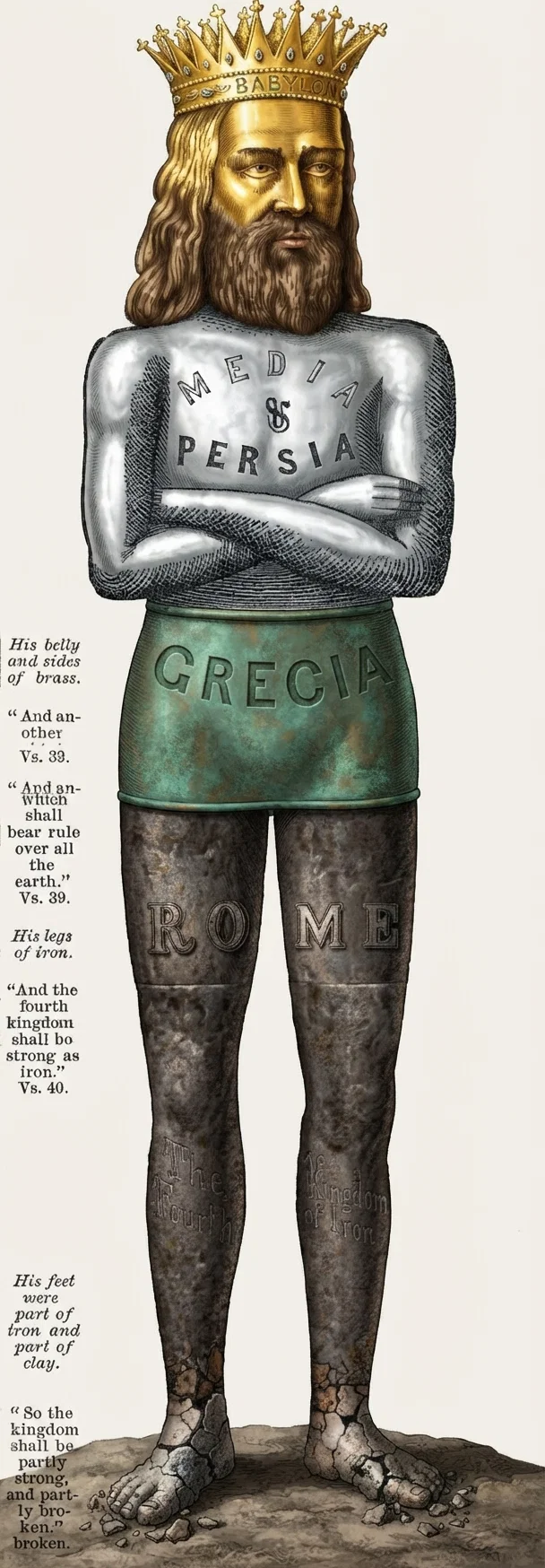
With these remarks we call the attention of the reader to the events and predictions recorded in Daniel ii. The scene opens with the kingdom of Babylon or Chaldea at the summit of its greatness and glory, b. c. 603. Nebuchadnezzar the Chaldean monarch, as it is natural for man to do, had been anxiously looking into the future, and pondering what should come to pass thereafter. Verse 29. Instead of rebuking or discouraging this spirit of inquiry in man, God takes occasion to grant to the king, and through him to the world, the information which he sought. Under the symbol of a great image he presents before him the most impressive and succinct history of the world from that time on, that can anywhere be found. This image's head was of fine gold, symbolizing the kingdom of Babylon, then existing. In his interpretation of the vision, the prophet addressed himself to the king in the following words: "Thou art this head of gold." Verse 38. The breast and arms of silver represented Media and Persia, which shortly supplanted Babylon in the empire of the world. The belly and sides of brass prefigured Grecia, which, conquering its predecessors, enjoyed its period of universal dominion. And finally Rome, the legs of the image, bore its iron sway over all the earth. In development of the ten toes, said the prophet, "The kingdom shall be divided" [verse 41]; and so was Rome divided into ten kingdoms between the years A. D. 306 and 483. What next? The monarch beheld till a stone cut out of the mountain without hand smote the image upon its feet, ground its metallic parts to powder, became a great mountain and filled the whole earth. The inspired interpretation of this impressive scene is given thus: "In the days of these kings shall the God of heaven set up a kingdom which shall never be destroyed, . . . but it shall break in pieces and consume all these kingdoms, and it shall stand for ever." Verse 44.
The earthly governments symbolized in this vision are all in the past. Their rise and fall may be easily traced by every lover of history. On these we shall not therefore dwell, but only inquire concerning that portion of the prophecy which yet alone remains to be fulfilled, namely, the setting up of the everlasting kingdom of God. Far too many, we are aware, will be ready to meet us here with the view that this kingdom of God is a spiritual kingdom and was set up in the days of Christ and the apostles. Let us ask such, must not the fifth universal kingdom be physically like the four which precede it? Is it at all admissible to suppose that the scene would suddenly shift without the least intimation from literal kingdoms on this literal earth, to a spiritual kingdom in the hearts of men? Such a kingdom as this, if the term is allowable, might exist without interfering with earthly governments; but the kingdom of God in Dan. ii, dashes in pieces all earthly governments ere it succeeds to their rule and absorbs their territory.
Another consideration more fatal still to this unscriptural though popular view of the kingdom, is found in the following: It was not till "the days of these kings" that the God of heaven was to set up his kingdom. Dan. ii, 44. "These kings" can be no other than the ten which arose out of the Roman empire. Not till after this division of the empire, therefore, could the kingdom of God contemplated in this prophecy, be set up; and it is a fact that this division wasnot accomplished till the year A. D. 483.
Whatever may therefore be meant by the expression, kingdom of God, in other places, it is certain beyond the shadow of doubt, that his kingdom which is to destroy and succeed all earthly governments, was not set up by Christ or his apostles; neither is it yet set up; for earthly governments still exercise their authority over the world.
A thought may here occur and be a source of perplexity to some. Have not the ten kingdoms, of the Roman empire, in the days of which the God of heaven should set up his kingdom, passed away? and has not the prophecy failed, if that kingdom is still future? We answer, the days of those kingdoms still continue. It matters not that their boundaries may have been changed, and their identity, in some cases, almost lost: The kingdom is still divided. We have passed that point where ten divisions out of the Roman empire completed the development of the image. It is now only waiting to be smitten upon the feet by the stone cut out of the mountain without hand.
Reader, are you ready for this destruction of all earthly governments? Have you an interest in the kingdom that is to be set up? Is your name enrolled among those highly privileged ones, who are to be its immortal subjects? Is your citizenship in heaven, from whence we look for the Lord and Saviour? Are you Christ's, and therefore an heir, according to the promise? Or are you, on the other hand, in that condition, that if the King should appear, to raise his people to their glorious and imperishable inheritance, you would covet, as the greatest blessing to be buried from his presence by rocks and mountains? Woful condition! Watch! lest coming suddenly he find you sleeping.