Food for Serious Thought in Connection With the Lincoln Anniversary

20%

Review and Herald Publishing Association · Takoma Park Station, Washington, D. C. · Apr 9, 1914

FromReview and Herald, Vol. 91, No. 15.

Read the full edition
Courtesy of the Religious Telescope

Food for Serious Thought in Connection With the Lincoln Anniversary

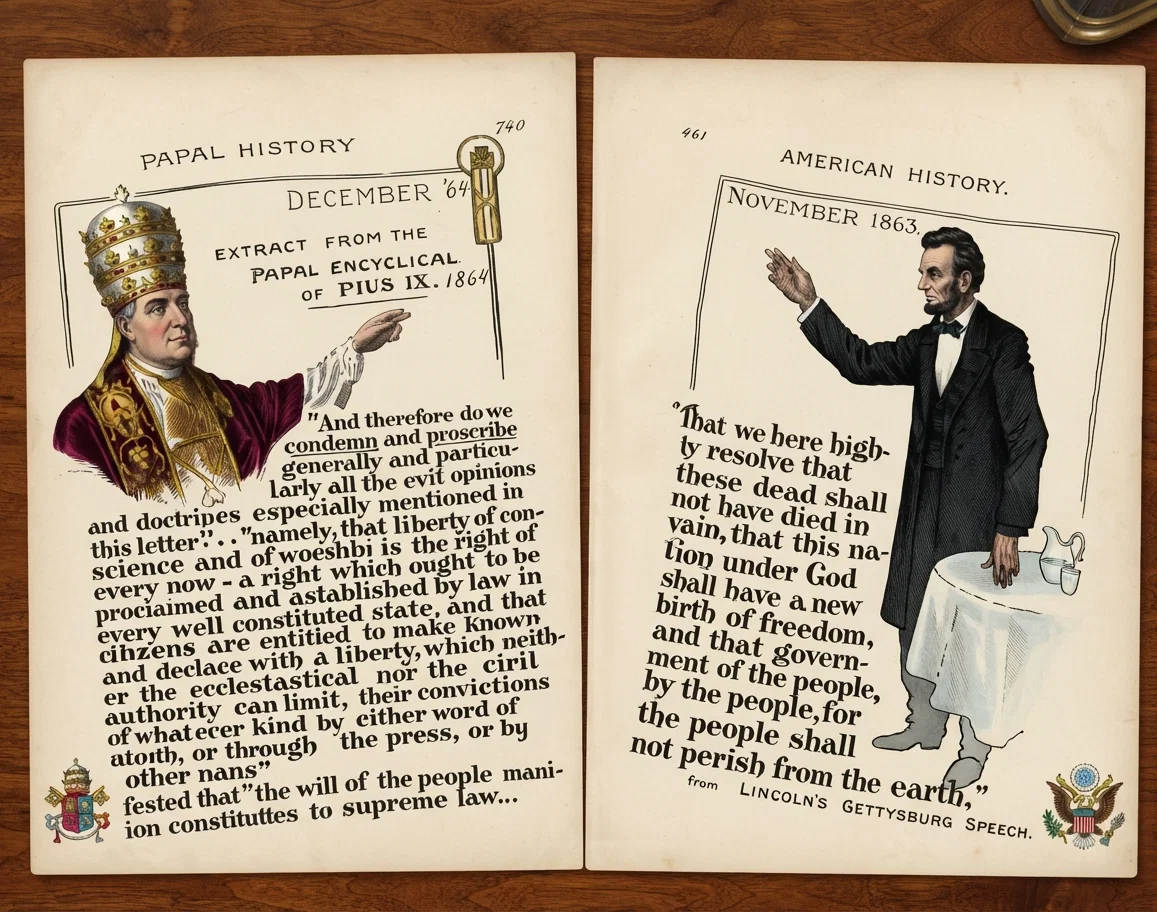
The following extracts from the encyclical letter of Pope Leo XIII, Libertas praestantissimum, published June 20, 1888, will furnish further proof of the un-American doctrines taught by authority in the Roman Catholic Church: —
"When once man is firmly persuaded that he is subject to no one, it follows that the efficient cause of the unity of civil society is not to be sought in any principle external to man, or superior to him [that is, not in the Pope or the Roman Church], but simply in the free will of individuals; that the authority in the state comes from the people only; and that, just as every man's individual reason is his only rule of life, so the collective reason of the community should be the supreme guide in the management of all public affairs. Hence the doctrine of the supremacy of the greater number, and that all right and all duty reside in the majority. But, from what has been said, it is clear that all this is in contradiction to reason. [Compare this with Lincoln's statement.]
"Although in the extraordinary condition of these times the church usually acquiesces in certain modern liberties [such as liberty of speech, liberty of the press, and liberty of conscience], not because she prefers them in themselves, but because she judges it expedient to permit them, she would in happier times exercise her own liberty. . . . One thing, however, remains always true — that the liberty which is claimed for all to do all things is not, as we have often said, of itself desirable, inasmuch as it is contrary to reason that error and truth should have equal rights."—"The Great Encyclical Letters of Pope Leo XIII," New York, Benziger Brothers, pages 145, 146, 158.