Singapore

8%

Review and Herald Publishing Association · Takoma Park Station, Washington, D. C. · Jun 4, 1914

FromReview and Herald, Vol. 91, No. 23.

Read the full edition

Singapore

H. E. SHARP
SINGAPORE is a good-sized modern city, with electric lights and cars, excellent roads and beautiful drives, many good schools, and a fine library and museum; and last but not least of those things necessary for the welfare of its many inhabitants, it is a clean city, which is more than can be said for most Eastern towns. It is here that the East and the West mingle together under a flag that insures equal justice to all — to the Asiatic and to the European. Here also one sees the ways of the East and the West side by side,— the Indian shop, with its proprietor sitting among his goods, within a stone's throw of the up-to-date department stores of the European; the humble ricksha, drawn by a half-naked Chinese coolie, running alongside the latest motor car; the steam road roller at work, while within sight of it, perhaps, will be a dozen or so Indian coolies doing the same kind of work with an iron maul, all slowly keeping time. The climate is warm, the thermometer always indicating between 80° and 90°; occasionally it may reach 92°.
The population is chiefly composed of Chinese and Malay, there being over 200,000 of the former and about 30,000 of the latter. There are also 5,000 Europeans, and about as many Eurasians, as well as 25,000 Indians from various parts of British India. Besides these, there are people living here from almost every nation, large or small, and these, added to a floating population of nearly 6,000, make another 10,000. The entire population of the island is approximately 300,000, about 44,000 of whom live outside the city. There is, therefore, a great deal of work to be done in this island; hence the need of more workers willing to consecrate themselves to this work of giving the last gospel message to the many people of the Malaysian field.
Here is located the headquarters of the Malaysian Mission, which comprises the Straits Settlements and Federated Malay States, Borneo, and the islands of the Dutch East Indies, with the exception of New Guinea.
In Singapore our work is making progress, and we see no cause for discouragement. The prospects are bright for future conquests, especially among the Chinese and Tamils, who are at the present time most susceptible to the truth. The battle often goes hard, it is true, but this brings greater rejoicing in victory, and greater faith in our great Commander.
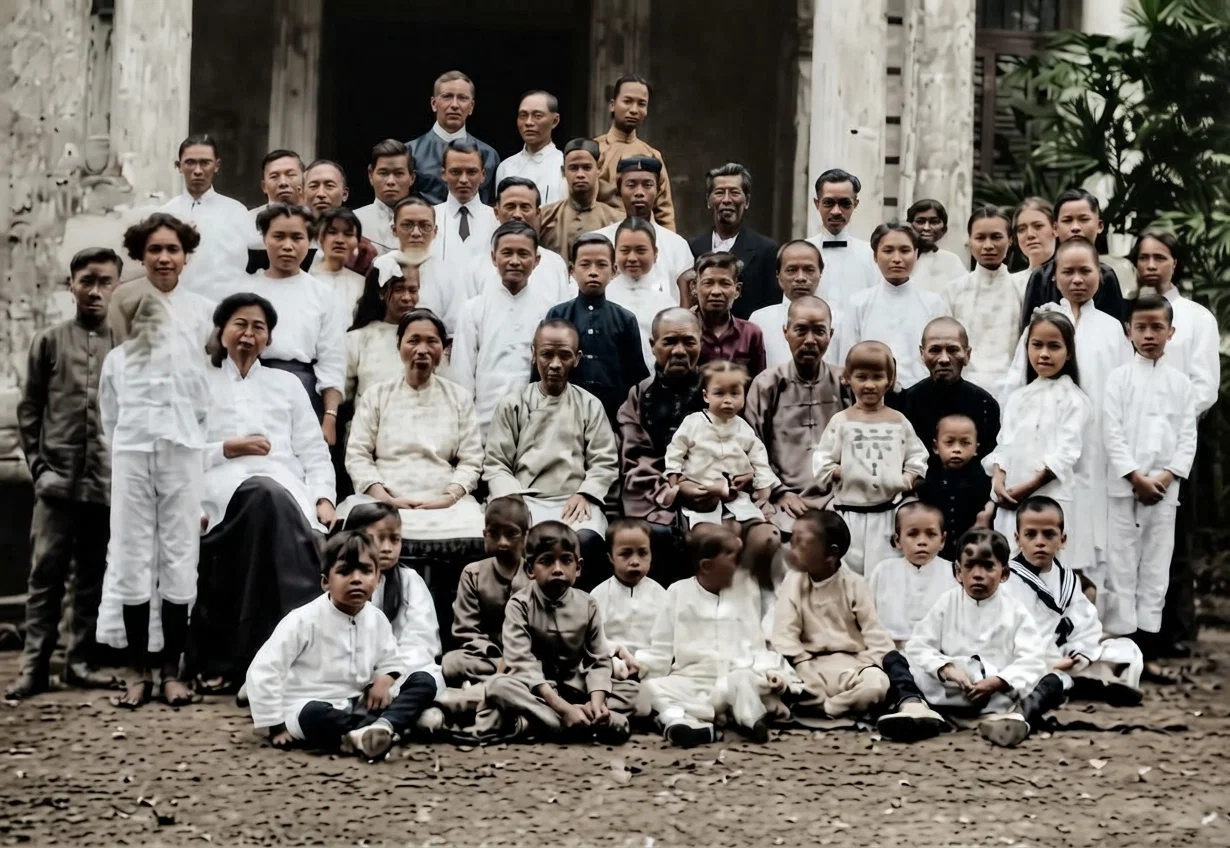
PORTION OF SINGAPORE SABBATH SCHOOL. SEVERAL NATIONALITIES REPRESENTED
Our church is centrally located, and at present has a membership of eighty, about twenty having been added during the past year. Several have expressed their desire to unite with the church, and are awaiting baptism.
The Sabbath school membership is about one hundred and fifteen, and we have classes in English, two or three dialects of Chinese, and Tamil (a language of South India). The picture shows a group of some of our Sabbath school members, most of whom are Chinese.
Recently our church has begun to take a fresh interest in missionary work. Literature is distributed in the English and Chinese languages, the sick are visited, and sewing for the poor is done.
A thousand copies of the Harvest Ingathering REVIEW have come to us. About three hundred and fifty of these were sent to Borneo, Java, and Sumatra, the remainder being disposed of by the Singapore church and workers. Many good experiences are gained in this work, and we were greatly encouraged to find so many friends of the cause who gladly gave to our work, so that in Singapore and Kuala Lumpur (the capital of the Federated Malay States), nearly $300, gold, was collected. In Batavia, Java, about $100 was collected.
Our field is large, and greatly scattered, but the good news of salvation and a soon-coming Saviour must go to the people of these islands.