A. G. DANIELLS

4%

Review and Herald Publishing Association · Takoma Park Station, Washington, D. C. · Mar 26, 1914

FromReview and Herald, Vol. 91, No. 13.

Read the full edition

A. G. DANIELLS

Does the History of Turkey and Egypt Since 1798 Fulfill the Prophecy of Dan. 11: 40-44 ?—No. 22

A. G. DANIELLS
"But tidings out of the east and out of the north shall trouble him: therefore he shall go forth with great fury to destroy, and utterly to make away many." Dan. 11:44.
At the battle of Nezib, near the Euphrates River, June 25, 1839, the Asiatic division of the Turkish army was destroyed, and the camp, with its entire equipment of baggage, arms, and ammunition, was taken by the Egyptian army. This made the Egyptians masters of the whole eastern division of the Turkish Empire. There was no obstacle left to prevent them from marching to Constantinople.
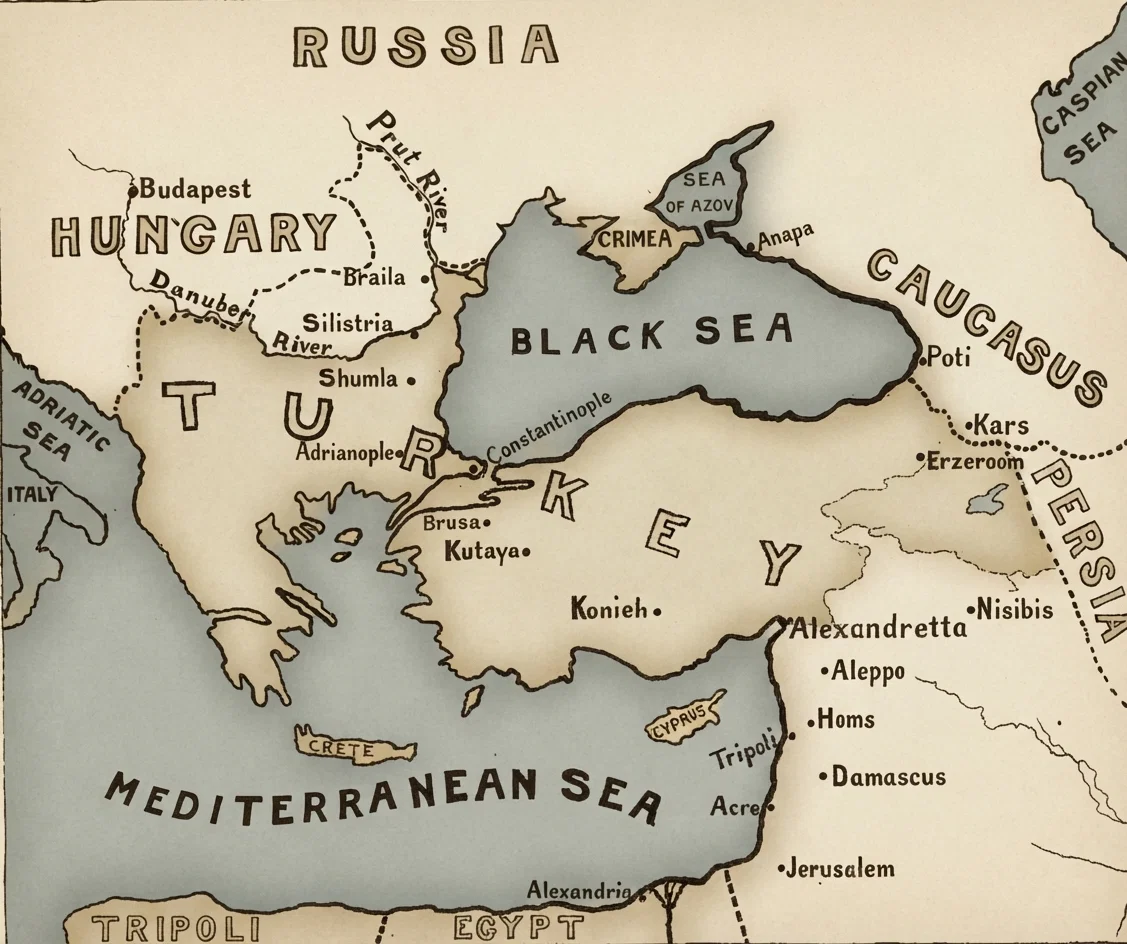
DISTANCES FROM CONSTANTINOPLE
The destruction of the army was quickly followed by the desertion of the entire navy. As this forms a part of the movement leading to the loss of Turkey's independence in 1840, we shall give a very brief account of this desertion. Alison Phillips says:—
"Disaster followed disaster, heralding, as it seemed, the downfall of the Turkish rule. On June 30 the old sultan Mahmud died, leaving the throne to Abdul-Medjid, a lad of sixteen. And finally, as though to crown the edifice of ruin, the Capudan Pasha Ahmed sailed to Alexandria, and, on the plea that the Turkish ministers were sold to Russia, handed over the Ottoman fleet to Mehemet Ali."—"Modern Europe," by Alison Phillips, page 130.
"Misfortunes fell thick and fast upon the Turks. The sultan Mahmud died June 30 (1839), and the empire fell to the sixteen-year-old youth, his son Abdul-Medjid. Five days later Capudan Pasha, with the Turkish fleet, sailed out of the Dardanelles under orders to attack the Egyptians. Instead of this, they went over to Mehemet Ali with this whole fleet."—"History of Ready Reference," by J. R. Larned, Vol. V, page 3152.
Of this surrender of the Turkish fleet, Paton gives a lengthy and interesting account, from which is taken the following:—
"Equally fatal to the sultan were the events of which the Mediterranean was the theater. The Ottoman fleet, which had been fitted out at a great expense, was intrusted to the command of a man whose character was disfigured by defects of a more serious kind than those of the unskillful but faithful Hafiz. . . .
"On the ninth of June the fleet left the Golden Horn for the Dardanelles, where it remained at anchor. On the morning of the fourth of July the Capudan Pasha received the official notification of the death of Sultan Mahmud. . . . In the afternoon of that day they weighed anchor and stood out of the Dardanelles—the fleet comprising eight ships of the line, twelve frigates, one corvet, four brigs, two schooners, three fire ships, and one steam vessel. . . .
"The fourteenth of July, they fell in with the Egyptian fleet, consisting of eleven ships of the line, three frigates, and two brigs, which were cruising about ten miles off Alexandria. . . . On the sixteenth the Turkish fleet anchored off the western entrance of Alexandria, about six miles from the town, when all the admirals and captains went on shore to wait upon Mehemet Ali. . . . The political agents of the five European powers in Alexandria were utterly astounded by this event. . . .
"The consuls maintained that the best method would be to restore the fleet to His Highness, and to send to Constantinople without delay some person charged to make in his (Mehemet Ali's) name his submission to the grand seignior. They urged that the Capudan Pasha, having quitted the Dardanelles after having received the order to proceed with the fleet to Constantinople, had committed an act of high treason, and that the representatives of the great courts were unwilling to believe that he (Mehemet Ali) was ready to make himself an accomplice of the Capudan Pasha by accepting the fleet at his hands. Mehemet Ali loudly protested against such an argument as this, alleging that 'in time of war it was permitted to receive deserters.'"—"A History of the Egyptian Revolution," by A. A. Paton, pages 137-142.
Thus, by the destruction of her army at Nezib, June 25, and the surrender of the fleet at Alexandria, July 16, Turkey's power of resistance was utterly broken.
"So far as the forces of the Ottoman Empire were concerned, Mehemet Ali was now absolute master of the situation."—Encyclopedia Britannica, article "Mehemet Ali."
"The Ottoman Empire now seemed hopelessly doomed; but the advisers of the new sultan decided to attempt a direct appeal to Mehemet Ali. In the name of Abdul-Medjid the great vizier wrote to the pasha enlarging on his master's desire to avoid the effusion of further Mussulman blood, promising him pardon for his offenses against the late sultan, together with the highest personal honor it was possible for him to bestow, and a settlement based on a grant of the hereditary pashalic of Egypt to Mehemet Ali himself and of the government of Syria to Ibrahim—the latter to be restored to the sultan in the event of Ibrahim's succeeding to Egypt on his father's death.
"To these overtures Mehemet Ali returned a diplomatic reply. They represented, indeed, far less in the way of concession than he had counted on receiving; but he knew that he must depend ultimately on the good will of one or more of the powers, and that this could only be gained by studied moderation."—"Cambridge Modern History," page 562.
As we are now to trace the history of negotiations between Constantinople and Alexandria and the passing of Turkey's independence into the hands of the European powers, it may be worth while to refresh our memories regarding the highway between Alexandria and Constantinople, and the immediate surroundings of the latter city. In his history of the Russian Empire, Abbott says:—
"A brief sketch of the geography of these realms will give one a more vivid idea of the nature of that conflict, which now, under the title of the Eastern, or Turkish, Question, engrosses the attention of Europe."The strait which connects the Mediterranean Sea with the Sea of Marmora was originally called the Hellespont, from the fabulous legend of a young lady, named Helle, falling into it in attempting to escape from a cruel mother-in-law. At the mouth of the Hellespont there are four strong Turkish forts, two on the European and two on the Asiatic side. These forts are called the Dardanelles, and hence, from them, the straits frequently receive the name of the Dardanelles. This strait is thirty-three miles long, occasionally expanding in width to five miles, and again being crowded by the approaching hills into a narrow channel less than half a mile in breadth. Through the serpentine navigation of these straits, with fortresses frowning upon every headland, one ascends to the Sea of Marmora, a vast inland body of water one hundred and eighty miles in length and sixty miles in breadth. Crossing this sea to the northern shore, you enter the beautiful straits of the Bosporus. Just at the point where the Bosporus enters the Sea of Marmora, upon the western shore of the straits, sits enthroned upon the hills, in peerless beauty, the imperial city of Constantine, with its majestic domes, arrowy minarets, and palaces of snow-white marble glittering like a fairy vision beneath the light of an oriental sun.
"The straits of the Bosporus, which connect the Sea of Marmora with the Black Sea, are but fifteen miles long and of an average width of but about one fourth of a mile. In natural scenery and artistic embellishments this is probably the most beautiful reach of water upon the globe. It is the uncontradicted testimony of all tourists that the scenery of the Bosporus, in its highly cultivated shores, its graceful sweep of hills and mountain ranges, in its gorgeous architecture, its atmospheric brilliance, and its vast accumulations of the costumes and customs of all Europe and Asia, presents a scene which can nowhere else be paralleled.
"On the Asiatic shore, opposite Constantinople, lies Scutari, a beautiful city embowered in the foliage of the cyprus. An arm of the strait reaches around the northern portion of Constantinople, and furnishes for the city one of the finest harbors in the world. This bay, deep and broad, is called the Golden Horn. Until within a few years, no ambassador of Christian powers was allowed to contaminate the Moslem city by taking up his residence in it. The little suburb of Pera, on the opposite side of the Golden Horn, was assigned to these ambassadors, and the Turk, on this account, denominated it 'the swine's quarters.'
"Passing through the Bosporus fifteen miles, there expands before you the Euxine, or Black, Sea. This inland ocean, with but one narrow outlet, receives into its bosom the Danube, the Dniester, the Dnieper, the Don, and the Kuban. These streams, rolling through unmeasured leagues of Russian territory, open them to the commerce of the world. This brief sketch reveals the infinite importance of the Dardanelles and the Bosporus to Russia. This great empire, 'leaning against the north pole,' touches the Baltic Sea only far away amidst the ices of the North. St. Petersburg, during a large portion of the year, is blockaded by ice. Ninety millions of people are thus excluded from all the benefits of a foreign commerce for a large portion of the year unless they can open a gateway to distant shores through the Bosporus and the Dardanelles."—"Empire of Russia," by Abbott, pages 507, 508.