A Visit to Africa's West Coast

6%

Review and Herald Publishing Association · Takoma Park Station, Washington, D. C. · May 21, 1914

FromReview and Herald, Vol. 91, No. 21.

Read the full edition

A Visit to Africa's West Coast

L. R. CONRADI
HAMBURG has become such an excellent shipping center that one can find steamers going from it to any part of the world. Twice a month there is an excellent mail service by the Wormann line to the West Coast of Africa. On the evening of Nov. 9, 1913, I boarded the "Lucie Wormann," saying farewell to my friends; but the low water and fog delayed us until the next afternoon. We were so near home, and yet so far! Our second cabin was well filled with people going to all parts of the West Coast, many of them being aged Africans. Two missionaries who were going to the Gold Coast, and a Hamburg merchant, who was also religiously inclined, were my companions during the voyage. Thus there was ample opportunity to receive and to give information, and it was well improved. We were happy indeed, when nearing Africa, to begin to feel the benefits of its warmer climate.
November 18 we reached Las Palmas, where Brother Aldrich met me, and we spent about an hour in conversation. I regretted very much that I could not visit him in Teneriffe. During the first part of the trip I improved every occasion to talk with the missionaries about our own mission experiences and to learn of theirs. But during the course of the journey they became so deeply impressed with these experiences that they themselves began to inquire about our doctrines. The night before we parted, I invited them to a special season of prayer. Before we knelt down, they said they desired to make a statement to me. In their mission seminary but little attention had been given to the prophetic portion of the Bible. What they heard of us there only prejudiced their minds, and they had used their influence against us. But while they were in the seminary in Berlin, the mission professor spoke favorably of our mission efforts, and now, after having become better acquainted with us, they felt that they ought to make a confession. We then sought the Lord together. Nothing removes prejudice from the hearts of missionaries more quickly than to learn that others are doing the same pioneer work as they are doing, and that God is blessing them.
Our boat reached Freetown one day late, Sunday evening, November 23. Brethren Myers and Lewis and several of our native workers met me at the ship, and within two hours after landing I was in their well-built and well-filled chapel, presenting the gospel. Our missionaries have secured a beautiful property at Freetown, and put up two large buildings, with dwellings for several missionaries. Since the school was removed to Waterloo, one building has been used for treatment rooms. Our water supply is excellent. Our chapel is about half a mile distant in another part of town.
Freetown, as the name infers, is an old settlement of freed slaves, which has gradually grown to an important town, containing about forty thousand people. A strip of land along the coast forms a British crown colony, while the hinterland is a protectorate. As these slaves came originally from several different parts of Africa, the English government knew no better way than to make the English the language for them. The Sierra Leonians are known as great traders all along the coast. Some of them have been educated in Oxford and Cambridge as doctors, lawyers, ministers, etc. They have also a fine college in Freetown, where both the English and the Timni are taught.
During my stay, I attended the distribution of prizes for all the schools, which was presided over by the governor. It spoke well for the progress made in education. But the religious influence of the people of Sierra Leone has not made itself felt very much among the heathen in the hinterland.
As the brethren expected me a day earlier, they had planned that we should leave Monday morning by train for a place one hundred and twenty miles inland. So we had to get ready the best we could, and early in the morning Dr. Myers and I, with eight porters, started out. Sierra Leone is being well supplied with railways; the main line runs from Freetown to the borders of Liberia, about one hundred and sixty miles. About eighty miles inland from Freetown, a branch starts out toward the French colony in the north, and we followed it to its present terminus, Macumb. Along the Atlantic coast French colonies intersperse with others, but the hinterland forms a vast, unbroken French colony.
West Africa differs in many ways from East Africa. Fine palm woods cover the country. Near the coast, the country is well built up, and farther inland, in the Timni country, we found that the natives had well-built villages. Late in the evening we arrived at Macumb, where a missionary of the Christian Alliance Mission met us and took us across the river to his station. The workers of this mission were gathering in for a conference, and right here was an excellent opportunity to become acquainted with them and their methods. To my surprise, in this hinterland I found among seven missionaries not less than four single women, who had charge of mission stations, and only one married couple. We were kindly received. Quite a number of graves testify to the hardships of their pioneer days.
Early next morning we walked in about three hours to Mapagi, where one of our native teachers lives in the same house with the chief, trying to do school work. After careful investigation of the situation, we were persuaded that we would better abandon the idea of continuing work in this village. As the canoe farther up the river had been carried down by the stream, we had to return on foot, and that night we stopped at Rolalla, having made about twenty-two miles with our porters. The native chief had one of the houses cleared for us, our camp beds were quickly put up, supper was cooked, and we slept quite comfortably in the native house.
At 4 A. M. we began to press our way through the forests and fields, and by 8 A. M. reached Matotoka, where Brother Thompson is teaching. The paramount chief here was very favorable to us. He had put up the building in which our teacher lives, and encouraged his people to attend our school. We regretted very much that he was away. The village as a whole consisted of well-built houses, having good doors. We also found sewing machines in every village, mostly run by men. There were carpenters at work, and there was even a silversmith.
We left Matotoka in the afternoon and marched till 9 P. M. Not having a map (something that every missionary ought to carry), we were surprised to find quite a large river between us and the village to which we wished to go. As the people were having a dance in the village on the opposite side, we had to shout a long time before a canoe came over and ferried us across. Here again a good house wascleared for us, and the next morning we marched in two hours to Boas, whence we took the train for Moyama, arriving there at 2 P. M.
The United Brethren have quite an old station here, with an American woman in charge. Associated with her is a woman doctor, who is located at Rotifunk, and is doing splendid medical mission work.
Photo by W. A. Barlow

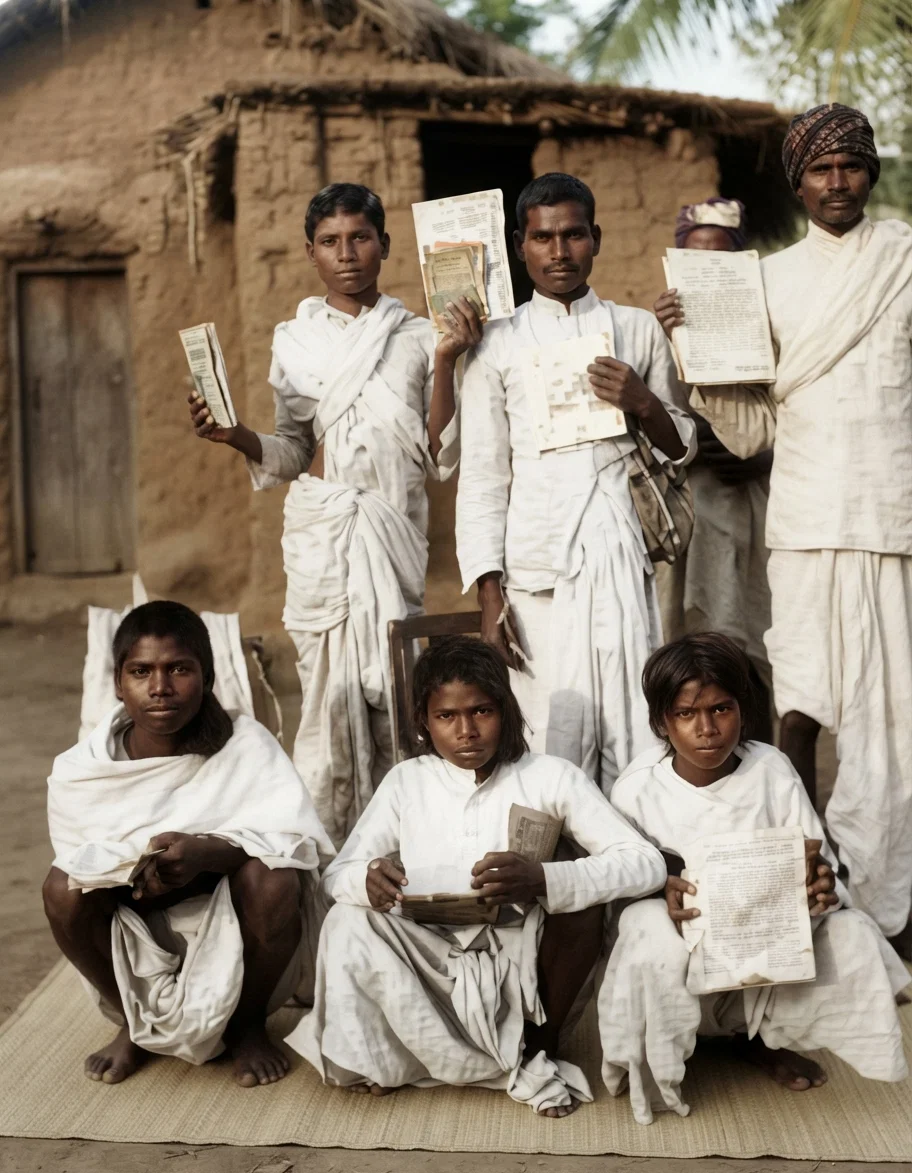
SANTALI TEACHERS AND STUDENTS OUT WITH PAPERS
Photo by W. A. Barlow SANTALI TEACHERS AND STUDENTS OUT WITH PAPERS
In four hours we marched to Gbanghama, where Brethren Harding and Davie are located. In this village we stayed three full days. The chief had built us two good houses at a cost of about fifteen dollars each, while our missionaries had put in windows and doors. We have three native boys as pupils here, and Brother Harding is trying to do some teaching and preaching. Wherever I went, I found that the schools are rather poorly attended, some of the missionaries being able to hold only evening schools. But I am sure that if proper efforts are put forth, much more can be done to reach the natives. Sabbath morning we had a Sabbath school. I spoke to the natives in the council house, and then in the afternoon in another village.
Monday we went by rail to Waterloo, where I spoke in the chapel in the evening. This chapel is in town, while just outside of the town, close to the railway track, are the mission buildings, consisting of a good school building, dwelling house for the teacher, and industrial wheelwright's shop. About half a mile away is the school farm. The buildings are well put up, roomy, and airy. We have about thirty natives in the school from the Gold Coast, Liberia, and from the coast and hinterland of Sierra Leone. Besides this advanced school, we have a primary school, which is conducted in the chapel. Professor French was in charge of the school, assisted by some native workers. Brother Lewis had thus far looked after the industrial department of the school, which is turning out very creditable trucks.
A week sufficed to visit every place where we had begun mission operations outside of Freetown. We learned what other missionaries were doing, and became somewhat acquainted with the great needs of the hinterland. One impression, however, had already fixed itself upon my mind, and that was that in order to do real, successful, permanent mission work, we must occupy territory in the hinterland, and place one white missionary among the Timnis and one among the Mendis, and associate with each some of the native men as assistants. As our mission conference in Freetown was to begin December 2, we returned there the same day.